How to Evaluate Ai Interview Platform for Faster Candidate Screening

What is an AI interview platform?

An AI interview platform is software that automates or assists parts of the candidate interview and screening process. Depending on the product, it may analyze a job description, generate role-specific questions, conduct text or voice interactions, capture responses, evaluate defined competencies, create transcripts and summaries, and route candidates to the next stage.
The purpose is not to make every hiring decision without people. The strongest use case is usually early-stage screening, where teams need to process many candidates consistently before investing time in deeper interviews. A platform can help recruiters reduce repetitive coordination, standardize first-round questions, and provide structured evidence for a human review.
This distinction is important for CHROs and HR-tech evaluators. A vendor may use “AI interview” to describe a chatbot, a one-way video workflow, a voice agent, an interview assistant, or a complete evaluation system. Buyers should define the exact workflow, decision authority, data captured, scoring logic, and human checkpoints before comparing products.
For a broader product view, review the . The published solution describes automated scheduling, AI resume-to-job-description matching, video interviews, a coding environment, interview question libraries, transcripts, summaries, structured reports, and candidate management.
AI interview platform supporting fair, structured candidate screening

Why AI screening needs a careful evaluation

Speed alone is not a sufficient buying criterion. A fast screening workflow can still create risk if the questions are irrelevant, the scoring is opaque, the candidate experience is confusing, or recruiters treat an automated recommendation as a final decision.
AI systems can also amplify weaknesses in the data, rubric, or workflow around them. If a job description is vague, generated questions may be poorly targeted. If a competency is not defined, a score may look precise without measuring anything useful. If candidates do not understand how their information is used, trust can weaken before the interview begins.
A responsible evaluation therefore looks at four outcomes together: screening speed, evidence quality, candidate experience, and governance. The system should help the organization move faster without lowering the standard for fairness, privacy, accessibility, explainability, or human accountability.
Teams building an AI governance framework can use the as an external reference point. It offers a useful vocabulary for identifying, measuring, managing, and governing AI-related risks. A vendor’s product claims should still be verified through a workflow demonstration and contract review.

10 checks before selecting a platform

1. Define the screening job to be done

Start with the bottleneck. Is the team struggling with resume volume, first-round scheduling, technical screening, voice calls, inconsistent questions, recruiter workload, or slow feedback? A platform should be selected for a measurable problem rather than an attractive feature list.

2. Check how questions are created

Ask whether questions are written by recruiters, selected from a library, generated from the job description, adapted to candidate responses, or reviewed by subject-matter experts. Buyers should be able to set competencies, difficulty, question types, follow-up behavior, and disallowed topics.

3. Evaluate role relevance

An AI interview should reflect the role. A software engineering screen may explore coding, debugging, architecture, or technical communication. A customer-support screen may focus on listening, judgment, clarity, and scenario handling. Request sample questions for your own job descriptions rather than accepting generic examples.

4. Review the candidate journey

Candidates should understand why they are invited, what the session involves, how long it may take, what device or browser is required, whether the interaction is text or voice, how their data is used, and what happens next. Clear instructions and accessible design are part of screening quality, not decorative extras.

5. Test voice, video, and coding capabilities
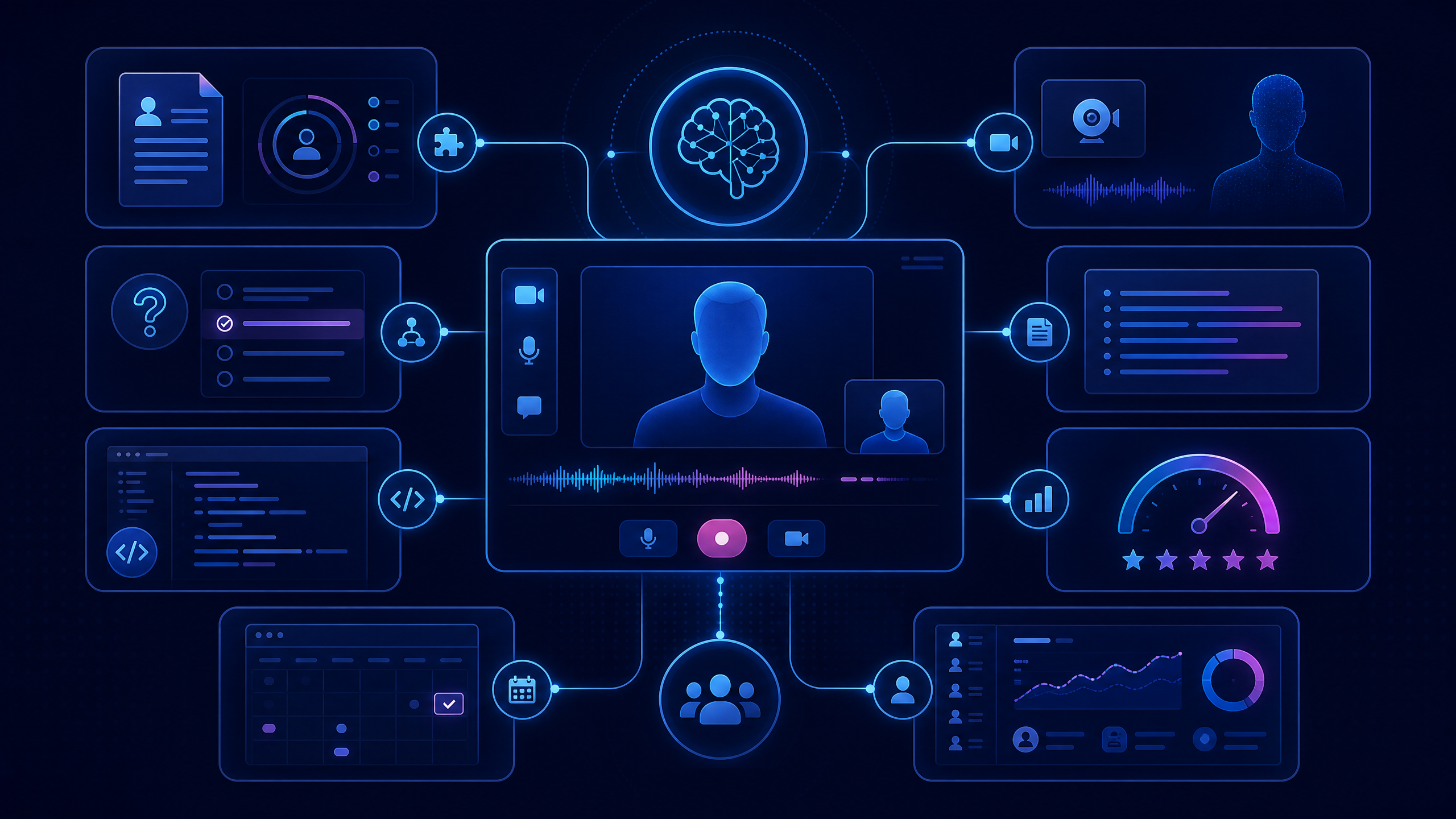
If the workflow includes voice or video, ask about audio quality, interruptions, language support, transcript accuracy, and recovery from connectivity problems. For technical roles, review the integrated coding environment, supported languages, test cases, code capture, and evaluator access.
AI interview platform with structured questions, voice screening, coding, and evaluation modules

6. Understand the scoring model

Ask what the system evaluates, how competencies are weighted, whether scoring is deterministic or model-generated, and how recruiters can inspect supporting evidence. A score should be connected to observable responses and a documented rubric. Avoid treating a single composite number as a complete view of candidate ability.

7. Inspect transcripts, summaries, and reports

Useful outputs may include full transcripts, audio recordings, interview summaries, strengths, gaps, red flags, competency scores, coding results, and recommendations. Reports should help a recruiter decide whether to advance, review, or stop—not simply produce attractive dashboards.

8. Verify integrations and workflow triggers

The system should fit the current hiring stack. Review ATS or CRM integrations, APIs, candidate profile updates, calendar links, email or messaging notifications, webhooks, and audit logs. Ask what happens when a candidate passes, fails, reschedules, or requires manual review.

9. Evaluate scale and support

A platform may work in a small pilot and fail during a high-volume campaign. Test bulk candidate upload, concurrent interviews, scheduling, rate limits, support response, reporting speed, user permissions, and escalation. Ask whether the vendor provides implementation help or managed interview operations.

10. Review governance before deployment

Before production use, confirm consent, privacy notices, data retention, access control, model monitoring, incident response, candidate appeals, human review, and deletion procedures. Governance cannot be added after a high-volume rollout has already created distrust.

How to assess AI interview quality

A credible evaluation uses a controlled pilot. Choose one or two roles with clear competencies and a representative candidate group. Run the same workflow with defined human review points, then compare the AI-supported process with the organization’s current screening method.
Pilot dimension
What to measure
Completion
Invitation opens, starts, completed sessions, and drop-off stage.
Speed
Time from invitation to report and time from report to recruiter decision.
Consistency
Whether candidates receive comparable questions and scoring treatment.
Evidence quality
Relevance of transcripts, summaries, scores, and supporting responses.
Human agreement
How often trained reviewers agree with or challenge the recommendation.
Candidate experience
Clarity, accessibility, technical issues, perceived fairness, and support requests.
Business outcome
Qualified candidates advanced, interview load reduced, and quality at later stages.
Risk signals
Complaints, false positives, false negatives, privacy incidents, or unexplained results.
Do not judge the pilot only by the number of candidates screened. A better system may surface fewer candidates but provide stronger evidence, reduce unnecessary interviews, and improve the quality of downstream decisions.
The evaluation should include edge cases. Test incomplete answers, accents or audio conditions where relevant, candidates needing accommodation, ambiguous job descriptions, resume gaps, nontraditional backgrounds, and borderline scores. Ask reviewers to document where the system is helpful and where human judgment is essential.

Governance and human oversight

Governance begins with decision design. Define which decisions the system may support, which decisions require human review, and which decisions it must never make alone. For example, an automated screen may recommend a next step, while a qualified recruiter or hiring manager confirms progression according to a documented policy.
Human oversight should be meaningful rather than symbolic. Reviewers need access to the underlying response, transcript, coding result, rubric, and model explanation available through the product. They should be able to override a recommendation, record a reason, escalate a concern, and correct an inaccurate candidate record.

Governance questions for vendors

Area
Questions for the vendor
Purpose
What hiring decisions is the system designed to support?
Data
What candidate data is collected, stored, processed, and shared?
Consent
How are candidates informed about AI involvement and recording?
Retention
How long are recordings, transcripts, scores, and logs retained?
Access
Which users can view candidate data, override results, or export reports?
Fairness
How are potential disparities monitored and investigated?
Accuracy
How are transcription, question relevance, and scoring errors handled?
Human review
Where are mandatory human checkpoints configured?
Security
What controls protect accounts, integrations, recordings, and reports?
Redress
Can candidates request clarification, correction, or another review route?
No platform can remove every hiring risk. The goal is to make the risk visible, manageable, and accountable. Legal, privacy, security, HR, and business stakeholders should approve the deployment model before scaling it.

AI interview platform use cases

High-volume first-round screening

Teams can use automated interviews to handle repetitive initial conversations, collect consistent answers, and prioritize recruiter review. This is useful when candidate volume exceeds the available screening capacity.

Technical candidate screening

Technical roles may combine resume-to-job-description matching, coding questions, structured technical prompts, and a live or automated interview. The system should show the evidence behind a recommendation and allow an engineer or qualified evaluator to review important cases.

Graduate and campus hiring

AI interviews can support fresher hiring, campus drives, and early-career programs where many candidates need a consistent first conversation. Employer teams should pay particular attention to accessibility, clear instructions, language, device support, and human escalation.

Global and distributed recruitment

Automated scheduling and asynchronous interviews can make screening available across time zones. Buyers should test language, accent, availability, consent, and local data requirements rather than assuming global suitability.

Interview capacity support

Some organizations need software; others need software plus interview operations. futuremug’s page describes expert panels, structured evaluations, scheduling, and reports for teams that need additional capacity alongside technology.
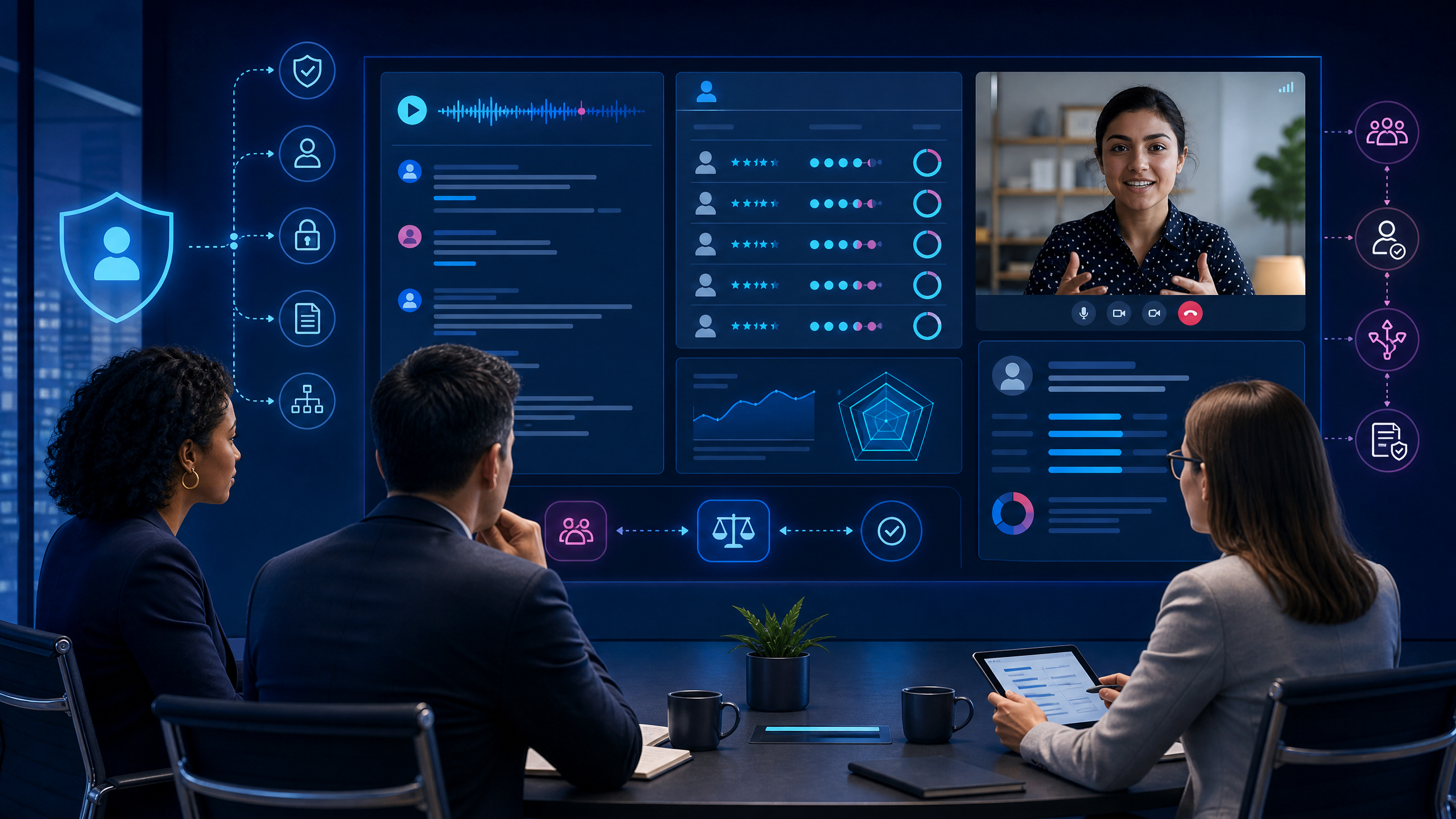
AI interview platform with human oversight, governance controls, and accountable hiring decisions

How futuremug approaches AI-enabled screening

futuremug’s published describes AI resume-to-job-description matching, automated scheduling, video interviews, an integrated coding IDE, question libraries, AI-generated questions, interview transcripts, summaries, personalized reports, and candidate management.
Its describes automated interviews, job-description and candidate-profile-based questioning, instant transcripts and evaluations, bulk scheduling, voice capabilities, red-flag detection, and automated next-step triggers. The page also states that the system is intended to handle first-level screening while human interviews remain important for final rounds.
For organizations that want to connect interviews with assessments, review the . For campus and graduate hiring programs, the shows how assessment, interview, college coordination, and candidate workflows can connect.
Product pages describe capabilities and intended use cases; buyers should verify current functionality, pricing, integrations, security terms, and governance controls during a live evaluation. A good demo should use your own job description, competencies, candidate volume, and review policy.

Implementation plan

Phase
Action
Decision gate
1. Define
Choose roles, competencies, screening stages, owners, and success metrics.
Approved use case and risk boundary.
2. Configure
Set questions, rubrics, consent language, notifications, permissions, and review rules.
Test workflow ready.
3. Pilot
Run a representative candidate cohort and include edge cases.
Evidence on speed, quality, experience, and risk.
4. Review
Compare AI recommendations with trained human reviewers.
Human agreement and exception process documented.
5. Launch
Train recruiters, inform candidates, and establish support and escalation.
Go-live checklist approved.
6. Monitor
Track completion, overrides, complaints, disparities, errors, and later-stage outcomes.
Monthly governance review.
Start with a bounded use case. Avoid deploying automated screening across every role before the team understands where the system performs well and where it needs stronger human involvement.

Request an AI interview platform demo

If your team is losing time to repetitive screening, scheduling, inconsistent questions, or delayed feedback, evaluate whether an AI-supported workflow can improve speed without weakening trust. Bring one live job description, your screening rubric, expected candidate volume, and governance requirements to the conversation.
to review AI screening, voice or video interviews, coding workflows, transcripts, structured reports, human review, integrations, support, and commercial fit. A practical demonstration should show both what the system automates and where your team remains accountable.

Frequently Asked Questions

What is an AI interview platform used for?

It is used to automate or assist early-stage candidate screening through job-specific questions, text or voice interactions, video interviews, coding tasks, transcripts, summaries, structured scoring, and recruiter workflows.

Can an AI interview platform replace human interviewers?

It can reduce repetitive first-round work, but it should not automatically replace human judgment for consequential hiring decisions. Human interviewers and hiring managers remain important for technical depth, context, exceptions, final evaluation, and accountability.

How do I evaluate whether AI interview questions are trustworthy?

Use your own job descriptions and competencies. Review question relevance, difficulty, prohibited topics, follow-up behavior, language, consistency, and human approval controls. Pilot the questions with qualified reviewers before production use.

How should human oversight work?

Define mandatory review points, give reviewers access to responses and supporting evidence, allow overrides, document reasons, and create an escalation route for candidates or recruiters. Oversight should affect decisions rather than simply appear in a policy document.

What governance questions should we ask?

Ask about consent, recordings, transcripts, retention, access control, model or scoring limitations, bias monitoring, security, integrations, incident response, candidate correction, human review, and deletion procedures.

Is AI screening fair by default?

No. Fairness depends on the job requirements, data, questions, scoring rubric, workflow, monitoring, and human review. A standardized process can improve consistency, but it still needs testing for unintended disparities and inappropriate proxies.

Can AI interviews support technical hiring?

Yes, when the workflow includes relevant technical questions, coding or assessment capability, structured evaluation, and qualified review. Technical hiring teams should inspect the actual evidence behind scores rather than relying on a summary alone.

What should an AI interview platform demo include?

Request a complete scenario: upload a job description, generate or configure questions, invite candidates, run an interview, review the transcript and score, override a recommendation, export a report, and show the ATS or next-step integration.

How do we avoid candidate drop-off?

Communicate clearly, keep the session relevant, provide device and time guidance, support accessibility, explain AI involvement, make recovery possible, offer help, and show candidates what happens after submission. Monitor drop-off by stage and investigate technical as well as content causes.

Leave a Reply

Your email address will not be published.