Technical Interview Outsourcing in India: Process, Quality Checks, and Costs
Technical interview outsourcing in India: the short answer
Technical interview outsourcing is the practice of using an external provider to conduct selected technical hiring rounds on behalf of an organization. The provider may supply expert interviewers, match panels to the role, schedule candidates, conduct coding or system-design interviews, apply a structured rubric, and return reports or recorded evidence.
In India, the commercial model is usually quote-based rather than a single public rate. The cost depends on the role seniority, technical domain, interview-round depth, volume, turnaround, delivery model, support requirements, integrations, and reporting needs.
Outsourcing works best when the problem is interviewer capacity, specialist coverage, scheduling, or hiring-volume variability. It does not remove the need for a clear role definition or internal decision ownership.
The buying goal is not simply to lower the visible cost per interview. It is to add technical capacity while preserving the hiring bar, candidate experience, and evidence quality.
A sound outsourcing decision answers five questions:
- Which rounds should leave the internal team?
- How will the provider match and vet technical interviewers?
- How will the provider calibrate scores to your role and level?
- What evidence and service levels will you receive?
- What is the true cost compared with the internal engineering time being used today?
This guide combines the process and cost decisions that buyers often evaluate separately. It is designed to consolidate the existing technical interview outsourcing guide and interview outsourcing cost guide into one decision path. Keep the technical panel page as the deeper panel-specific resource: technical interview panel as a service.
What technical interview outsourcing includes
The scope can be narrow or managed. A buyer should not assume that every provider includes the same work.
A technical interview outsourcing engagement may include:
- Role and job-description intake.
- Competency and level mapping.
- Interview-plan design.
- Coding, debugging, data-structures-and-algorithms, system-design, architecture, domain, or functional rounds.
- Interviewer or panel matching.
- Interviewer verification and briefing.
- Calibration against the buyer’s rubric.
- Candidate invitations and scheduling.
- Rescheduling, reminders, and candidate support.
- Video, live-coding, whiteboarding, or other interview delivery.
- Structured scorecards.
- Recordings, transcripts, code, or notes where permitted.
- Quality review and incomplete-feedback checks.
- Consolidated reports.
- Recruiter and hiring-manager status updates.
- Metrics and service-level reporting.
- Account management and escalation.
The provider may deliver the work through one of three models:
|
Model
|
What the buyer provides
|
What the provider provides
|
|
Platform-only
|
Interviewers, role expertise, and internal coordination.
|
Scheduling, video, coding, scorecards, dashboards, and reports.
|
|
Expert-panel service
|
Role brief, rubric, decision ownership, and stakeholder review.
|
Matched technical interviewers, scheduling, interview delivery, evidence, and support.
|
|
Managed hybrid
|
Selected internal rounds and final decisions.
|
External technical rounds, overflow coverage, platform workflow, and coordination.
|
The statement of work should specify each round, owner, output, service level, data responsibility, and escalation path.
Why technology companies outsource technical interviews
Interviewer bandwidth is constraining delivery
Senior engineers often conduct interviews in addition to their core responsibilities. The visible interview may take one hour, but preparation, context switching, debriefing, and feedback can consume more time.
When interview volume grows, the organization may lose engineering capacity before it notices a direct hiring cost. An outsourced panel can add capacity for selected rounds without adding permanent interviewer headcount.
Specialist coverage is missing
A company may be hiring for a stack or domain that only a few internal engineers know well. It may need expertise in a language, cloud environment, security area, data platform, or architecture pattern that is not yet available internally.
A panel provider can fill a temporary coverage gap, but the buyer should verify the specific expertise rather than rely on a broad category label.
Hiring volume is unpredictable
Product launches, market expansion, acquisitions, campus drives, and seasonal programs can create an interview spike. Building a permanent internal panel for a temporary peak may be inefficient.
A flexible engagement can scale the number of interviewers, rounds, and time slots while preserving a defined rubric.
Global candidates need time-zone coverage
A distributed candidate pool may require early-morning, evening, or weekend availability across regions. Internal interviewers may not cover those slots consistently.
The outsourcing decision should include communication, scheduling, rescheduling, candidate support, and report turnaround across every required time zone.
Evaluation quality is inconsistent
Different interviewers may ask different questions, apply different standards, or submit incomplete feedback. Structured outsourcing can help standardize competencies, score anchors, evidence requirements, and reporting.
The provider must still be calibrated. An outsourced interview is not automatically more consistent than an internal one.
The technical interview outsourcing process
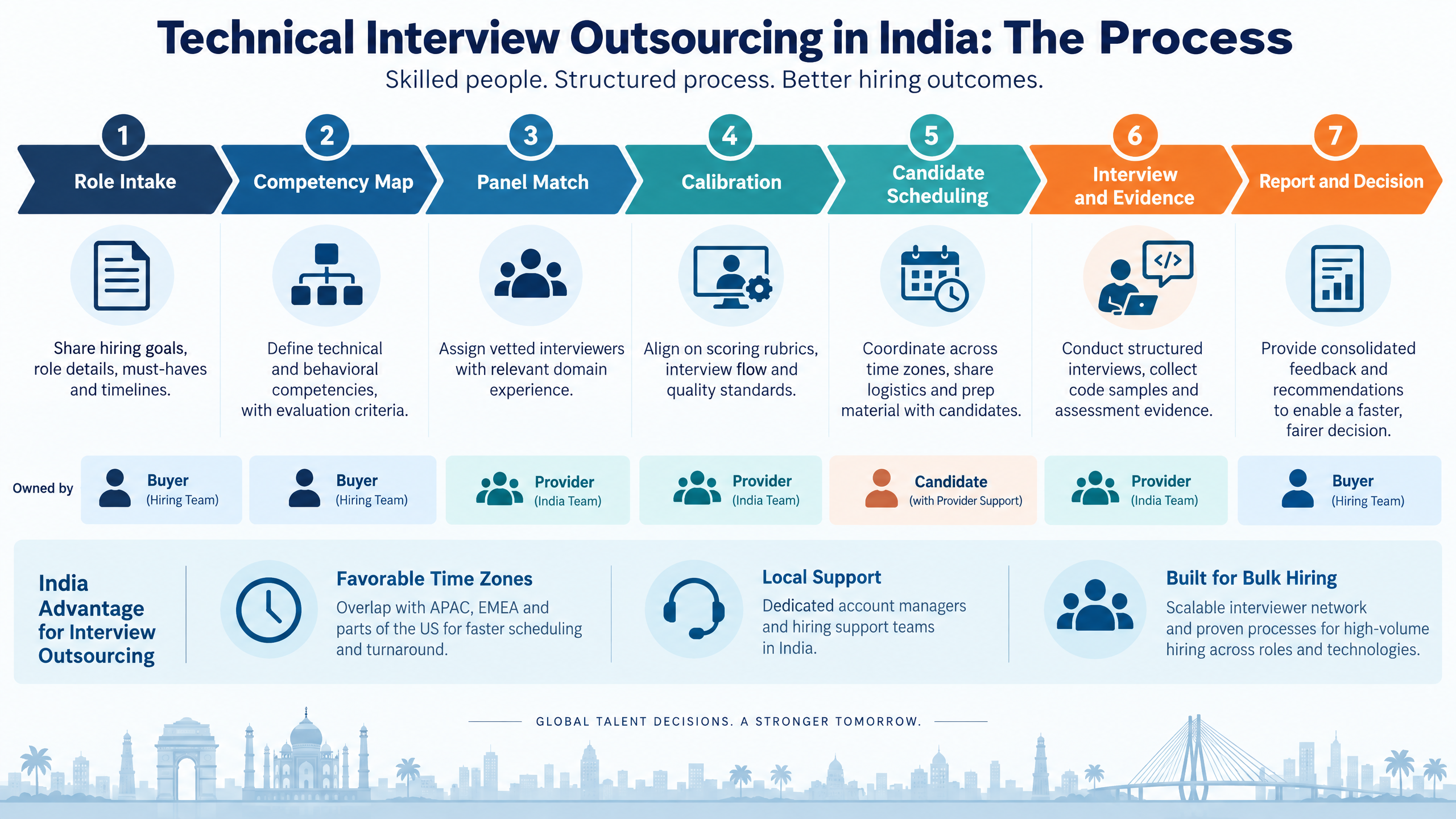
Step 1: Define the business and hiring trigger
Start with the operational problem. Is the business trying to protect engineering time, fill a specialist coverage gap, reduce scheduling delays, manage a hiring spike, or improve evaluation consistency?
Quantify the current situation:
- Number of roles in scope.
- Candidates expected per role.
- Interview rounds and average duration.
- Internal interviewer hours.
- Scheduling wait time.
- Feedback turnaround.
- Candidate completion or drop-off.
- Rework caused by incomplete or inconsistent reports.
This baseline makes the outsourcing decision concrete.
Step 2: Draw the outsourcing boundary
Not every round must be outsourced. Many organizations use a hybrid model.
Common rounds to outsource include:
- High-volume first-round technical screens.
- Coding and data-structures interviews.
- Overflow during hiring spikes.
- Specialist rounds that internal teams cannot staff.
- Repeatable domain assessments.
- Global time-zone coverage.
Common rounds to keep internal include:
- Final technical bar-raiser.
- Team and product context.
- Role-specific stakeholder conversations.
- Leadership and culture discussions.
- Offer and closing conversations.
The boundary should be based on the signal the round needs to produce. If internal context is the signal, retain the round. If repeatable technical evidence is the signal, outsourcing may be appropriate.
Step 3: Create the competency map
Turn the job description into a short map of competencies, levels, and observable evidence.
For a senior backend role, the map may include:
- Coding correctness and maintainability.
- Data structures and algorithmic reasoning.
- API and service design.
- Distributed-system trade-offs.
- Reliability, security, and observability.
- Debugging and incident reasoning.
- Communication and technical judgment.
Each competency should have a question theme, expected evidence, and score anchor. Avoid asking an external panel to “assess the candidate” without defining what success means.
Step 4: Match and vet interviewers
The provider should propose interviewers based on role, stack, seniority, competency coverage, availability, and conflict checks.
Ask for the matching logic and the evidence behind the match. A large network is useful only when the provider can identify the right people for the specific role.
Step 5: Calibrate the panel
Before live delivery, align the provider and buyer on the rubric. Review sample answers, shadow interviews, or a calibration batch. Compare internal and external scores where possible.
Calibration should cover:
- What each score level means.
- What evidence is required.
- Which follow-up questions are allowed.
- How partial solutions are treated.
- How unusual but valid approaches are handled.
- When to recommend a follow-up round.
- How to record uncertainty or missing evidence.
Step 6: Schedule and support candidates
The provider sends invitations, confirms time slots, handles reminders, manages changes, and supports the candidate before or during the interview.
A candidate should know the interview format, expected duration, required device or environment, recording or data-use notice, support channel, and next step.
Step 7: Conduct the interview and capture evidence
The interviewer follows the approved plan while allowing reasonable probing. Evidence should include the candidate’s approach, decisions, trade-offs, code or design where relevant, and areas that remain uncertain.
A bare recommendation is not sufficient for a high-stakes technical decision.
Step 8: Review, report, and decide
The provider checks whether the feedback is complete, consistent, and tied to the rubric. The final report should help the recruiter and hiring manager decide whether to progress, hold, reject, or request more evidence.
The buyer remains accountable for the hiring decision and should have access to the supporting evidence required by its policies.
Step 9: Monitor and improve
Review service, quality, candidate, and hiring outcomes. Look for false fails, false passes, score drift, role mismatch, incomplete reports, and candidate complaints.
The process should improve as more evidence becomes available.
Technical interview outsourcing quality rubric
A buyer can score each provider on five dimensions. The exact weights should reflect the role and risk.
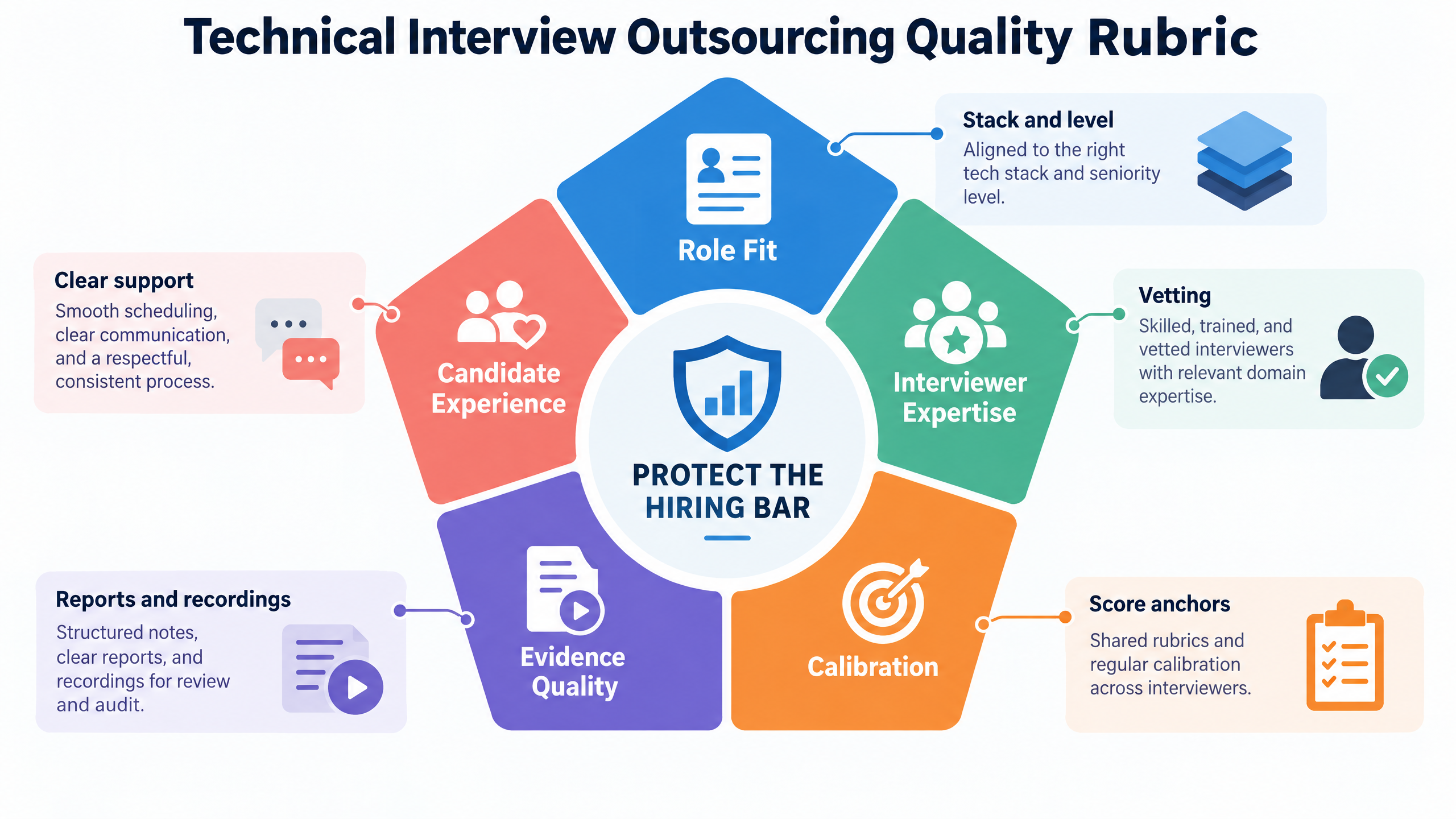
1. Role fit
Evaluate whether the provider can match interviewers to:
- Technical stack.
- Role level.
- Required competencies.
- Domain context.
- Interview format.
- Geography and time zone.
A provider that matches only on job-title keywords may produce a technically plausible but poorly relevant panel.
2. Interviewer expertise
Ask how interviewers are vetted, verified, briefed, and monitored.
Check:
- Practical experience in the relevant technologies.
- Seniority and scope of work.
- Experience assessing the target level.
- Communication and probing ability.
- Conflict-of-interest controls.
- Identity and background checks where appropriate.
- Ongoing performance review.
- Replacement process.
futuremug’s public interview-outsourcing page describes a pool of 5,000+ verified experts across 250+ IT domains. This is a provider-published capability claim. Validate the specific stack, level, availability, and quality evidence for your hiring program.
3. Calibration
Use a rubric that connects role requirements to evidence and score anchors. Have internal reviewers compare a sample of outsourced evaluations against their own assessments.
The U.S. Office of Personnel Management guidance on structured interviews notes that higher structure is associated with validity, rater reliability, rater agreement, and less adverse impact . Structure is not a guarantee of quality, but it gives teams a better basis for consistency checks.
4. Evidence quality
Reports should make the evaluation understandable. Look for:
- Competency-level scores.
- Supporting examples.
- Code, design, or work-sample evidence where relevant.
- Strengths and gaps.
- Uncertainty or incomplete evidence.
- Interviewer notes.
- Recording or transcript access where permitted.
- Clear recommendation.
- Reviewer comments and overrides.
Ask for anonymized sample reports and inspect them with an engineering hiring manager.
5. Candidate experience
The provider represents your employer during the outsourced round. Evaluate invitations, instructions, accessibility, technical support, scheduling flexibility, interviewer professionalism, and next-step communication.
The W3C Web Content Accessibility Guidelines 2.2 provides a useful reference for accessible digital experiences . Test the actual interview workflow with different devices and connectivity conditions.
A practical quality scorecard
|
Dimension
|
Strong evidence
|
Warning sign
|
|
Role fit
|
Provider maps panel seats to competencies, stack, and seniority.
|
Matching is based only on broad titles or keywords.
|
|
Interviewer expertise
|
Vetting, experience, calibration, and monitoring are documented.
|
Provider shares only a network count.
|
|
Calibration
|
Sample scores are compared and disagreements are resolved.
|
Provider says interviewers “follow best practices” without evidence.
|
|
Evidence quality
|
Reports show competency evidence, code or design context, and rationale.
|
Buyer receives only a pass/fail or unexplained score.
|
|
Candidate experience
|
Instructions, support, accessibility, and next steps are clear.
|
Candidates report unclear links, delays, or no support route.
|
|
Service reliability
|
SLA metrics, escalation, replacement, and reporting are defined.
|
Performance is described with general promises only.
|
Technical interview outsourcing cost in India
There is no single reliable public price for technical interview outsourcing in India. A quote depends on the service mix.
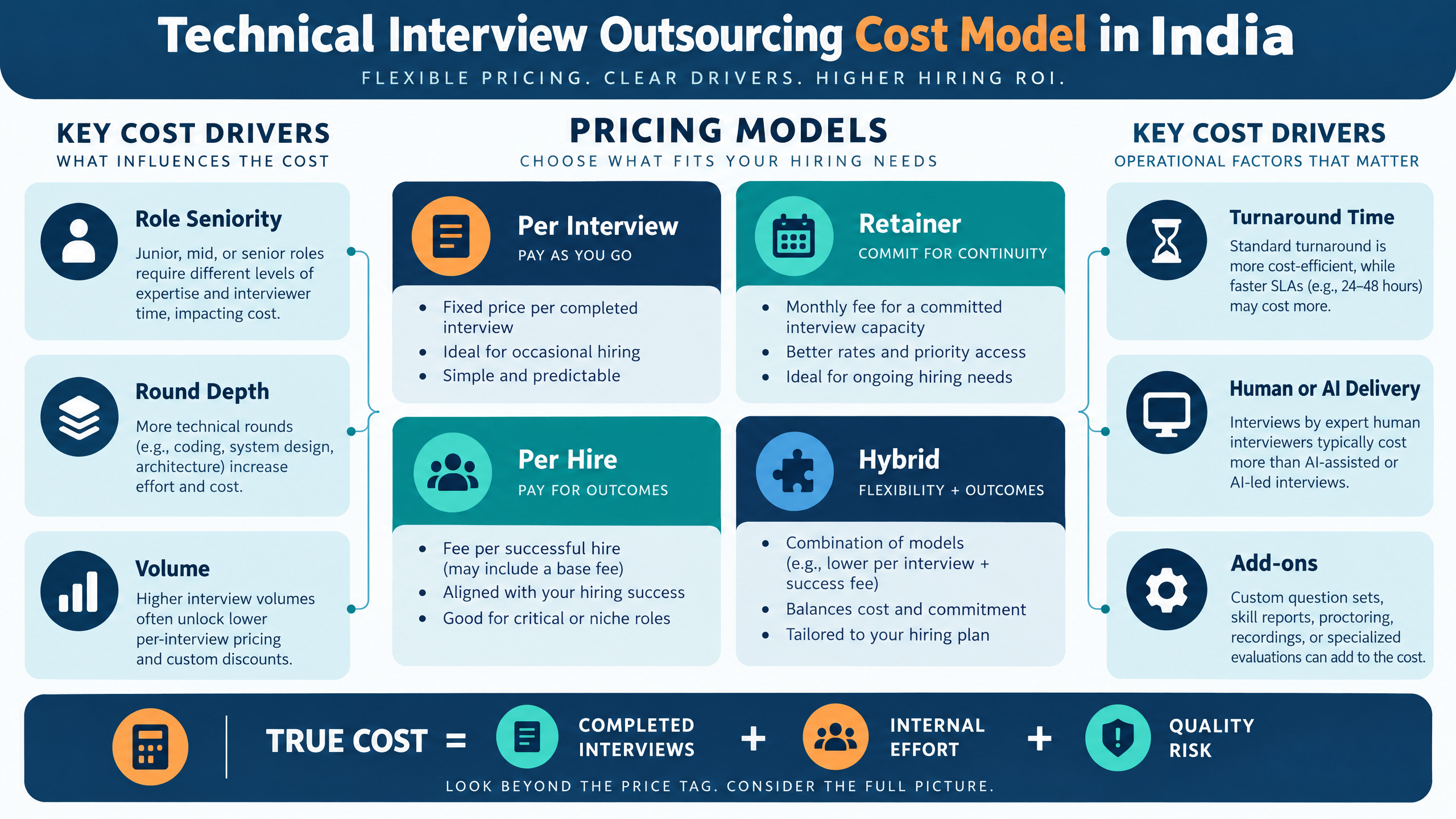
The main cost drivers are:
- Role seniority.
- Technical specialization.
- Interview-round depth.
- Interview duration.
- Volume and forecast stability.
- Turnaround target.
- Human, platform, AI-assisted, or hybrid delivery.
- Panel size and competency coverage.
- Scheduling and candidate-support requirements.
- Recording, transcript, report, or white-label requirements.
- ATS, calendar, or API integration.
- Account management and quality review.
- Geographic or time-zone coverage.
- Re-interview, cancellation, or no-show terms.
A senior system-design round and a high-volume first-round screen should not be priced as if they were the same product.
Common pricing models
Per interview
The buyer pays for each completed or scheduled interview. This model is easy to test and fits variable volume or a first pilot.
Ask whether the fee is charged per scheduled slot, attended interview, completed interview, or submitted report. Those bases produce different total costs.
Subscription or retainer
The buyer pays a recurring fee for an agreed capacity or service level. This can suit predictable hiring volume and may lower the effective unit cost when the capacity is used consistently.
Ask about unused capacity, rollover, peak volume, scope changes, and cancellation terms.
Per hire
The buyer pays based on a successful hire. This may align the provider with an outcome but can make the economics less transparent when candidates enter through other channels or when multiple interview rounds occur.
Define what counts as a hire, which rounds are included, and whether replacement or attrition terms apply.
Hybrid
The buyer pays a base amount for readiness, account support, or platform access plus a variable amount per interview or candidate.
This can fit growing or bursty programs. Ask which costs are fixed, which costs vary, and when the unit rate changes.
Cost estimate structure
Build a simple estimate before requesting final quotes.
|
Input
|
Calculation or question
|
Why it matters
|
|
Roles
|
Number of roles and candidates per role.
|
Establishes expected demand.
|
|
Rounds outsourced
|
Which technical stages will leave the internal team?
|
Sets the interview count.
|
|
Interviews required
|
Candidates × outsourced rounds.
|
Creates the base volume.
|
|
Role mix
|
Junior, mid-level, senior, specialist, leadership.
|
Determines interviewer expertise and rate.
|
|
Turnaround
|
Standard, urgent, same-day, or scheduled capacity.
|
Affects provider readiness and staffing.
|
|
Delivery model
|
Human, platform, AI-assisted, or hybrid.
|
Changes the cost and evidence model.
|
|
Add-ons
|
Recordings, transcripts, integrations, custom reports, support.
|
Prevents hidden-cost surprises.
|
|
Completion rate
|
Expected attendance and completed reports.
|
Converts headline cost into useful-output cost.
|
|
Internal effort
|
Recruiter, hiring-manager, and engineering review time.
|
Shows the true operating cost.
|
A useful normalization formula is:
True cost per useful interview = external fees + implementation + internal coordination + reviewer effort + expected rework, divided by completed calibrated interviews.
The formula is more informative than “price per scheduled interview.”
Cost versus internal interviewing
Internal interviewing may have no invoice, but it still consumes resources. Include:
- Interviewer preparation.
- Interview duration.
- Debrief and feedback time.
- Context switching.
- Scheduling coordination.
- Rescheduling.
- Hiring-manager review.
- Delayed roadmap work.
- Cost of inconsistent or incomplete evaluation.
Outsourcing may be more expensive at low, stable volume and more efficient during high volume, specialist demand, or engineering capacity constraints. Model the crossover using your own rates and time assumptions.
How to compare outsourcing quotes
Ask every provider to quote the same scenario:
- Role and level.
- Stack and competencies.
- Number of candidates.
- Number and type of rounds.
- Interview duration.
- Required time zones.
- Turnaround.
- Candidate-support expectations.
- Report format.
- Recording and transcript requirements.
- Integration needs.
- Quality review.
- Cancellation and re-interview policy.
Then normalize the response into one comparison sheet.
|
Quote question
|
Why it matters
|
|
Is the fee per scheduled, attended, or completed interview?
|
Prevents false price comparisons.
|
|
Is the scorecard included?
|
A cheap interview without usable evidence is not equivalent.
|
|
Are interviewer matching and calibration included?
|
Quality work may be hidden as an add-on.
|
|
Are recordings, transcripts, or code reports included?
|
Evidence may carry a separate charge.
|
|
What happens when a candidate or interviewer cancels?
|
No-show rules can change total cost.
|
|
Is urgent or after-hours scheduling priced differently?
|
Turnaround affects provider effort.
|
|
Is account management included?
|
Coordination can otherwise return to the buyer.
|
|
What are the minimum volume and contract terms?
|
Predictability changes the effective rate.
|
|
How are scope changes handled?
|
Hiring programs rarely stay static.
|
|
What service-level credit or remedy applies?
|
Makes performance accountable.
|
Do not select a provider only because its headline rate is lower. Compare the cost of a completed, calibrated, decision-ready interview.
What to outsource and what to keep in-house
A hybrid model is often the most practical option.
|
Keep in-house when…
|
Consider outsourcing when…
|
|
The round depends on team, product, or codebase context.
|
The round is repeatable and competency-based.
|
|
The purpose is executive judgment or final team fit.
|
Internal interviewers are the capacity bottleneck.
|
|
The interview is the final bar-raiser.
|
Hiring volume is bursty or rapidly increasing.
|
|
The hiring manager must build a direct relationship.
|
Specialist stack coverage is unavailable internally.
|
|
A sensitive leadership or stakeholder discussion is required.
|
Global time zones make internal scheduling slow.
|
|
The team has stable volume and enough calibrated experts.
|
Senior engineers are losing roadmap time to interviews.
|
Your organization should retain decision ownership even when it outsources delivery. The provider should be able to explain what it assesses and what it cannot assess about your context.
Use-case examples
Fast-growing product company
The product company is hiring across backend, frontend, data, and platform roles. Senior engineers spend too much time in first-round screens and debriefs.
Outsource repeatable technical screens and selected coding rounds. Keep the final technical and team-context rounds internal. Track engineering hours returned, score agreement, false fails, false passes, and time to hire.
Specialist cloud or security hiring
The company needs a technical evaluation for a domain its internal team does not yet cover deeply. The provider should demonstrate specific practitioner expertise, not only general interview capacity.
Use a calibration sample and ask internal reviewers to inspect the evidence before allowing the external panel to operate independently.
Hiring spike after funding or market expansion
The company needs to interview a large number of candidates over a limited period. A retainer may be wasteful after the spike, while per-interview pricing may be expensive at volume.
Compare per-interview and hybrid quotes. Include peak scheduling, replacement, support, reporting, and a capacity step-down plan.
Distributed engineering organization
Candidates are in India, Europe, and North America. Internal interviewers are concentrated in India and cannot cover all slots.
Evaluate time-zone availability, candidate communication, support coverage, report turnaround, and data handling across regions.
Campus or early-career technical hiring
The employer needs to screen a high volume of candidates and then conduct consistent technical interviews. The provider should coordinate with assessment, candidate management, and campus workflows.
Use online assessments or AI-assisted screens for the repeatable early stage, then use human technical panels for deeper evaluation where appropriate.
How to run a technical interview outsourcing pilot
Choose one live role
Select a role with a stable job description and enough candidate flow to produce comparable evidence. Define the exact rounds and candidates included.
Establish the internal baseline
Measure current scheduling time, engineering hours, interview completion, report turnaround, candidate feedback, and progression rates.
Define the rubric and boundary
Specify competencies, score anchors, evidence requirements, decision ownership, and the rounds that remain internal.
Test the complete process
Include role intake, panel matching, calibration, invitation, scheduling, interview delivery, report review, candidate support, cancellation, and escalation.
Shadow-score a sample
Have internal interviewers independently score a sample or review the same evidence. Compare agreement, false fails, false passes, and report usefulness.
Review candidate experience
Ask candidates about clarity, fairness, technical access, support, time commitment, and communication. Treat candidate feedback as a quality signal, not a cosmetic metric.
Define scale gates
Set minimum thresholds for service-level performance, technical relevance, evidence quality, candidate experience, internal effort, and total cost per useful interview.
Decide the operating model
After the pilot, choose whether to scale, narrow, redesign, or stop. Document the internal and external responsibilities before moving to steady-state delivery.
How futuremug fits the decision
futuremug’s public interview outsourcing services describe a managed interview model with expert panels, customizable interviews, 24/7 auto-scheduling, structured rubrics, quality checks, consolidated reports, multi-channel updates, and dedicated account support.
The page states that futuremug offers a global pool of 5,000+ verified experts across 250+ IT domains, along with published operating metrics such as daily interviews, expert panels, scheduling turnaround, and interview volume. Treat these as current provider-published claims and validate the specific service level, interviewer coverage, and role fit for your engagement.
For panel-specific matching and internal-versus-outsourced trade-offs, link to technical interview panel as a service. For the platform path, futuremug’s AI interview platform describes live coding, video interviews, question libraries, interviewer dashboards, automated scheduling, centralized reports, transcripts, and summaries.
A futuremug consultation should scope:
- Roles, levels, stacks, and competencies.
- Interview rounds to outsource.
- Human, AI-assisted, or hybrid delivery.
- Interviewer and panel requirements.
- Calibration approach.
- Candidate communication and support.
- Reports, recordings, transcripts, and code evidence.
- Integrations and access controls.
- India and global time-zone coverage.
- Pricing model and completion basis.
- Pilot success criteria and scale plan.
Request a futuremug technical interview outsourcing consultation to receive a scope-based discussion rather than a generic rate comparison.
Buyer checklist
Before selecting a technical interview outsourcing provider in India, confirm that you can answer these questions:
- What operational problem are we solving?
- Which rounds will be outsourced and which remain internal?
- What role, stack, seniority, and competencies must the provider cover?
- How are interviewers vetted, matched, briefed, and monitored?
- How will the provider calibrate to our rubric?
- What evidence and report format will we receive?
- How are coding, system design, debugging, and domain skills assessed?
- How are candidates invited, supported, rescheduled, and updated?
- What time zones and service hours are covered?
- What service levels apply to matching, scheduling, feedback, reports, and escalation?
- How are recordings, transcripts, code, and candidate data protected?
- What is the pricing basis: scheduled, attended, or completed interview?
- Which costs are included or treated as add-ons?
- What internal engineering and recruiter effort remains?
- What pilot thresholds must be met before scale?
- What happens if the provider misses the quality or service standard?