
Online Assessment vs Skills Assessment: How to Choose for Hiring
Online assessment vs skills assessment: the short answer
The difference between online assessment vs skills assessment is that the terms describe two different layers of hiring evaluation.
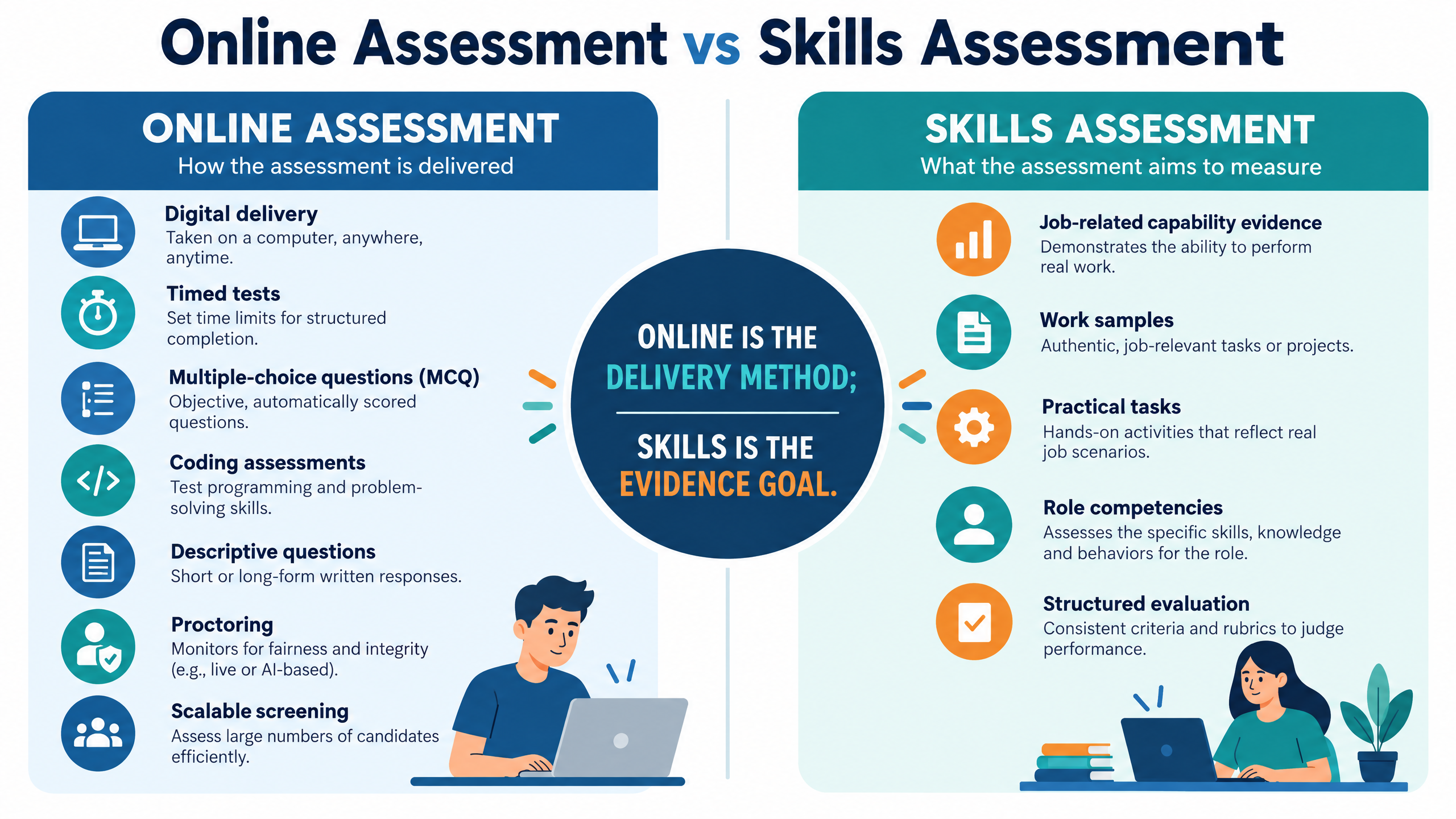
An online assessment is a digital way to deliver questions, tasks, scoring, monitoring, and reports. It may include multiple-choice questions, coding tests, descriptive responses, aptitude tests, domain tests, or video questions.
A skills assessment is an evaluation designed to collect evidence of a candidate’s ability to perform a job-related skill. It may be delivered online, in person, through a work sample, in a coding environment, in a simulation, or during a structured interview.
So an online assessment can be a skills assessment, but not every online assessment measures the skills that matter for a role. A timed quiz may be easy to deliver online while providing weak evidence of practical job performance. Conversely, a realistic work sample may measure a skill well but require more review time.
Choose the evidence first. Choose the delivery platform second.
The right hiring approach depends on the role, the hiring stage, the decision you need to make, the candidate population, the acceptable time and effort, and the level of integrity or supervision required.
This guide is intentionally different from the existing online assessment platform guide. That article focuses on platform features that reduce candidate drop-off. This decision guide focuses on which type of assessment to use, when to use it, and how to evaluate the platform against the evidence you need.
What is an online assessment?
An online assessment is a digital testing workflow used to invite candidates, present questions or tasks, collect responses, score results, monitor activity, and generate reports.
Common online assessment formats include:
- Multiple-choice questions.
- Image-based questions.
- Aptitude and reasoning tests.
- Coding assessments with an integrated compiler.
- Descriptive or essay responses.
- Domain-specific knowledge tests.
- Video or recorded responses.
- Behavioral or situational questions.
- AI-generated questions or AI-assisted evaluation.
- Proctored or monitored tests.
The online format provides operational benefits. Hiring teams can invite many candidates, standardize instructions, apply time controls, randomize questions, monitor completion, automate scoring, and compare results in a dashboard.
The format does not automatically guarantee that the test is job-related, accessible, fair, or predictive. Those qualities depend on assessment design, question quality, scoring rules, candidate experience, and human review.
futuremug’s online assessment platform describes MCQ, image-based, descriptive, coding, AI-generated question, proctoring, bulk invitation, live tracking, configurable scoring, reports, role-based access, and candidate management capabilities. Buyers should validate each capability against their role and hiring stage.
What is a skills assessment?
A skills assessment is a method for evaluating whether a candidate can demonstrate a capability relevant to a role.
Examples include:
- A coding task for a software engineering role.
- A debugging exercise for an application-support role.
- A spreadsheet or data-analysis task for an operations analyst.
- A writing sample for a content or communications role.
- A customer scenario for a support or sales role.
- A design brief for a product or visual-design role.
- A work sample for a role with repeatable practical outputs.
- A structured technical interview for system design or engineering judgment.
- A role-based simulation for decision-making under realistic constraints.
A skills assessment should make the expected capability visible. It should define the task, the evidence, the evaluation criteria, and the level of performance required.
The U.S. Equal Employment Opportunity Commission guidance on employment tests and selection procedures states that an employment test or selection procedure should be job-related and appropriate for the employer’s purpose . The principle is useful beyond one jurisdiction: an assessment should be connected to the work and used for a clearly defined decision.
A skills assessment is not automatically superior to a knowledge test. A role may genuinely require factual knowledge, reasoning, communication, or speed. The question is whether the selected method gives enough relevant evidence without imposing unnecessary candidate effort.
Are online assessments and skills assessments the same?
No. They overlap, but they are not interchangeable.
|
Term
|
What it describes
|
Example
|
|
Online assessment
|
The digital delivery and administration method.
|
A browser-based test with timed questions, scoring, and reports.
|
|
Skills assessment
|
The capability or job-related evidence being evaluated.
|
A debugging task that shows how a candidate diagnoses and fixes a real issue.
|
|
Online skills assessment
|
A skills assessment delivered through a digital platform.
|
A coding task with test cases, an editor, and an automated report.
|
|
Work sample
|
A practical artifact or simulation that resembles job output.
|
A candidate analyzes a dataset and presents the recommendation.
|
|
Knowledge test
|
Recall or understanding of concepts and rules.
|
Multiple-choice questions on a programming language or policy.
|
|
Structured interview
|
Evidence collected through consistent questions and scoring criteria.
|
A system-design interview using defined competencies and score anchors.
|
When buyers search for an online assessment platform, they may want software. When they ask for a skills assessment, they may want a validated method for measuring a capability. A vendor can satisfy the first request without satisfying the second.
Online assessment vs skills assessment comparison matrix
|
Decision area
|
Online assessment
|
Skills assessment
|
|
Main question answered
|
Can we deliver, monitor, score, and report a digital test?
|
Can the candidate demonstrate the capability required for the role?
|
|
Primary value
|
Scale, consistency, speed, workflow automation, and centralized records.
|
Job relevance, practical evidence, and decision quality.
|
|
Typical formats
|
MCQ, coding, descriptive, aptitude, video, proctored, and domain tests.
|
Work samples, simulations, coding, case tasks, structured interviews, and practical exercises.
|
|
Best hiring stages
|
Application screening, early screening, high-volume shortlisting, and standardized validation.
|
Technical validation, role-specific evaluation, final evidence, and deeper selection decisions.
|
|
Scalability
|
Usually high when questions and scoring are standardized.
|
Depends on task design, review effort, and evaluator capacity.
|
|
Candidate effort
|
Can be low or high depending on length, difficulty, and friction.
|
Can be low for a focused task or high for a realistic work sample.
|
|
Scoring
|
Automated, manual, AI-assisted, or combined.
|
Usually requires a rubric, evidence review, and sometimes expert judgment.
|
|
Integrity controls
|
Timers, randomization, browser controls, proctoring, and activity monitoring.
|
Task design, identity controls, supervision, plagiarism review, and evidence inspection.
|
|
Main risk
|
Measuring test familiarity, recall, or speed instead of job capability.
|
High review effort, inconsistent evaluators, or an assessment that is too burdensome.
|
|
Buyer focus
|
Platform capabilities and operational reliability.
|
Validity, relevance, evidence quality, fairness, and decision use.
|
The strongest hiring workflows often combine both layers. A platform delivers a role-relevant skills assessment at scale, while trained reviewers inspect the evidence for consequential decisions.
8 hiring decisions to make before choosing a platform
1. What job question are you trying to answer?
Start with the decision, not the feature list.
Examples:
- Can this candidate meet a minimum eligibility requirement?
- Does the candidate have the expected programming fundamentals?
- Can the candidate debug a realistic issue?
- Can the candidate reason through a system-design trade-off?
- Can the candidate communicate a recommendation to a stakeholder?
- Can the candidate perform the core task with limited supervision?
If the team cannot state the question clearly, the platform cannot tell you which assessment type to use.
2. Which skills are essential at this hiring stage?
Separate essential skills from useful signals. An early screen may test a small number of foundational capabilities. A later stage may require a deeper task or structured interview.
A useful skills map connects:
- Job responsibility.
- Required competency.
- Observable behavior or output.
- Assessment method.
- Scoring criteria.
- Hiring decision.
This prevents teams from selecting a generic test because it is easy to deploy.
3. How much evidence is enough?
More assessment is not automatically better. Longer tests increase candidate effort and may create drop-off, fatigue, or irrelevant measurement.
Use the lightest method that can answer the hiring question with enough confidence. A five-minute eligibility screen may be enough to filter an obvious mismatch. A senior engineering hire may require coding, system design, and evidence review.
Define the minimum evidence before building the assessment. Then test whether the method produces it reliably.
4. Does the assessment reflect the real work?
Role relevance should be visible in the task, question, or scenario.
For technical roles, check whether the assessment reflects the languages, frameworks, systems, debugging patterns, or design constraints used in the job. For non-technical roles, check whether candidates work with realistic data, communication, prioritization, writing, or decision scenarios.
A test can be difficult without being relevant. Difficulty alone is not a quality standard.
5. What level of scale is required?
High-volume hiring changes the platform requirements. You may need bulk candidate upload, automated invitations, role-based access, live tracking, configurable cut-offs, auto-disqualification rules, reports, and API triggers.
Lower-volume specialist hiring may prioritize custom tasks, manual review, evaluator collaboration, and evidence-rich reports over bulk administration.
Match the platform to the operating pattern rather than paying for scale you will not use.
6. What integrity controls are proportionate?
Assessment integrity can involve question randomization, time restrictions, identity checks, browser controls, tab or off-screen activity monitoring, proctoring, plagiarism review, or live supervision.
Use controls proportionately. An intrusive workflow can damage candidate trust and may not be necessary for a low-risk early screen. A high-stakes certification or technical filter may justify stronger controls.
Ask what each control detects, what it cannot detect, how false positives are reviewed, and whether candidates receive clear information.
7. Who will review the evidence?
Automated scores are efficient, but they may not explain why a candidate succeeded or failed. Human review is especially important for descriptive answers, code quality, work samples, accommodations, unusual solutions, and consequential decisions.
Define the review model:
- Automated score only.
- Automated score plus exception review.
- Recruiter review.
- Hiring-manager review.
- Subject-matter expert review.
- Two-reviewer or adjudication model.
The platform should support the level of review required by the role and the risk of error.
8. How will results change the next step?
An assessment is useful when the result connects to an action. Define what happens after each score band.
For example:
- Below the minimum threshold: close or hold the application.
- Borderline score: request a manual review or shorter follow-up.
- Strong technical score: schedule a structured interview.
- Strong skill evidence with a communication gap: plan a targeted follow-up.
- Suspicious activity: investigate before making a decision.
The platform should make status, evidence, reviewer comments, and next steps visible to the right people.
Match the assessment to the hiring stage
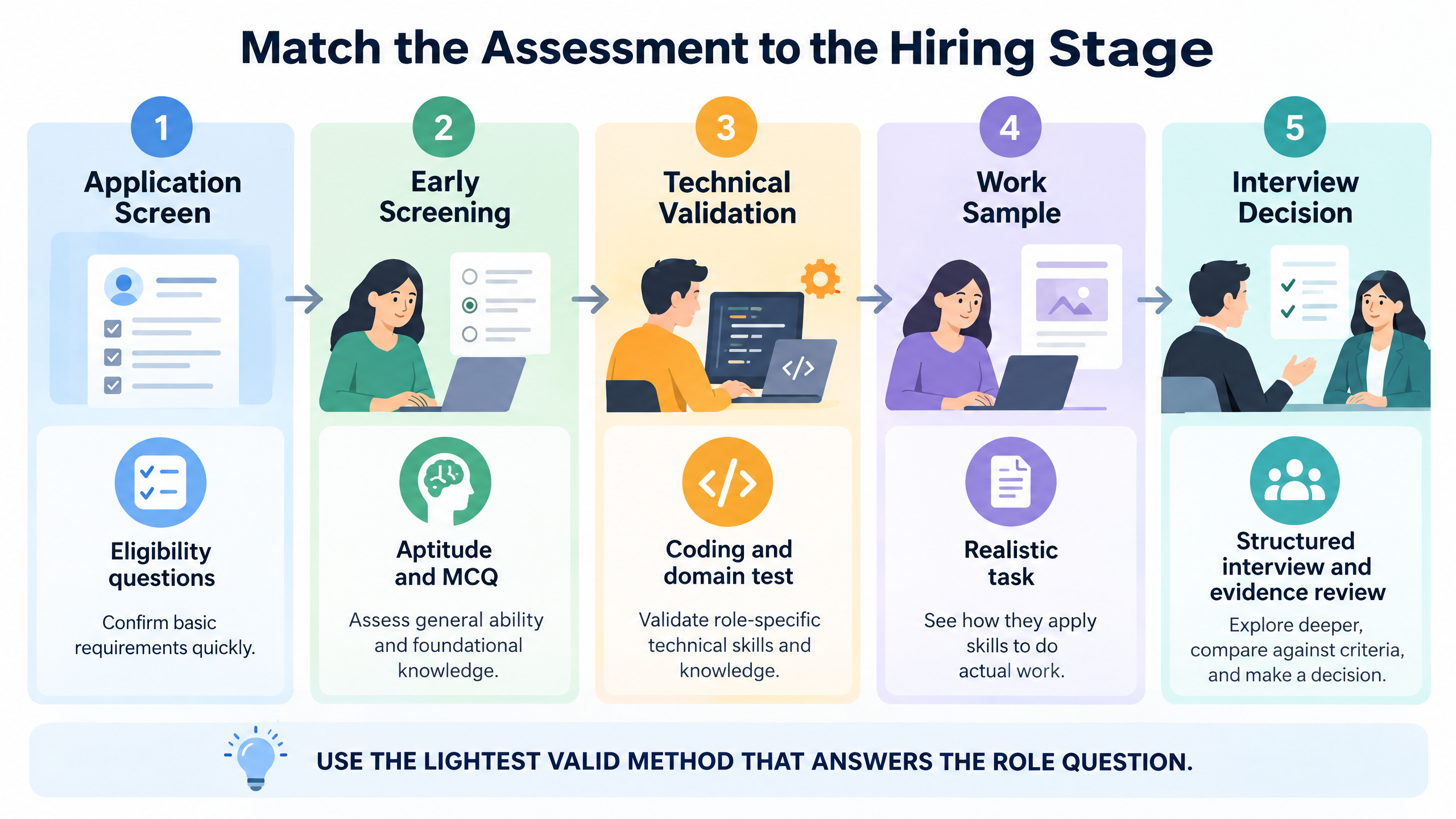
Application and eligibility screening
At this stage, the goal is usually to confirm basic requirements or collect a small amount of comparable information.
Suitable methods may include eligibility questions, knockout questions, simple aptitude tests, language checks, or short job-related knowledge tests. Keep the candidate experience fast and transparent.
Do not use a long work sample when a basic requirement can be confirmed with a short, relevant question.
Early screening
Early screening may identify candidates who have the foundational knowledge or reasoning needed for the next stage.
Online assessments work well when the volume is high and the criteria are clear. Use question randomization, time controls, and standardized scoring where appropriate. Monitor completion and drop-off to identify design problems.
Technical validation
Technical validation should collect evidence that a candidate can apply technical knowledge. Coding, debugging, architecture, data, and domain assessments may be appropriate.
An online coding environment can improve consistency by giving candidates the same editor, language options, test cases, and submission process. Automated results should be supplemented by review when code quality, trade-offs, or maintainability matter.
Work sample or simulation
Use a work sample when the job requires a recognizable output or decision. The task should resemble the role without requiring unpaid production work.
Define the expected time, submission format, evaluation rubric, and candidate ownership of the work. A realistic task can produce strong evidence, but it also requires more reviewer effort.
Interview decision
Assessments should not always replace interviews. A structured interview can explore reasoning, communication, judgment, and role context that a test may not capture.
Use the assessment report to make the interview more focused. Ask follow-up questions based on the evidence rather than repeating the same generic screen.
Use-case examples
High-volume graduate hiring
A company needs to screen thousands of early-career applicants for quantitative reasoning, communication, coding fundamentals, and role eligibility.
A staged online assessment is appropriate. Use a short first screen, a role-relevant technical or domain test, and a defined cut-off before interviews. Optimize for mobile clarity, candidate support, bulk invitations, and report visibility.
Senior software engineering hiring
A senior engineer needs to demonstrate coding, debugging, system design, trade-off analysis, and communication.
A single generic online assessment is unlikely to provide enough evidence. Combine a focused coding or debugging task with a structured system-design interview and human review.
Customer support or operations hiring
The role requires written communication, prioritization, attention to detail, and judgment in customer scenarios.
Use scenario-based or descriptive questions, a short work sample, and a rubric that explains what a strong response looks like. Avoid testing unrelated technical knowledge merely because the platform supports it.
Campus or early-talent hiring
The employer needs an assessment that can be delivered across institutions with consistent instructions, eligibility rules, tracking, and reports.
An online platform can handle bulk invitations, timed tests, candidate status, coding or aptitude sections, proctoring controls, and role-based access. Pair the assessment with a practical interview or work sample when the role requires deeper evidence.
For integrated campus workflows, review futuremug’s campus placement and hiring platform, which connects candidate management, assessments, interviews, employer coordination, and college placement operations.
Internal mobility or reskilling
An organization is evaluating existing employees for a new role or training program. The goal may be to identify current skill levels and development needs rather than reject candidates.
Use diagnostic assessments, skill profiles, practical tasks, and feedback reports. Avoid importing an external hiring cut-off without considering the purpose of the assessment.
Regulated or high-integrity selection
The hiring team needs stronger identity, monitoring, audit, and review controls. The platform should explain how proctoring signals are created, how false positives are handled, and who makes the final decision.
A strong control environment includes transparent candidate notices, access restrictions, evidence retention, reviewer accountability, and documented exceptions.
How to evaluate an online assessment platform
Start with a role-based demo
Ask the vendor to use a real job description or assessment plan. The demo should cover creation, candidate invitation, candidate completion, scoring, review, reporting, and next-step decisioning.
A feature tour can hide the work that happens between modules. A realistic workflow exposes configuration effort, handoffs, permissions, and support needs.
Compare capabilities with evidence needs
|
Evidence need
|
Platform capability to inspect
|
Buyer question
|
|
Foundational knowledge
|
MCQ, image, aptitude, or domain sections
|
Can questions be mapped to the role and difficulty level?
|
|
Practical coding
|
Coding editor, compiler, test cases, code report
|
Can reviewers inspect both output and approach?
|
|
Written reasoning
|
Descriptive responses and manual review
|
Can the rubric support nuanced evaluation?
|
|
Work sample
|
File upload, simulation, or custom task
|
How are submissions stored and reviewed?
|
|
Integrity
|
Timers, randomization, monitoring, proctoring
|
Are controls proportionate and explainable?
|
|
Accessibility
|
Keyboard use, readable content, supported devices, accommodations
|
Can candidates complete the test without avoidable barriers?
|
|
Scale
|
Bulk upload, invites, APIs, live tracking
|
Can the operations team manage peak volume?
|
|
Decision support
|
Section scores, cut-offs, comments, reports, shortlists
|
Can hiring managers understand what to do next?
|
|
Governance
|
Permissions, audit logs, retention, exports
|
Can the organization control sensitive candidate data?
|
|
Experience
|
Instructions, practice, recovery, support, status updates
|
Does the journey protect completion and trust?
|
Test the candidate journey
Invite internal testers who have not seen the workflow. Ask them to use common devices, browsers, connectivity conditions, and accessibility settings.
Measure:
- Time to understand the invitation.
- Sign-in and registration effort.
- Clarity of instructions.
- Confidence about the timer and navigation.
- Ability to recover from a connection problem.
- Clarity of submission confirmation.
- Understanding of the next step.
The existing futuremug article on what to look for in an online assessment platform provides additional candidate-drop-off guidance. Use that page for experience optimization and this decision guide for assessment selection.
Inspect the report
A report should support the next hiring action. Ask whether it shows section performance, skill signals, candidate answers, code results, manual comments, reviewer status, suspicious activity flags, and next-step recommendations.
The buyer should be able to distinguish a candidate who answered quickly from one who demonstrated the required skill. A rank or percentage without context is rarely enough for a consequential decision.
Review pricing and internal effort
Compare more than the per-assessment price. Include question design, configuration, candidate support, proctoring, manual review, report customization, integrations, data retention, user seats, minimum volume, implementation, and internal operations.
A low-cost test can become expensive when recruiters manually upload candidates, answer support requests, consolidate reports, and review unclear flags.
How futuremug fits the decision
futuremug’s free online assessment platform presents an assessment workflow with configurable question banks, AI-generated questions, MCQ, image-based, descriptive, and coding formats. The page also describes timers, proctoring, question randomization, negative marking, bulk candidate upload, live tracking, auto-disqualification rules, role-based access, AI-assisted evaluation, downloadable reports, and a built-in coding compiler.
The platform page presents a freemium entry path and pay-as-you-go credits. Pricing, included limits, features, and commercial terms can change, so confirm the current plan and usage model before publishing a price claim or starting procurement.
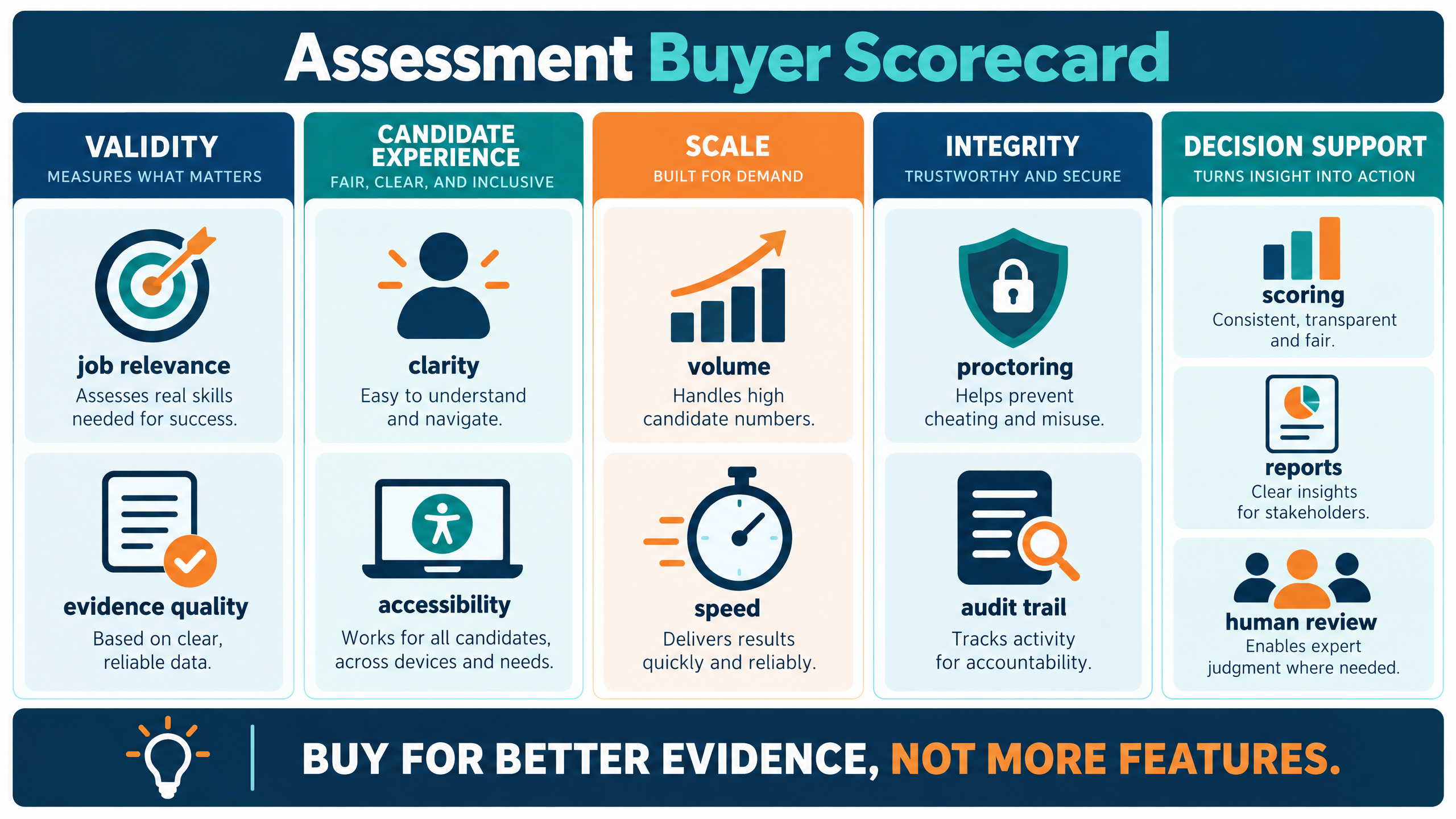
For hiring teams, the important evaluation questions are:
- Which assessment format matches the role?
- Can the question set be customized to the competency map?
- Can the platform support early screening and deeper skills validation?
- How are coding, descriptive, and AI-assisted results reviewed?
- How are proctoring and activity signals handled?
- Can reports show evidence rather than only scores?
- Can recruiters, hiring managers, and TPOs receive appropriate access?
- Can the workflow scale for campus, graduate, or enterprise hiring?
- What support, integration, privacy, and retention controls apply?
Request a futuremug assessment-platform consultation to map your role requirements to an online assessment, skills assessment, interview, or combined workflow.
Buyer checklist
Before selecting an online assessment platform, confirm that you can answer these questions:
- What hiring decision must the assessment support?
- Which skills or knowledge are essential at this stage?
- What evidence will demonstrate each skill?
- Is an online test, work sample, interview, or combination appropriate?
- Which question formats and task types are required?
- How long should the candidate experience take?
- What accessibility and device requirements apply?
- What integrity controls are proportionate?
- Who reviews automated, AI-assisted, or flagged results?
- What reports and evidence will hiring managers see?
- How will results connect to the next hiring step?
- How will candidate data, recordings, code, and reports be protected?
- Can the operations team manage volume, invitations, and support?
- What integrations and permissions are needed?
- What pilot criteria must be met before scale?