
Skills Assessment Platform for Hiring: Features That Matter by Role
Skills assessment platform: the short answer
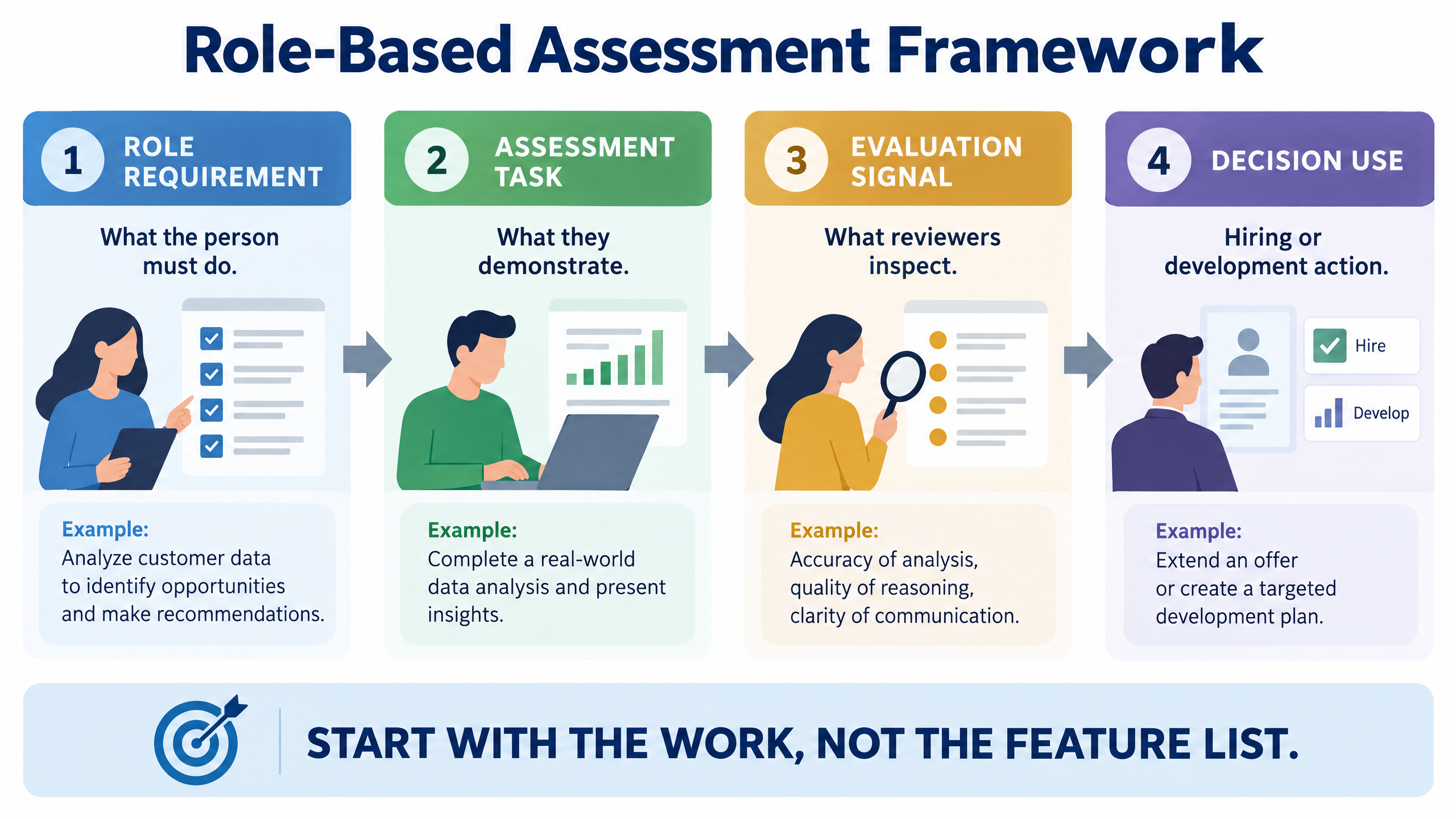
- Role requirement: What must the person do on the job?
- Assessment task: What can the candidate or learner demonstrate?
- Evaluation signal: How will the response be scored and reviewed?
- Decision use: What action will the result support?
How this guide differs from a general buyer checklist
The role-by-role assessment framework
|
Question
|
Example for a software engineer
|
Example for a sales representative
|
|
What must the person do?
|
Build, test, debug, and explain software.
|
Prospect, qualify, present value, and manage objections.
|
|
What should the assessment ask them to do?
|
Solve a coding task and explain trade-offs.
|
Prioritize leads and respond to a customer scenario.
|
|
What evidence should reviewers see?
|
Correctness, reasoning, code quality, and communication.
|
Judgment, clarity, listening, and commercial reasoning.
|
|
What decision will the result support?
|
Progress to a technical interview.
|
Progress to a role-play or hiring-manager round.
|
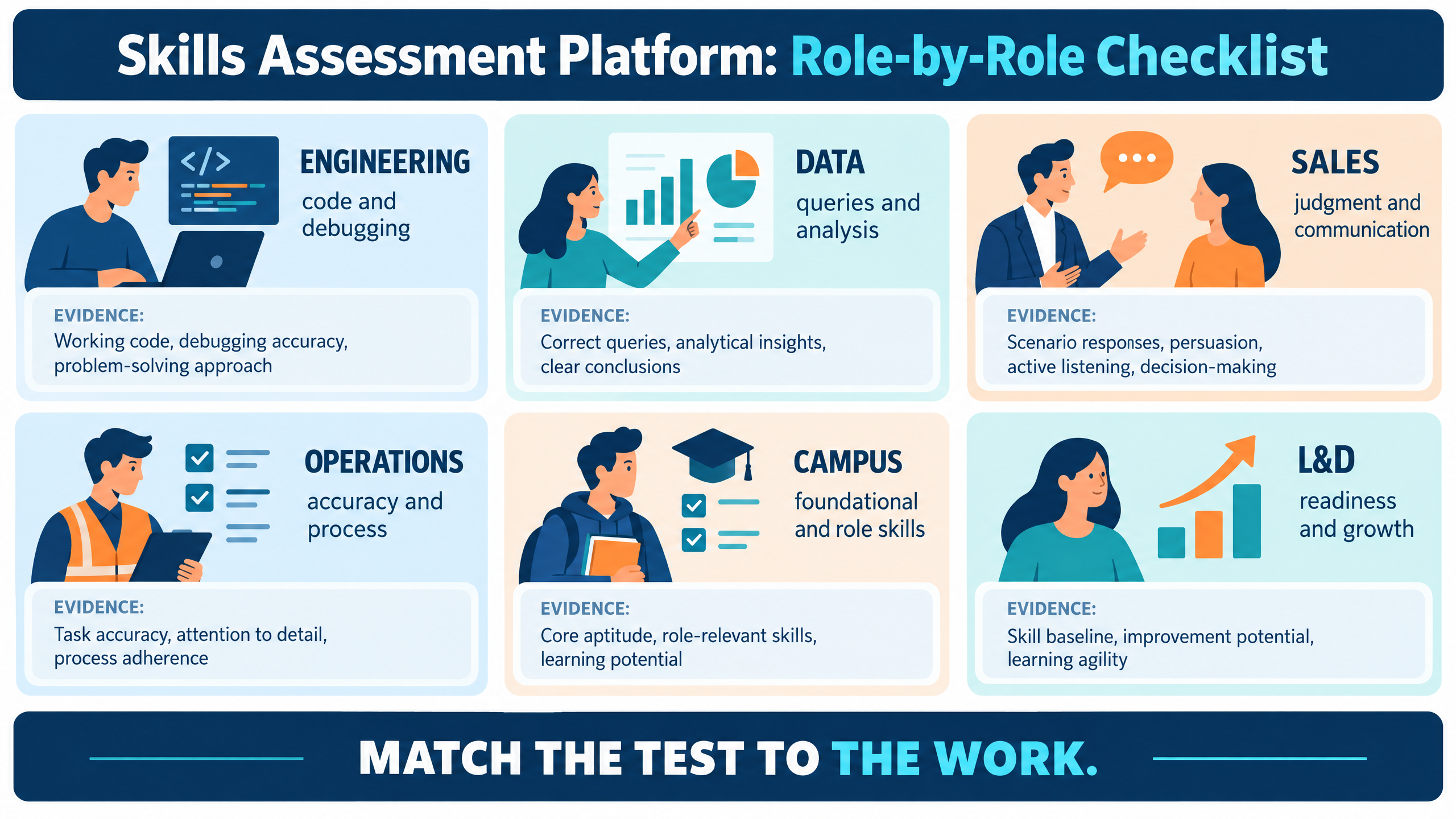
Engineering and software development
Evidence that matters
Assessment formats to consider
- Coding questions with a suitable compiler or execution environment.
- Practical coding tasks with test cases.
- Debugging or code-review scenarios.
- SQL or data-manipulation exercises.
- Multiple-choice questions for targeted technical knowledge.
- Descriptive responses for architecture or trade-off explanations.
- Framework or domain questions where the role requires them.
Platform features that matter
- Language and framework coverage.
- Built-in compiler or execution environment.
- Private and public test cases.
- Code output and error visibility.
- Time and memory controls.
- Plagiarism or similarity signals.
- Code evidence in reports.
- Manual review and reviewer notes.
- Assessment variation for repeated hiring campaigns.
- Skill and difficulty tagging.
What to avoid
Demo question
Data, analytics, and business intelligence
Evidence that matters
Assessment formats to consider
- SQL questions or query-writing tasks.
- Data interpretation and chart-reading questions.
- Spreadsheet or structured-data exercises.
- Statistical reasoning.
- Case-based analysis.
- Descriptive explanations of findings.
- Multiple-choice questions for targeted concepts.
- Practical scenarios that test prioritization and data quality judgment.
Platform features that matter
- Code or query execution where required.
- Ability to combine objective and descriptive sections.
- Dataset or image support.
- Section-level and skill-level scoring.
- Rubrics for explanation quality.
- Report exports that preserve evidence.
- Candidate instructions that define available tools and assumptions.
- Flexible time controls for multi-step tasks.
What to avoid
Demo question
Sales, customer success, and support
Evidence that matters
Assessment formats to consider
- Situational judgment questions.
- Written customer-response scenarios.
- Role-specific case studies.
- Video or audio responses where appropriate.
- Prioritization exercises.
- Product or domain knowledge questions.
- Descriptive responses assessed with a rubric.
- Communication and language tasks designed for the actual role.
Platform features that matter
- Flexible descriptive or media-response support.
- Rubric-based human evaluation.
- Custom scoring by competency.
- Evidence capture for reviewer discussion.
- Candidate instructions that define the customer context.
- Review workflows for multiple evaluators.
- Reports that separate communication quality from product knowledge.
What to avoid
Demo question
Operations, finance, and administrative roles
Evidence that matters
Assessment formats to consider
- Numerical and quantitative reasoning.
- Spreadsheet or data-entry tasks.
- Process and policy scenarios.
- Error-spotting exercises.
- Work-sample simulations.
- Descriptive explanations.
- Role-specific knowledge questions.
- Prioritization and exception-handling tasks.
Platform features that matter
- Clear time and navigation controls.
- Section-level results.
- Negative marking only when it reflects the assessment purpose.
- Configurable cut-offs.
- Randomized questions where appropriate.
- Audit-friendly report exports.
- Candidate status and completion tracking.
- Support for bulk assessment campaigns.
What to avoid
Demo question
Graduate, fresher, and campus hiring
Evidence that matters
Assessment formats to consider
- Aptitude and logical reasoning.
- Verbal or written communication.
- Coding and technical fundamentals.
- Domain or role-specific questions.
- Situational judgment.
- Structured descriptive responses.
- Group or cohort-level evaluation where appropriate.
Platform features that matter
- Bulk candidate upload and invitations.
- Mobile-aware candidate delivery.
- Clear instructions and status visibility.
- Configurable cut-offs by role or cohort.
- Proctoring and question randomization where justified.
- Real-time tracking.
- Candidate shortlisting.
- Recruiter, TPO, or coordinator access.
- Cohort and campaign reports.
What to avoid
Demo question
L&D, internal mobility, and reskilling
Evidence that matters
Assessment formats to consider
- Diagnostic knowledge tests.
- Practical work samples.
- Scenario-based judgment.
- Role-readiness assessments.
- Pre- and post-training comparisons.
- Certification or recertification tests.
- Descriptive reflections or explanations.
- Repeat assessments with controlled variation.
Platform features that matter
- Skill-gap reporting.
- Individual feedback.
- Cohort analysis.
- Repeat-test controls.
- Assessment versions.
- Learning-path or workflow triggers.
- Access separation between employee and manager views.
- Reports that support development rather than only selection.
What to avoid
Demo question
8 platform features that matter across roles
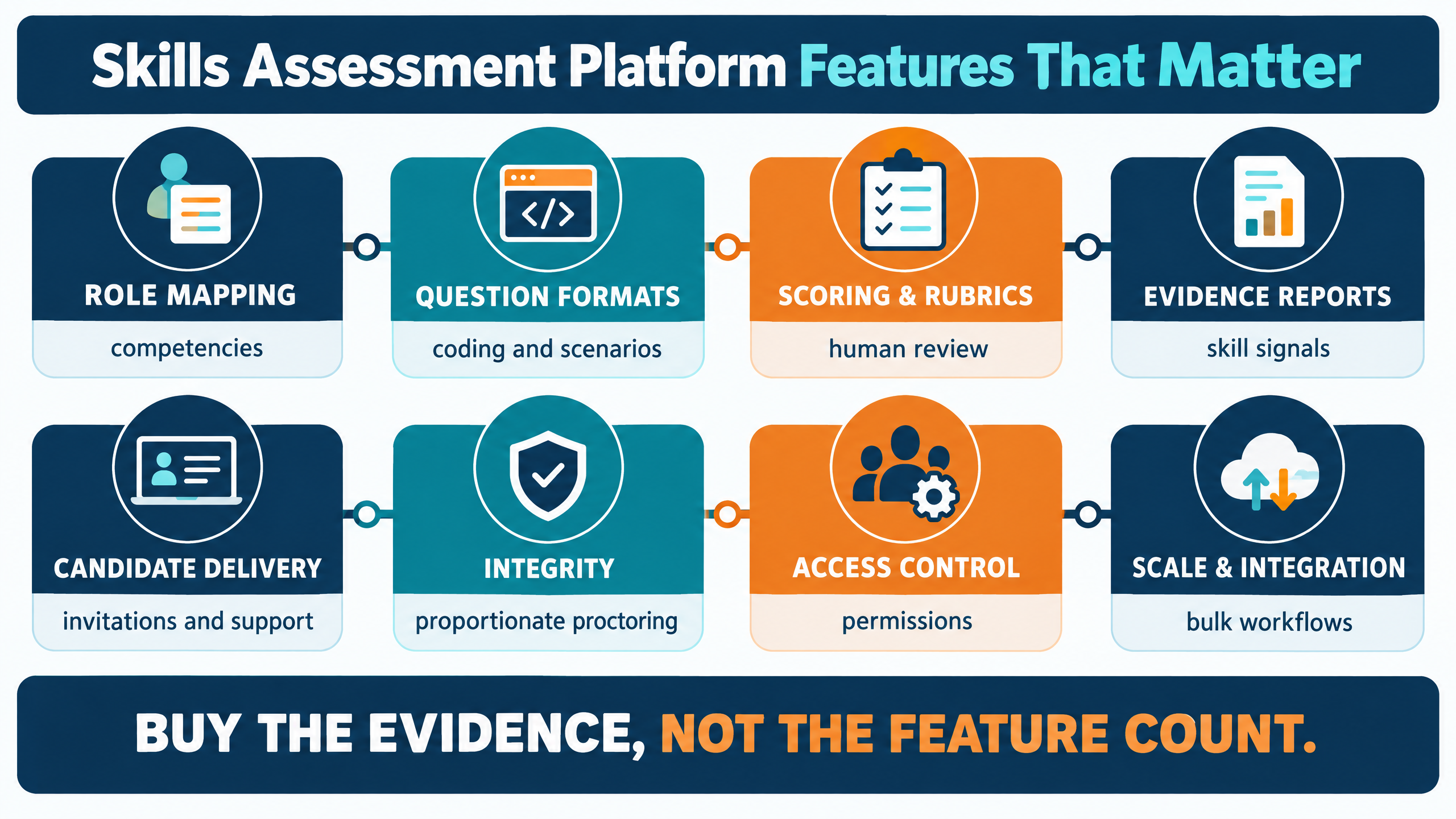
1. Role and skill mapping
2. Multiple assessment formats
3. Configurable scoring and rubrics
4. Evidence-rich reporting
5. Candidate delivery and support
6. Integrity controls
7. Collaboration and access control
8. Scale and integration
How to test a skills assessment platform in a demo
Test 1: Build a role-relevant assessment
Test 2: Complete the candidate journey
Test 3: Inspect the evidence
Test 4: Trigger an exception
Test 5: Compare role workflows
Test 6: Review the operating cost
Role-based vendor scorecard
|
Dimension
|
Engineering
|
Data and analytics
|
Sales and support
|
Campus and graduate
|
L&D and mobility
|
|
Core evidence
|
Code, debugging, design
|
Query, analysis, explanation
|
Judgment, communication, prioritization
|
Foundational and role skills
|
Readiness and skill growth
|
|
Key formats
|
Coding, MCQ, descriptive
|
SQL, data, case
|
Scenario, descriptive, media
|
Aptitude, coding, domain
|
Diagnostic, work sample, repeat test
|
|
Critical feature
|
Compiler and code evidence
|
Dataset and section reporting
|
Rubric and response review
|
Bulk delivery and tracking
|
Feedback and cohort reporting
|
|
Main risk
|
Over-testing algorithms
|
Rewarding memorization
|
Subjective scoring
|
Generic one-size-fits-all test
|
Treating development as pass/fail
|
|
Demo proof
|
Review code and test cases
|
Inspect reasoning and output
|
Review rubric and response
|
Run a cohort workflow
|
Compare pre- and post-assessment
|
How futuremug fits the evaluation



Frequently Asked Questions
A skills assessment platform is software that helps organizations create, deliver, score, and report assessments of job-related or development-related capabilities. It may support coding, aptitude, domain, descriptive, scenario, video, or other assessment formats.
A quiz tool may present questions and collect answers. A skills assessment platform adds role mapping, assessment creation, candidate or learner management, scoring, reports, integrity controls, permissions, and workflow support. Buyers should verify the actual capabilities instead of relying on the label.
Engineering teams should evaluate coding environments, language support, test cases, debugging or practical tasks, code evidence, assessment variation, technical scoring, reviewer notes, and reports. They should also test whether the assessment measures the role rather than only algorithm speed.
Useful formats may include situational judgment, written customer responses, role-specific scenarios, prioritization, product or domain knowledge, and structured communication tasks. Use a clear rubric and separate communication quality from product knowledge where relevant.
Some platforms can support recruitment, L&D, internal mobility, and certification. The buyer should confirm whether the product supports feedback, skill-gap reporting, repeat assessments, cohort analysis, and separate access for employees, managers, and administrators.
AI-assisted scoring can reduce repetitive work, but the buyer should understand the scoring logic, calibration, original response access, confidence or exception signals, and human-review process. AI should support accountable evaluation rather than make it opaque.
Start with the work the person must perform. Define the evidence that would demonstrate competence. Select the assessment format that produces that evidence. Then evaluate whether the platform supports the format, scoring, workflow, reporting, governance, and scale required.
No. The right control depends on the assessment purpose, role risk, candidate population, and consequence of the decision. Use proportionate controls and define how flags and exceptions receive human review.
Compare the complete cost of candidate or learner volume, users, assessments, credits, managed services, content creation, candidate support, scoring, reporting, integrations, implementation, and internal administration. A lower unit price may create more manual work.
It should include two different role scenarios, assessment creation, candidate delivery, response evaluation, report review, an exception path, permissions, and a total-cost discussion. Ask the vendor to demonstrate the workflow rather than only list features.