
How to Measure Employer Branding vs Recruitment Marketing: 10 Ways to Prove Employer Brand Impact on Recruitment
Employer branding vs recruitment marketing: the short answer
What is employer branding?
- What kind of work will I do?
- How will I learn and grow?
- Who will manage me?
- What does the team value in practice?
- How are decisions made?
- Will the hiring process be clear and fair?
- Does the employee story match the public promise?
What is recruitment marketing?
- Which talent audience are we trying to reach?
- What does this audience need to know?
- Which message and proof will be relevant?
- Which channel will reach them?
- What action should they take next?
- How will we measure the cost and quality of that action?
Employer brand, employer branding, and candidate experience
|
Concept
|
What it means
|
Primary question
|
|
Employer brand
|
The perception people hold about the organization as a place to work.
|
“What do people believe about us?”
|
|
Employer branding
|
The strategy and activities used to shape that perception.
|
“What promise and proof should we build?”
|
|
Candidate experience
|
The lived sequence of interactions during the recruitment journey.
|
“What did the candidate actually experience?”
|
|
Recruitment marketing
|
The campaigns and channels used to attract and engage potential candidates.
|
“How do we reach and move the right audience?”
|
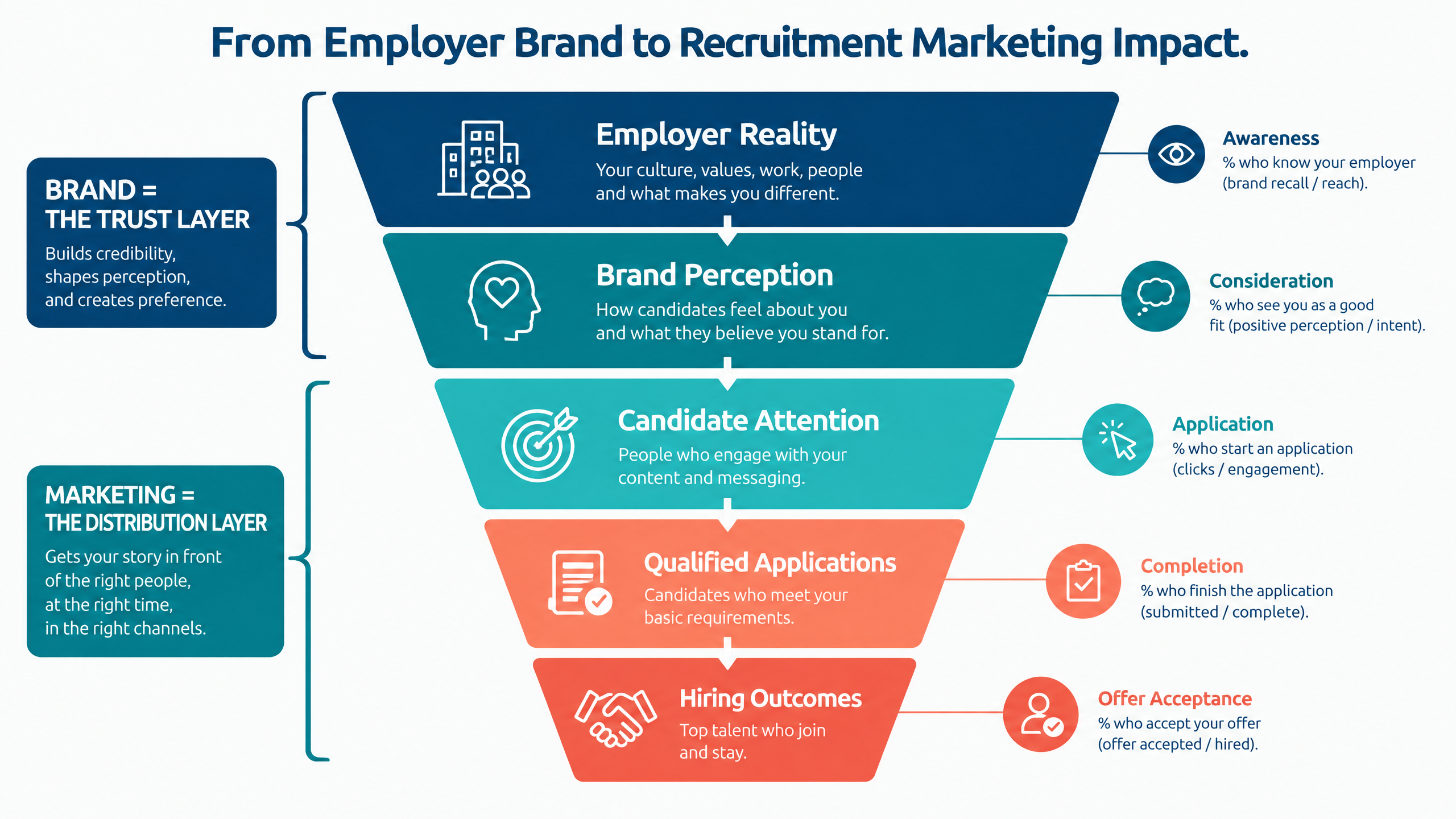
How the two disciplines work together
Employer branding creates the strategic foundation
Recruitment marketing turns the foundation into action
Candidate experience tests credibility
Recruitment operations complete the system
10 ways to measure employer brand impact on recruitment
1. Measure unaided and aided awareness
2. Measure perception and trust
3. Measure branded and qualified traffic
4. Measure engagement with employer-brand proof
5. Measure application quality and conversion
6. Measure candidate-experience quality
7. Measure offer acceptance and decision confidence
8. Measure source-to-hire quality
9. Measure employee advocacy and referral behavior
10. Measure early retention and promise delivery
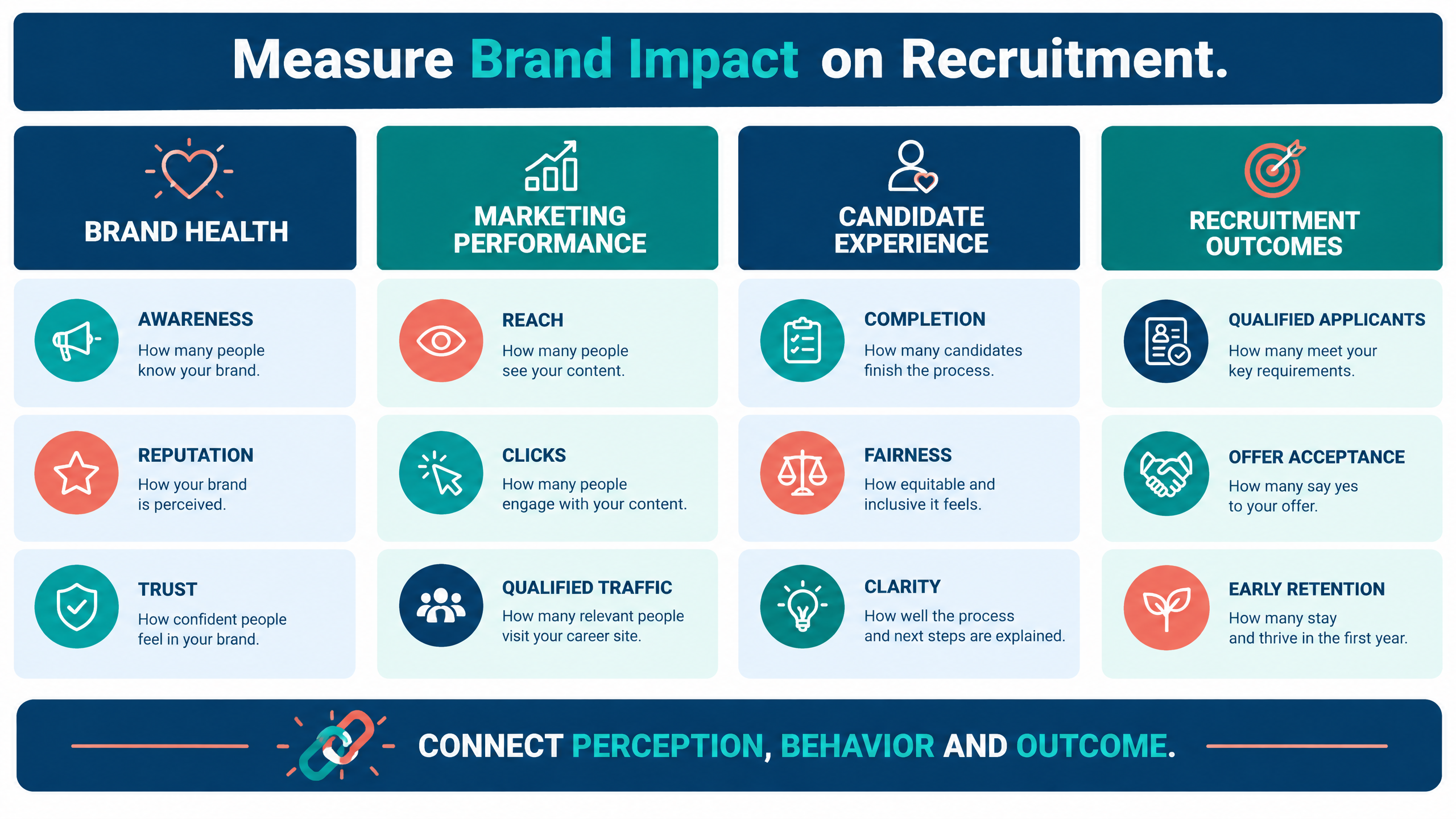
How to connect employer-brand metrics to recruitment outcomes
|
Measurement layer
|
Example questions
|
Example metrics
|
|
Brand health
|
What do target audiences believe?
|
Awareness, trust, reputation, relevance, recommendation.
|
|
Marketing performance
|
Did the message reach and engage the intended audience?
|
Reach, qualified traffic, content engagement, click-through, community sign-ups.
|
|
Candidate behavior and experience
|
Did people continue and feel respected?
|
Application conversion, assessment completion, interview attendance, drop-off, clarity, fairness.
|
|
Recruitment and retention outcomes
|
Did the system produce better hiring results?
|
Qualified applicants, progression, offer acceptance, source-to-hire quality, early retention.
|
- Are the right talent audiences aware of us?
- Do they believe the employer promise?
- Are they taking the intended recruitment action?
- Does the candidate experience validate the message?
- Are hiring and retention outcomes improving for the right reasons?
How recruitment operations affect brand impact
How futuremug supports the operational side of candidate experience



Frequently Asked Questions
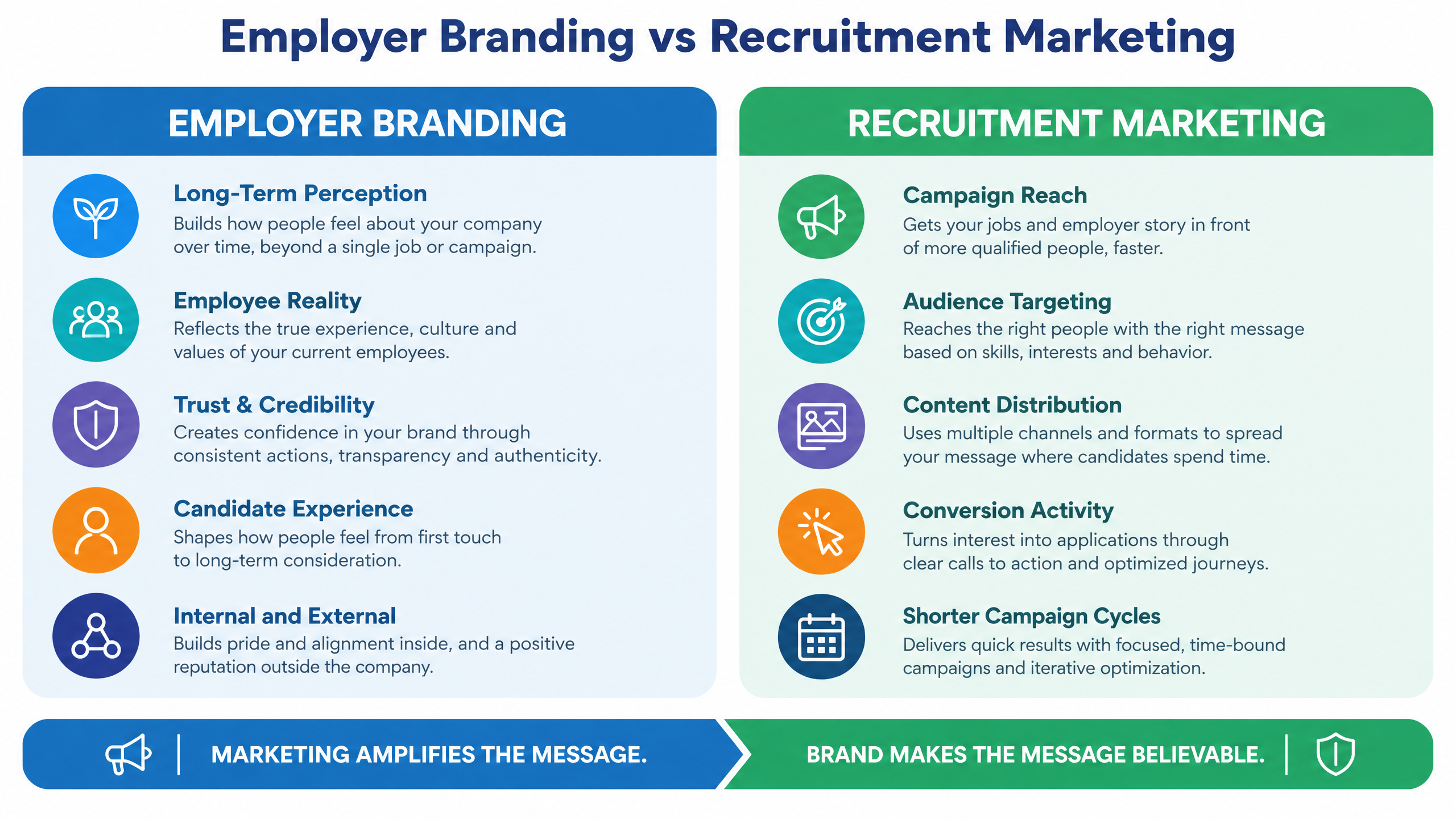
Employer branding shapes the organization’s reputation and the expectations people have about working there. Recruitment marketing uses campaigns, content, channels, and audience targeting to attract and engage potential candidates. Branding creates the trust foundation, while marketing distributes and activates the message.
Employer branding and recruitment marketing overlap, but they are not identical. Recruitment marketing is one way to activate the employer brand. Employer branding is broader because it includes employee reality, leadership, candidate experience, workplace proof, and the organization’s ability to deliver its promise.
Candidate experience provides direct evidence of the employer promise. Clear instructions, respectful communication, relevant evaluation, predictable scheduling, and timely outcomes can strengthen trust. Delays, confusion, inconsistency, and silence can weaken it.
There is no single universal metric. A useful measurement system connects brand perception with candidate behavior, candidate experience, recruitment outcomes, and early retention. The right metrics depend on the organization’s talent problem and target audience.
Connect perception research and campaign data with application quality, progression, completion, interview attendance, offer acceptance, source-to-hire outcomes, and early retention. Use cohorts, trend analysis, qualitative research, and controlled campaign comparisons where possible.
It should measure both. Reach shows whether the organization is visible, but hiring outcomes show whether the message is relevant and credible. A campaign can be successful at generating attention while failing to attract or retain the right talent.
Automation can improve the delivery of the candidate experience by supporting scheduling, reminders, status updates, assessments, feedback collection, reporting, and next-step communication. It should preserve human review and support rather than making the process harder to understand.
Use a mix of ongoing operational monitoring, periodic candidate and employee research, campaign reviews, and quarterly or semiannual strategic analysis. High-volume hiring teams may need weekly funnel visibility, while brand-perception studies may run less frequently.