
Why Hiring Teams Use an Interview as a Service Platform with Structured Evaluation
What is an Interview as a Service platform?
Why hiring teams use the model
|
Hiring challenge
|
How an Interview as a Service platform can help
|
|
Limited interviewer bandwidth
|
Adds expert capacity without requiring every internal engineer to conduct every round.
|
|
Specialist skill gaps
|
Provides access to interviewers with relevant domain and technology experience.
|
|
Inconsistent evaluation
|
Uses shared rubrics, question structures, and reporting formats.
|
|
Scheduling delays
|
Coordinates availability, reminders, time zones, and rescheduling.
|
|
High candidate volume
|
Supports repeatable first-round screening and batch interview programs.
|
|
Delayed feedback
|
Consolidates scorecards, evidence, and recommendations for review.
|
|
Distributed recruitment
|
Enables remote interviews and structured digital evidence across locations.
|
|
Temporary hiring spikes
|
Adds elastic capacity without building a permanent panel for every skill.
|
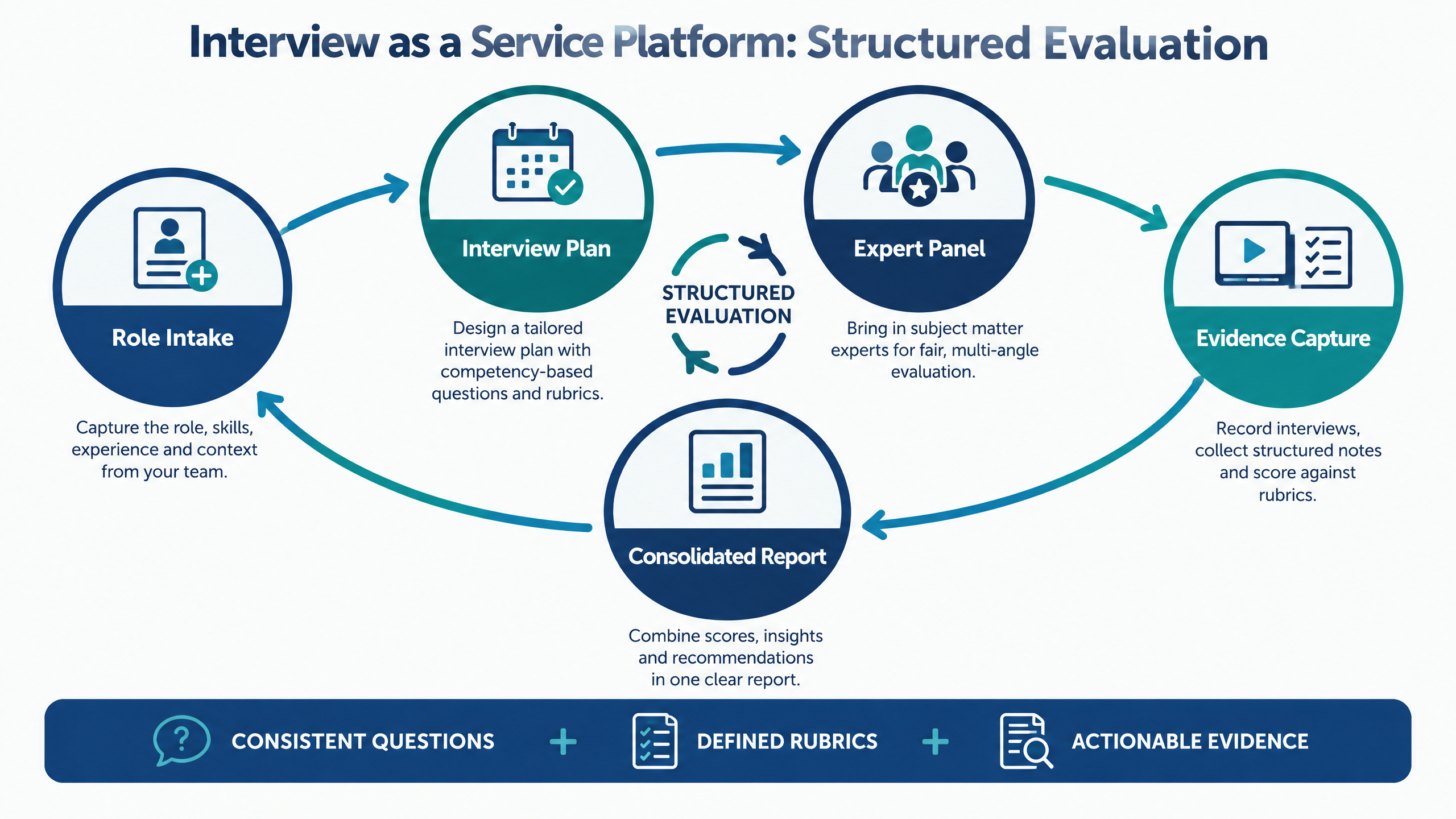
What structured evaluation means
- The hiring team defines the competencies that matter.
- The interview plan maps questions or exercises to those competencies.
- The interviewer uses relevant follow-up questions to test understanding.
- The scorecard defines what strong, acceptable, weak, and borderline performance looks like.
- The report records the evidence behind the score.
- The employer reviews the evidence and makes the decision.
10 smart benefits of an Interview as a Service platform
1. It expands interviewer capacity without expanding the internal panel
2. It creates a repeatable evaluation standard
3. It improves access to specialist expertise
4. It reduces scheduling and coordination work
5. It produces evidence-linked reports
6. It supports technical hiring at higher volume
7. It makes quality review possible
8. It supports a hybrid human and AI operating model
9. It improves candidate communication
10. It creates an operating model for changing demand
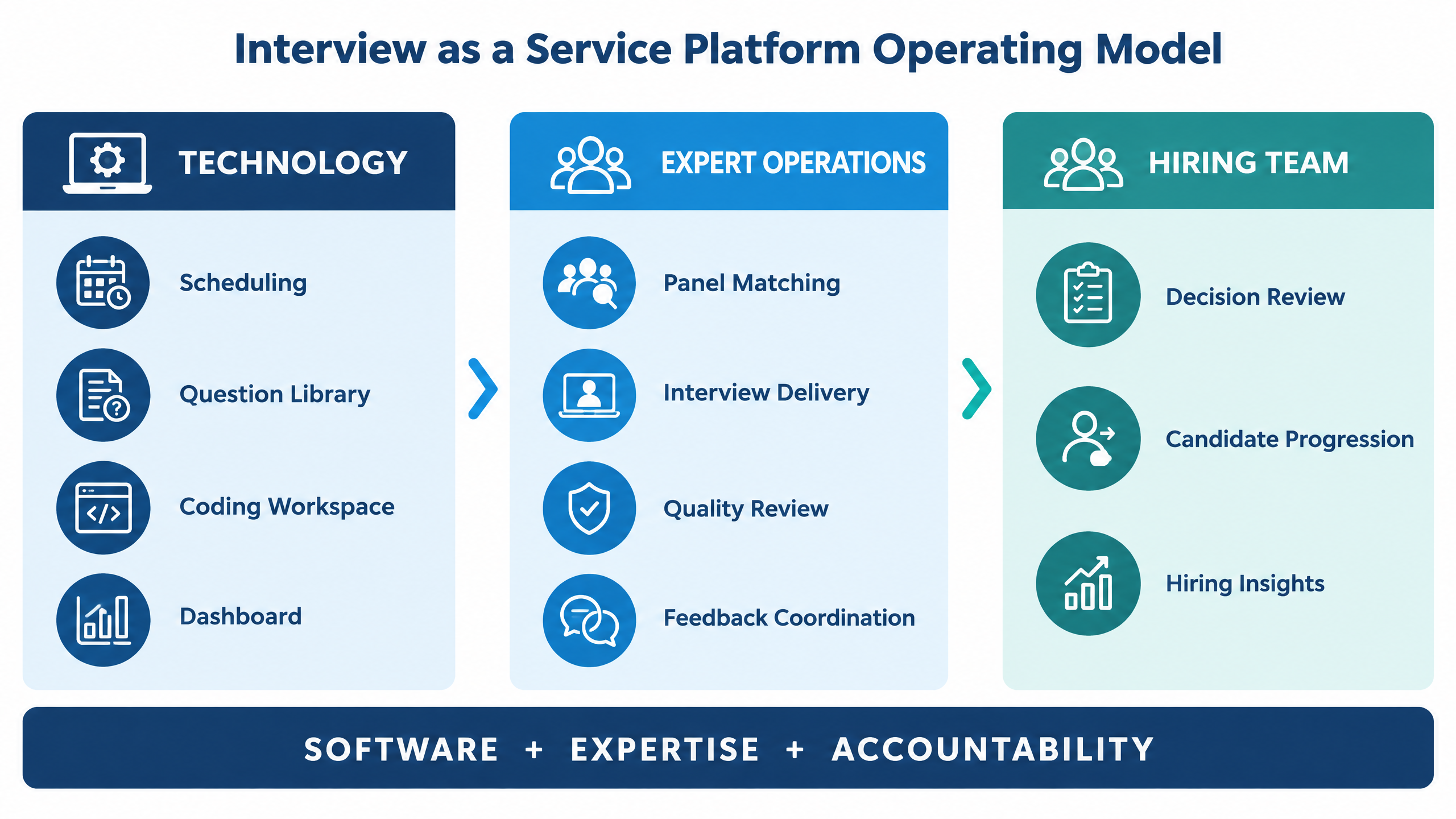
How the workflow works from role intake to decision
1. Role intake
2. Interview-plan design
3. Calibration
4. Expert or workflow matching
5. Candidate scheduling
6. Interview delivery
7. Evidence capture and scoring
8. Quality review and reporting
9. Employer decision
10. Continuous improvement
Expert panels, AI interviews, and hybrid delivery
|
Delivery model
|
Best suited for
|
Strengths
|
Buyer questions
|
|
Expert human panel
|
Specialist roles, technical depth, senior hiring, and nuanced judgment.
|
Domain knowledge, probing, context, and two-way discussion.
|
How are experts vetted, matched, calibrated, and monitored?
|
|
AI interview workflow
|
High-volume screening and repeatable first-round evaluation.
|
Availability, consistency, automated scheduling, and scalable reporting.
|
How are prompts, scoring, oversight, accessibility, and escalation managed?
|
|
Hybrid delivery
|
Multi-stage hiring where speed and expert judgment both matter.
|
Automation for volume plus human review for depth and final decisions.
|
Which stages are automated, who reviews the output, and what evidence is retained?
|
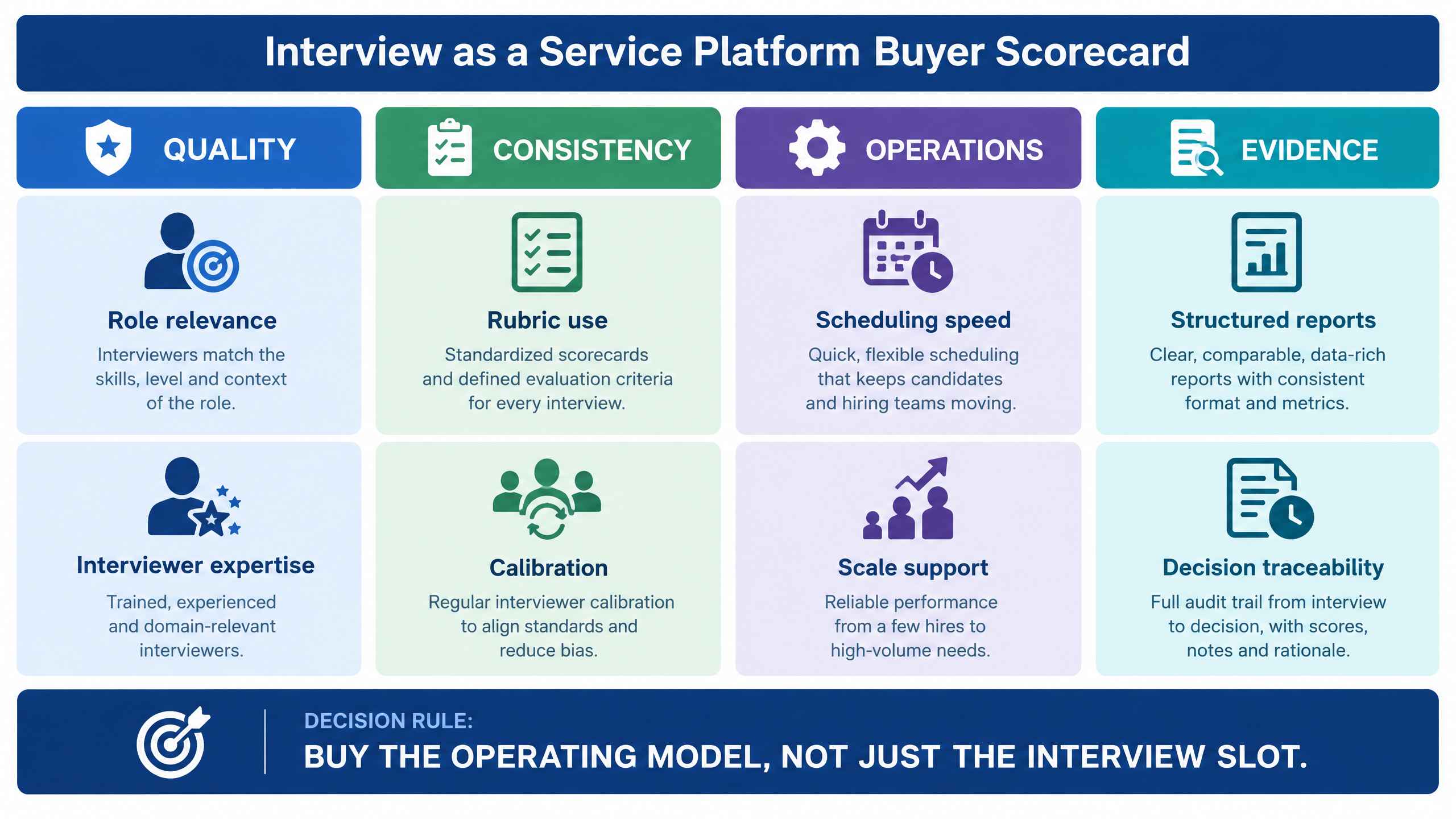
What to evaluate before choosing a platform
Interviewer quality and coverage
Role-specific customization
Structured evaluation
Scheduling and service levels
Interview formats
Candidate experience
Reporting and integrations
Governance and security
Commercial flexibility
How to run a practical pilot
|
Pilot dimension
|
What to measure
|
|
Role fit
|
Whether questions and exercises reflect the actual role and level.
|
|
Evaluation quality
|
Whether scores are supported by specific evidence and useful rationale.
|
|
Consistency
|
Whether candidates are assessed against the same essential bar.
|
|
Scheduling
|
Time from request to confirmed slot, rescheduling, and no-show handling.
|
|
Turnaround
|
Time from interview completion to report delivery and decision review.
|
|
Candidate experience
|
Clarity, accessibility, technical issues, support, and completion.
|
|
Human agreement
|
How often trained internal reviewers agree with or challenge the output.
|
|
Operational fit
|
Integration, status visibility, permissions, reporting, and escalation.
|
|
Commercial fit
|
Cost under normal volume, peak volume, and change scenarios.
|
How futuremug supports structured interview delivery
Request an Interview as a Service consultation



Frequently Asked Questions
An Interview as a Service platform combines interview delivery, expert or AI-assisted evaluation, scheduling, candidate coordination, reporting, and operational support. It helps organizations add interview capacity and consistency while retaining ownership of hiring decisions.
They use the model to address limited interviewer bandwidth, specialist skill gaps, scheduling delays, inconsistent evaluation, feedback bottlenecks, distributed hiring, and temporary volume spikes. The goal is to make the evaluation workflow faster, more scalable, and easier to review.
Structured evaluation includes defined competencies, role-relevant questions or exercises, calibrated expectations, evidence-linked scorecards, consistent reporting, and human review of the final decision. It is more than assigning a score after an informal conversation.
Yes. Depending on the provider, it can support coding, debugging, system design, architecture, domain, behavioral, communication, and managerial interviews. Buyers should confirm role coverage, interviewer expertise, coding tools, evidence capture, and report quality.
Not necessarily. Many organizations use a hybrid model. External experts or AI workflows support repeatable, specialist, or high-volume stages, while internal leaders retain final rounds, context-critical discussions, offer conversations, and consequential decisions.
Candidates should receive clear instructions, reasonable notice, expected duration, accessible technology, privacy information, a support route, and next-step communication. Providers should also explain how recordings, transcripts, code, reports, and personal information are handled.
Ask how interviewers are vetted, matched, calibrated, monitored, scheduled, and replaced when needed. Review experience by role, technology, domain, level, language, and interview type rather than relying only on the size of the panel network.
Use a weighted scorecard covering interviewer quality, role coverage, structured evaluation, scheduling, candidate experience, reporting, integrations, governance, support, and commercial flexibility. Then run a pilot using a real role and measurable success criteria.
The demo should show role intake, rubric setup, question or exercise configuration, interviewer matching, candidate invitation, scheduling, interview delivery, evidence capture, scorecard completion, report generation, human review, integrations, and exception handling.