
Virtual Campus Recruitment: How to Run an Online Campus Drive End to End
What Is Virtual Campus Recruitment?
Virtual campus recruitment moves the steps of a campus drive online. The employer still works with the college’s Training and Placement Officer, and students still go through a pre-placement talk, tests and interviews. The difference is that nobody has to travel.
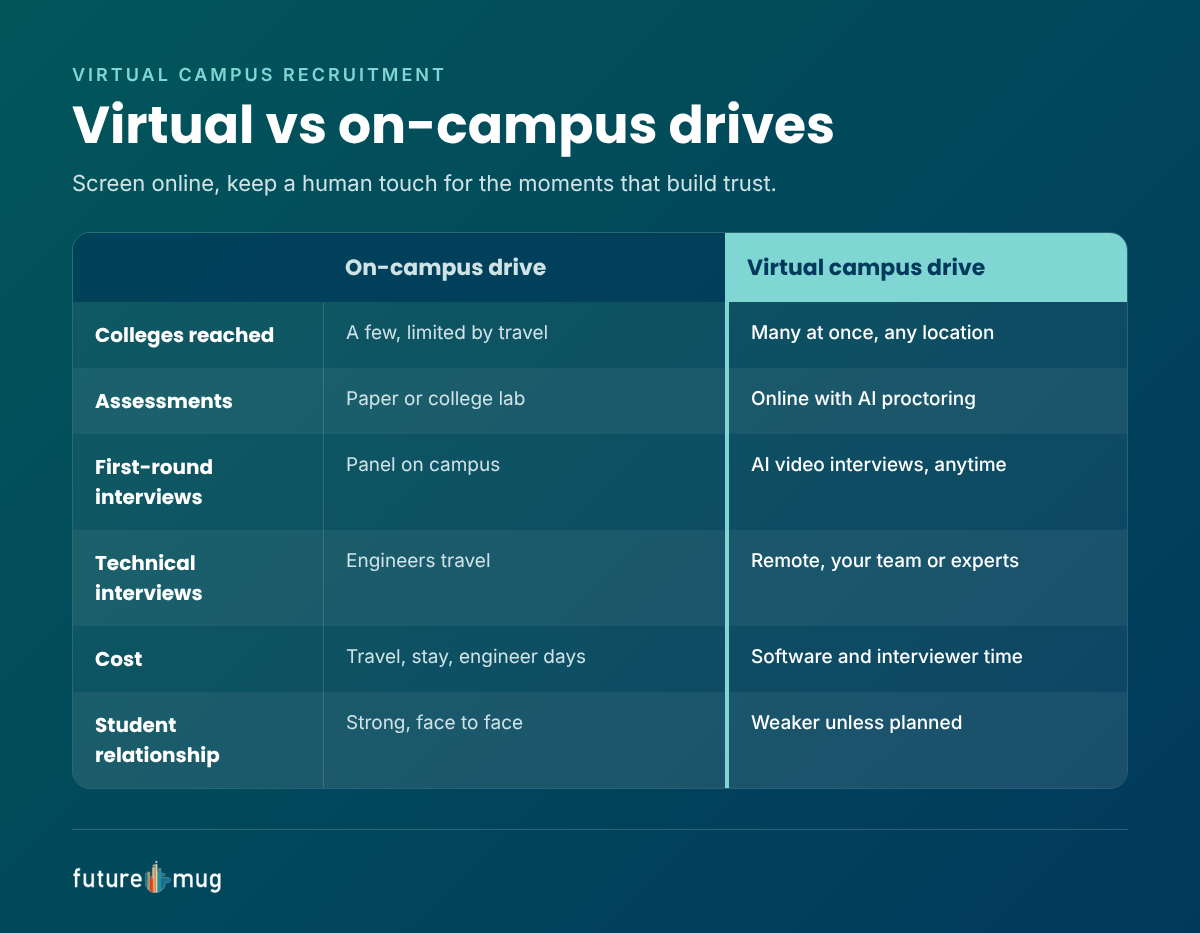
| On-campus drive | Virtual campus drive | |
|---|---|---|
| Colleges reached | A few, limited by travel | Many at once, any location |
| Pre-placement talk | In the auditorium | Live webinar, recorded for later |
| Assessments | Paper or college computer lab | Online, with AI proctoring |
| First-round interviews | Panel on campus | AI video interviews, taken anytime |
| Technical interviews | Your engineers travel | Remote, by your team or expert interviewers |
| Cost | Travel, stay and lost engineer days | Software and interviewer time only |
| Time to results | Often a week or more | Can be days |
| Relationship with students | Strong, face to face | Weaker unless you plan for it |
Most employers now use a hybrid model. They run screening online across many colleges, then visit a few key campuses in person or hold a live online session for final rounds and offers.
Benefits and Limits of Virtual Campus Hiring
Benefits
- Reach more colleges. Hire from tier-2 and tier-3 colleges you would never have visited.
- Lower cost per hire. No travel, hotels or engineers away from work for days.
- Faster drives. Online tests and AI interviews can screen hundreds of students in a day.
- Fairer screening. Every student takes the same proctored test and answers the same interview questions.
- Better data. Every score and interview report is stored, so you can compare colleges and improve next year.
Limits to plan for
Virtual events alone don’t build relationships with students the way in-person ones do. In NACE’s 2025 survey of US employers, in-person fairs and on-campus recruiting were rated effective by more than two-thirds of respondents, while fewer than one in five rated virtual fairs and virtual recruiting effective (NACE).
The lesson is not to avoid virtual hiring, but to use it where it is strongest. Put screening online, and keep a live, human touch for the pre-placement talk, final interviews and offers.
How to Run an Online Campus Drive in 8 Steps
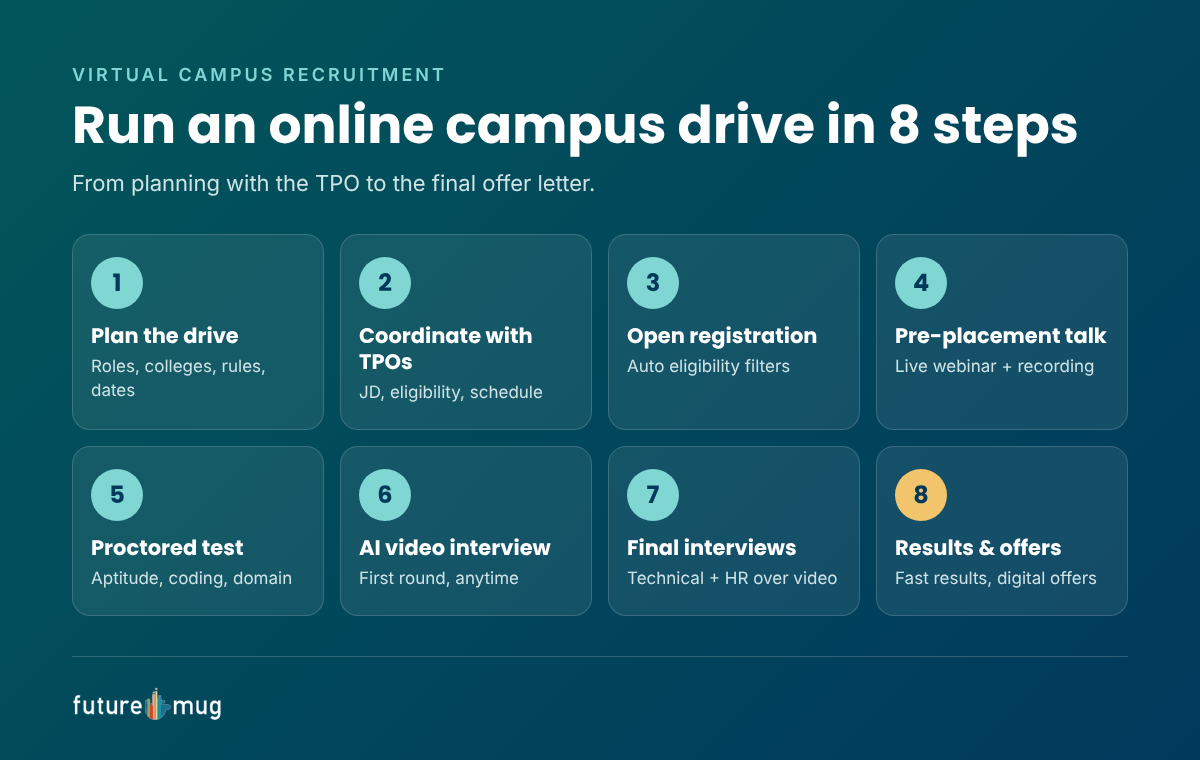
1. Plan the drive (3 to 4 weeks before)
Decide the roles, number of hires, target colleges, eligibility rules and salary. Set the dates for every round and agree who interviews whom.
2. Coordinate with each college’s TPO
Share the job description, eligibility criteria, schedule and technical requirements with the Training and Placement Officer. Ask them to confirm a contact person for the drive day.
3. Open student registration
Students register through the college’s TPO portal or your branded page. Apply eligibility filters automatically so only qualified students move forward.
4. Hold a live pre-placement talk
Run a 30 to 45 minute webinar about your company, the role and the selection process. Leave time for questions, and share the recording for students who miss it.
5. Run a proctored online assessment
Send aptitude, coding or domain tests with AI proctoring, so results from home or a college lab can be trusted. Share a practice test a few days earlier to cut technical problems on the day.
6. Screen with AI video interviews
Invite students who clear the test to an AI video interview they can take within a set window. You get scored reports for hundreds of students without booking a single interviewer.
7. Hold technical and HR interviews online
Run final rounds over video. If your engineers can’t spare the time, interview outsourcing puts shortlisted students in front of futuremug’s 5,000+ expert interviewers across 250+ IT domains.
8. Announce results and roll out offers
Share results with the TPO and students quickly, ideally within a few days. Send offer letters digitally, track acceptances, and keep in touch with selected students until they join.
Virtual Campus Recruitment Software Checklist
You don’t need one tool for everything, but your virtual campus recruitment software should cover these needs:
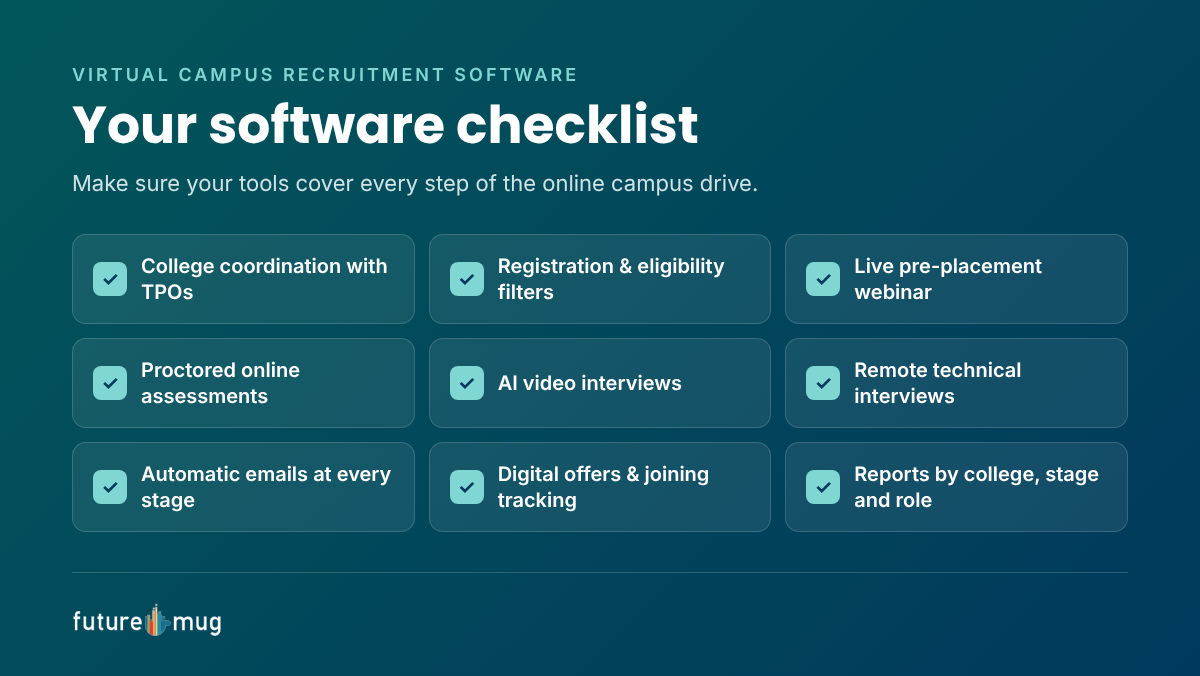
- College coordination: share drives with TPOs and track which colleges have confirmed.
- Registration and eligibility filters: students apply once, and the rules are applied automatically.
- Webinar or live video: host the pre-placement talk and answer questions live.
- Proctored online assessments: aptitude, coding and domain tests with AI proctoring.
- AI video interviews: first-round screening students can take at any time.
- Remote technical interviews: video interviews with scorecards, run by your team or expert interviewers.
- Communication: automatic emails and messages for every stage and result.
- Offer tracking: digital offers, acceptances and joining dates.
- Reports: results by college, stage and role.
To compare tools, see our list of the best campus recruitment software in India. futuremug covers the assessment and interview steps on one virtual campus recruitment platform.
Common Challenges and How to Fix Them
| Challenge | Fix |
|---|---|
| Students with poor internet or no laptop | Let the college host tests in its computer lab, give flexible time windows, and use a mobile-friendly platform |
| Cheating in remote tests | Use AI proctoring with webcam and screen monitoring, randomised questions and ID checks |
| Low turnout at the pre-placement talk | Schedule it with the TPO in class hours and share the recording |
| Students drop out between rounds | Keep the gap between rounds short and send clear updates after every stage |
| Weak connection with your brand | Add a live Q&A with recent hires, and invite alumni who studied at that college |
| Engineers too busy to interview | Use AI video interviews for first rounds and expert interviewers for technical rounds |
Tips for TPOs
- Book the computer lab and test the internet a day before the assessment.
- Share the company’s practice test link with students early.
- Keep one placement coordinator online throughout the drive to solve problems.
- Ask the employer for a results timeline before the drive starts, and share it with students.
Conclusion
Virtual campus recruitment lets you reach more colleges, screen students faster and hire at a lower cost, as long as you keep a human touch for the moments that build trust. Put tests and first-round interviews online, work closely with each TPO, and move quickly from results to offers.
futuremug runs the hardest part of an online campus drive on one platform: proctored assessments, AI video interviews and technical rounds by 5,000+ expert interviewers. Book a virtual campus hiring demo to plan your next drive.



Frequently Asked Questions
Virtual campus recruitment is hiring freshers from colleges online. The pre-placement talk, assessments, interviews and offers happen remotely instead of on campus.
Plan the drive, coordinate with each college's TPO, open registration, hold a live pre-placement talk, run a proctored online test, screen with AI video interviews, hold final interviews over video, and roll out offers.
It is very effective for screening at scale, but weaker for building relationships with students. Most employers use a hybrid model: screening online, with live sessions or campus visits for final rounds.
Use AI proctoring with webcam and screen monitoring, randomised question banks, ID checks, and confirm top scores with a live interview.
You need tools for college coordination, registration, a live webinar, proctored assessments, AI video interviews, remote technical interviews, communication and offer tracking.
The TPO shares the drive with students, confirms eligibility, arranges labs or internet where needed, and coordinates schedules and results with the employer.