
How to Measure Employer Branding vs Recruitment Marketing: 10 Ways to Prove Employer Brand Impact on Recruitment

Employer branding vs recruitment marketing: the short answer
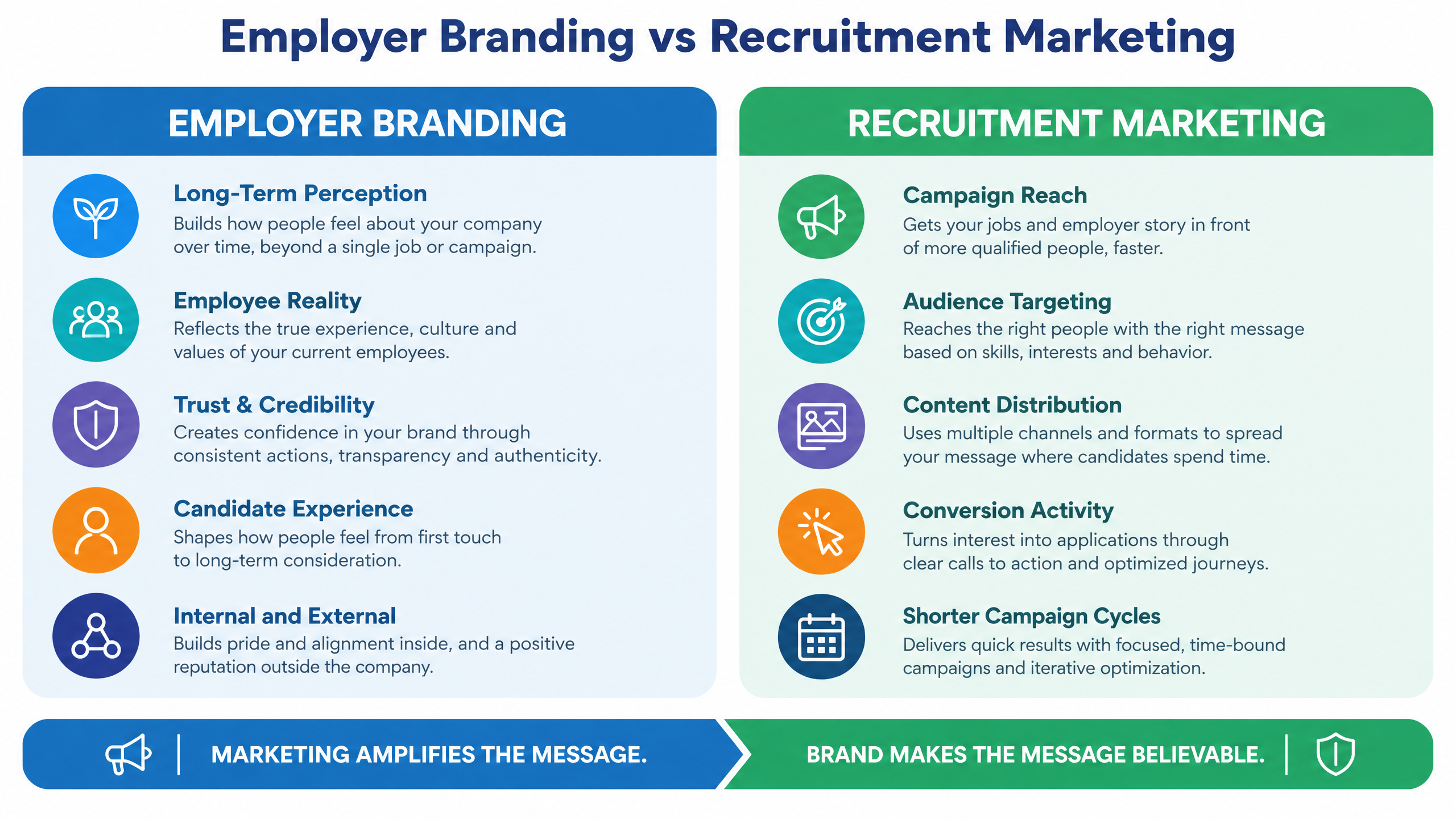
Employer branding vs recruitment marketing is not a choice between two competing activities. They solve different problems and work best as one connected talent-attraction system.
Employer branding shapes the organization’s reputation and the expectations people have about working there. It is influenced by employee reality, leadership behavior, manager quality, candidate experience, workplace proof, and how consistently the organization delivers its promises.
Recruitment marketing uses campaigns, content, channels, audience targeting, events, talent communities, and calls to action to attract and engage potential candidates. It brings the employer message to the right audience and encourages a measurable action such as visiting a careers page, joining a talent community, applying, or responding to outreach.
A simple way to remember the difference is:
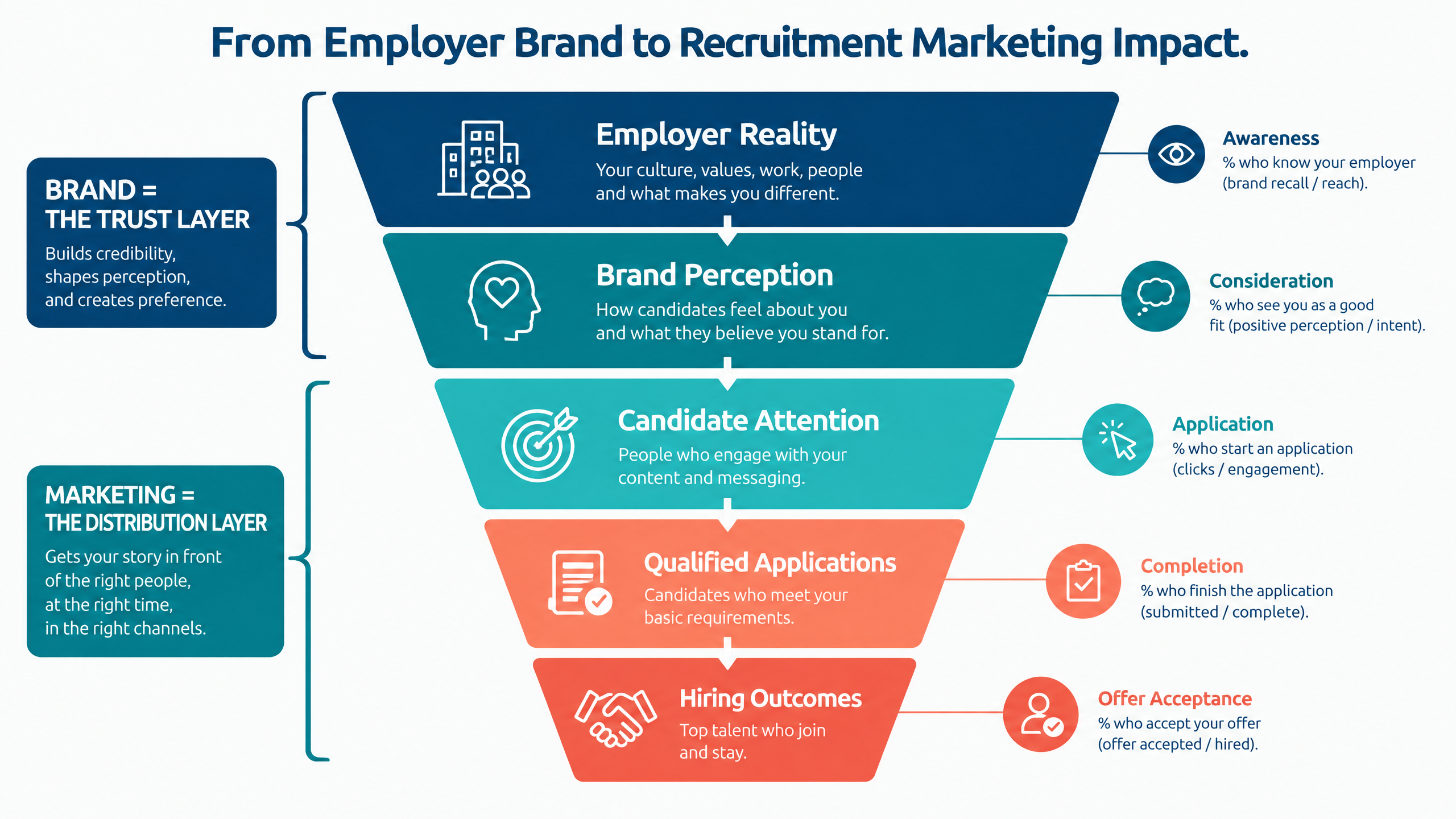
Employer branding is the trust layer. Recruitment marketing is the distribution and activation layer.
Marketing can create reach without creating belief. Branding can create a strong reputation without reaching enough of the people who would be a good fit. The strongest recruitment programs connect credible employer evidence with targeted campaigns and a respectful candidate journey.
The measurement question is therefore not only, “How many people saw the campaign?” It is also, “Did perception improve, did the right candidates take action, and did the experience deliver on the promise?”
Employer branding vs recruitment marketing comparison showing brand perception, campaign activity, candidate experience, and hiring outcomes

What is employer branding?

Employer branding is the ongoing work of shaping and communicating an organization’s reputation as a place to work. It includes the stories, experiences, signals, and proof that influence how employees, candidates, alumni, customers, and the wider market perceive the organization as an employer.
Employer branding is broader than a careers-page headline. It is shaped by the work itself, leadership decisions, manager behavior, learning opportunities, rewards, flexibility, inclusion, communication, hiring practices, onboarding, and employee advocacy.
A credible employer brand helps a candidate answer practical questions:
  • What kind of work will I do?
  • How will I learn and grow?
  • Who will manage me?
  • What does the team value in practice?
  • How are decisions made?
  • Will the hiring process be clear and fair?
  • Does the employee story match the public promise?
The brand exists whether the organization manages it or not. Employer-brand strategy makes the organization more intentional about understanding perception, selecting the right proof, closing promise-delivery gaps, and improving the experiences that create reputation.
The recommends combining internal and external insight, including employee research and auditing the candidate journey . This is useful because brand perception is created by both communication and experience.
For a broader foundation, read futuremug’s .

What is recruitment marketing?

Recruitment marketing is the use of marketing principles and channels to attract, engage, nurture, and convert potential candidates. It can include careers content, social campaigns, employee stories, talent communities, events, job advertising, search optimization, email, referrals, recruiter outreach, and audience-specific landing pages.
Recruitment marketing answers a different set of questions:
  • Which talent audience are we trying to reach?
  • What does this audience need to know?
  • Which message and proof will be relevant?
  • Which channel will reach them?
  • What action should they take next?
  • How will we measure the cost and quality of that action?
Recruitment marketing is often campaign-oriented, but it should not be limited to short-term promotion. A good program uses audience insight, content, distribution, conversion design, and measurement to build relationships over time.
A campaign may generate clicks and applications, but those actions have meaning only when the audience understands the opportunity and the organization can deliver a credible experience. This is why recruitment marketing should be connected to employer-brand strategy, candidate experience, and recruitment operations.

Employer brand, employer branding, and candidate experience

These three concepts are related but distinct.
Concept
What it means
Primary question
Employer brand
The perception people hold about the organization as a place to work.
“What do people believe about us?”
Employer branding
The strategy and activities used to shape that perception.
“What promise and proof should we build?”
Candidate experience
The lived sequence of interactions during the recruitment journey.
“What did the candidate actually experience?”
Recruitment marketing
The campaigns and channels used to attract and engage potential candidates.
“How do we reach and move the right audience?”
Candidate experience is the point where the brand promise becomes tangible. A campaign may describe a thoughtful, inclusive, and well-organized workplace. The candidate then tests that promise through the application, screening, assessment, interview, scheduling, communication, offer, and rejection process.
Slow scheduling, unclear instructions, inconsistent evaluation, missing feedback, or silence after an interview can weaken employer-brand trust even when the campaign creative is strong.
Read the related guide on to connect brand strategy with the full candidate journey.

How the two disciplines work together

Employer branding and recruitment marketing should be connected through a shared audience, promise, proof library, candidate journey, and measurement model.

Employer branding creates the strategic foundation

The employer-brand team clarifies the employee value proposition, identifies the experiences that make the organization distinctive, gathers proof, and defines what the organization can credibly promise to candidates.

Recruitment marketing turns the foundation into action

The recruitment-marketing team adapts that promise for specific talent segments and distributes it through relevant channels. It creates the path from awareness to consideration, application, assessment, interview, offer, and future relationship.

Candidate experience tests credibility

The recruitment process either validates or contradicts the message. Every interaction should make the promise more believable. That does not mean every interaction needs the same tone or content. It means the candidate should encounter clarity, respect, and consistency at the moments that matter.

Recruitment operations complete the system
Recruiters, hiring managers, interviewers, systems, and support teams deliver the experience. They influence whether a candidate receives timely communication, understands the process, can complete each step, and receives a professional outcome.
Employer branding to recruitment marketing funnel showing perception, attention, applications, and hiring outcomes

10 ways to measure employer brand impact on recruitment

Employer-brand measurement should combine perception, behavior, experience, and outcome metrics. No single metric can show the complete effect.

1. Measure unaided and aided awareness

Ask whether target talent audiences recognize the organization as an employer and what associations they make with it. Unaided awareness asks which employers come to mind without prompts. Aided awareness asks whether respondents recognize the organization when shown its name or content.
Segment results by role, geography, seniority, career stage, and talent community. Awareness among the general market may be less useful than awareness among the scarce-skill audience the organization needs to hire.

2. Measure perception and trust

Use surveys, interviews, focus groups, review-site monitoring, social listening, candidate feedback, and employee listening to understand what people believe. Ask about credibility, work quality, leadership, growth, inclusion, flexibility, stability, and the likelihood of recommending the organization.
Track positive and negative themes rather than reducing perception to one score. A rising awareness number can coexist with declining trust if a campaign makes promises that the employee or candidate experience does not support.

3. Measure branded and qualified traffic

Recruitment marketing can bring people to careers pages, role pages, events, talent communities, or application forms. Track branded search interest, direct traffic, content engagement, source quality, returning visitors, and qualified traffic from priority audiences.
Separate reach from relevance. A large audience is not necessarily valuable if it does not contain people with the skills, location, eligibility, or motivation required for the role.

4. Measure engagement with employer-brand proof

Track which content helps candidates understand the organization. Useful signals include employee-story views, role-preview completion, event attendance, technical-content engagement, talent-community sign-ups, recruiter-message responses, and return visits.
Combine behavioral data with qualitative feedback. High engagement may indicate strong interest, confusion, controversy, or simply a compelling headline. Ask candidates what they learned and what influenced their decision to continue.

5. Measure application quality and conversion

Application volume is not enough. Measure the transition from qualified visit to completed application, then examine the quality of applicants against role requirements and downstream outcomes.
Useful cuts include source, campaign, role, audience segment, location, device, landing page, and time period. Review whether the campaign attracts candidates who meet the requirements and understand the work.

6. Measure candidate-experience quality

Ask candidates whether the process was clear, fair, accessible, respectful, timely, and relevant. Track completion, drop-off, interview attendance, support requests, rescheduling, complaints, candidate effort, and willingness to consider the organization again.
Candidate experience is not only an operational metric. It is evidence of whether the employer brand survives contact with the recruitment process.

7. Measure offer acceptance and decision confidence

Offer acceptance can reflect compensation, role fit, manager quality, market conditions, competing offers, and employer-brand trust. Use acceptance data with candidate interviews and rejection reasons to understand the drivers.
Ask candidates what increased or decreased their confidence. The most useful insights often appear in the gap between what attracted a person and what made them hesitate.

8. Measure source-to-hire quality

Connect campaign source and employer-brand touchpoints with later outcomes such as interview progression, offer acceptance, early performance, and early retention. The purpose is not to claim that one content asset caused a hire. It is to understand which audiences and messages are associated with better-fit outcomes.
Use consistent definitions for qualified applicant, progressed candidate, offer, hire, and retained employee. Without shared definitions, teams can optimize different stages and reach conflicting conclusions.

9. Measure employee advocacy and referral behavior

Employees can strengthen the employer brand through authentic stories, referrals, participation in events, and useful conversations with candidates. Track referral activity, employee-story participation, advocacy engagement, and the sentiment of employee feedback.
Do not treat employees as an always-on media channel. Participation should be voluntary, accurate, and supported by clear boundaries. The goal is credible advocacy, not forced promotion.

10. Measure early retention and promise delivery

Employer-brand impact continues after the offer. Compare what candidates expected with what new hires experience during onboarding and the first months of work. Track early attrition, onboarding feedback, manager clarity, role understanding, and whether the employee can recognize the promised experience.
If a campaign improves applications but early attrition rises, the organization may have improved attention while weakening fit or expectation-setting. That is a signal to examine the promise and the reality together.

How to connect employer-brand metrics to recruitment outcomes

A useful measurement model connects four layers rather than treating each metric as a separate dashboard.
Measurement layer
Example questions
Example metrics
Brand health
What do target audiences believe?
Awareness, trust, reputation, relevance, recommendation.
Marketing performance
Did the message reach and engage the intended audience?
Reach, qualified traffic, content engagement, click-through, community sign-ups.
Candidate behavior and experience
Did people continue and feel respected?
Application conversion, assessment completion, interview attendance, drop-off, clarity, fairness.
Recruitment and retention outcomes
Did the system produce better hiring results?
Qualified applicants, progression, offer acceptance, source-to-hire quality, early retention.
Do not force every metric into a last-click attribution model. Employer branding often influences people before they click a campaign or apply to a role. Use a combination of trend analysis, cohort comparison, source analysis, candidate research, campaign tests, and qualitative evidence.
A practical dashboard can answer five questions:
  1. Are the right talent audiences aware of us?
  2. Do they believe the employer promise?
  3. Are they taking the intended recruitment action?
  4. Does the candidate experience validate the message?
  5. Are hiring and retention outcomes improving for the right reasons?
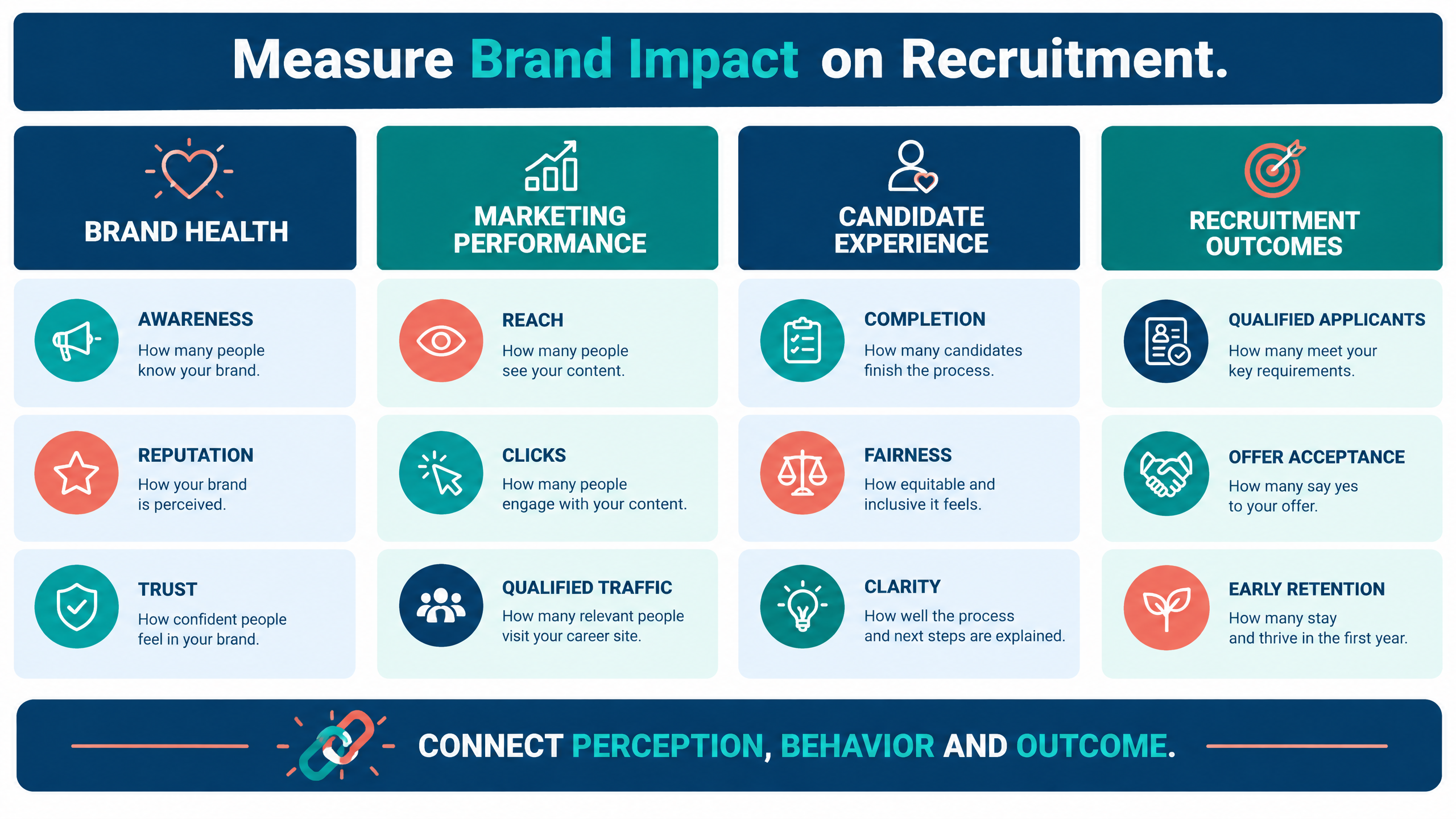
Employer branding versus recruitment marketing measurement framework covering brand health, campaign performance, candidate experience, and recruitment outcomes

How recruitment operations affect brand impact

A strong brand promise can be weakened by an operationally inconsistent hiring process. Candidates judge the organization through small moments: whether instructions are understandable, whether a recruiter responds, whether the interview starts on time, whether the assessment reflects the role, whether feedback arrives, and whether the outcome is communicated respectfully.
Recruitment automation can help standardize repeatable parts of this journey. Candidate reminders, availability matching, interview scheduling, status notifications, assessment invitations, feedback collection, and report consolidation are often suitable for workflow support.
Automation should not remove human responsibility. Recruiters and hiring leaders should still define the criteria, review exceptions, interpret evidence, handle sensitive conversations, and decide how the organization responds to candidate feedback.
The explains how workflow automation can connect candidate intake, screening, assessments, scheduling, interviews, feedback, reporting, and next-step communication. This is relevant to employer-brand teams because operational clarity is part of the brand experience.
The provides a related framework for choosing what to automate, how to protect candidate experience, and how to measure the whole hiring workflow.

How futuremug supports the operational side of candidate experience

futuremug’s published hiring solutions connect AI-powered interviews, assessments, expert-led evaluation, scheduling, candidate management, and structured reporting. Its describes automated scheduling, video interviews, interviewer dashboards, notifications, coding workflows, transcripts, summaries, reports, and candidate management.
These capabilities do not replace employer-brand strategy. They can support the delivery layer by helping teams create clearer scheduling, more consistent evaluation, timely status updates, and more organized candidate records. Enterprise buyers should verify current functionality, integrations, data handling, and governance controls in a live evaluation.
For organizations that need additional evaluation capacity, describes expert interview panels, structured evaluation, auto-scheduling, communication updates, and reports. The relevant question for an employer-brand team is whether the operating model helps candidates experience the organization as clear, respectful, and consistent.
A useful discussion should use one real hiring campaign. Bring the target audience, employer-brand promise, candidate journey, communication standards, interview stages, and measurement goals. Then review where workflow design can reinforce the promise and where human support is essential.

Frequently Asked Questions

What is the difference between employer branding and recruitment marketing?

Employer branding shapes the organization’s reputation and the expectations people have about working there. Recruitment marketing uses campaigns, content, channels, and audience targeting to attract and engage potential candidates. Branding creates the trust foundation, while marketing distributes and activates the message.

Is employer branding part of recruitment marketing?

Employer branding and recruitment marketing overlap, but they are not identical. Recruitment marketing is one way to activate the employer brand. Employer branding is broader because it includes employee reality, leadership, candidate experience, workplace proof, and the organization’s ability to deliver its promise.

How does candidate experience affect employer brand?

Candidate experience provides direct evidence of the employer promise. Clear instructions, respectful communication, relevant evaluation, predictable scheduling, and timely outcomes can strengthen trust. Delays, confusion, inconsistency, and silence can weaken it.

What is the most important employer-brand metric?

There is no single universal metric. A useful measurement system connects brand perception with candidate behavior, candidate experience, recruitment outcomes, and early retention. The right metrics depend on the organization’s talent problem and target audience.

How can employer-brand teams prove impact on hiring?

Connect perception research and campaign data with application quality, progression, completion, interview attendance, offer acceptance, source-to-hire outcomes, and early retention. Use cohorts, trend analysis, qualitative research, and controlled campaign comparisons where possible.

Should employer branding focus on reach or hiring outcomes?

It should measure both. Reach shows whether the organization is visible, but hiring outcomes show whether the message is relevant and credible. A campaign can be successful at generating attention while failing to attract or retain the right talent.

How can recruitment automation support employer branding?

Automation can improve the delivery of the candidate experience by supporting scheduling, reminders, status updates, assessments, feedback collection, reporting, and next-step communication. It should preserve human review and support rather than making the process harder to understand.

How often should employer-brand impact be measured?

Use a mix of ongoing operational monitoring, periodic candidate and employee research, campaign reviews, and quarterly or semiannual strategic analysis. High-volume hiring teams may need weekly funnel visibility, while brand-perception studies may run less frequently.

Leave a Reply

Your email address will not be published.