
On-Demand Technical Interviews: Scale Hiring Without Burning Engineering Time
Every technical interview your engineers run is time not spent shipping — and during a hiring push, that tax compounds until the roadmap slips. An on-demand technical interview service is the answer engineering managers reach for: interviews on tap, your engineers meeting only finalists, and interview capacity that flexes with hiring instead of eating your sprint. This guide quantifies the drain, explains the on-demand model, and shows the hours you get back.
Quick answer: An on-demand technical interview service supplies vetted interviewers on tap — you request a coding or system-design interview, it gets conducted and scored, and your engineers only meet pre-screened finalists. It protects sprint capacity two ways: it removes the hidden hours interviewing drains from deep work, and it scales elastically with hiring spikes instead of forcing a fixed internal panel to absorb them.
The Hidden Tax on Engineering Velocity
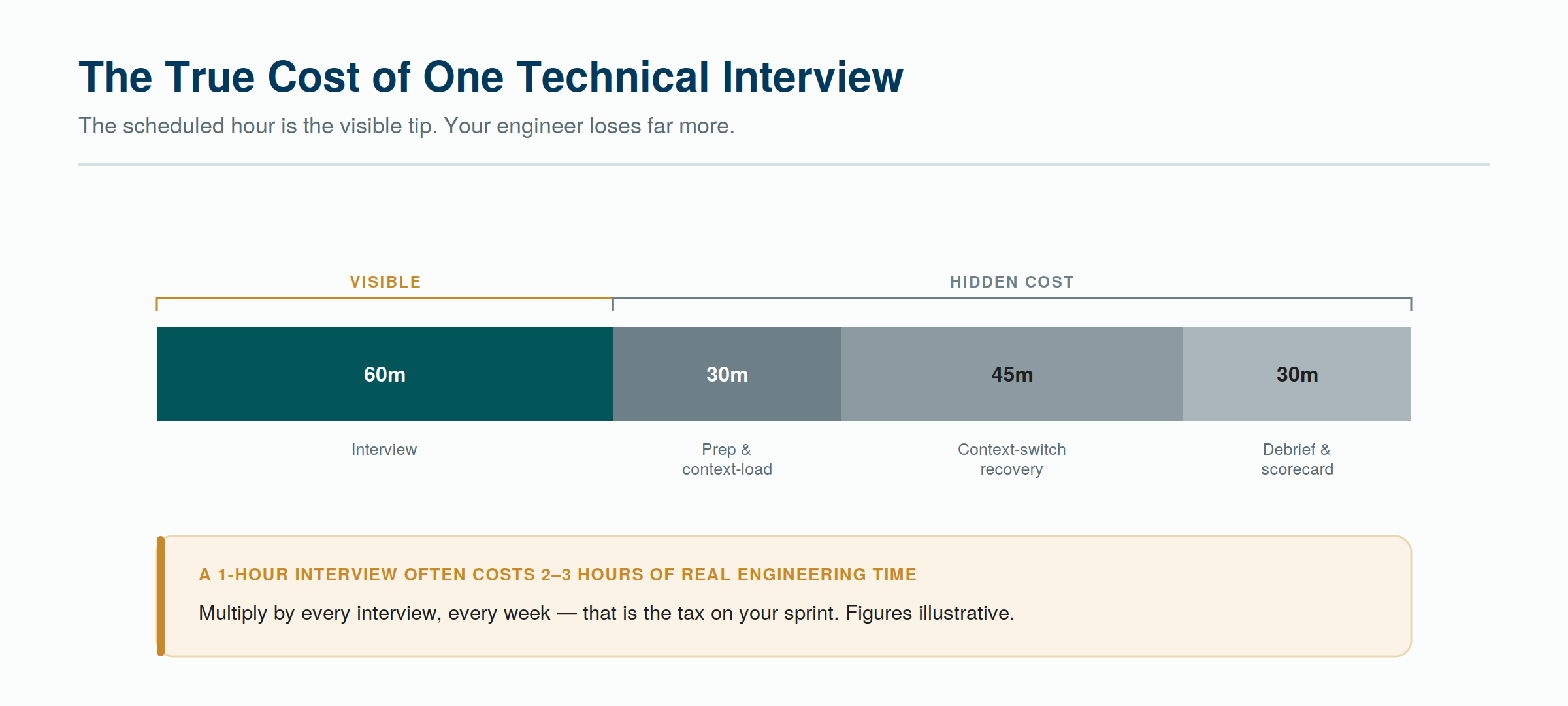
The cost of a technical interview is badly underestimated because only the scheduled hour is visible. The real bill includes the prep and context-load before it, the deep-work recovery after it — an engineer pulled out of a hard problem does not resume at full speed — and the debrief and scorecard afterward. Counted honestly, a one-hour interview often costs two to three hours of real engineering time.
Now scale that across a hiring push. An engineer doing three interviews a week is not losing three hours — they are losing the better part of a day, most of it in the context-switching that fragments the deep work your roadmap depends on. That is the tax an on-demand technical interview service is designed to remove, and it is why the smartest framing of this decision is velocity, not cost per hire.
What “On-Demand” Actually Means
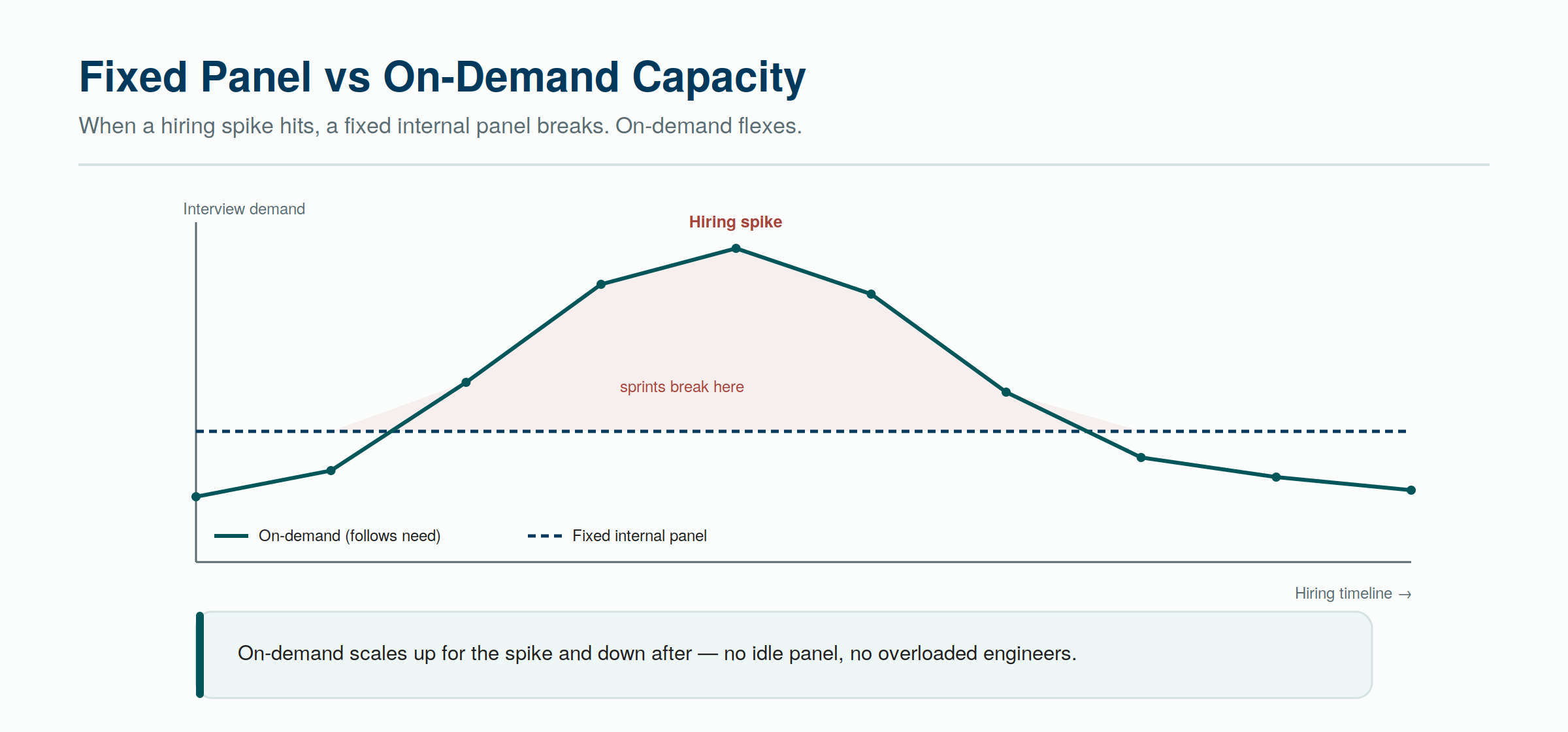
On-demand is an availability model, and the distinction from a standing arrangement is the whole point. You request an interview when you have a candidate; a vetted interviewer conducts and scores it; you get evidence back. There is no fixed panel to staff, no rota to maintain, and — critically — capacity scales up when your requisition load spikes and down when it settles.
This is the failure a fixed internal panel cannot avoid. Size it for steady state and a hiring spike crushes it — sprints slip while engineers absorb the surge. Size it for the spike and it sits idle the rest of the year, an expensive standing cost. On-demand capacity tracks the hiring curve, so you get neither the overload nor the waste.
How On-Demand Interviews Recover Engineering Time
The recovery comes from three specific removals, each aimed at a different way interviewing drains a team.
First rounds leave your engineers’ calendars. The highest-volume, most standardised rounds — initial coding screens, DSA — are exactly the ones that eat the most time for the least differentiated signal. Handing them to expert interview panels or, at higher volume, to AI-structured interviews means engineers stop spending deep-work hours on candidates who were never going to clear the bar.
Coordination overhead disappears. Scheduling across engineer calendars, chasing panellists, reconciling debriefs — the invisible admin around interviewing often costs as much as the interviews. On-demand removes it: you request, you receive.
Screening happens without you. With agentic AI interviews and an upstream coding-test layer filtering fundamentals, your engineers enter only at the finalist stage — seeing the few candidates worth their time, with evidence already attached.
What to Offload, and What to Keep
Protecting engineering time is not about removing engineers from hiring — it is about spending their hours only where they are irreplaceable. The split that achieves it:
Round Offload to on-demand? Why First-round / DSA screens Yes Highest volume, most standardised — the biggest time drain for the least differentiated signal Overflow during spikes Yes Elastic capacity absorbs the surge your fixed panel can’t Specialist rounds you can’t staff Yes Fills a depth gap without pulling a scarce internal expert Final round Keep in-house Culture read and the close are yours to own Bar-raiser Keep in-house Your calibration standard; do not outsource the standard itself
The principle: offload the rounds that scale and the ones you can’t staff; keep the rounds where judgement and culture are the signal. Engineers stay on the decisions that need them and off the ones that were only ever burning their time.
The Math: Time Reclaimed
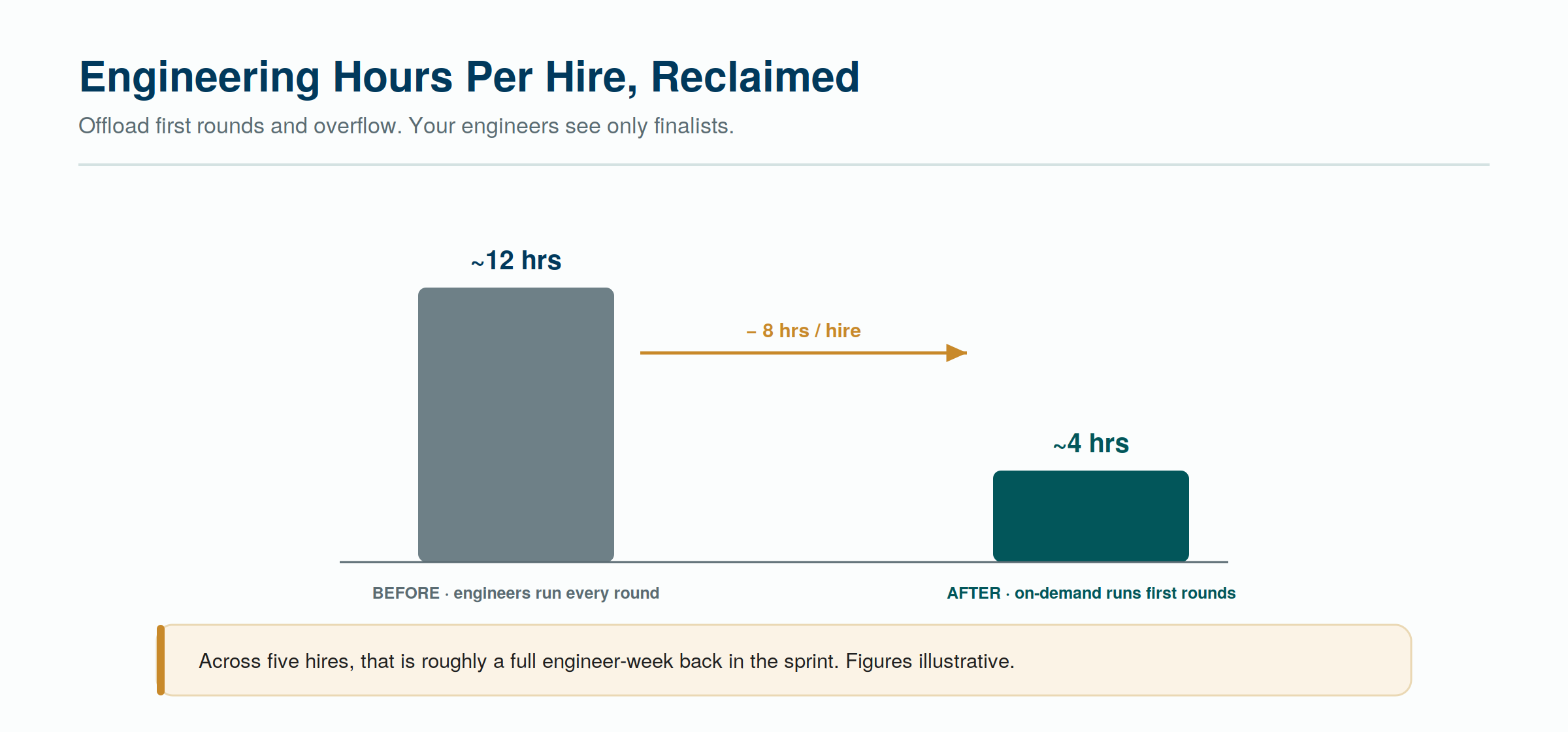
Put illustrative numbers on it. Say each hire takes four first-round interviews before a finalist reaches your team, and each interview costs three real engineering hours — that is twelve hours per hire spent on screening. Move those first rounds to an on-demand service and your engineers’ share drops to the finalist round alone: roughly four hours per hire.
Across five open roles, that is around a full engineer-week returned to the sprint — not saved on a spreadsheet, but actually back in the backlog. The figures are illustrative, but the shape holds for any team: the more first rounds your engineers run, the larger the reclaim.
An on-demand technical interview service is not really about interviews — it is about engineering velocity. Remove the hidden hours interviewing drains, flex capacity with your hiring curve instead of overloading a fixed panel, and keep your engineers on the finalist rounds that actually need them. The bar stays yours; the sprint stays intact.
futuremug provides exactly this — on-demand technical interviews across expert human panels, AI-structured interviews, and agentic AI interviews — calibrated to your rubric, elastic with your hiring, and built so your engineers see only the candidates worth their time. A pilot is the fastest way to measure the hours you’d get back.



Frequently Asked Questions
It is a service that supplies qualified technical interviewers on request — you submit a role and a candidate, and a coding, system-design, or domain interview is conducted and scored on your behalf, with a recording and rubric returned. It is the elastic form of technical interview as a service: capacity you turn up during a hiring spike and down after, without a standing panel.
Two ways. It removes the hidden cost of interviewing — a scheduled hour actually consumes two to three, once prep, context-switching, and debrief are counted — by keeping engineers out of first rounds entirely. And it removes the coordination overhead: no scheduling, no chasing panellists, no debrief backlog. Your engineers meet only pre-screened finalists.
It is, until hiring is uneven — which it always is. A fixed panel sized for steady state gets crushed during a spike (sprints slip) and sits idle after (capacity wasted). On-demand capacity follows the hiring curve, so neither failure happens. The point is elasticity, not replacing your engineers.
Not if the service is calibrated to your rubric and returns evidence you can audit. Engineers still own the final round and the bar-raiser; on-demand handles the high-volume screening that was eating their time without differentiating candidates. You reclaim the hours and keep the standard.
That elasticity is the core of the model — capacity should flex within days, not quarters, as your requisition load changes. Confirm the ramp-up and ramp-down terms before signing; a service that needs a long commitment to add capacity is not really on-demand.
A staffing agency sources candidates and charges a percentage of salary. An on-demand technical interview service does not source anyone — it interviews the candidates you already have, priced per interview, to save your engineers the interviewing time. Pipeline problem versus bandwidth problem.