How AI Interview Platforms Enable Responsible, Scalable Hiring

What are AI interview platforms?

AI interview platforms are software systems that use artificial intelligence to support or conduct parts of the candidate interview process. Depending on the platform, they may generate role-specific questions, conduct conversational or video interviews, ask follow-up questions, analyze responses, create transcripts and summaries, score defined competencies, schedule next steps, and provide shortlisting insights.
The term covers several different operating models. Some platforms provide self-service tools for recruiters and hiring teams. Others offer AI-led first-round interviews, voice screening, or agentic workflows. Some combine AI with expert interviewers, assessments, scheduling, reporting, and human review.
The important buyer distinction is between automation of interview work and automation of hiring accountability. A platform can automate repetitive screening and coordination while keeping hiring standards, exception handling, interpretation, and final decisions with authorized people.
A responsible AI interview workflow should connect six layers:
  1. Role definition: the job description, level, competencies, and decision criteria.
  2. Question design: role-relevant questions, permitted follow-ups, and calibrated rubrics.
  3. Candidate interaction: clear instructions, accessible technology, support, and consent.
  4. Evidence capture: responses, transcripts, recordings where appropriate, and competency signals.
  5. Review: model output, reviewer checks, exception handling, and escalation.
  6. Decision workflow: next-round actions, candidate communication, audit history, and reporting.
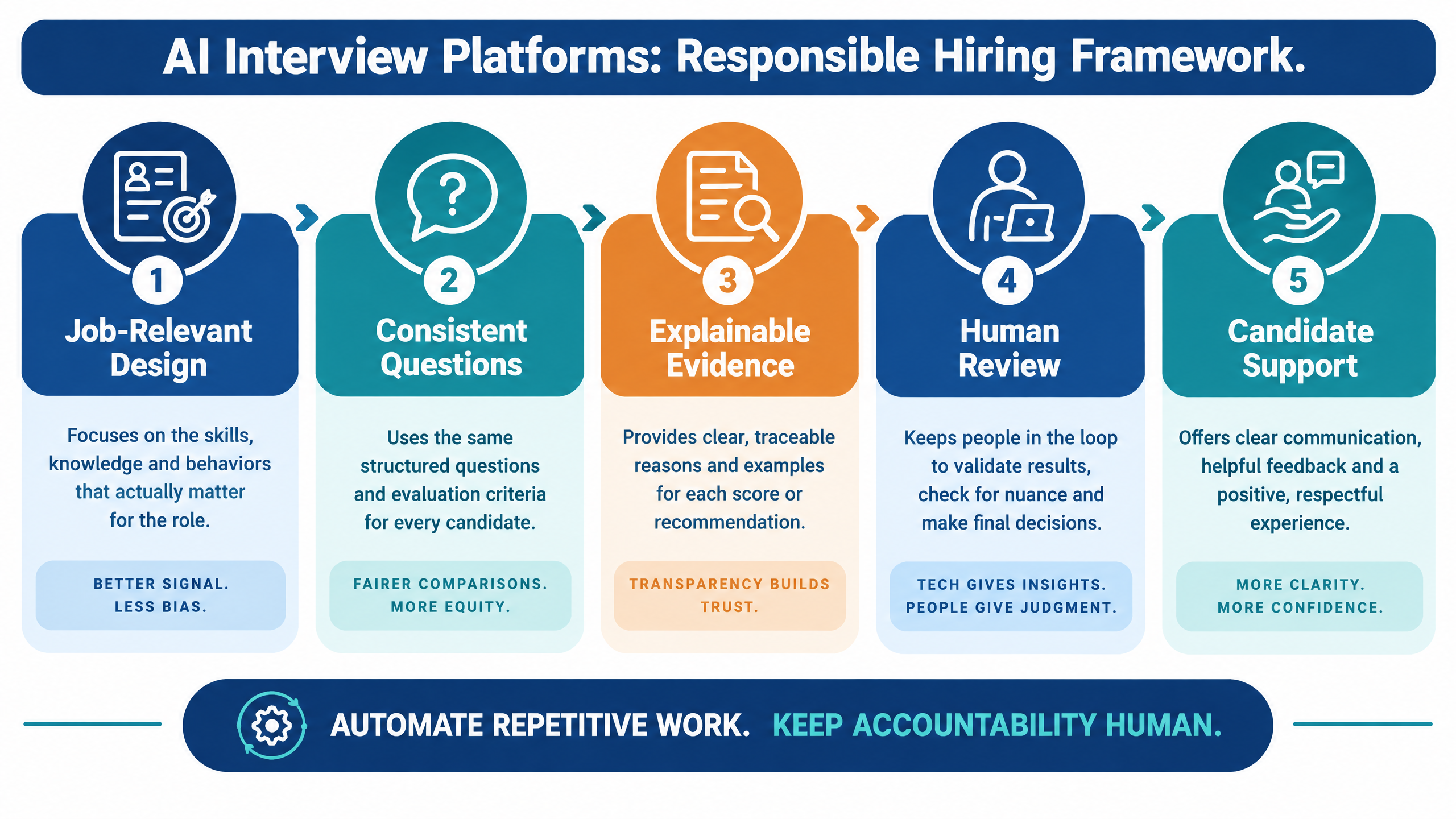
The platform is responsible only for the parts it is designed and governed to perform. The employer remains accountable for using it appropriately.
Explore futuremug’s to review automated scheduling, video interviews, live coding, question libraries, transcripts, summaries, dashboards, and interview reports.
AI interview platforms responsible hiring framework showing job-relevant design, consistent questions, explainable evidence, human review, and candidate support

Why responsible scalability matters in hiring

Hiring teams often face two pressures at the same time. They need to evaluate more candidates quickly, and they need to protect candidate trust, fairness, privacy, and decision quality.
A manual first-round process may create inconsistent questions, slow scheduling, delayed feedback, and interviewer fatigue. A poorly governed AI process may create opaque scores, irrelevant prompts, inaccessible interactions, or unreviewed recommendations. Replacing one problem with another is not responsible scaling.
Responsible scalability means that the organization can increase throughput without losing control over the elements that affect hiring quality.
Scaling pressure
Risk without governance
Responsible platform objective
More candidates
Reviewers cannot inspect enough evidence.
Standardize collection and surface relevant evidence.
Faster screening
Speed becomes more important than role validity.
Keep questions tied to job requirements.
Consistent evaluation
A single flawed rubric is applied everywhere.
Calibrate, test, monitor, and revise the rubric.
Automated scoring
Candidates receive unexplained outcomes.
Keep scores reviewable and distinguish signals from decisions.
Global hiring
Language, accessibility, and cultural context are overlooked.
Provide support, accommodation, and appropriate localization.
Bulk scheduling
Candidate communication becomes impersonal or confusing.
Automate reminders while preserving escalation and clarity.
Shortlisting
False precision hides borderline or unusual cases.
Route exceptions and high-impact decisions to human reviewers.
The goal is not to make every interview fully automated. The goal is to use automation where it improves availability, consistency, and evidence while keeping human accountability where judgment and context matter.

How AI interview platforms work

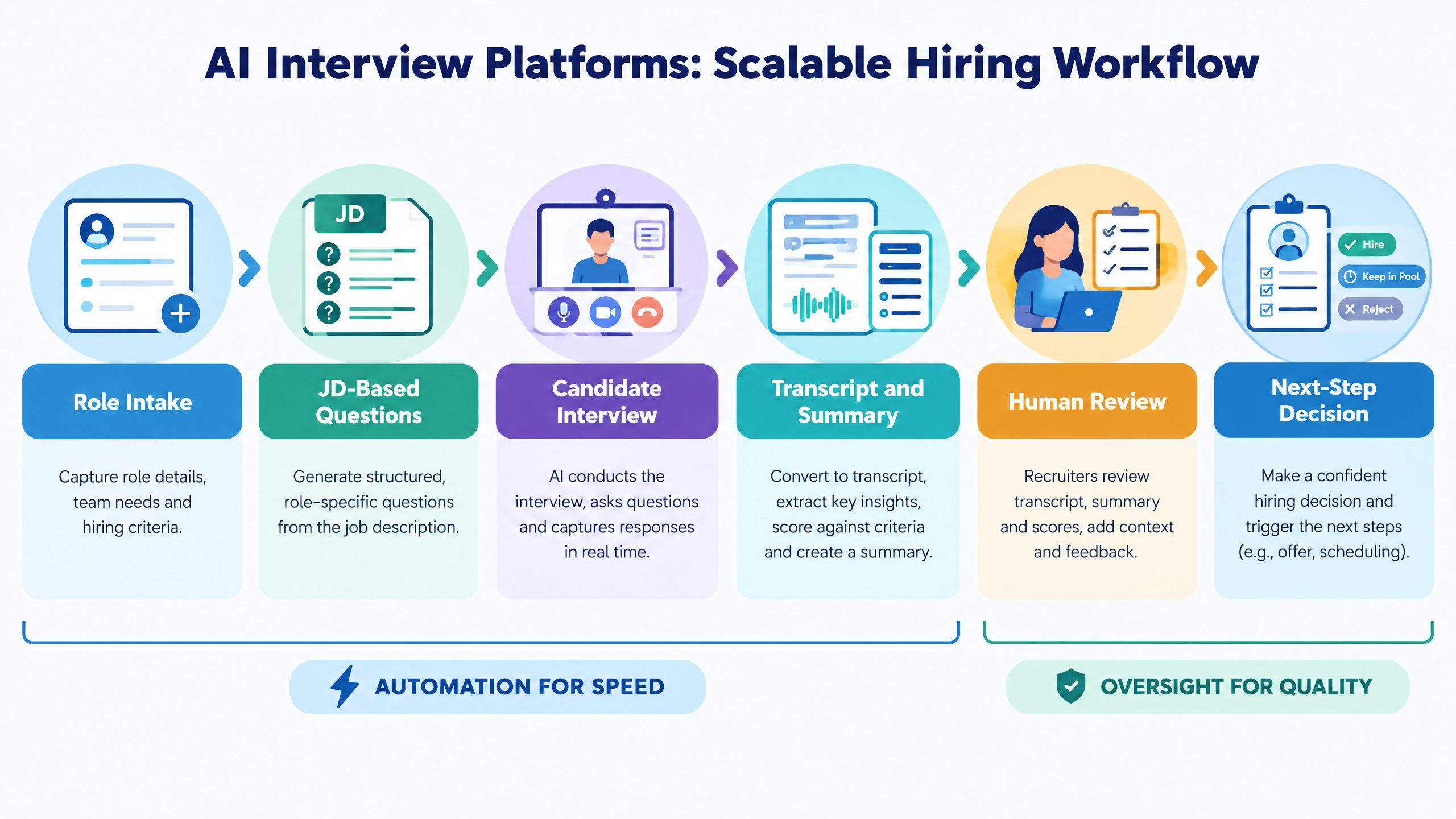
A typical AI interview workflow begins with the employer’s job description and hiring requirements. The platform uses that information to configure questions, competencies, evaluation criteria, and candidate instructions.

Role intake and competency mapping

The hiring team defines the position, seniority, technical or functional skills, behavioral competencies, location, language needs, interview stage, and expected outcome. The platform should not be expected to infer the entire hiring bar from an incomplete job description.

Question and follow-up design

AI may generate or adapt questions based on the job description and candidate profile. A responsible setup defines the topics that must be covered, the follow-ups that are allowed, the competencies being evaluated, and the questions or subjects that are excluded.
Adaptive questioning can improve the depth of a conversation, but it should not introduce irrelevant or discriminatory assumptions. The employer must be able to review and approve the interview design.

Candidate interaction

The candidate may complete a text, video, voice, or conversational interview. The platform provides instructions, prompts, timing, joining links, and support information. Candidates should understand what the interview measures, what data is collected, how long the session will take, and what happens next.

Evidence capture

The platform may capture responses, code, audio, video, transcripts, timestamps, summaries, and competency-level signals. Evidence should be relevant to the role and handled according to the organization’s privacy and retention rules.

Scoring and summary

AI can organize responses, identify patterns, summarize evidence, or score defined competencies. The output should communicate what the system observed and how it maps to the rubric. A summary should not be treated as a replacement for the underlying evidence.

Human review and next steps

Recruiters or hiring managers review the output according to the organization’s policy. They may advance a candidate, request another assessment, route an exception, or reject the recommendation. The platform can trigger next-round scheduling or candidate communication, but the workflow should make decision ownership clear.
AI interview platforms scalable hiring workflow showing role intake, job-description questions, candidate interview, transcript and summary, human review, and next-step decision


10 smart ways to evaluate the model

1. Start with job relevance

The first test of an AI interview platform is whether it evaluates capabilities that matter for the role. Ask which competencies are measured, how they relate to the job, and how the employer can review the mapping.
A technical interview should not rely only on generic communication patterns if the role requires coding, debugging, architecture, or domain reasoning. A customer-facing role may require communication and judgment, but those should be defined in observable terms.
The assessment or interview should be based on a current role analysis and calibrated by level. A prompt that is suitable for an entry-level role may be inadequate or unfair for a senior position.

2. Inspect question generation and follow-up controls

AI-generated questions can reduce preparation time, but generation needs boundaries. Review the question bank, prompt logic, forbidden topics, difficulty controls, competency mapping, and approval workflow.
Ask whether the platform can create questions from the job description, candidate profile, or chosen skill framework. Then ask who reviews the questions before they are used and how changes are recorded.
Follow-up questions should clarify or probe the candidate’s answer. They should not introduce assumptions about accent, personality, background, health, age, family, or other protected or irrelevant characteristics.

3. Require explainable evidence

A hiring team should be able to understand why an interview received a particular output. The platform should connect scores or summaries to responses, transcript excerpts, code, timestamps, or other relevant evidence where appropriate.
Explainability does not require exposing proprietary model internals. It does require giving authorized reviewers enough information to verify whether the result is relevant, complete, and reasonable.
Ask to see a borderline candidate report. This often reveals more than a polished example showing an obvious pass.

4. Define human review points

Human review should be built into the workflow before launch. Define when a recruiter reviews the output, when a hiring manager reviews it, which cases require additional assessment, and how candidates can request support or correction.
Human oversight is especially important for borderline scores, unusual candidate profiles, accessibility requests, suspicious activity, technical issues, candidate disputes, senior hiring, and final decisions.
A human reviewer should have authority to challenge a model output and record the reason. Oversight is not meaningful if the organization treats the model recommendation as final by default.

5. Separate screening from final judgment

AI interview platforms are often most useful in repeatable early-stage screening. They can help gather structured information, reduce scheduling work, and identify candidates for deeper review.
Final interviews, role-specific technical judgment, leadership hiring, confidential positions, offer conversations, and context-critical decisions may be better handled by internal or expert human interviewers.
A hybrid model can preserve speed without pretending that every hiring decision has the same information requirement.

6. Test consistency without confusing it with fairness

A system can ask every candidate the same question and still be unfair if the question is irrelevant, inaccessible, culturally narrow, or poorly connected to the role. Consistency is necessary but not sufficient.
Test the platform with candidates who vary in experience, communication style, location, language background, disability status where appropriate and lawful, and career path. Review whether the interaction and output remain relevant and interpretable.
Monitor score distributions, completion, drop-off, manual overrides, escalation, and progression by cohort where lawful and appropriate. A pattern does not prove bias, but it can identify where investigation is needed.

7. Evaluate candidate experience as a quality metric

Candidates should know that they are interacting with an AI system when that disclosure is required or appropriate. They should understand the interview format, expected duration, data use, support route, accessibility options, and next step.
A responsive interview may be efficient, but it should not feel like a test of the candidate’s ability to navigate an opaque interface. The employer should provide human support for unusual or sensitive situations.
Measure completion, technical failures, rescheduling, support requests, feedback, drop-off, and willingness to consider the organization again. Candidate experience is part of responsible operation, not a separate marketing metric.

8. Review privacy and data controls

AI interview platforms may process resumes, answers, audio, video, transcripts, code, scores, and behavioral signals. Buyers should understand what is collected, why it is collected, who can access it, how long it is retained, where it is processed, and whether it is used to train models.
Review consent, access controls, deletion, export, audit logs, sub-processors, incident response, encryption, and integration permissions. Ensure the organization’s privacy notice matches the actual workflow.
Do not collect sensitive signals simply because a platform makes them technically available. Each data element should have a justified purpose and a clear retention rule.

9. Connect platform output to recruitment operations

An AI interview platform creates value when its output fits the talent acquisition workflow. Ask how the platform handles candidate intake, invitations, bulk scheduling, reminders, ATS updates, report sharing, recruiter review, interview progression, and candidate communication.
futuremug’s describes job-specific questioning, adaptive follow-ups, competency evaluation, transcripts, summaries, red-flag alerts, and automated next-step actions. Buyers should verify current features, implementation responsibilities, and human review controls during a live evaluation.

10. Measure downstream hiring value

Do not judge an AI interview platform only by the number of interviews completed or reports generated. Measure whether it improves the decisions that matter.
Useful measures include qualified-shortlist rate, interview progression, time to decision, recruiter review time, candidate completion, offer acceptance, hiring-manager confidence, early retention, and quality of hire where those data are available.
Compare outcomes with the previous workflow or a defined pilot group. Review whether the platform is reducing work, improving evidence, and maintaining candidate trust rather than optimizing activity alone.

What to automate and what to keep human

A practical division of responsibility makes governance easier.
Activity
Suitable for automation
Human responsibility
Scheduling and reminders
Match calendars, send invitations, notify candidates, manage routine rescheduling.
Handle exceptions, accommodations, and sensitive communication.
Question preparation
Generate drafts, suggest role-relevant topics, create variations.
Approve questions, remove irrelevant content, calibrate difficulty.
First-round interviewing
Conduct structured screening at scale.
Monitor quality, review exceptions, and decide progression policy.
Transcript and summary
Convert sessions into searchable records and concise summaries.
Check completeness, context, and factual accuracy.
Competency signals
Organize responses against a defined rubric.
Validate relevance, investigate borderline cases, and override when needed.
Shortlist recommendation
Rank or flag candidates according to approved criteria.
Review evidence and make the progression decision.
Candidate updates
Send status messages and next-step instructions.
Manage disputes, rejections requiring care, and escalations.
Analytics
Track volume, completion, turnaround, and score patterns.
Interpret trends and change the process responsibly.
The correct boundary depends on the role and risk. A high-volume initial screen can support more automation than a final executive interview. A regulated or sensitive role may require additional controls and human review.

Fairness, validity, privacy, and accountability

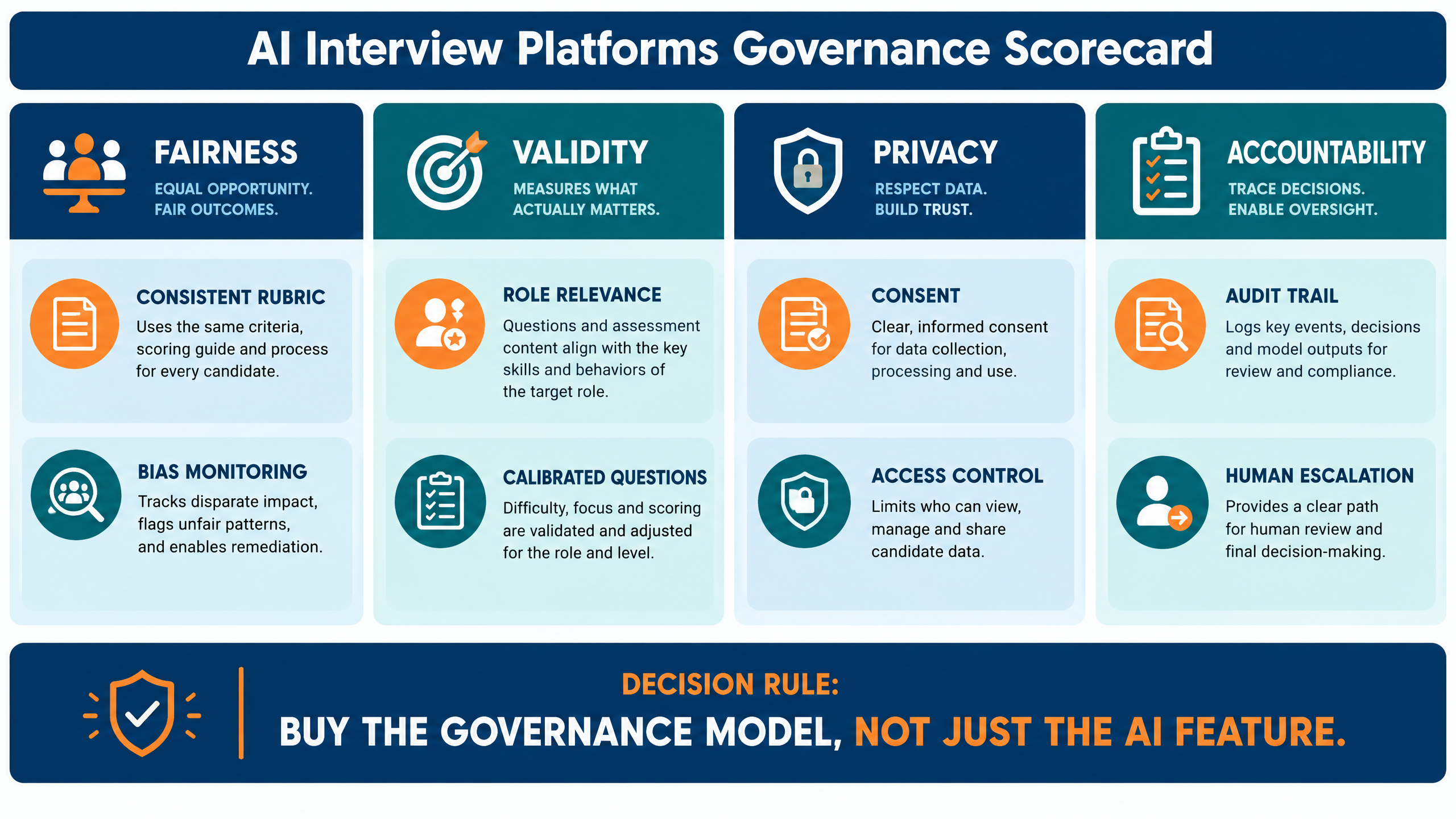
Responsible AI hiring requires more than a fairness statement on a product page. It requires a system of controls that the organization can explain, operate, and improve.

Fairness

Use consistent, role-relevant criteria. Review whether the interview interaction, questions, scoring, and progression outcomes create unexpected differences across candidate groups. Investigate patterns rather than relying on a single aggregate score.
Avoid using voice, facial expression, accent, or other proxies as unexplained measures of candidate quality. If a feature is used, the employer should understand its job relevance, limitations, evidence base, and governance requirements.

Validity

The platform should evaluate capabilities that relate to the job. Define the competencies before selecting the technology. Validate the interview structure through expert review, pilot data, human comparison, and downstream outcomes.
Do not assume that an AI score is more objective because it is generated by software. Objectivity depends on the quality of the construct, the rubric, the data, the process, and the review.

Privacy

Collect only the data needed for the defined hiring purpose. Give candidates appropriate notice, explain retention and access, and protect recordings, transcripts, code, and reports. Limit access by role and review integrations for unnecessary data exposure.

Accountability

Name the people responsible for the job design, question approval, vendor governance, security, candidate support, review policy, exception handling, and final decision. Document changes to prompts, rubrics, thresholds, and model features.
The provides a useful external reference for organizing AI risk identification, measurement, management, and governance . Organizations should also review applicable employment, privacy, accessibility, and anti-discrimination requirements in the jurisdictions where they hire.
AI interview platforms governance scorecard showing fairness, validity, privacy, and accountability controls


Candidate experience and accessibility

The candidate’s experience is evidence of the organization’s hiring standards. An AI interview should be easy to understand, reasonably accessible, and supported by a human escalation path.
Before launch, complete the journey as a candidate. Review the invitation, consent, sign-in, instructions, sample question, timer, recording or transcription notice, submission process, confirmation, and next-step communication.
Ask how the platform supports:
  • Mobile and desktop candidates.
  • Different browsers and network conditions.
  • Screen readers and other assistive technologies.
  • Candidates who need an accommodation.
  • Candidates who lose connectivity or need to reschedule.
  • Candidates who need clarification about the interview.
  • Candidates who question a transcript, score, or status.
  • Candidates who prefer a human contact for sensitive issues.
A candidate should not be penalized for failing to understand an undisclosed AI interaction. Instructions should explain the format, expected duration, data handling, permitted resources, and support route.
Candidate communication should also remain respectful after rejection. If automated actions trigger a rejection or next step, establish review and escalation controls before the campaign begins.

How to choose an AI interview platform

A buyer should evaluate the product and the operating model together. Use a weighted scorecard before vendor demos so that a polished interface does not outweigh weak governance or poor evidence.
Evaluation area
Questions to ask
Suggested weight
Role relevance
Can the platform map questions and scoring to competencies and levels?
20%
Evidence quality
Are transcripts, responses, code, summaries, and scores connected?
15%
Human oversight
Can reviewers inspect, override, escalate, and document decisions?
15%
Fairness and validity
How are bias risks, score patterns, and role validity monitored?
15%
Candidate experience
Are instructions, accessibility, support, disclosure, and next steps clear?
10%
Privacy and security
What is collected, retained, accessed, exported, and deleted?
10%
Workflow integration
Does it connect to ATS, calendars, communication, reporting, and interviews?
10%
Scalability and commercial fit
Can it handle normal and peak demand with transparent support and cost?
5%
Ask each provider to demonstrate one real role rather than a generic AI conversation. Provide a job description, competencies, candidate volume, interview stage, escalation policy, and report requirements.
The provider should show role intake, question approval, candidate invitation, interview delivery, transcript and summary, reviewer controls, score or recommendation, ATS or workflow handoff, candidate communication, and audit history.

How to run a responsible pilot

A pilot should test the technology, the hiring process, and the governance model at the same time.
Choose one role family or hiring campaign with a clear job description, realistic candidate volume, defined competencies, and a human comparison group where possible. Document the intended use and prohibited use before candidates enter the process.
Pilot dimension
What to measure
Role fit
Whether prompts, follow-ups, and scoring reflect the role and level.
Evidence quality
Whether summaries and recommendations are supported by relevant responses.
Human agreement
How often trained reviewers agree with or challenge the output.
Candidate experience
Completion, support requests, technical issues, accessibility, and feedback.
Fairness signals
Score, progression, drop-off, and override patterns by cohort where lawful.
Operational value
Scheduling time, recruiter review time, turnaround, and next-step automation.
Governance
Access, retention, consent, audit, incident handling, and escalation.
Downstream outcome
Interview conversion, offer acceptance, hiring-manager confidence, and early retention where available.
Include edge cases such as incomplete answers, ambiguous responses, unusual career paths, accessibility requests, connectivity problems, false-positive red flags, borderline scores, candidate disputes, and manual overrides.
At the end of the pilot, decide what should be automated, what must remain human, which controls are mandatory, and how the organization will monitor performance after deployment.

How futuremug supports AI-assisted interviews

futuremug’s published describes automated scheduling, live video interviews, integrated coding, AI-generated interview questions, question libraries, interviewer dashboards, candidate management, transcripts, summaries, personalized reports, and real-time interview insights.
Its describes agentic AI interviews, customized questions based on job descriptions and candidate profiles, adaptive follow-up questions, competency evaluation, instant reports, transcripts, summaries, red-flag detection, and automated next-step triggers.
The published product information also positions AI interviews as a first-level screening capability while stating that human interviews remain important for final rounds. This supports a hybrid operating model in which AI handles repeatable early-stage work and human interviewers retain responsibility for deeper evaluation and consequential decisions.
futuremug’s broader platform combines AI-powered screening, assessments, expert-led interviews, automated scheduling, candidate management, structured reports, and workflow support. Buyers should verify current model behavior, question controls, review requirements, privacy terms, integrations, security, service levels, and pricing during a live evaluation.
A useful futuremug demo should use a real hiring role. Ask the team to show job-description intake, question creation and approval, candidate experience, transcript and summary generation, reviewer controls, shortlisting logic, human escalation, ATS or CRM updates, reporting, and governance settings.

Request an AI interview platform demo

If your hiring team is losing time to repetitive first-round screening, scheduling conflicts, inconsistent questions, delayed summaries, or fragmented candidate records, AI interview platforms may provide a scalable way to improve the workflow.
Bring one live job description, role level, hiring volume, interview stages, required competencies, candidate-experience standards, governance requirements, and current systems to the conversation.
to review AI interviews, job-specific questions, adaptive follow-ups, transcripts, summaries, human review, candidate management, reporting, integrations, and a responsible pilot plan.

Frequently Asked Questions

What are AI interview platforms? ▼

AI interview platforms are software systems that support or conduct parts of the candidate interview workflow using artificial intelligence. They may generate questions, conduct conversational or video interviews, ask follow-ups, analyze responses, create transcripts and summaries, score defined competencies, schedule next steps, and provide shortlisting insights.

How do AI interview platforms enable scalable hiring? ▼

They can automate repeatable screening, bulk scheduling, reminders, transcript creation, summaries, reporting, and workflow triggers. This allows hiring teams to process more candidates without adding the same amount of manual coordination. Scaling still requires role calibration, monitoring, candidate support, and human review.

Are AI interview platforms responsible by default? ▼

No. Responsibility depends on the role design, question quality, scoring controls, privacy, candidate experience, human oversight, monitoring, and governance. Buyers should evaluate the operating model rather than assume that AI produces fair or valid decisions automatically.

Can an AI interview platform replace human interviewers? ▼

It can support or replace selected early-stage screening tasks, depending on the use case and governance requirements. Human interviews remain important for final rounds, technical depth, leadership hiring, context-critical judgment, exceptions, candidate support, and final decisions.

How can employers reduce bias in AI interviews? ▼

Use job-relevant competencies, calibrated questions, consistent rubrics, human review, cohort monitoring, accessibility support, transparent escalation, and periodic validation. Avoid unexplained proxies and treat patterns as signals for investigation rather than assuming that standardization alone proves fairness.

What should candidates know about an AI interview? ▼

Candidates should receive clear information about the format, expected duration, data collected, recording or transcription, permitted resources, accessibility support, privacy, next steps, and how to request help. Applicable legal and organizational disclosure requirements should be reviewed before launch.

What data do AI interview platforms collect? ▼

Depending on the workflow, they may process resumes, responses, audio, video, transcripts, code, timestamps, scores, summaries, and status information. Buyers should confirm what is collected, why it is needed, who can access it, how long it is retained, and whether it is used for model training.

How do recruiters review AI interview output? ▼

A recruiter or hiring manager should review the recommendation alongside relevant evidence such as responses, transcript excerpts, code, competency scores, flags, and summary limitations. The reviewer should be able to challenge or override the output with a documented reason.

What should be included in an AI interview platform demo? ▼

Ask the provider to demonstrate role intake, question approval, adaptive follow-ups, candidate invitation, interview delivery, transcript and summary, scoring, human review, exception handling, candidate communication, integrations, access controls, audit history, and reporting.

What is the best way to pilot an AI interview platform? ▼

Use one real role or hiring cohort. Define competencies, permitted use, prohibited use, success metrics, human comparison, candidate support, escalation, privacy, and review requirements before the pilot. Test normal candidates and edge cases before scaling.

Leave a Reply

Your email address will not be published.