
A Practical Guide to Why Is Employer Branding Important for Talent Acquisition

What is employer branding?

Employer branding is the set of perceptions and associations that current employees, candidates, former employees, and the wider talent market hold about an organization as a place to work.
It includes the company’s reputation, employee experience, leadership behavior, work practices, compensation context, development opportunities, hiring process, communication, and public stories. It is expressed through formal campaigns, but it is also revealed through everyday interactions.
Employer branding is not the same as a slogan or careers-page design. A polished message may attract attention, but the experience behind that message determines whether people trust it. A company that promotes growth but provides no evidence of development creates a credibility gap. A company that promises a respectful process but leaves candidates without updates weakens its employer brand through operations.
The describes employer brand as a set of attributes and qualities that shape how an organization is perceived as an employer . This definition connects brand to the lived experience of employees and candidates rather than limiting it to advertising.
Employer branding therefore sits across several parts of talent acquisition:
  • Employer reputation: what people believe about the organization before they engage.
  • Employee advocacy: what employees and alumni can credibly say about working there.
  • Talent attraction: why a person notices and considers an opportunity.
  • Candidate experience: how the hiring process confirms or contradicts the promise.
  • Recruitment operations: how consistently the organization communicates and follows through.
  • Employee expectations: what a new hire expects when they join.
A strong employer brand does not mean every candidate will want to work for the organization. It means the organization communicates a credible employee proposition to the people it wants to attract and gives candidates enough evidence to make an informed decision.
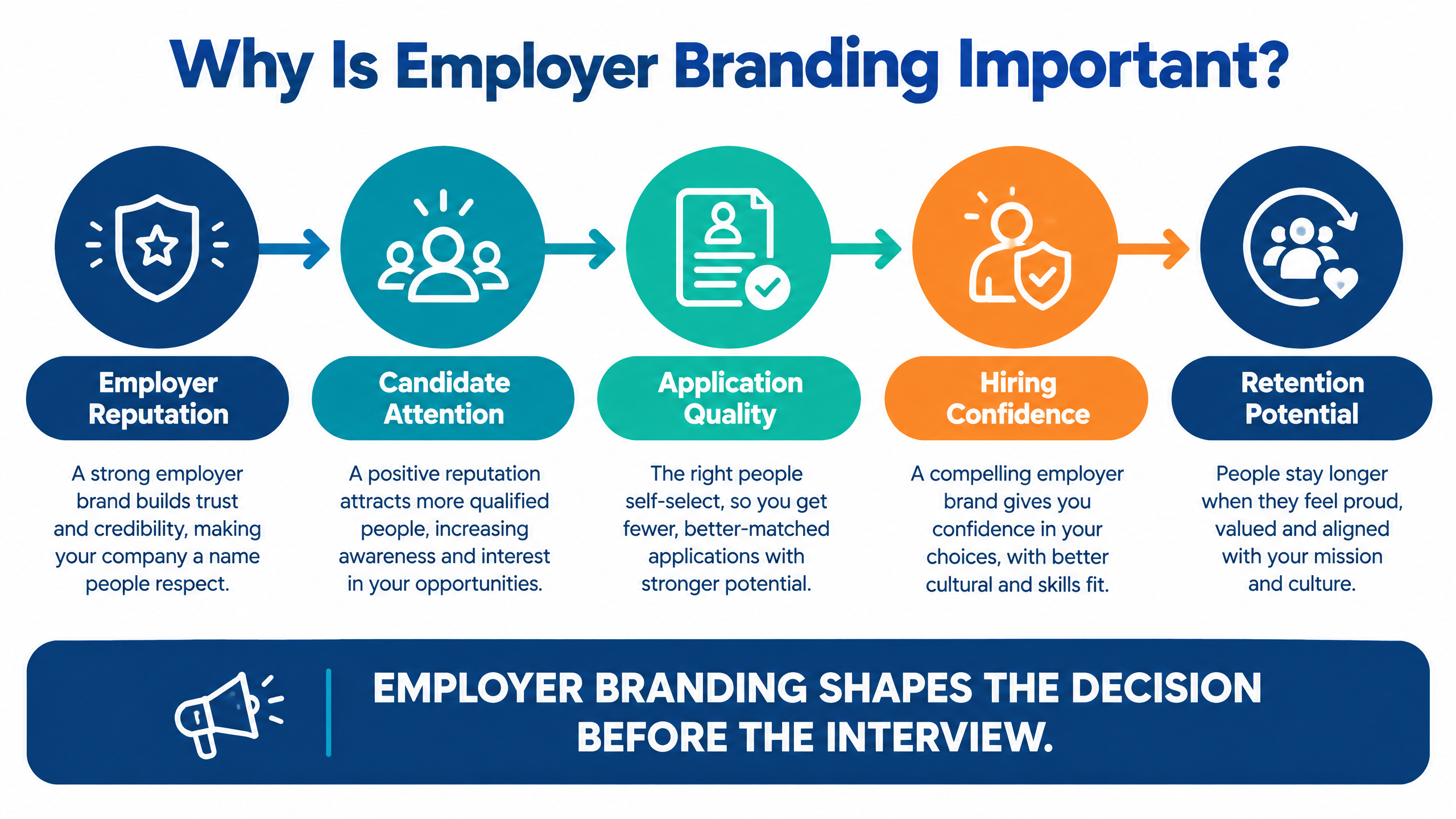
Why is employer branding important infographic showing employer reputation, candidate attention, application quality, hiring confidence, and retention potential

Why is employer branding important for talent acquisition?

Employer branding is important because talent decisions are made under uncertainty. Candidates often have limited information about the work, management, culture, growth, flexibility, and stability they will experience. They use visible signals to decide whether an opportunity deserves attention and effort.
Those signals affect more than application volume. They influence who applies, whether qualified people complete the process, whether candidates accept offers, how employees describe the organization, and whether people remain engaged after joining.
Employer branding also changes the economics of recruitment. When candidates understand the organization and trust the process, teams may spend less effort explaining basic expectations, chasing disengaged applicants, replacing avoidable drop-off, or correcting mismatched offers.
The value is not that employer branding makes every hire easier. The value is that it improves the quality of the relationship between the organization and the talent market.
Talent acquisition challenge
How employer branding can help
Low awareness
Make the organization easier to recognize and understand.
Weak qualified-candidate flow
Communicate role relevance, work context, and employee value more clearly.
High application drop-off
Reduce uncertainty about process, expectations, and next steps.
Offer declines
Build confidence before the offer and align expectations earlier.
Candidate ghosting
Create a more respectful, predictable, and responsive journey.
Hard-to-fill roles
Explain why the work matters and what makes the opportunity credible.
Inconsistent recruiter messages
Give teams shared language and evidence for candidate conversations.
Early attrition
Set more accurate expectations before people join.
High recruitment spend
Improve the efficiency and quality of attraction over time.
Employer branding is not a substitute for competitive pay, good management, meaningful work, or a fair process. It helps the organization communicate those realities accurately and consistently.

10 powerful employer-branding benefits

1. It increases awareness among relevant talent

A company cannot be considered by people who do not recognize it or understand the work it offers. Employer-brand content helps the organization become visible to specific talent communities, such as engineers, sales professionals, campus candidates, healthcare workers, or experienced leaders.
Relevance matters more than reach alone. A large audience is not automatically useful if it does not include people with the skills, motivations, or location needed for the role.
Useful awareness content may include employee stories, project explanations, leadership perspectives, learning examples, workplace practices, role previews, and honest information about the hiring process.

2. It clarifies the employee value proposition

The employee value proposition is the practical and emotional reason a person might choose to work for the organization. It can include the work itself, manager quality, growth, learning, flexibility, rewards, purpose, belonging, stability, and team environment.
A clear proposition helps candidates self-select. That can reduce irrelevant applications while improving the confidence of candidates who genuinely value what the organization offers.
The proposition should be specific enough to test. “A great culture” is difficult to evaluate. “Engineers work on customer-facing products, receive structured feedback, and can contribute to architecture decisions” gives candidates more useful information.

3. It improves the quality of applications

Employer branding can influence not only how many people apply, but also whether they understand the role before applying. Clear role stories and realistic expectations help candidates assess their own fit.
Better-informed applications can reduce screening effort and improve the proportion of candidates whose skills, motivations, and expectations match the opportunity.
This benefit depends on honesty. Overstated messages may create more initial interest but can increase later drop-off, offer rejection, or early attrition when the actual experience differs.

4. It strengthens candidate trust

Candidates evaluate how an organization behaves during recruitment. They notice whether the job description is accurate, whether communication is timely, whether interviews are structured, whether feedback is respectful, and whether the organization explains delays.
A trustworthy employer brand is reinforced by consistent operations. Careers content may create the first impression, but the application, assessment, interview, and offer process determine whether the impression holds.
A useful can help teams make communication, scheduling, status updates, and next steps more consistent.

5. It supports stronger candidate experience

Candidate experience is one of the clearest places where employer branding becomes real. Candidates do not experience a brand only through campaigns. They experience it through forms, emails, assessments, interviews, waiting periods, scheduling, recruiter conversations, and decisions.
A positive process does not require promising every candidate a job. It requires clear information, reasonable effort, respectful communication, reliable coordination, and an appropriate route for questions or support.
A negative process can weaken a strong brand message quickly. If candidates encounter unexplained silence, broken links, repeated requests, or inconsistent evaluation, they may judge the organization by that experience.

6. It improves offer confidence and acceptance

An offer is easier to evaluate when the candidate has already built a realistic understanding of the organization, role, manager, team, and working environment.
Employer branding supports this understanding before the offer stage. It can show how the organization works, what success looks like, how people develop, and what candidates should expect during hiring.
Offer acceptance still depends on compensation, role scope, location, timing, competing opportunities, personal circumstances, and trust in the specific team. Employer branding supports the decision; it does not control it.

7. It helps hard-to-fill roles compete for attention

Some roles have limited talent supply, strong competition, specialized requirements, or difficult locations. A generic job advertisement may not give candidates enough reason to prioritize the opportunity.
Employer branding can explain the work’s significance, technical or professional challenge, learning value, team context, customer impact, and leadership access. The message should answer why a qualified person might choose this opportunity instead of a similar one.
For hard-to-fill roles, subject-matter experts and employees are often more credible than generic brand language. Their stories should be accurate, voluntary, and representative rather than scripted beyond recognition.

8. It improves recruiter and hiring-manager consistency

Candidates may interact with recruiters, sourcers, hiring managers, interviewers, executives, and employees. If each person describes the organization differently, the candidate must interpret the inconsistency.
An employer-branding strategy gives the hiring team a shared foundation. It defines the employee proposition, evidence, role narratives, tone, candidate commitments, and boundaries for what should not be promised.
Consistency does not mean every conversation uses the same script. It means the core facts and expectations remain aligned while people communicate naturally.

9. It supports employee advocacy and referrals

Employees can extend an employer brand through referrals, professional networks, events, communities, and everyday conversations. Their credibility depends on whether the experience they describe is real.
An advocacy program should make participation voluntary and should not pressure employees to present an unrealistic picture. Encourage specific stories about work, learning, teams, customers, and challenges. Avoid treating employees as a broadcast channel without listening to them.
Referral quality can improve when employees understand which roles, skills, and experiences the organization is seeking. The referral process itself should remain transparent and respectful to people who are referred.

10. It connects recruitment to long-term workforce outcomes
Employer branding affects what candidates expect before joining. Those expectations influence how new employees interpret onboarding, management, development, recognition, and work conditions.
When the external promise and internal experience are aligned, the organization has a stronger foundation for trust. When they diverge, recruitment may produce short-term volume but create disappointment, attrition, and reputational damage.
Employer branding should therefore be connected to employee listening, retention patterns, exit feedback, engagement data, and manager practices. Talent acquisition can own the message, but the employee experience determines whether the message remains credible.
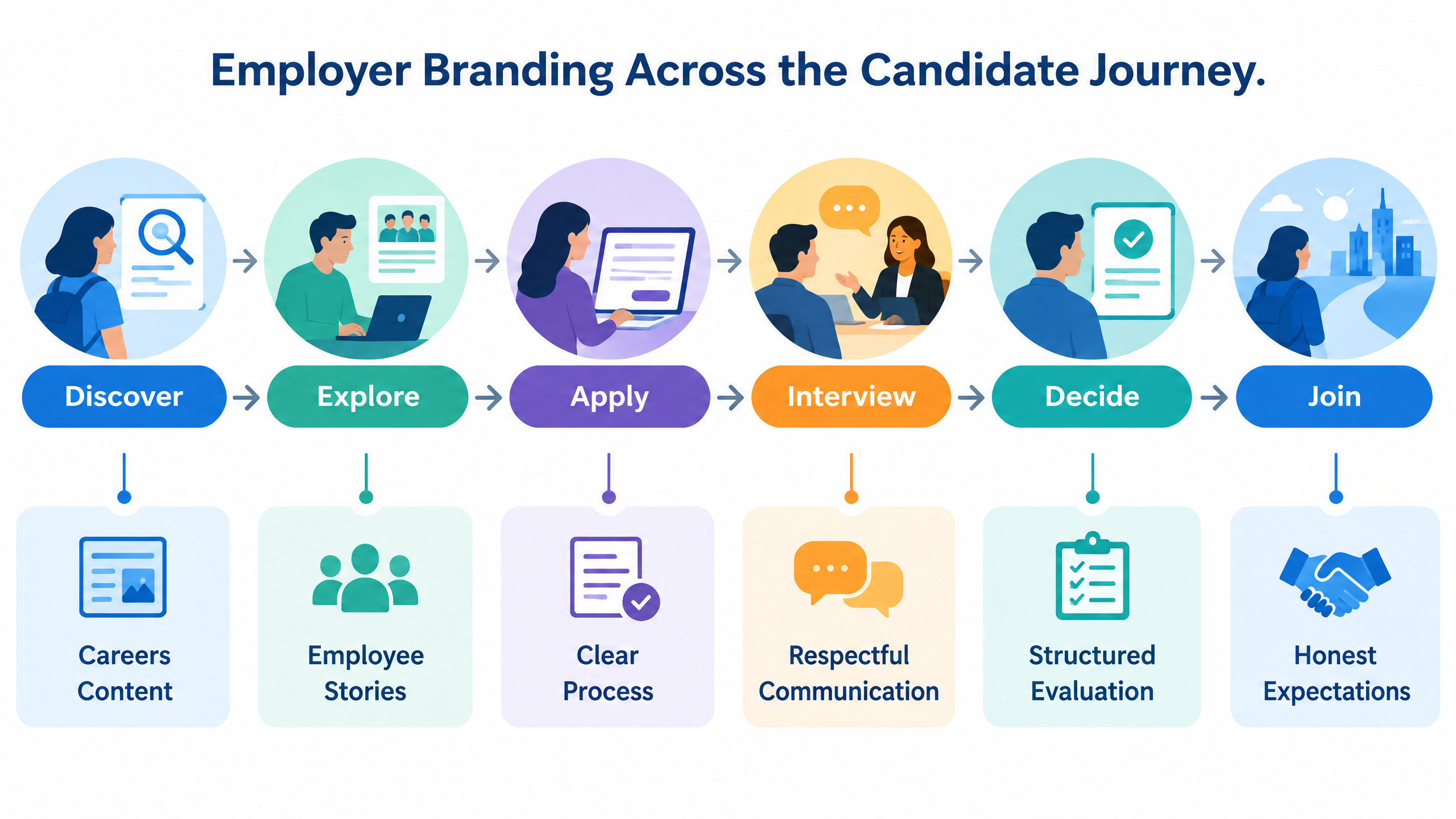
Employer branding across the candidate journey showing discover, explore, apply, interview, decide, and join stages
Candidate-journey infographic: Employer branding is reinforced at every stage, from the first discovery of an organization through joining the team.

Employer branding and candidate experience

Employer branding and candidate experience are related but not identical.
Employer branding describes the perceptions and promise associated with an organization as an employer. Candidate experience describes what a person actually encounters while researching, applying, interviewing, waiting, receiving a decision, and joining or leaving the process.
The relationship can be understood as a loop:
  1. Employer-brand content creates an expectation.
  2. The candidate enters the hiring process with that expectation.
  3. Recruiters, systems, interviewers, and communications deliver an experience.
  4. The candidate compares the experience with the expectation.
  5. The experience influences whether the candidate continues, accepts, recommends, or shares an opinion.
  6. Those opinions affect future employer-brand perception.
Employer-brand promise
Candidate-experience proof
We value people’s time
Clear timelines, prepared interviews, punctual communication, and fewer unnecessary steps.
We support development
Specific role information, learning examples, manager conversations, and realistic growth expectations.
We are inclusive
Accessible processes, respectful language, accommodation support, and consistent criteria.
We are innovative
Modern work examples, relevant technology, and a hiring process that is efficient without being impersonal.
We are transparent
Accurate job information, clear stages, honest delays, and understandable next steps.
We care about quality
Structured evaluation, prepared interviewers, useful feedback, and consistent decision standards.
The employer brand becomes credible when the organization can point to observable evidence. Every promise should have an owner, a proof point, and a way to identify when the experience is falling short.

Employer branding and recruitment marketing

Recruitment marketing is the set of campaigns, channels, content, targeting, and conversion activities used to attract potential candidates. Employer branding is the broader perception and employee proposition that recruitment marketing communicates.
Recruitment marketing asks questions such as:
  • Which audience should we reach?
  • Which channel should we use?
  • What content should we promote?
  • How should we measure engagement and conversion?
  • Which campaign should support the hiring plan?
Employer branding asks questions such as:
  • What should people understand about working here?
  • Which experiences make the organization credible?
  • What do employees and candidates actually perceive?
  • Where is the external promise different from the internal reality?
  • What should remain consistent across roles and channels?
The two functions work best together. Recruitment marketing can distribute employer-brand evidence, while employer branding gives campaigns a credible foundation. Neither should be used to conceal poor candidate experience or weak employee conditions.

How employer branding supports recruitment operations

Employer branding is often treated as a communications responsibility, but recruitment operations directly affect brand perception. The way a hiring workflow is designed determines whether the organization appears prepared, respectful, and reliable.
Operational touchpoints include:
  • The accuracy and clarity of job descriptions.
  • The speed and quality of application confirmation.
  • The accessibility of forms, assessments, and interview tools.
  • The ease of scheduling and rescheduling.
  • The consistency of recruiter and interviewer communication.
  • The transparency of assessment and interview expectations.
  • The timing and tone of status updates.
  • The handling of delays, technical issues, and candidate questions.
  • The quality of candidate records and handoffs.
  • The respect shown when a candidate is rejected or withdraws.
Recruitment automation can support these touchpoints when it is configured around candidate needs. Automated scheduling, reminders, multi-channel updates, structured feedback, assessment reports, and candidate status tracking can reduce avoidable friction.
futuremug’s public describes automated scheduling across time zones, candidate workflows, reporting, structured evaluation, assessments, expert interviews, and enterprise-grade security. Buyers should verify current features and implementation responsibilities during an evaluation.
Automation should not replace human care. It should make reliable care easier to deliver at scale.

How to build an employer-branding strategy

A useful strategy begins with evidence, not a slogan. The objective is to understand how the organization is perceived, identify which talent communities matter, define a credible proposition, and connect the message to the experience.

1. Define the talent priorities

Start with the roles, skills, locations, levels, and communities the organization needs to attract. Different groups may value different proof points. Engineers may want to understand technical ownership and learning. Early-career candidates may want clarity about development and support. Senior leaders may focus on decision rights, mission, and organizational stability.
Do not build one broad message if the talent strategy requires several role or audience narratives.

2. Gather perception evidence

Use employee listening, candidate feedback, recruiter observations, interview data, review-site themes, search behavior, social engagement, offer-decline reasons, referral patterns, and exit feedback. Look for repeated perceptions rather than isolated comments.
Separate what the organization wants to be known for from what people currently believe. The gap is often more strategically useful than the ideal statement.

3. Identify credible proof points

For each important claim, identify evidence. Proof may include employee stories, development programs, project examples, manager practices, benefits, flexibility policies, customer impact, community work, or transparent process information.
If a claim has no evidence, revise the claim or improve the underlying experience before promoting it.

4. Create audience-specific narratives

Translate the core employee proposition into role and audience language. Keep the underlying truth consistent, but show why it matters to each community.
A technical candidate may need a deeper view of architecture, tooling, and engineering practices. A customer-success candidate may need insight into customer relationships, enablement, and team collaboration. A campus candidate may need a clear view of learning, mentoring, role expectations, and progression.

5. Connect content to the candidate journey

Map employer-brand content to discovery, exploration, application, interview, decision, and joining stages. Use content to answer the questions candidates have at each stage rather than publishing disconnected promotional material.

6. Align recruiters and interviewers

Give the hiring team approved facts, role narratives, evidence, candidate commitments, and guidance on what not to promise. Train interviewers to describe the work accurately and to explain the evaluation process.

7. Fix process friction

Review the actual hiring journey. Remove unnecessary steps, improve instructions, reduce waiting, make support visible, and establish ownership for exceptions. A process improvement may strengthen the employer brand more than another campaign.

8. Create a feedback loop

Review candidate feedback, recruiter observations, offer outcomes, employee experience, and hiring results on a regular cadence. Update content when the organization changes, and update the experience when the evidence exposes a gap.

How to measure employer-branding impact
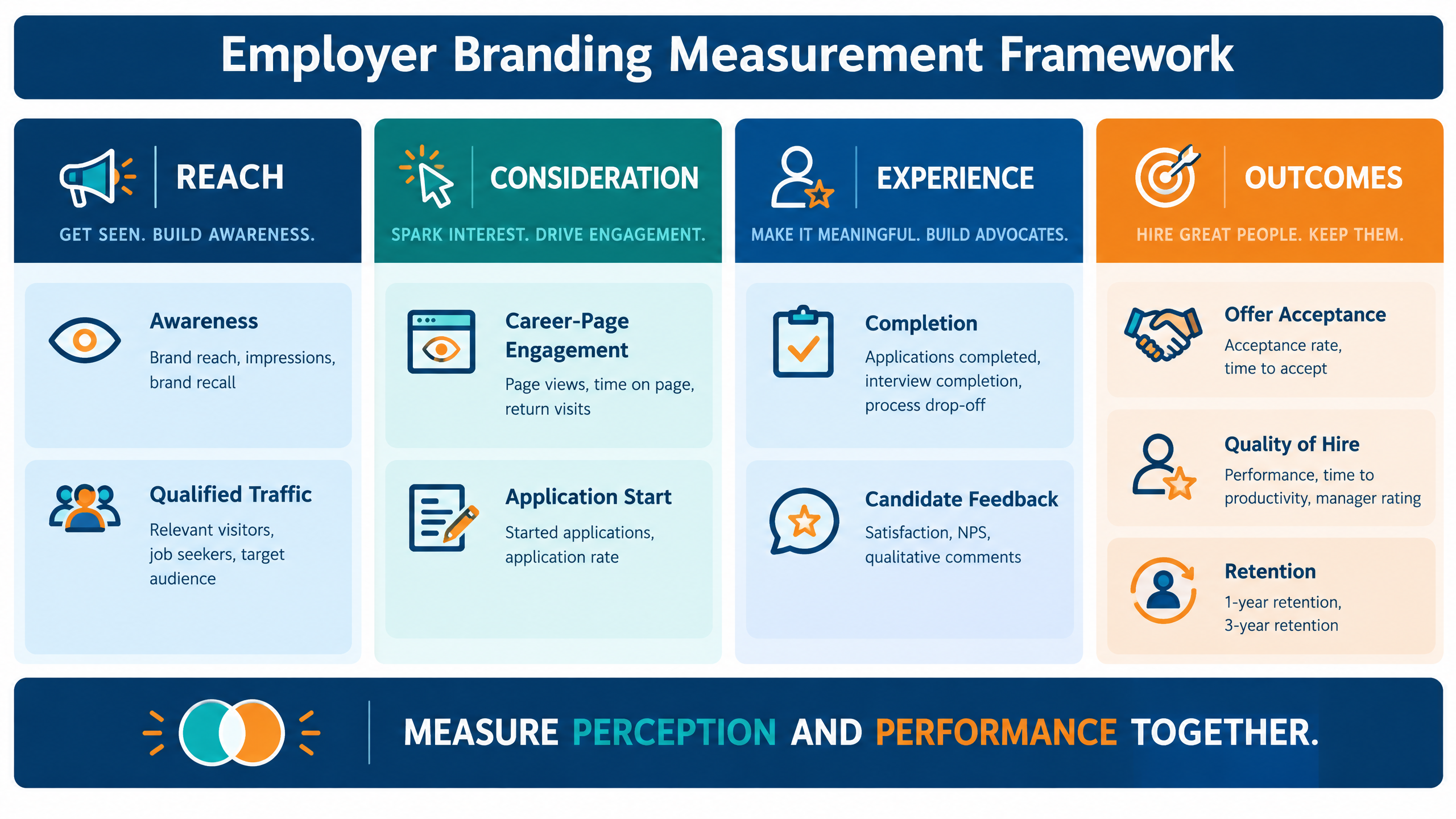
Employer-branding measurement should connect perception, behavior, experience, and outcomes. No single metric can explain whether the strategy is working.
Employer branding measurement framework showing reach, consideration, experience, and outcomes
Measurement layer
Example metrics
Question answered
Reach
Relevant audience awareness, branded search, qualified traffic, community growth.
Are the right people encountering the organization?
Consideration
Careers-page engagement, content completion, application starts, event registration.
Are people exploring the opportunity?
Application
Qualified application rate, source quality, application completion, drop-off.
Are the message and process attracting suitable candidates?
Experience
Candidate feedback, response time, scheduling satisfaction, assessment completion, support requests.
Does the process reinforce the promise?
Decision
Interview progression, offer acceptance, decline reasons, time to decision.
Do candidates remain confident through the process?
Outcome
Quality of hire, early retention, referral activity, employee advocacy, regretted attrition.
Does the promise align with longer-term results?
Interpret metrics by audience, role, location, source, stage, and hiring campaign where appropriate. A strong average can hide a poor experience for a particular candidate group.
Avoid treating engagement as the final outcome. A highly viewed video may create awareness, but it does not prove that qualified candidates applied, had a good experience, accepted offers, or stayed. Connect content measures to the downstream stages that matter.

How futuremug supports the hiring experience

futuremug is a hiring platform that publicly describes AI-powered interviews, assessments, expert-led evaluations, structured hiring reports, automated scheduling, candidate workflows, and support for global hiring. These capabilities can help TA teams make the operational part of the employer brand more consistent.
Its describe role-specific evaluation frameworks, automated scheduling, recorded interviews, structured feedback, candidate updates through email, SMS, and WhatsApp, and performance analytics. These workflows can support a more predictable and informed candidate journey when configured with accurate communication and human support.
futuremug’s describes automated scheduling, video interviews, live coding, question libraries, interviewer dashboards, candidate management, transcripts, summaries, personalized reports, and interview insights. These features can help hiring teams coordinate the evaluation stage while keeping the employer’s role narrative and process standards visible.
For assessment-led hiring, review the . For teams that need to connect assessment and interview operations, request a discussion about the full workflow rather than evaluating one isolated feature.
A useful futuremug conversation should examine how the organization’s employer-brand promise appears in job information, candidate messages, scheduling, assessments, interviews, reports, status updates, support, and next-step decisions.

Create a more consistent hiring experience

Employer branding becomes stronger when the organization can deliver on what it communicates. Start with one priority talent segment or role family. Document the employee proposition, evidence, candidate expectations, process commitments, and metrics.
Then review the full journey from first discovery through application, assessment, interview, decision, and joining. Identify where the experience supports the promise and where the process creates doubt.
to discuss candidate communication, scheduling, assessments, interviews, structured reports, recruitment automation, and a more consistent talent-acquisition experience.

Frequently Asked Questions

Why is employer branding important? ▼

Employer branding is important because it shapes how candidates perceive an organization before and during hiring. It can influence awareness, application quality, candidate trust, process completion, offer confidence, employee expectations, referrals, and long-term workforce outcomes.

Why is employer branding important for talent acquisition? ▼

Talent acquisition depends on attracting the right people, helping them understand the opportunity, and giving them a credible reason to continue. Employer branding makes the organization’s employee proposition clearer and helps align recruitment communication with the candidate experience.

Is employer branding the same as recruitment marketing? ▼

No. Recruitment marketing focuses on campaigns, channels, content distribution, and conversion. Employer branding is the broader perception and employee proposition that those campaigns communicate. Recruitment marketing works better when it is built on a credible employer brand.

How does employer branding affect candidate experience? ▼

Employer branding creates expectations about the organization. Candidate experience shows whether the hiring process supports or contradicts those expectations. Clear communication, reliable scheduling, structured evaluation, respectful treatment, and timely updates can reinforce the employer brand.

Does employer branding only matter for large companies? ▼

No. Smaller organizations may benefit from employer branding because they need to explain their mission, work, leadership access, growth opportunity, and employee experience clearly when competing with better-known employers.

Can employer branding reduce recruitment costs? ▼

It may improve recruitment efficiency by increasing relevant awareness, improving application quality, reducing avoidable drop-off, supporting referrals, and strengthening offer confidence. Cost outcomes depend on the role, labor market, compensation, process quality, and employee experience.

What makes an employer brand credible? ▼

Credibility comes from alignment between the promise and the lived experience. Specific evidence, honest expectations, employee voice, accurate job information, consistent hiring operations, and transparent communication are stronger than generic claims.

How can HR measure employer-branding success? ▼

Use a balanced framework covering reach, consideration, application behavior, candidate experience, offer outcomes, quality of hire, early retention, referrals, and employee advocacy. Segment results by role, audience, location, stage, and source where appropriate.

How does recruitment automation affect employer branding? ▼

Automation affects employer branding through the practical hiring experience. Accurate reminders, easy scheduling, status updates, structured feedback, and reliable support can reinforce trust. Broken workflows, silence, irrelevant messages, and no escalation path can weaken it.

What should employer-brand teams ask recruitment operations? ▼

Ask whether job information is accurate, messages are consistent, scheduling is reliable, assessments and interviews are accessible, candidates can receive support, delays are communicated, and outcomes are measured. The brand is delivered through these operational details.

What should be shown in a hiring-workflow platform demo? ▼

Ask the provider to show candidate intake, job information, invitations, scheduling, reminders, assessments, interviews, feedback, reports, status updates, support, exception handling, permissions, integrations, and a measurement plan.

Leave a Reply

Your email address will not be published.