
Technical Interview as a Service in India: How It Works End to End
For a technical hiring lead, the question about interview-as-a-service is not “what is it” — it is “does an outsourced technical interview actually preserve signal, and how does it plug into my process?” This guide answers that directly: the six-stage workflow from rubric to decision, which technical rounds get run, and the specific safeguards that keep an outsourced coding or system-design score trustworthy enough to hire on.
| Quick answer: Technical interview as a service in India is a model where an external provider runs your coding, system-design, and domain interviews against your rubric and returns recorded, evidence-linked scorecards. It works in six stages — calibrate, match, interview, score, review, decide — with the interviewing outsourced and the hiring decision always yours. Signal stays high through structured rubrics, stack-vetted interviewers, recorded rounds, AI-assist detection, and your own panel shadow-scoring a sample. |
What Technical Interview as a Service Means
Technical interview as a service is the delivery of coding, system-design, and domain interviews by an external provider, against your rubric, with recorded and scored output returned to your team. It is a specialisation of the broader category covered in our complete buyer’s guide — same principle, narrowed to the rounds where the signal is technical and the bar is set by engineers.
For Indian engineering teams the pull is specific. Interviewing is done by your senior engineers, and every technical panel is an hour off the roadmap. When hiring spikes — a funded sprint, a GCC ramp, a campus batch — either the roadmap slips or the interview bar does. Technical interview as a service separates interview capacity from your engineering headcount, without separating the decision from your team.
How It Works: End to End
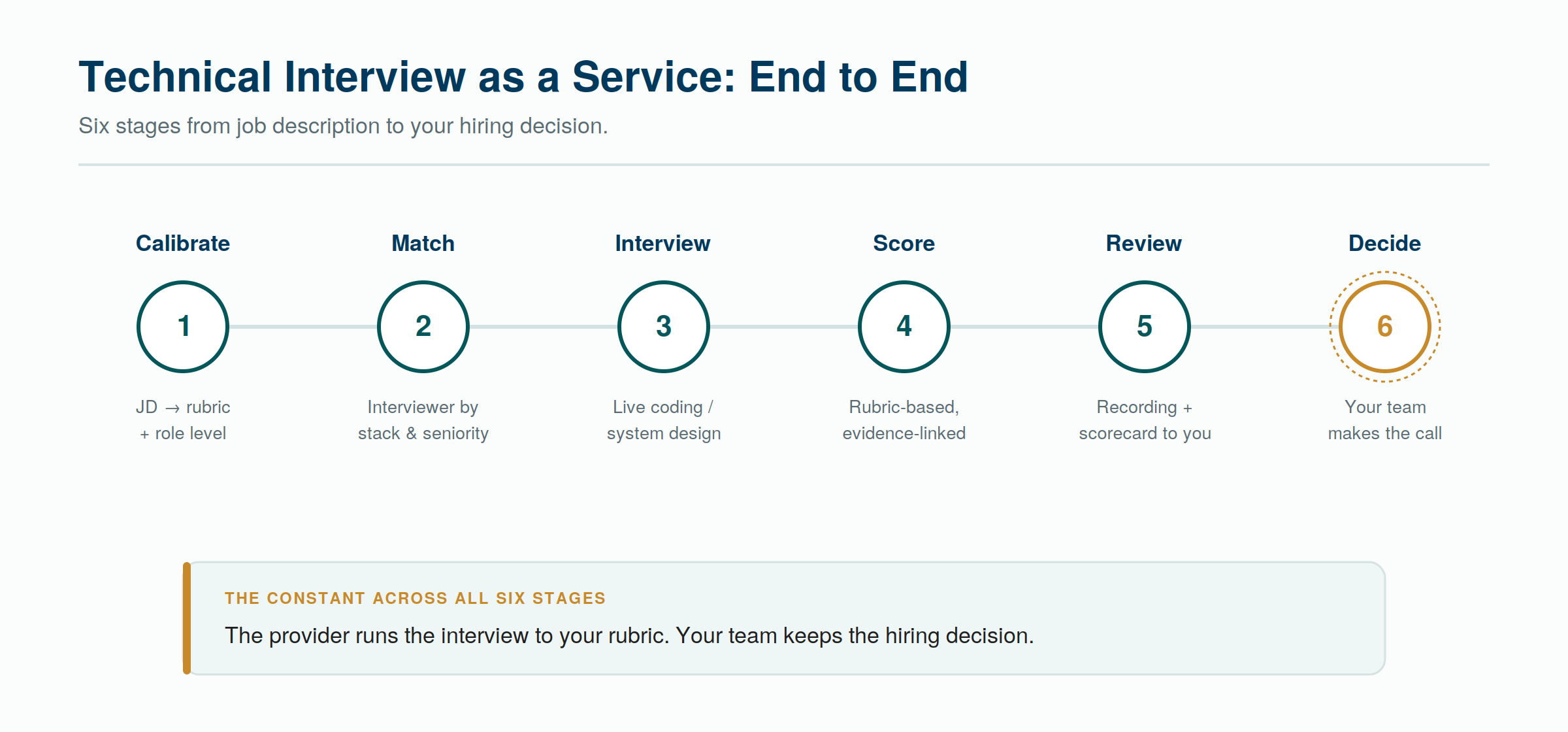
The engagement runs in six stages. The first is the one that determines whether the other five are worth anything.
Stage 1 — Calibrate the rubric and role level
Every credible engagement starts here, and skipping it is why outsourced interviews get a bad name. You and the provider agree the role level, the competencies that matter, and a rubric with observable criteria per band — what a “strong hire” looks like on system design at senior versus mid. This is a working session, not a form, and it is the step that makes every later score mean the same thing.
Stage 2 — Match the interviewer to the stack
An interviewer who has not shipped in your stack cannot read depth in it. Providers match a vetted practitioner by technology and seniority — someone who can tell a memorised answer from real understanding on the specific problem. This is the core of expert interview panels, and it is a fair question to ask exactly how the match is made.
Stage 3 — Run the interview
The round itself: live coding, system design, a domain deep-dive, or a structured take-home review, on a shared environment with the rubric open. Where volume is high, AI-structured interviews and agentic AI interviews run the first technical screen at scale before a human round for finalists — the same signal, delivered at a volume no human panel can match.
Stage 4 — Score against the rubric
Scoring is criterion-by-criterion against the calibrated rubric, with each rating tied to a moment in the interview rather than an overall gut feel. A good scorecard shows its work: where the candidate met the bar, where they missed, and the evidence for each. That traceability is what lets your team trust a score it did not witness.
Stage 5 — Review the evidence
Your team receives the scorecard and the recording. This is the difference between outsourcing interviewing and outsourcing judgement: you are handed evidence you can audit, not a verdict you must accept. For a borderline candidate, the recording settles the debate faster than a re-interview.
Stage 6 — Decide
You make the call. The provider supplies calibrated signal; the hire, the level, and the offer stay entirely with your team. Any engagement that blurs this — that wants to decide for you — has stopped being interview-as-a-service and become something you should scrutinise.
Which Technical Rounds Get Run
Technical interview as a service covers the full range of technical rounds — the art is matching the round to the signal you need and the seniority you are hiring.
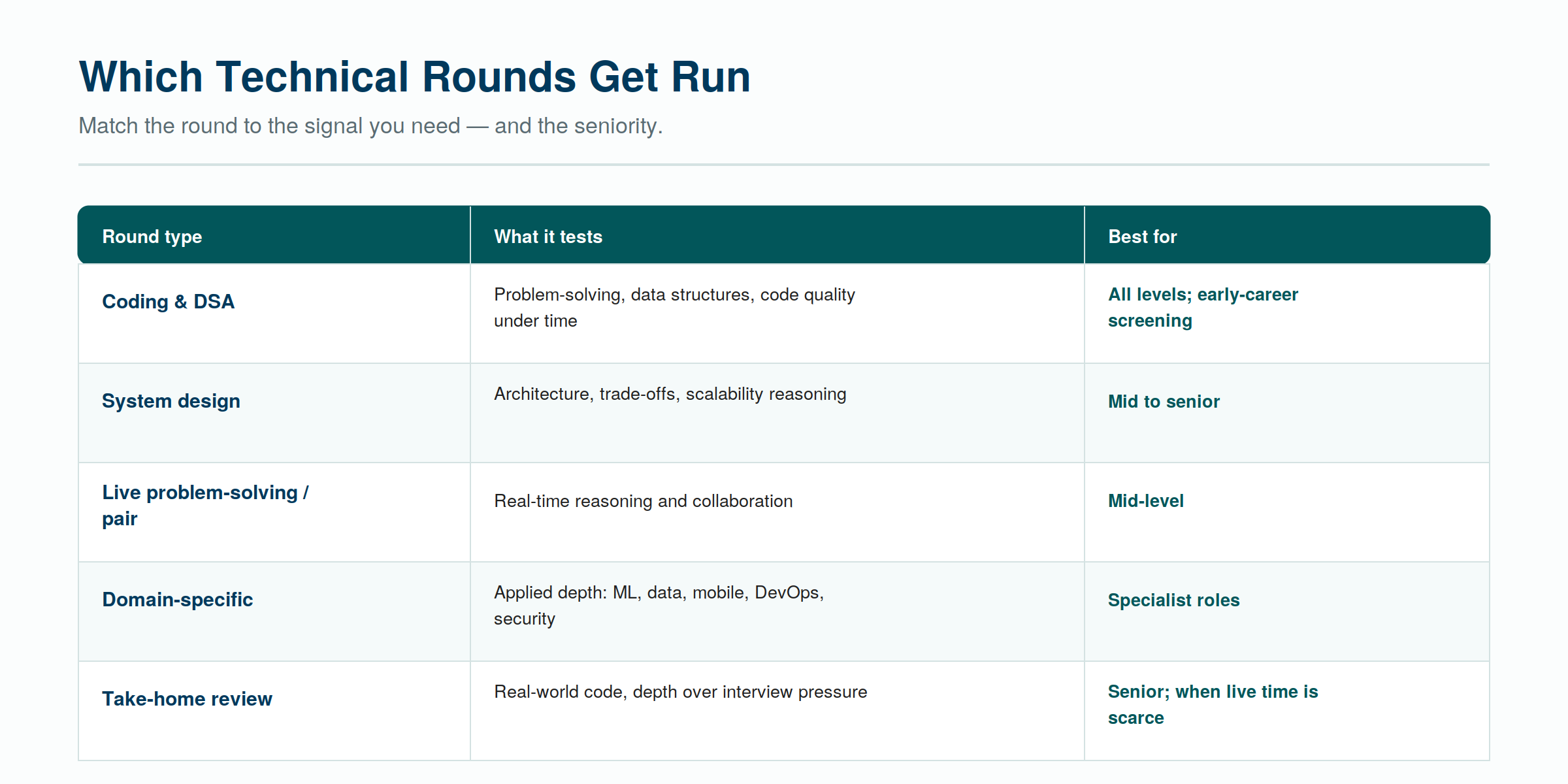
| Round | What it tests | Best for |
| Coding & DSA | Problem-solving, data structures, code quality under time | All levels; early-career screening |
| System design | Architecture, trade-offs, scalability reasoning | Mid to senior |
| Live problem-solving | Real-time reasoning and collaboration | Mid-level |
| Domain-specific | Applied depth in ML, data, mobile, DevOps, security | Specialist roles |
| Take-home review | Real-world code, depth over interview pressure | Senior; scarce live time |
Upstream of the interview, a coding-test and assessment layer filters volume before a human or AI round — so expensive interview time is spent only on candidates who cleared the bar on fundamentals.
How Signal Stays High
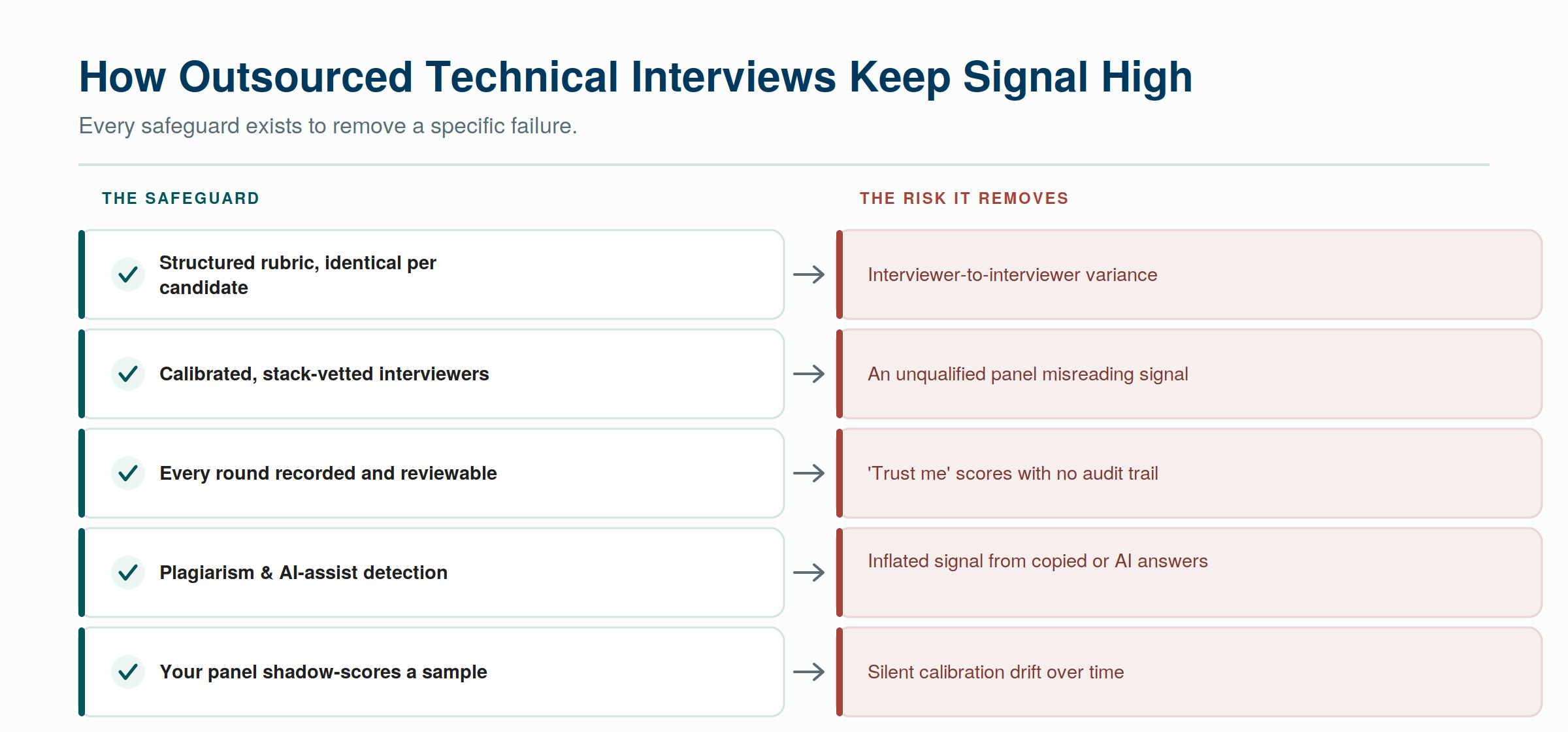
This is the question every technical leader actually asks: if I did not run the interview, can I trust the score? The answer is yes — conditionally — and the conditions are specific. Each safeguard below exists to remove a specific way an outsourced score could mislead you.
The AI-cheating point deserves its own emphasis. In 2026, the live risk is not a weak interviewer — it is a candidate with an AI assistant in another window. Insist on plagiarism detection, AI-assist flags, and interviewers who probe beyond the first answer, because follow-up questioning is what a memorised or generated solution cannot survive. A provider without a clear position on this is behind the threat.
Where It Fits Your Process
The productive framing is not all-or-nothing. Outsource the rounds that scale and the ones you lack depth for; keep the rounds that are yours to own.
Outsource: high-volume first rounds (DSA, initial coding screens) and specialist rounds outside your in-house expertise — the rounds that eat the most engineering time for the most standardised signal.
Keep in-house: the final round and the bar-raiser. Culture read and the offer conversation are yours, and no external panel should own them.
For teams running technical hiring at campus scale, the interview layer sits inside the wider drive — the operational side of which is covered in our campus hiring platform guide.
What to Ask a Technical IaaS Provider
Four questions separate a technical partner from a vendor. Make them answer with artifacts.
Interviewer depth. Who interviews for my stack, and how are they vetted in it?
Ask for: interviewer profiles matched to your specific technologies and seniority.
Signal integrity. How do you keep scores consistent, and how do you detect AI-assisted or copied answers?
Ask for: their calibration process and their anti-cheating approach, in writing.
Evidence. What exactly do I receive after each interview?
Ask for: a redacted sample scorecard and recording from a real technical round.
Fit to process. How does this land in my ATS, and what stays manual?
Ask for: a walkthrough of the data flow from request to scorecard in your stack.
Technical interview as a service works when it is built the way this guide describes: calibrate the rubric first, match interviewers to the stack, keep every score tied to evidence you can review, and hold the AI-cheating line. Run it that way and you reclaim your engineers’ calendars without lowering the bar — the interview is outsourced, the judgement stays yours.
futuremug delivers technical interviews across all three models — expert human panels, AI-structured interviews, and agentic AI interviews — with the rubric calibration, recorded evidence, and anti-cheating safeguards a technical hire demands. If you want to see the scorecard your team would actually read, a pilot is the fastest way to judge it.



Frequently Asked Questions
It is a model where an external provider conducts your technical interviews — coding, system design, and domain rounds — against your rubric and returns recorded, evidence-linked scorecards. The provider supplies interview capacity and calibrated signal; your team keeps the hiring decision. For the broader category, see our guide to what interview as a service is.
Through five safeguards: a structured rubric applied identically to every candidate, interviewers vetted in the specific stack, every round recorded and reviewable, plagiarism and AI-assist detection, and your own panel shadow-scoring a sample to catch drift. Together these hold interviewer-to-interviewer variance down and keep the signal auditable.
AI-structured and agentic interviews now run first-round technical screens at scale with consistent rubrics, which is genuinely useful for volume. Cheating is the real 2026 concern — copied solutions and AI-assisted answers — so insist on plagiarism detection, AI-assist flags, and follow-up probing that a memorised answer cannot survive. Ask any AI-interview vendor for human-agreement data on their scores.
A common split: outsource high-volume first rounds (DSA, initial coding screens) and specialist rounds where you lack in-house depth; keep the final round and the bar-raiser in-house, because culture read and the offer conversation are yours to own. The point is to reclaim your engineers' time on the rounds that scale, not to remove them from the decision.
Mature providers push status and scorecards into your ATS so the engagement does not create a parallel admin trail. Confirm what integrates natively versus what needs middleware before you sign — otherwise the coordination hours you saved on interviewing reappear as status-chasing.
Pricing is usually per interview, with rates rising for senior and specialist rounds and faster turnaround. Compare on cost per completed, calibrated interview against your engineers’ loaded hourly cost — the full pricing breakdown and vendor scorecard are in our interview as a service buyer’s guide.