
Interview as a Service vs In-House Interviewing: Cost, Speed and Quality Compared
Before a team buys interview as a service, someone has to make the case against the status quo — keeping interviewing in-house. This is that comparison, run straight: interview as a service versus in-house on the three axes that decide it, cost, speed, and quality. It is written to help you build an honest business case, which means it says plainly where in-house still wins. Spoiler: for most teams the answer is not either one.
| Quick answer: Neither model wins outright. In-house interviewing is cheaper at low volume and unbeatable on context, culture read, and control. Interview as a service wins on speed under load, consistency, an audit trail, and cost at scale or during hiring spikes. Most teams should not choose one — the strongest setup is hybrid: outsource the high-volume rounds that drain engineering time, keep the context-critical rounds in-house. |
The Honest Summary First
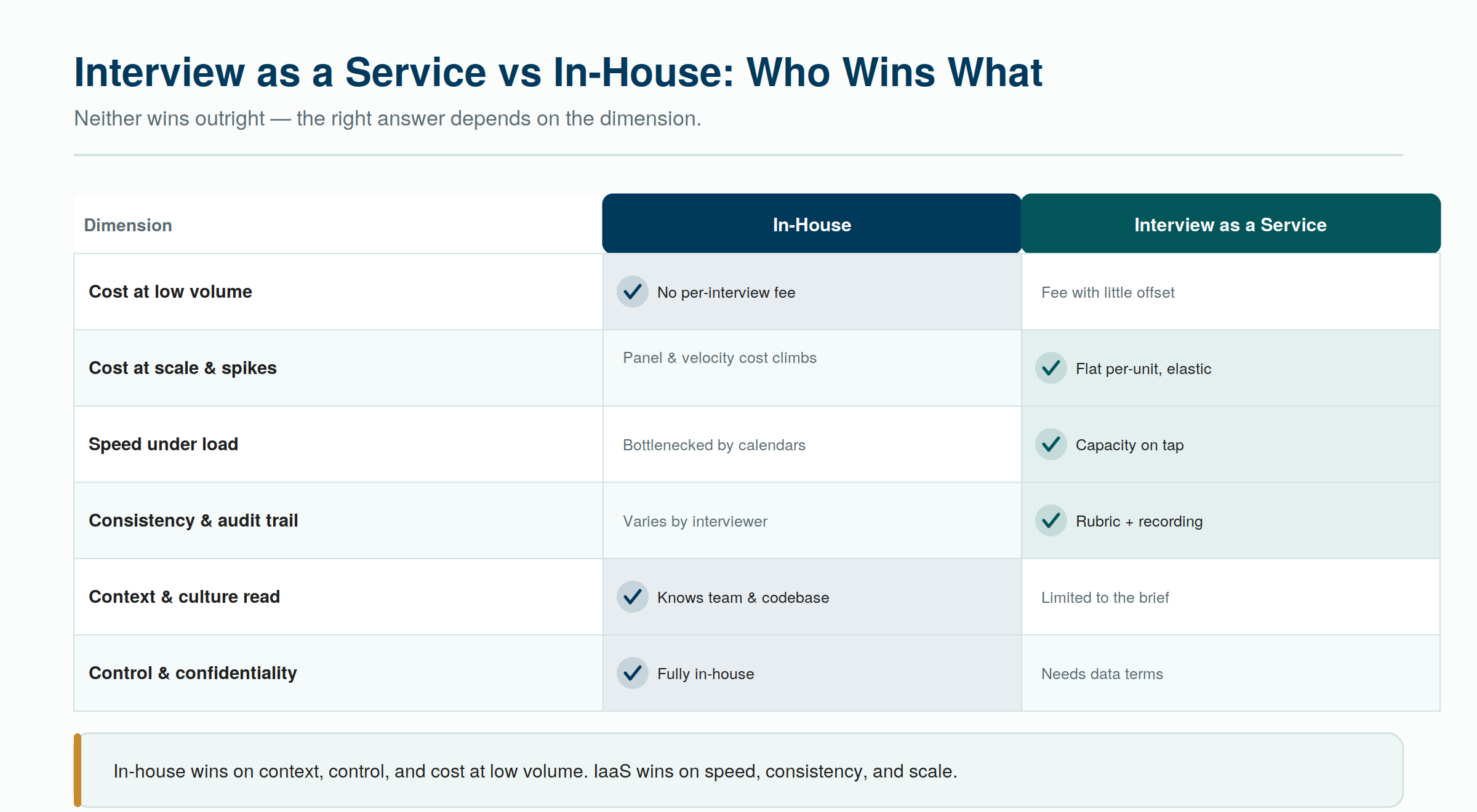
A comparison from a provider is only useful if it is fair, so here is the balanced verdict up front. In-house interviewing wins on three dimensions: cost at low volume, context and culture read, and control. Interview as a service wins on three others: speed under load, consistency and auditability, and cost at scale. The rest of this guide works through each axis — and then shows why the two are not really rivals for most teams.
Cost: The Comparison That Isn’t What It Looks Like
In-house interviewing feels free because there is no invoice — but the cost is real, just hidden in your engineers’ time. The honest tally counts senior-engineer hours at loaded cost, the coordination overhead around scheduling and debriefs, and the opportunity cost of lost sprint velocity. Interview as a service replaces all of that with a per-interview fee.
| Cost element | In-house | Interview as a service |
| Direct fee | None | Per interview conducted |
| Interviewer time | Senior engineers at loaded cost | Included in the fee |
| Opportunity cost | High — lost sprint velocity | None on your team |
| Coordination overhead | Scheduling, chasing, debriefs | Handled by the provider |
| Cost behaviour | Climbs steeply with volume | Flat per-unit, elastic |
Because in-house cost is dominated by engineer time, it climbs steeply with volume — and fastest during a hiring spike, exactly when you can least afford the velocity hit. A per-interview fee stays flat per unit. That produces a cross-over: below a certain volume in-house is cheaper, above it the service is.
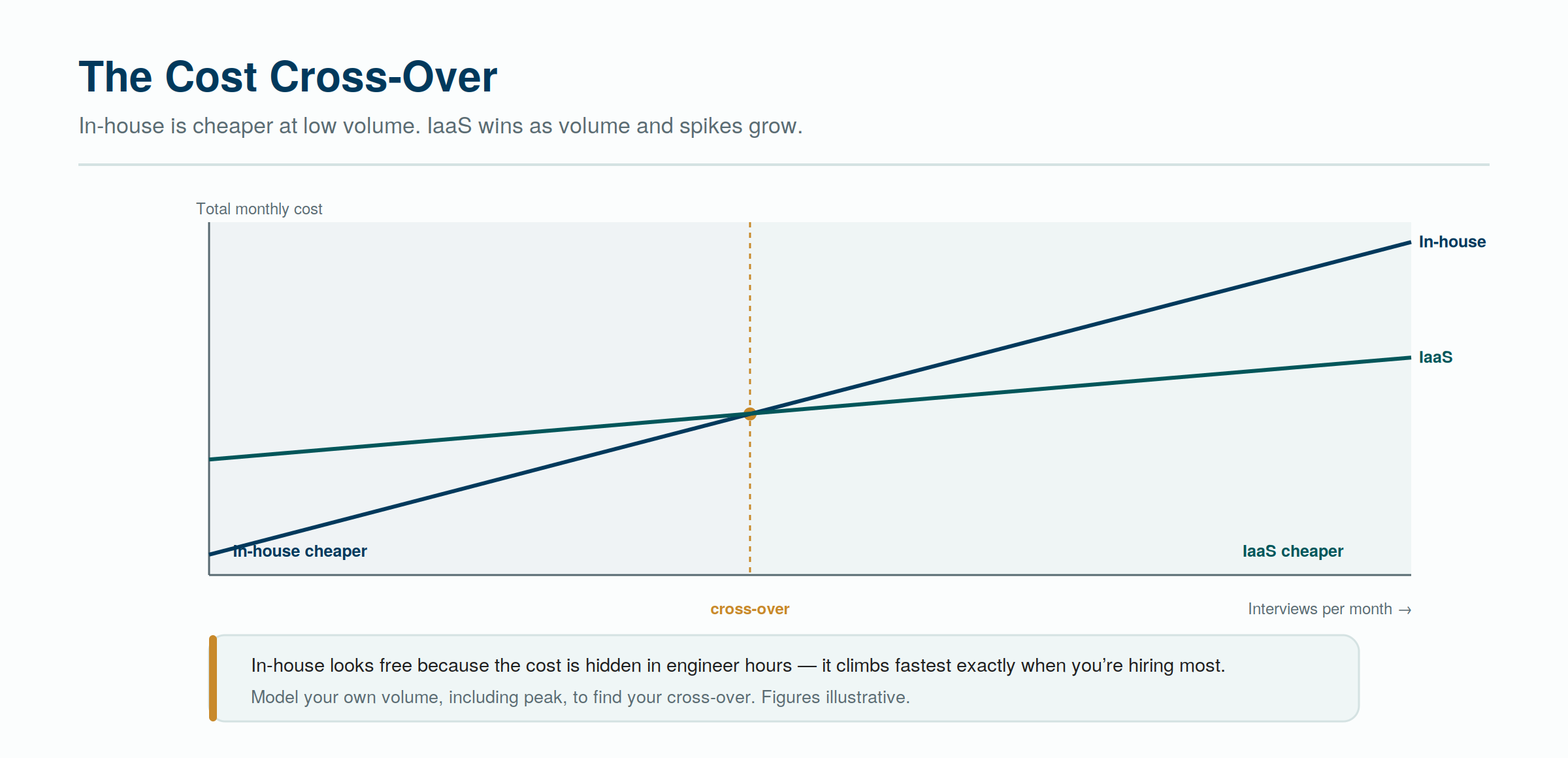
The business-case move: model your own volume through both, and include your peak month rather than your average. The cross-over is where the decision actually gets made, and most teams find it lower than they expect once lost velocity is counted honestly.
Speed: Calendars vs Capacity
In-house interview speed is capped by your engineers’ availability. Every round competes with sprint work for calendar space, scheduling latency stacks up, and the process slows most during a crunch — precisely when speed matters. In-house can be quick for a single senior hire with a motivated panel, but it does not hold up under load.
Interview as a service decouples speed from your team’s calendar: capacity is on tap, and turnaround stays steady during a hiring push. Expert paanels and, at higher volume, AI-structured interviews absorb surges an internal panel cannot. The honest cost on this side is the upfront calibration ramp — a week or two to align on the rubric before the speed advantage kicks in.
Quality: Two Different Definitions
This is where the comparison is most often oversimplified, because “quality” means two different things. In-house interviewing wins decisively on context: your engineers know the team, the codebase, and the culture, and they read fit in a way no external interviewer can. For final rounds and culture-critical hires, that context is the whole point.
Interview as a service wins on consistency and evidence: a structured rubric applied identically to every candidate, calibrated interviewers, and a recording you can audit. The hidden truth is that in-house variance is often the real quality problem — an untrained internal panel, scoring on gut feel under time pressure, can be less reliable than a calibrated external one. Where consistency and defensibility matter, and increasingly where AI interviews add scale, the service is stronger. Neither wins quality outright; it depends on whether the round is testing context or consistency.
So Which Should You Choose? Usually, Both
The framing of “versus” is misleading, because the two models are strongest on different rounds. The best-run teams do not pick a side — they map their hiring and route each round to whichever model fits.
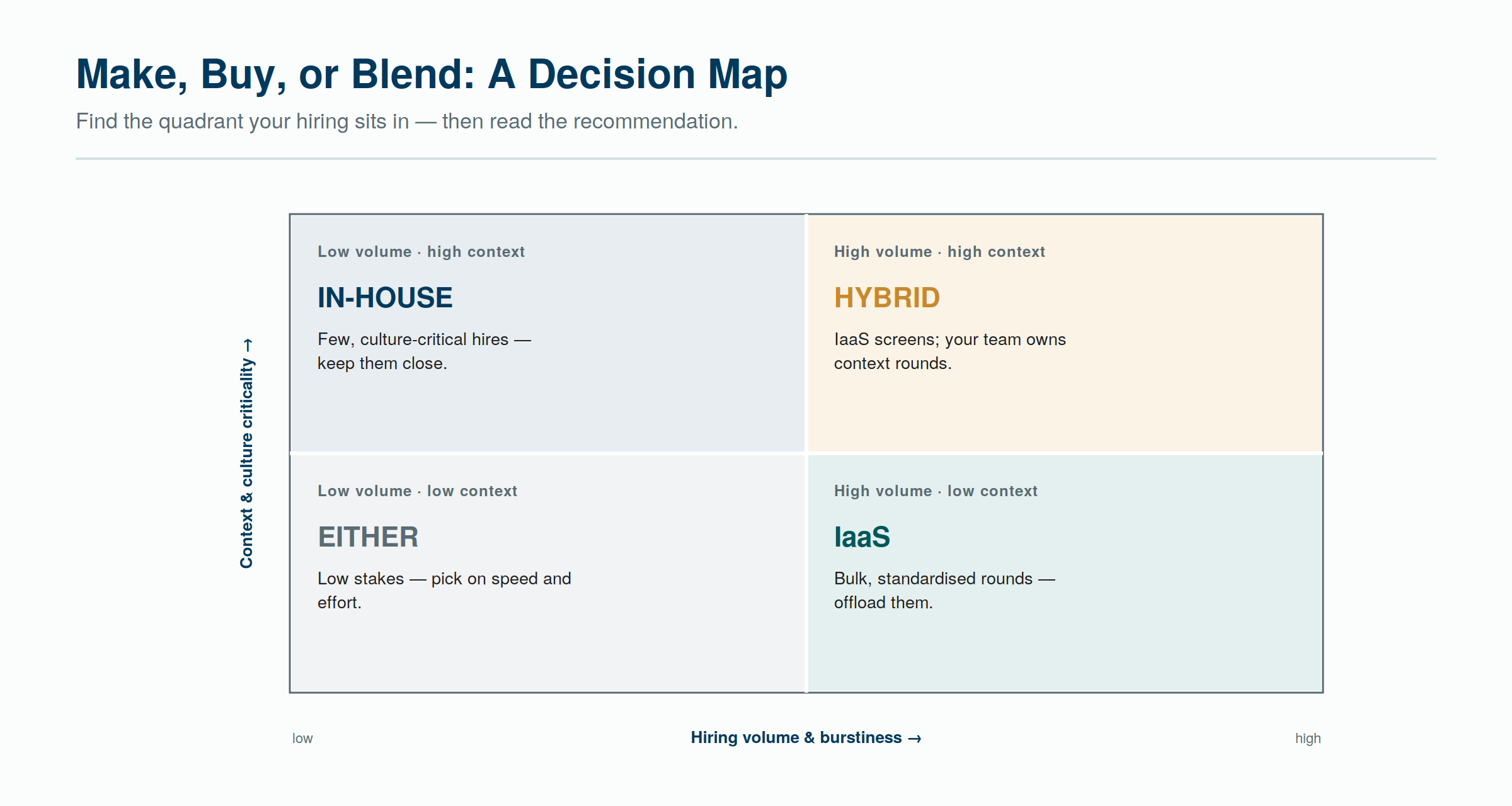
Read your hiring against two axes: volume and burstiness on one, how context- or culture-critical the round is on the other. Low volume and high context stays in-house. High volume and low context goes to the service. High volume and high context is the hybrid zone — the service screens, your team owns the context rounds — and that is where most growing companies actually sit.
What to Offload and What to Keep
Offload: high-volume first rounds, overflow during spikes, and specialist rounds you cannot staff internally. These are where the service’s speed, consistency, and elasticity pay off, and where in-house cost climbs fastest.
Keep in-house: the final round and the bar-raiser. Culture read, the offer conversation, and your calibration standard are yours to own — do not outsource the standard itself.
Interview as a service versus in-house is the wrong question for most teams; the right one is which rounds go where. In-house keeps its edge on cost at low volume, context, and control; the service wins speed, consistency, and cost at scale. Build the business case on your real numbers — including the hidden engineer-hours in-house — and the answer is usually a deliberate blend, not a purchase or a status quo.
futuremug is built for the hybrid model — expert panels, AI interviews, and agentic AI interviews that take the rounds draining your team while your engineers keep the ones that need them. If you are building the case, a pilot gives you the real numbers to put in it.



Frequently Asked Questions
It depends on volume. At low, steady hiring, in-house is usually cheaper because you have no per-interview fee. As volume rises or spikes, in-house cost climbs steeply — senior-engineer hours plus lost velocity — while an interview-as-a-service fee stays flat per unit. Above a cross-over volume, the service is cheaper on true cost. Model your own numbers, including your peak month.
It changes the kind of quality. In-house wins on context — it knows the team, the codebase, and the culture. A service wins on consistency and auditability — a structured rubric applied identically to every candidate, with a recording you can review. In-house variance is often the hidden quality problem; an untrained internal panel can be less reliable than a calibrated external one. Neither dominates; it depends on what the round needs to measure.
A service is generally faster once calibrated, because it is not bottlenecked by your engineers' calendars — capacity is on tap, and turnaround holds even during a crunch when in-house slows down most. In-house can be fast for a single senior hire with a motivated panel, but it does not scale under load. The trade is an upfront calibration ramp for the service versus ongoing scheduling latency in-house.
Keep it in-house when hiring volume is low and steady, when the round is culture- or context-critical, when the role needs deep internal knowledge to assess, or when confidentiality and IP sensitivity are high. In those cases the per-interview fee buys you little and the loss of context costs you a lot.
Hybrid means outsourcing the rounds that scale and drain engineering time — high-volume first rounds, overflow during spikes, specialist rounds you can't staff — while keeping the final round and bar-raiser in-house. It captures the service's speed, consistency, and elasticity where they help, and preserves in-house context where it matters. For most teams it beats either pure model. Our on-demand interviews guide covers how the offload works in practice.
Put three numbers side by side for your volume: fully-loaded in-house cost per hire (engineer hours + coordination + velocity lost), interview-as-a-service cost per hire at the same volume, and time-to-hire under each. Then map your hiring on volume and context-criticality to decide which rounds go where. The comparison is rarely all-or-nothing once the real in-house cost is on the table.