
A Practical Guide to Online Assessment Platform for Recruitment for a Modern Talent Acquisition Stack
What is an online assessment platform for recruitment?
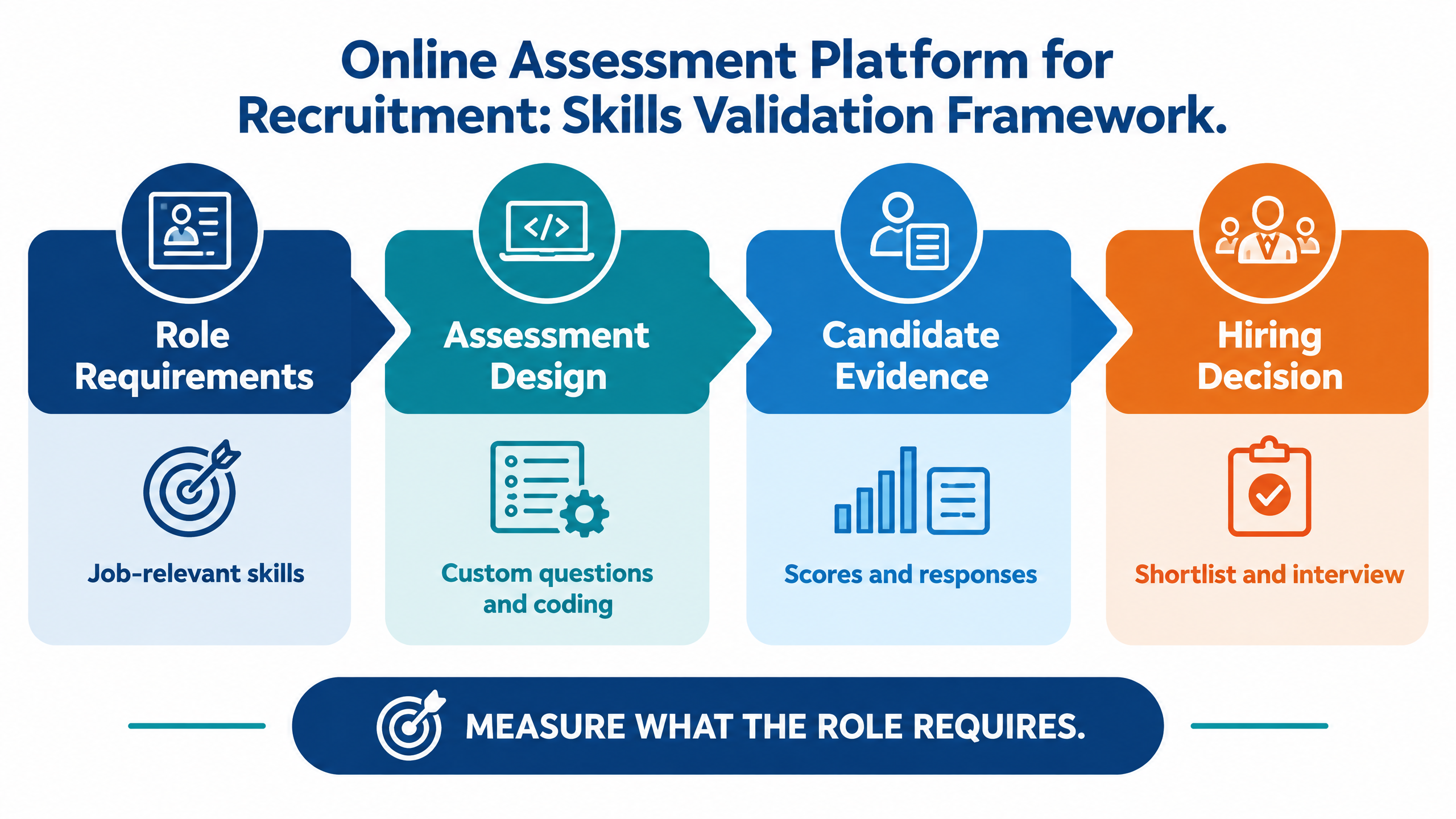
- Role requirements: the competencies and outcomes the job needs.
- Assessment design: questions, tasks, time limits, rules, and scoring.
- Candidate delivery: invitations, instructions, access, support, and completion.
- Integrity controls: identity, proctoring, randomization, monitoring, and review.
- Evaluation: automated, AI-assisted, manual, or hybrid scoring.
- Decision support: reports, rankings, shortlists, integrations, and audit history.
Why assessment platforms matter in a modern talent acquisition stack
|
Recruitment challenge
|
What the right platform should provide
|
|
High candidate volume
|
Bulk candidate upload, scalable delivery, live tracking, and automated reports.
|
|
Different role requirements
|
Configurable tests, question banks, coding, domain, descriptive, behavioral, and video formats.
|
|
Remote or distributed hiring
|
Browser and mobile support, reminders, clear instructions, and candidate assistance.
|
|
Integrity concerns
|
Proctoring, identity checks, randomization, tab monitoring, suspicious-activity review, and audit trails.
|
|
Slow evaluation
|
Automated scoring, AI-assisted evaluation where appropriate, section-level reports, and exports.
|
|
Distributed hiring teams
|
Role-based access, permissions, shared records, and reviewer collaboration.
|
|
Campus and staffing use cases
|
Bulk invites, cutoffs, rankings, candidate shortlisting, TPO or recruiter access, and campaign reports.
|
|
Hiring-manager scrutiny
|
Explainable scorecards tied to competencies and role expectations.
|
10 smart buying criteria
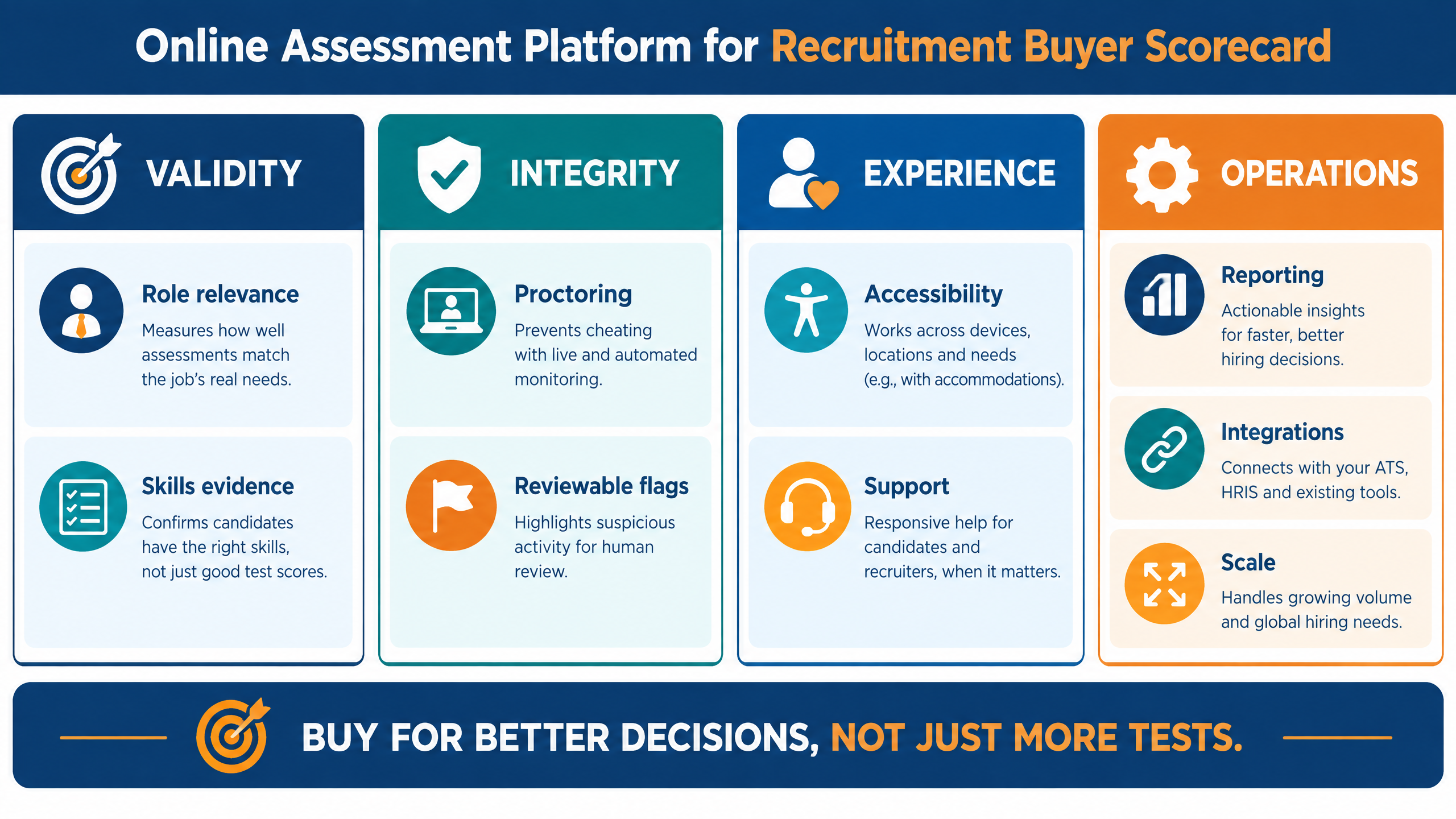
1. Role relevance and skills validity
- Which competencies does the assessment measure?
- Why are those competencies important for the role?
- How is difficulty calibrated by level?
- Can the hiring team map sections to role requirements?
- Can internal experts review and approve the assessment before launch?
2. Question-bank quality and customization
3. Coding and technical assessment depth
4. Proctoring and assessment integrity
5. Scoring and AI-assisted evaluation
6. Candidate experience and accessibility
7. Reporting and decision support
8. Workflow and integration fit
|
Handoff
|
Buyer question
|
|
ATS to assessment
|
Can the team trigger the right assessment from the correct stage?
|
|
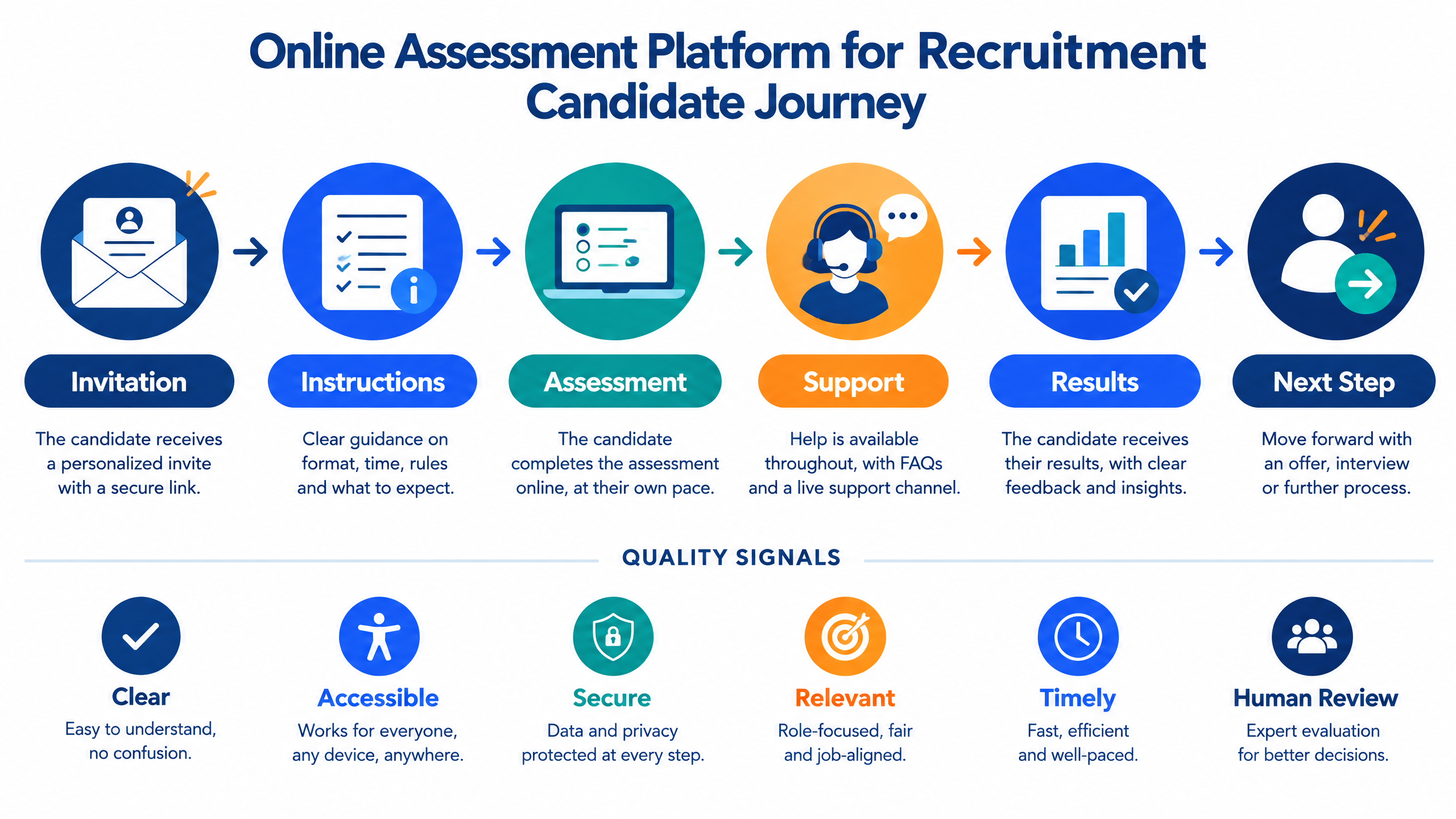
Candidate to invitation
|
Are instructions, deadlines, reminders, and support clear?
|
|
Assessment to report
|
Are scores, responses, flags, and evidence consolidated automatically?
|
|
Report to recruiter
|
Can recruiters review, filter, compare, and shortlist efficiently?
|
|
Recruiter to interview
|
Can qualified candidates move to interview without duplicate data entry?
|
|
Assessment to analytics
|
Can leaders see completion, quality, funnel, and time-to-decision trends?
|
9. Security, privacy, and governance
10. Total cost and scalability
Assessment types to compare
|
Assessment type
|
Best used for
|
Buyer questions
|
|
Aptitude and reasoning
|
Graduate hiring, operations, support, sales, and general screening.
|
Are questions role-relevant, refreshed, and configurable by difficulty?
|
|
Coding assessment
|
Software engineering, data, QA automation, and technical roles.
|
Does the environment support languages, test cases, partial scoring, and evidence review?
|
|
Domain assessment
|
Finance, healthcare, engineering, customer operations, and specialist functions.
|
Can the employer use custom content and role-specific scoring?
|
|
Descriptive assessment
|
Writing, analysis, explanation, and structured thinking.
|
Is evaluation manual, automated, AI-assisted, or hybrid?
|
|
Psychometric or behavioral
|
Work preferences, traits, communication, and role fit.
|
Is the instrument appropriate, transparent, and interpreted responsibly?
|
|
Video or communication
|
Customer-facing roles, language, presentation, and soft skills.
|
Are instructions clear and scoring linked to a defined rubric?
|
|
Case or simulation
|
Consulting, product, operations, management, and real-work tasks.
|
Can the platform capture reasoning and output, not only a score?
|
|
Campus or cohort assessment
|
College hiring, training institutes, certifications, and placement programs.
|
Can the platform handle cohorts, rankings, TPOs, and reports?
|
Assessment validity, integrity, and human oversight
- Define which skills the assessment measures and why they matter for the job.
- Use the same core criteria for candidates applying to the same role.
- Review whether questions depend on unnecessary cultural, linguistic, or technical assumptions.
- Provide an accommodation route and a support channel.
- Treat proctoring signals as evidence for review, not automatic proof of misconduct.
- Monitor completion, scores, flags, and drop-off by cohort where lawful and appropriate.
- Document who can change cutoffs, override a score, or clear an integrity flag.
- Retain the information required for audit and delete what is no longer needed.
- Validate AI-assisted evaluation against human review before using it for high-stakes decisions.
Candidate experience and accessibility
- Mobile and desktop candidates.
- Different browsers and network conditions.
- Screen readers or other accessibility needs.
- Extra time or approved accommodations.
- Candidates who lose connectivity.
- Candidates who need to reschedule.
- Candidates who dispute an integrity flag.
- Candidates who need clarification about permitted resources.
Reporting, integrations, and workflow fit
Recruiter view
Hiring-manager view
Assessment-owner view
Leadership view
Build, buy, or outsource assessment operations
|
Model
|
Best suited for
|
Strengths
|
Questions to ask
|
|
Build internally
|
Organizations with specialized requirements, engineering capacity, and long-term ownership needs.
|
Maximum customization and control.
|
Who maintains content, security, scoring, proctoring, support, and integrations?
|
|
Buy self-service software
|
Teams that want control over assessment creation and delivery.
|
Faster deployment, configurable workflows, and internal ownership.
|
Can the platform scale, integrate, and support governance?
|
|
Outsource assessment operations
|
Teams with high volume, limited administrators, tight timelines, or complex coordination.
|
Managed setup, candidate communication, monitoring, evaluation, and reporting.
|
What remains under employer control and how is quality reviewed?
|
|
Hybrid model
|
Organizations that need platform control plus operational capacity.
|
Internal standards with external execution support during peaks.
|
How are responsibilities divided and how is evidence transferred?
|
How to evaluate a platform with a practical pilot
|
Pilot dimension
|
What to measure
|
|
Role fit
|
Whether questions and tasks reflect the actual role and level.
|
|
Assessment quality
|
Whether results provide relevant and interpretable evidence.
|
|
Candidate completion
|
Completion rate, time, technical issues, and support requests.
|
|
Integrity workflow
|
Quality of flags, false-positive handling, and reviewer control.
|
|
Reporting
|
Whether recruiters and hiring managers can act on the output.
|
|
Integration
|
Data handoffs, permissions, status updates, exports, and duplicate effort.
|
|
Operational effort
|
Internal time required to configure, launch, monitor, and review.
|
|
Commercial fit
|
Cost under pilot, normal, and peak-volume scenarios.
|
|
Downstream value
|
Qualified-shortlist rate, interview conversion, and hiring-manager confidence.
|
How futuremug supports recruitment assessment workflows
Request an assessment-platform demo



Frequently Asked Questions
It is software that helps employers design, deliver, monitor, score, and report candidate assessments. It can support coding, aptitude, domain, behavioral, descriptive, communication, video, case, and other role-based formats.
It can standardize assessment delivery, reduce manual scoring, support candidate communication, protect integrity, create structured reports, and connect results to shortlisting and interviews. Its value depends on whether the assessment measures relevant skills and whether people can review the evidence.
It should measure capabilities that matter for the role and hiring stage. The answer may include coding, reasoning, communication, domain knowledge, data interpretation, writing, behavioral judgment, or a realistic job simulation.
AI-assisted scoring can accelerate evaluation, but buyers should understand what is scored, how the model is calibrated, how performance is monitored, and when human review is required. High-stakes or borderline results should remain reviewable by an authorized person.
No. Proctoring creates signals and controls, but it can produce false positives and does not eliminate every form of assistance. A defensible workflow combines proportionate controls, transparent candidate communication, human review, and an appeal or support route.
It can provide clear invitations, simple instructions, reliable access, reminders, accessible design, technical support, rescheduling, status updates, and transparent next steps. Candidate experience should be measured alongside completion and score quality.
Useful reports may include section scores, competency mapping, responses, coding results, integrity signals, reviewer notes, comparisons, rankings, cutoffs, completion, and recommendations. Different stakeholders need different views with appropriate permissions.
Usually, yes. Integration can reduce duplicate data entry and connect assessment results to the candidate’s hiring stage. Confirm how invitations, scores, reports, status changes, consent, permissions, and audit history move between systems.
Outsourcing may help when candidate volume is high, internal administrators are limited, timelines are compressed, proctoring and coordination are complex, or the team needs managed setup and reporting. A hybrid model can keep assessment standards internal while adding operational capacity.
Ask the provider to demonstrate a real job description becoming an assessment, candidate invitation, bulk upload, coding or descriptive evaluation, proctoring, live tracking, reports, shortlist review, permissions, integrations, exception handling, and support.