A Buyer’s Guide to Online Assessment Platform in India for Indian Recruitment Teams

What is an online assessment platform in India?

An online assessment platform in India is software that helps employers create, deliver, monitor, evaluate, and report candidate tests through a digital workflow. The platform may support aptitude, coding, domain, behavioral, psychometric, language, communication, descriptive, or video-based assessments.
For a recruitment team, the value is not simply moving a test online. A serious platform should help the employer measure job-relevant skills consistently, support candidates across devices and locations, protect test integrity, reduce manual evaluation, and provide evidence that hiring managers can use.
The Indian hiring environment adds important considerations. Teams may recruit across cities, colleges, languages, time zones, and network conditions. Drives can create a sudden surge in candidates. Recruiters may need to coordinate with TPOs, staffing partners, business leaders, and external interview panels. A platform must therefore work in both everyday hiring and peak-volume scenarios.
The buyer should also distinguish between a self-service assessment product and managed assessment operations. Self-service software gives the team control over test creation and delivery. Managed services add administration, candidate coordination, proctoring support, evaluation, reporting, or expert review. Many organizations need a hybrid of both.
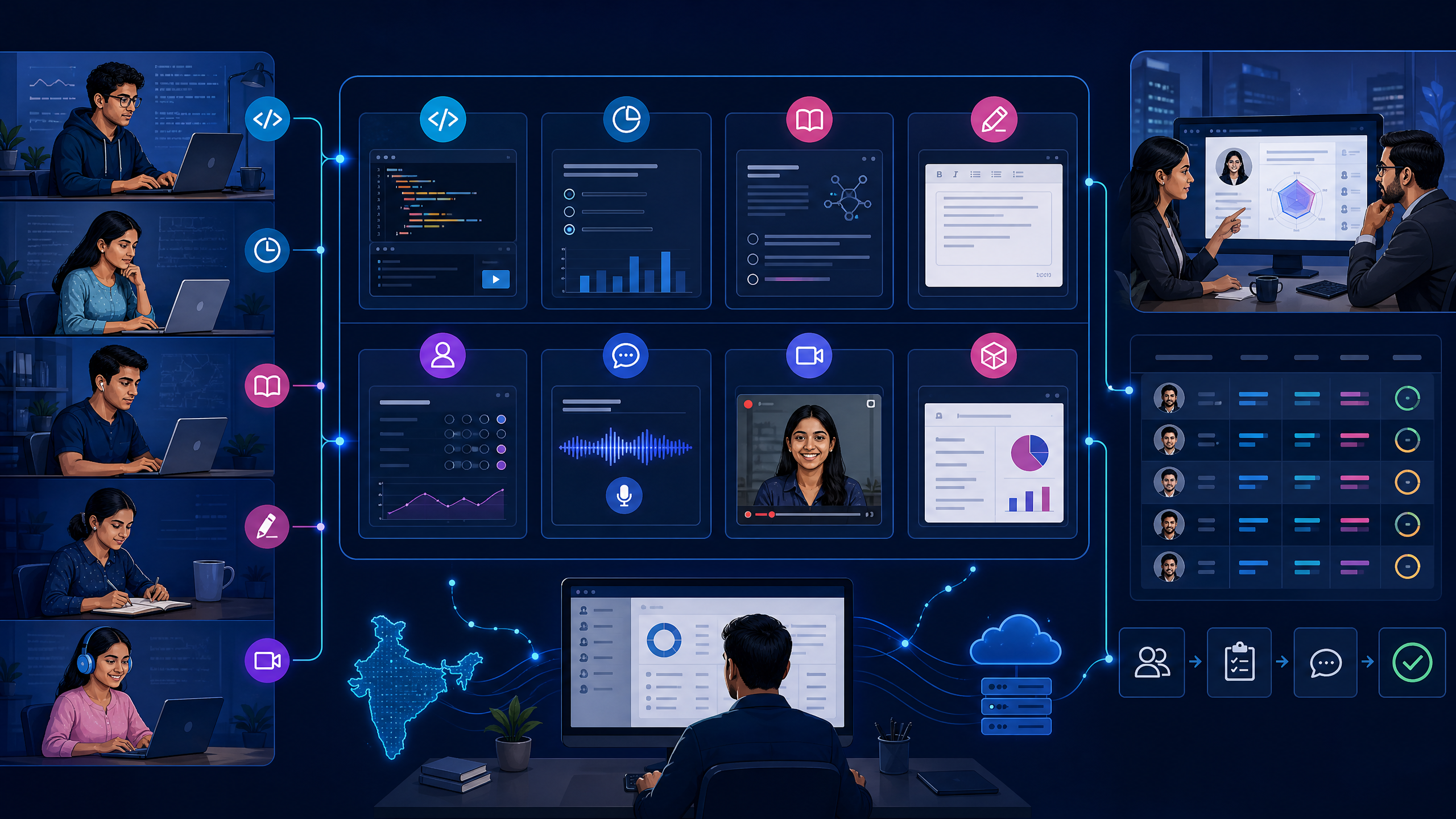
Online assessment platform in India showing recruiters, candidates, coding tests, proctoring, skill reports, and hiring decisions

Why Indian recruitment teams need a specialist assessment platform

A spreadsheet, form, or basic quiz tool may be adequate for a small internal exercise. It becomes risky when the assessment influences shortlisting, interview access, campus selection, staffing quality, or a high-value hire.
Recruitment problem
What the right platform should provide
Large candidate volume
Bulk candidate upload, scalable delivery, live tracking, and automated reports.
Different role requirements
Configurable tests, question banks, coding, domain, descriptive, and behavioral formats.
Remote delivery
Browser and mobile support, reliable access, reminders, and candidate help.
Integrity concerns
Proctoring, identity verification, question randomization, tab monitoring, and review workflows.
Slow evaluation
Automated scoring, AI-assisted evaluation, section-level reports, and exports.
Distributed hiring teams
Role-based access, collaboration, permissions, and centralized candidate records.
Campus and staffing use cases
TPO or recruiter access, bulk invites, ranking, cutoffs, and candidate shortlisting.
Hiring-manager scrutiny
Explainable reports tied to competencies and role expectations.
An assessment platform should reduce friction without weakening judgment. Automation is valuable when it creates more time for recruiters and hiring managers to review meaningful evidence. It is harmful when it hides how a score was produced or makes candidate support difficult.

10 buying criteria for an online assessment platform

1. Role relevance and assessment flexibility

Start with the role, not the vendor’s feature list. Ask whether the platform can test the skills that actually predict success in the position.
For an engineering role, this may mean coding challenges, debugging, language knowledge, SQL, data structures, system concepts, or a practical task. For sales or customer-facing roles, it may involve communication, situational judgment, writing, reasoning, and role-play. For campus recruitment, aptitude and foundational technical skills may need to be combined with an interview or group discussion.
Look for configurable sections, question difficulty, time limits, cutoffs, negative marking, randomization, role-specific question pools, and support for employer-owned content. A large library is useful only when the team can select, customize, review, and refresh questions.

2. Question-bank quality and customization

A question bank should be treated as a content system, not a number printed on a brochure. Evaluate the source, validation process, refresh cycle, difficulty labeling, domain coverage, leakage controls, and ability to upload proprietary questions.
A strong platform may support multiple-choice, image-based, descriptive, fill-in-the-blank, framework, video, and coding questions. The assessment owner should be able to create variations, randomize sections, set question pools, and maintain versions for different roles or hiring campaigns.
Ask for a content demonstration using one of your own job descriptions. The provider should be able to show how the job requirements become a defensible assessment blueprint.

3. Coding and technical assessment depth

Technical screening requires more than a text box. Compare the coding environment, language support, test cases, compilation, runtime feedback, plagiarism or similarity controls, candidate instructions, partial scoring, and evaluator workflow.
For software roles, ask whether the system can test real problem-solving rather than memorized answers. Consider whether candidates can explain their approach, whether the platform preserves code evidence, and how technical reviewers inspect borderline performance.
For non-engineering roles, assess whether the platform supports role-relevant simulations rather than forcing every candidate into coding or generic aptitude.

4. Proctoring and assessment integrity

Integrity controls should be proportionate to the risk of the role and transparent to candidates. Common controls include identity or OTP verification, browser restrictions, tab-switch monitoring, copy-paste controls, question randomization, webcam or video proctoring, suspicious-activity review, and automated disqualification rules.
No control eliminates every form of assistance. The buyer should ask how signals are surfaced, how false positives are handled, whether a human can review a case, and whether candidates can request help or an accommodation.
A defensible process does not treat an automated flag as an automatic final verdict. It creates an evidence trail for a reviewer to consider alongside the candidate’s performance.

5. Scoring and AI-assisted evaluation

Automated scoring can accelerate objective sections. AI-assisted evaluation may help with descriptive responses, communication, or structured criteria, but the buyer should understand the scoring logic, review controls, calibration process, and limits.
Ask whether scores are reproducible, whether evaluators can override them with a reason, whether the platform preserves the original response, and whether reports distinguish raw scores from AI-generated summaries. Human review remains important for nuanced, high-stakes, or borderline decisions.

6. Candidate experience and accessibility

The best assessment is not useful if qualified candidates cannot complete it. Evaluate mobile responsiveness, browser support, load time, instructions, practice access, language clarity, time-zone handling, accommodation workflows, resume or profile reuse, and support channels.
Candidates should know the duration, format, required equipment, permitted resources, data use, and next step. They should receive confirmation, reminders, and a clear route to support when a connectivity or access issue occurs.
A smooth candidate experience also protects employer brand. An assessment that feels confusing, intrusive, or unreliable can reduce completion and discourage future applicants.

7. Reporting and decision support

Reports should help recruiters answer a decision question. They should not merely display a total score.
Look for section-wise performance, competency mapping, question-level evidence where appropriate, candidate comparisons, rank lists, cutoffs, flags, reviewer notes, downloadable reports, custom branding, and dashboards for different stakeholders.
A hiring manager may need a concise scorecard. A recruiter may need funnel status and completion. An assessment owner may need item-level analysis. A leadership team may need pass rates, time to decision, cost, and quality trends.

8. Workflow and integration fit

An online assessment platform in India should fit the way your team already hires. Ask how candidates enter the system, how invitations are triggered, how results return to the ATS, how interview stages are updated, and how calendars, email, SMS, WhatsApp, or APIs are supported.
Integration is not only technical. Define who owns candidate records, consent, status changes, report access, rescheduling, exceptions, and retention. A platform that requires recruiters to retype results into several systems will create a new operational bottleneck.

9. Security, privacy, and governance

Assessment data may include identity information, resumes, video, code, responses, scores, proctoring signals, and hiring decisions. Review hosting, encryption, role-based permissions, audit logs, retention, deletion, consent, exports, access controls, and incident response.
Ask whether the platform can support your organization’s privacy, security, procurement, and data-residency requirements. If AI is used, ask what data is processed, whether it is used for model training, and how the organization can review or restrict the feature.

10. Total cost and scalability

Compare more than the licence price. Include candidate volume, assessment types, proctoring, AI evaluation, question creation, customization, integrations, support, implementation, managed operations, and reporting.
Model the cost at three volumes: a small pilot, a normal hiring month, and a peak campaign. A platform that is inexpensive at 100 candidates may be expensive at 10,000. The right comparison is cost per completed assessment, cost per qualified shortlist, and cost per successful hire.

Assessment types to compare

Assessment type
Best used for
Buyer questions
Aptitude and reasoning
Graduate hiring, operations, support, sales, and general screening.
Are questions role-relevant, refreshed, and configurable by difficulty?
Coding assessment
Software engineering, data, QA automation, and technical roles.
Does the environment support languages, test cases, partial scoring, and evidence review?
Domain assessment
Finance, healthcare, engineering, customer operations, and specialist functions.
Can the employer use custom content and role-specific scoring?
Descriptive assessment
Writing, analysis, explanation, and structured thinking.
Is evaluation manual, automated, AI-assisted, or hybrid?
Psychometric or behavioral
Work preferences, traits, communication, and role fit.
Is the instrument appropriate, transparent, and interpreted responsibly?
Video or communication
Customer-facing roles, language, presentation, and soft skills.
Are instructions clear and scoring linked to a defined rubric?
Case or simulation
Consulting, product, operations, management, and real-work tasks.
Can the platform capture the reasoning and output, not only a score?
Campus or mock exam
College hiring, training institutes, certifications, and preparation.
Can the platform handle cohorts, TPOs, rankings, and reports?
Online assessment platform in India with coding, aptitude, domain, descriptive, psychometric, and video assessment modules

How to evaluate assessment integrity and fairness

Integrity and fairness are related but different. Integrity asks whether the assessment represents the candidate’s own work. Fairness asks whether the process gives candidates a consistent and relevant opportunity to demonstrate ability.
Use a governance checklist:
  • Define which assistance is allowed and communicate it before the test.
  • Use the same core criteria for candidates applying to the same role.
  • Review whether questions depend on unnecessary cultural, linguistic, or technical assumptions.
  • Provide an accommodation route and a support channel.
  • Treat proctoring signals as evidence for review, not automatic proof of misconduct.
  • Monitor completion, scores, flags, and drop-off by cohort where lawful and appropriate.
  • Document who can change cutoffs, override a score, or clear an integrity flag.
  • Retain the information required for audit and delete what is no longer needed.
  • Validate AI-assisted evaluation against human review before using it for high-stakes decisions.
The provides a useful external reference for organizations evaluating governance, measurement, and risk controls around AI-enabled systems [1]. It does not replace legal advice or a company-specific assessment, but it can improve the questions asked during procurement.

Candidate experience and accessibility

Candidate experience should be evaluated as part of platform quality, not as a separate branding project. Test the process as a candidate would experience it.
Create a test invitation on a phone and a laptop. Check how the candidate receives instructions, confirms identity, starts the assessment, handles a connection issue, asks for help, submits, and receives the next-step message.
Look for:
  • Clear duration and format information.
  • Mobile-friendly screens where the assessment type allows it.
  • Low-bandwidth resilience and save or resume behavior.
  • Accessible typography, contrast, keyboard navigation, and instructions.
  • Time-zone and regional scheduling support.
  • Language clarity for early-career and multilingual candidate groups.
  • A visible support route for technical problems.
  • Transparent communication about proctoring, data, and evaluation.
  • Confirmation after submission and a defined follow-up timeline.
The buyer should request candidate feedback from a pilot. Completion rate alone cannot explain why candidates abandon an assessment.

Reporting, integrations, and workflow fit

Reports should be designed for the people who use them. A recruiter may want a live completion view. A hiring manager may want a role-specific scorecard. An assessment administrator may need to audit question performance. A business leader may want the relationship between assessment results, interviews, offers, and joining.
Stakeholder
Useful platform view
Recruiter
Candidate status, completion, reminders, shortlist, and next action.
Hiring manager
Competency scores, evidence, comparisons, and recommendation.
Assessment owner
Test settings, question performance, integrity flags, and version control.
TA operations
Funnel conversion, turnaround, workload, integrations, and SLA.
Security or compliance
Permissions, logs, consent, retention, and data exports.
Leadership
Cost, volume, quality, time to shortlist, and hiring outcomes.
A platform can support these views through dashboards, downloadable files, APIs, webhooks, role-based access, and custom reports. Ask to see a sample report using your own assessment structure rather than a generic screenshot.

Build, buy, or outsource assessment operations

Recruitment teams typically consider three approaches.
Model
Strengths
Trade-offs
Best fit
Build internally
Maximum control over content, workflow, and data.
High development, maintenance, security, and content cost.
Large organizations with a mature assessment product team.
Buy self-service software
Faster launch, configurable tests, dashboards, and scalable delivery.
Team still owns content, candidate operations, support, and evaluation.
Recruiters and HR teams that want operational control.
Use managed assessment services
Provider handles setup, invites, administration, support, evaluation, and reporting.
Less direct control and a need to validate service quality.
High-volume, time-sensitive, or bandwidth-constrained hiring.
Hybrid model
Software handles repeatable work while experts handle review or administration.
Requires clear ownership across teams.
Organizations balancing scale, quality, and internal capacity.
futuremug’s presents role-specific question libraries, multiple formats, automated scheduling, real-time reporting, coding environments, AI-generated questions, AI evaluation, proctoring, live tracking, and use cases including virtual campus hiring, tech screening, staffing, pre-employment testing, soft-skill evaluation, and training.
For teams that prefer to operate the workflow directly, futuremug’s presents assessment creation, a question bank, MCQ and coding formats, bulk candidate upload, configurable scoring, proctoring controls, role-based access, reports, and a free starting option. Product availability, limits, pricing, and feature eligibility should be confirmed during the evaluation because they can change.

A practical vendor-evaluation process

Week 1: Define the evaluation brief

Document the roles, candidate volume, assessment formats, locations, languages, expected completion window, integrity needs, report requirements, ATS or HRIS integrations, security controls, and decision criteria.

Week 2: Run structured demos

Give every vendor the same job description and candidate scenario. Ask them to build or configure an assessment, invite candidates, show the candidate experience, demonstrate integrity controls, review a result, and export a report.

Week 3: Run a pilot

Use a representative candidate group. Include a mix of strong, average, borderline, and unusual cases. Measure completion, support requests, time to report, score consistency, reviewer effort, candidate feedback, and data flow.

Week 4: Compare total value

Score the platform against role relevance, content, technical depth, integrity, candidate experience, reports, integration, security, support, scalability, and total cost. Include the internal hours required to administer the process.
Do not choose only on the number of features. Choose the platform that produces trusted evidence with the least avoidable friction.

What to ask in an assessment-platform demo

Use these questions to make the demo useful:
  1. Can you configure a test from our job description during the session?
  2. Which assessment formats support our target roles?
  3. How do we upload our own questions and manage versions?
  4. How are question difficulty and domain relevance reviewed?
  5. What happens when a candidate loses connectivity?
  6. What proctoring and integrity controls are available?
  7. How are suspicious events reviewed and documented?
  8. Can the platform support AI-assisted evaluation, and where is human review required?
  9. What evidence appears in the report beyond the total score?
  10. Can recruiters and hiring managers receive different views?
  11. How do results integrate with our ATS, HRIS, calendar, or API workflow?
  12. What are the data retention, deletion, permission, and audit controls?
  13. What support is available during a peak hiring drive?
  14. Can you provide references or anonymized examples for similar volume?
  15. What is included in implementation, customization, and managed operations?
  16. What is the modelled cost at our pilot, normal, and peak volumes?

Online assessment platform in India dashboard showing candidate completion, proctoring signals, coding results, scorecards, reports, and hiring analytics

Explore futuremug’s assessment solutions

futuremug offers multiple routes for recruitment teams evaluating assessment technology and services:
  • The presents configurable assessment creation, question-bank management, MCQ and coding formats, bulk candidate upload, AI-assisted evaluation, proctoring, real-time reporting, role-based access, and a free starting route.
  • The presents managed assessment workflows, AI-generated questions, automated scheduling, coding environments, proctoring, real-time tracking, reports, and use-case support.
Ready to evaluate your hiring workflow? and share your role families, candidate volume, assessment formats, proctoring needs, integrations, reporting requirements, and expected timeline. A useful demo should show your use case, not only a generic product tour.

Frequently Asked Questions

What is an online assessment platform in India?

It is a digital platform used by Indian employers to create, deliver, monitor, score, and report candidate assessments. Depending on the product, it may include aptitude, coding, domain, descriptive, psychometric, video, proctoring, AI evaluation, reporting, integrations, and managed services.

Which teams use online assessment platforms?

TA teams, HR departments, recruiters, hiring managers, staffing firms, campus recruitment teams, colleges, training providers, and learning-and-development teams use assessment platforms for screening, hiring, upskilling, certification, and readiness measurement.

Are online assessments suitable for technical hiring?

Yes, when the platform supports role-relevant coding or technical tasks, realistic evaluation, test cases, evidence review, integrity controls, and a transition to technical interviews. A generic aptitude score should not be treated as proof of engineering ability.

How can an assessment platform reduce candidate drop-off?

It can reduce friction through clear instructions, mobile-friendly access, reliable performance, reasonable test duration, reminders, save or resume options, accessible support, transparent proctoring, and timely next-step communication. Measure the full candidate journey rather than assuming a feature prevents drop-off.

Does AI scoring replace human evaluation?

It should not automatically replace human judgment in high-stakes hiring. AI-assisted scoring can accelerate objective or structured evaluation, but organizations should validate accuracy, monitor outcomes, preserve evidence, provide human review, and define override and escalation rules.

What is the difference between assessment software and assessment outsourcing?

Assessment software gives the employer tools to create and run tests. Assessment outsourcing adds operational support such as test setup, candidate invitations, scheduling, proctoring administration, evaluation, reporting, and candidate communication. Some teams use both.

How important is proctoring?

It depends on the assessment’s purpose, role risk, candidate context, and integrity requirements. Proctoring can help identify suspicious activity, but it must be configured proportionately, communicated clearly, and supported by human review to reduce false positives and unnecessary candidate friction.

How should Indian recruiters compare pricing?

Compare the total cost at pilot, normal, and peak volume. Include candidate invitations, test delivery, coding, proctoring, AI evaluation, reports, integrations, customization, support, managed operations, implementation, and internal administration time.

What should a good assessment report include?

It should include candidate identity and assessment status, section scores, competency mapping, relevant evidence, integrity signals where applicable, evaluator notes, recommendation context, and export or integration options. The report should help a hiring manager make a defensible next-step decision.

How can a company test an assessment platform before buying?

Run a controlled pilot using a real role, representative candidates, the intended assessment formats, and the actual hiring workflow. Measure completion, support requests, evaluation time, report quality, reviewer agreement, candidate feedback, and shortlist quality.

Leave a Reply

Your email address will not be published.