
Training and Placement Officer (TPO) Job Description: Roles, Responsibilities & Skills
TPO Job Description Template
Copy this template and adjust it to your college. Each part is explained in the sections that follow.
Job title: Training and Placement Officer (TPO)
Department: Training and Placement Cell
Reports to: Principal / Director
Job summary: The Training and Placement Officer leads the college’s placement activity. The TPO builds relationships with recruiters, prepares students for campus recruitment, runs placement drives and reports placement outcomes to management and accreditation bodies.
Key responsibilities:
- Build and maintain relationships with recruiters across IT, core, product and service sectors.
- Plan the annual placement calendar around exams, internships and recruiter hiring cycles.
- Organise aptitude, technical, communication and interview training for students.
- Maintain an accurate student placement database with academics, skills and resumes.
- Coordinate campus drives, online assessments, interviews and offer letters.
- Bring in internships and live projects that can lead to pre-placement offers.
- Track placement data and prepare reports for management, NAAC and NIRF.
- Counsel students on careers and higher studies, and engage alumni as recruiters and mentors.
Qualifications:
- Postgraduate degree, preferably an MBA (HR) or a master’s in the college’s core discipline.
- Experience in corporate HR, campus recruitment or college placements.
- An existing network of recruiters is a strong advantage.
Skills: relationship building, communication, event planning, data handling, negotiation and student counselling.
Roles and Responsibilities of a Training and Placement Officer
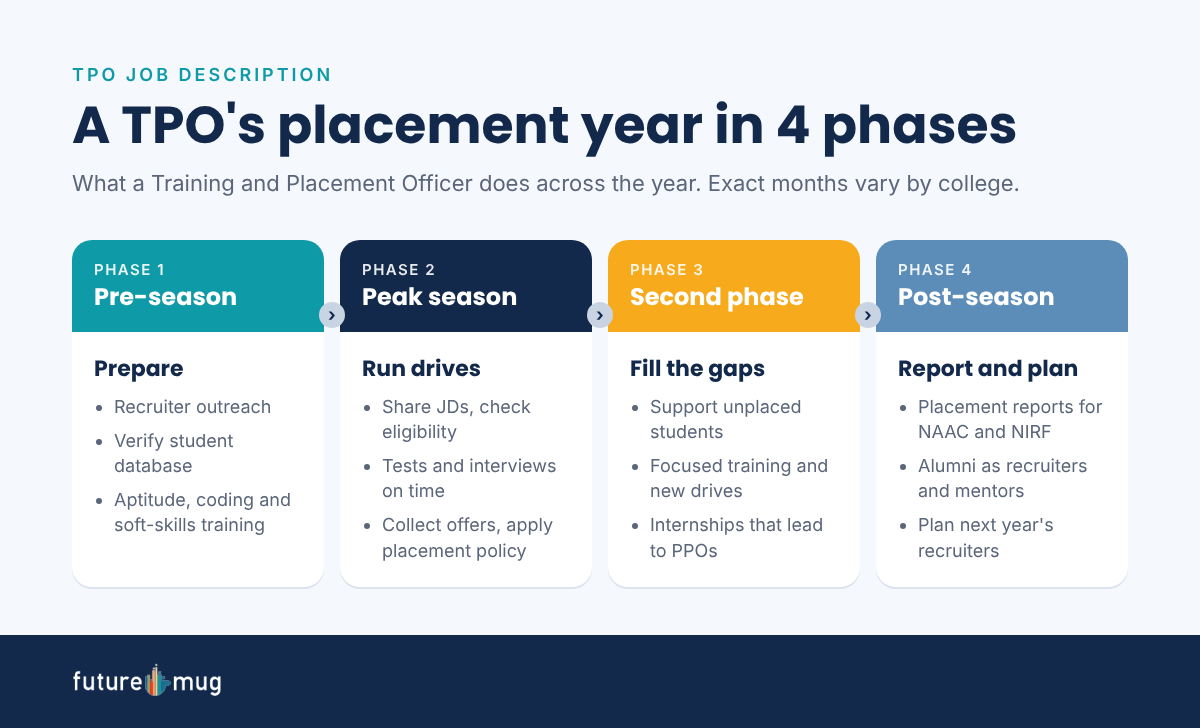
A TPO’s work runs in a yearly cycle. Exact months vary by college, but most placement teams move through four phases.
1. Before placement season: prepare
- Recruiter outreach. Contact past recruiters, add new companies and confirm visit dates.
- Student database. Collect and verify each student’s academics, backlogs, skills and resume on the TPO portal.
- Training. Run aptitude, coding, group-discussion and soft-skills sessions so students are ready before the first company arrives.
2. Peak placement season: run drives
- Drive coordination. Share job descriptions, check eligibility, book venues or test links and line up interview panels.
- Assessments and interviews. Make sure online tests and interviews run on time and results reach students quickly.
- Offer management. Collect offer letters and enforce the college’s placement policy, such as one-offer or dream-offer rules.
3. Second phase: fill the gaps
- Support unplaced students. Identify why students missed out and arrange focused training and new drives for them.
- Internships and PPOs. Bring in internships and live projects for pre-final-year students that can turn into pre-placement offers.
4. After placement season: report and plan
- Placement reports. Compile placement rate, salaries and company-wise results for management, NAAC and NIRF.
- Alumni and industry links. Invite alumni back as recruiters, mentors and guest speakers.
- Plan next year. Review what worked and update the recruiter list and training plan.
Skills and Qualifications in a TPO Job Description
Qualifications colleges usually ask for
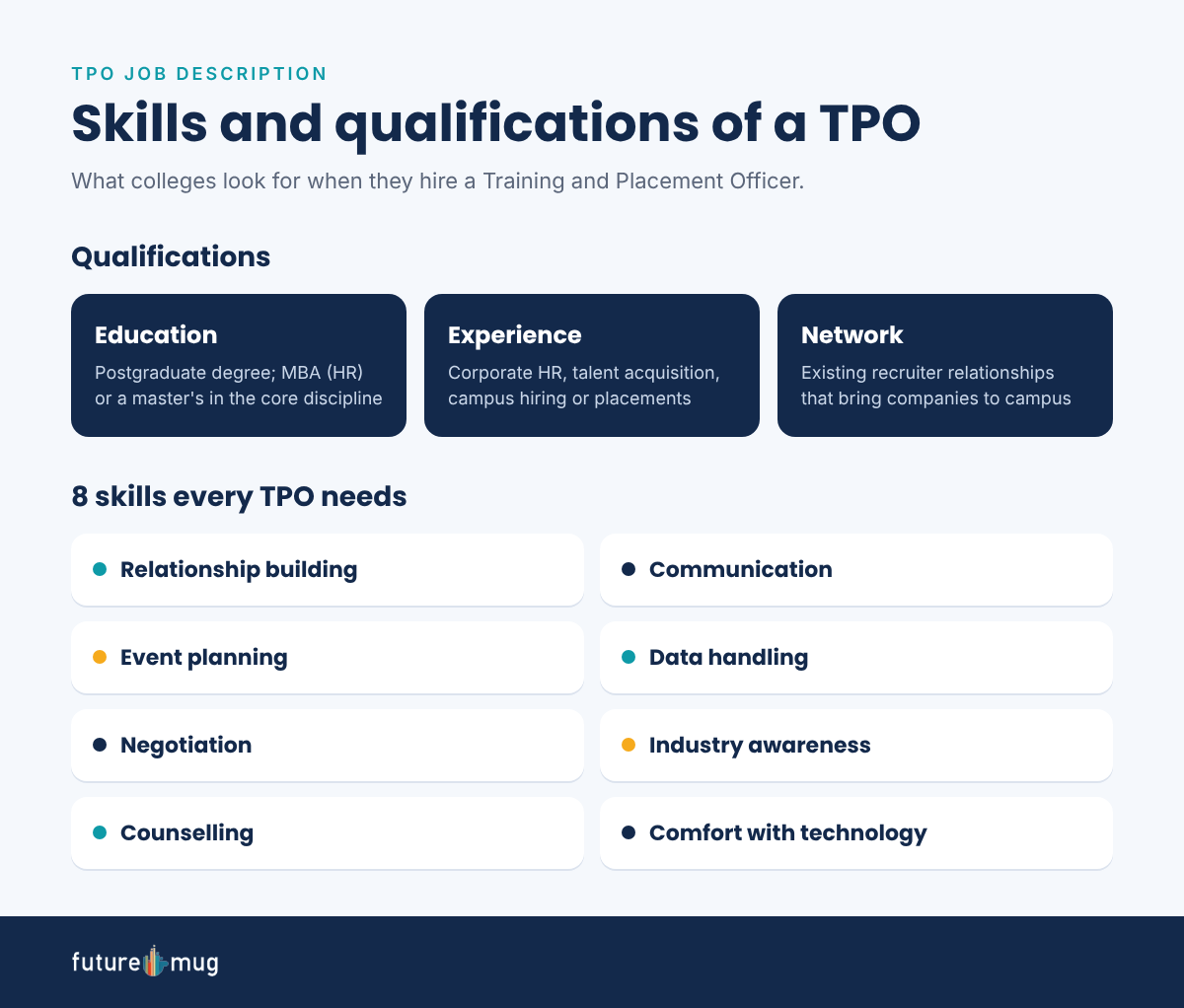
- Education: a postgraduate degree. An MBA in HR is common, and engineering colleges often prefer a technical background.
- Experience: corporate HR, talent acquisition, campus hiring or prior placement work. Senior TPO roles usually ask for several years of it.
- Network: existing relationships with recruiters, which bring companies to campus from the first season.
Skills a TPO needs
| Skill | Why it matters |
|---|---|
| Relationship building | Recruiters return to colleges where the TPO is reliable and easy to work with. |
| Communication | The TPO briefs students, faculty, management and HR teams every week. |
| Event planning | A single drive can mean tests, interviews and results for hundreds of students in a day. |
| Data handling | Eligibility checks, shortlists and placement reports all depend on clean records. |
| Negotiation | Better roles and salaries for students start with confident conversations with recruiters. |
| Industry awareness | Knowing which skills companies hire for keeps training relevant. |
| Counselling | Students need honest career guidance, especially after a rejection. |
| Comfort with technology | Placement portals, online assessments and AI interviews are now part of the job. |
How TPO Performance Is Measured
A TPO job description is only useful if everyone agrees how success is judged. Most colleges track six KPIs.
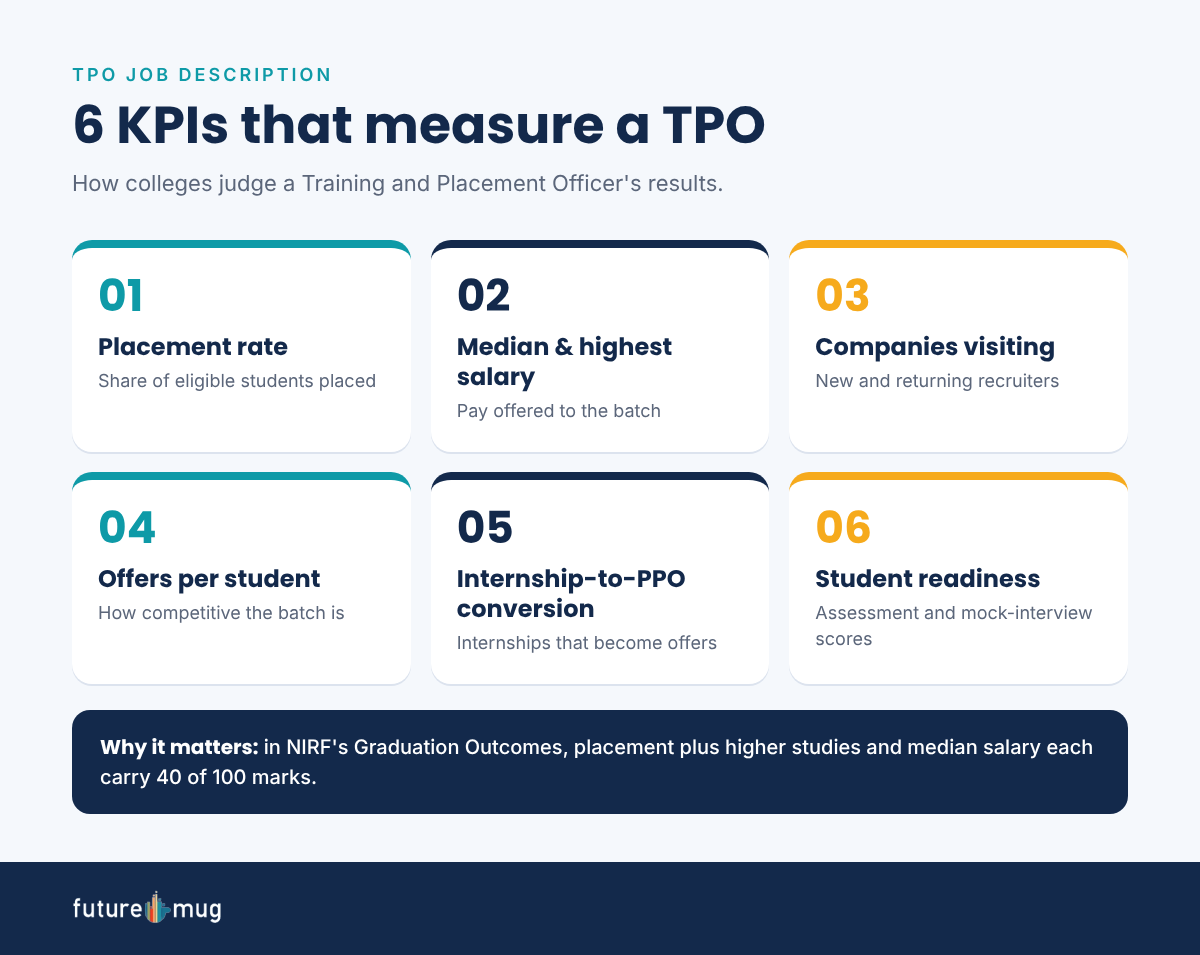
- Placement rate: the share of eligible students placed.
- Median and highest salary: the pay students are offered.
- Companies visiting: how many recruiters come to campus, and how many return.
- Offers per student: a sign of how competitive the batch is.
- Internship-to-PPO conversion: how many internships turn into pre-placement offers.
- Student readiness: assessment and mock-interview scores before placement season.
The first two feed national rankings. In NIRF’s Graduation Outcomes parameter, placement plus higher studies and median salary each carry 40 of 100 marks (NIRF framework). For targets, formulas and benchmarks, read our full guide to placement cell KPIs.
TPO vs Placement Coordinator vs Career Counsellor
| Role | Main focus | Typical person |
|---|---|---|
| Training and Placement Officer (TPO) | Leads the placement cell, recruiters and overall results | Full-time officer or senior faculty |
| Placement coordinator | Supports the TPO within one department: notices, data, drive days | Faculty member or final-year student |
| Career counsellor | Guides students on career choices and higher studies | Counsellor, mentor or faculty |
Career path for a TPO
Many TPOs start as placement executives or corporate HR and talent acquisition professionals. With results and a strong recruiter network, they can move up to Head of Placements, Director of Corporate Relations or Dean of Industry Relations, or back into senior campus-hiring roles in companies.
Tools That Help TPOs Work Faster
Much of a TPO’s week goes on work software can take over: eligibility checks, test scheduling, chasing results and rebuilding reports. Modern placement teams use:
- A placement portal and dashboard to keep student records, drives and offers in one place. See how a TPO dashboard works.
- Online assessments with AI proctoring to test a full batch remotely and share verified scores with recruiters.
- AI video interviews so students practise realistic interviews and get feedback before the real one.
- Expert interview panels for technical mock interviews when faculty time is short.
futuremug’s FutureReady brings these together, with a Candidate Dashboard for students and a College/TPO Dashboard for the placement team. Colleges can also draw on futuremug’s 5,000+ expert interviewers across 250+ IT domains for technical rounds.
Conclusion
A clear TPO job description helps colleges hire the right person and helps aspiring TPOs know exactly what the role demands. The core of the job stays the same: prepare students, bring in recruiters, run fair drives and prove results with data.
If you lead placements at your college, book a FutureReady demo to see how your TPO office can spend less time on paperwork and more time with students and recruiters.



Frequently Asked Questions
A TPO prepares students for recruitment, brings companies to campus, runs placement drives, manages offers and reports placement results to management, NAAC and NIRF.
The TPO officer full form is Training and Placement Officer, the person who heads a college's Training and Placement Cell.
A placement officer is responsible for helping a college's students get jobs. In most Indian colleges, placement officer and TPO refer to the same role.
Most colleges ask for a postgraduate degree, often an MBA in HR or a master's in the core discipline, plus experience in HR, campus recruitment or placements.
Key skills are relationship building, communication, event planning, data handling, negotiation, industry awareness, counselling and comfort with placement technology.
A TPO usually reports to the Principal, Director or Dean of the college.
Colleges track placement rate, median and highest salary, companies visiting, offers per student, internship-to-PPO conversion and student readiness.