
Employee Assessment Platform: Using Skills Tests for Internal Mobility, Promotions & L&D
What Is an Employee Assessment Platform?
An employee assessment platform is software that creates, delivers, proctors and scores skills tests for your current workforce. It turns each employee’s results into a skill profile, and each team’s results into a gap report HR and managers can act on.
Many companies already own an assessment tool for hiring. The difference is in the purpose and what happens after the test.
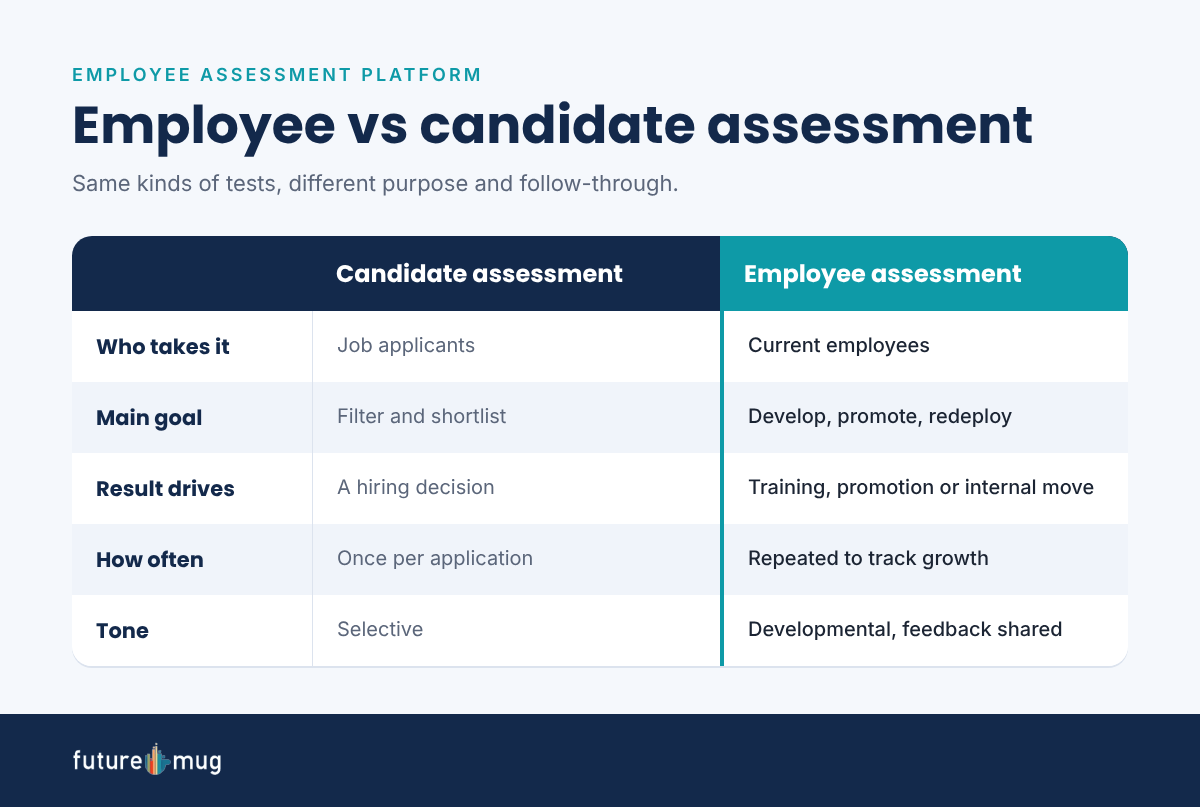
| Candidate assessment | Employee assessment | |
|---|---|---|
| Who takes it | Job applicants | Current employees |
| Main goal | Filter and shortlist | Develop, promote and redeploy |
| What the result drives | A hiring decision | A training plan, promotion or internal move |
| How often | Once per application | Repeated over time to track growth |
| Data kept | Until the role is filled | Builds a skills history for each employee |
| Tone | Selective | Developmental, with feedback shared |
For tools focused on hiring, see our guide to the best skill assessment tools and online assessment platforms for hiring.
5 Ways to Use Employee Skills Tests
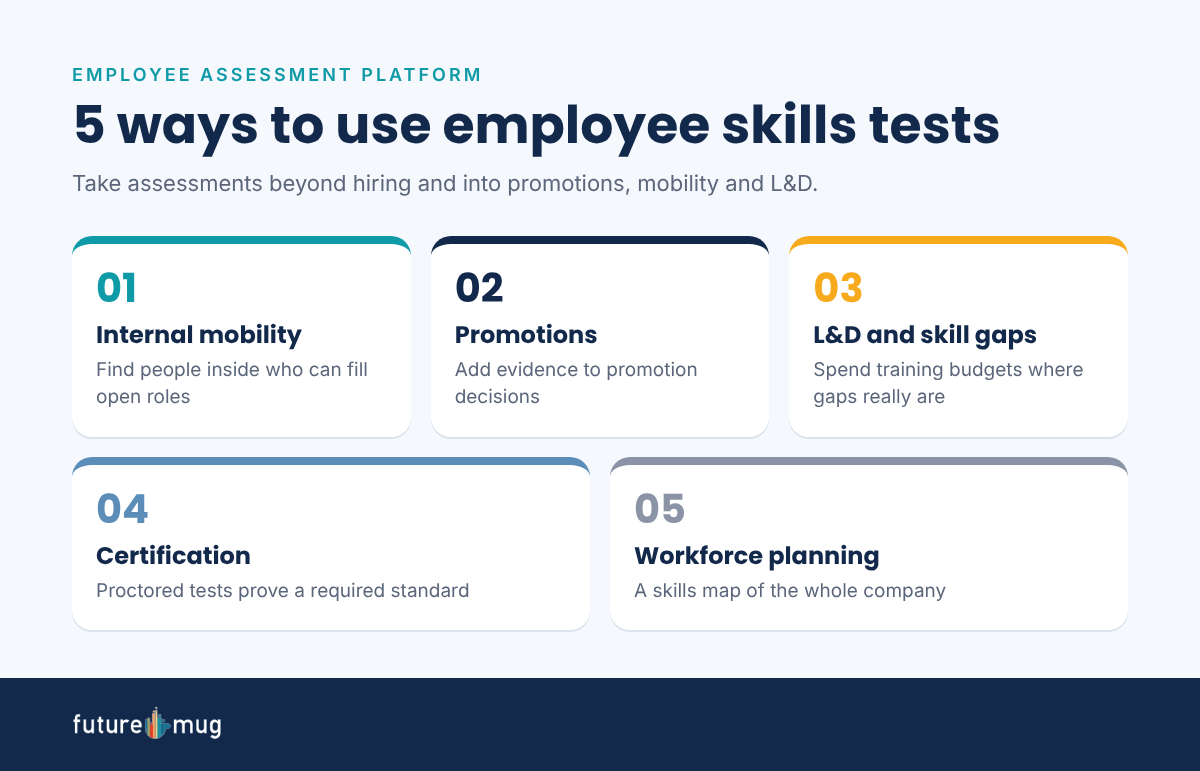
1. Internal mobility
Before you hire from outside, test whether someone inside can do the job. A support engineer who scores well on a cloud fundamentals test may be ready for a DevOps role with a short course. Internal moves are faster to fill and keep knowledge in the company.
2. Promotions
Add a skills test to the promotion process so decisions don’t rest only on manager opinion. For a team lead role, combine a domain test with a people-management scenario test and a structured interview.
3. L&D planning and skill gap analysis
Test a team before you buy training. If 70% of your analysts already know SQL but few can build dashboards, spend the budget on dashboards. Re-test after training to prove the programme worked.
4. Certification and compliance
Use proctored tests to certify that employees meet a required standard, such as product knowledge for sales teams or security awareness for everyone. AI proctoring keeps remote results trustworthy.
5. Workforce planning
Roll individual results up into a skills map of the company. It shows where you are strong, where you depend on a few people, and which skills you need to build or hire for next year.
How to Run an Employee Skills Assessment Programme in 6 Steps
Employee assessment works best as a cycle, not a one-off test.
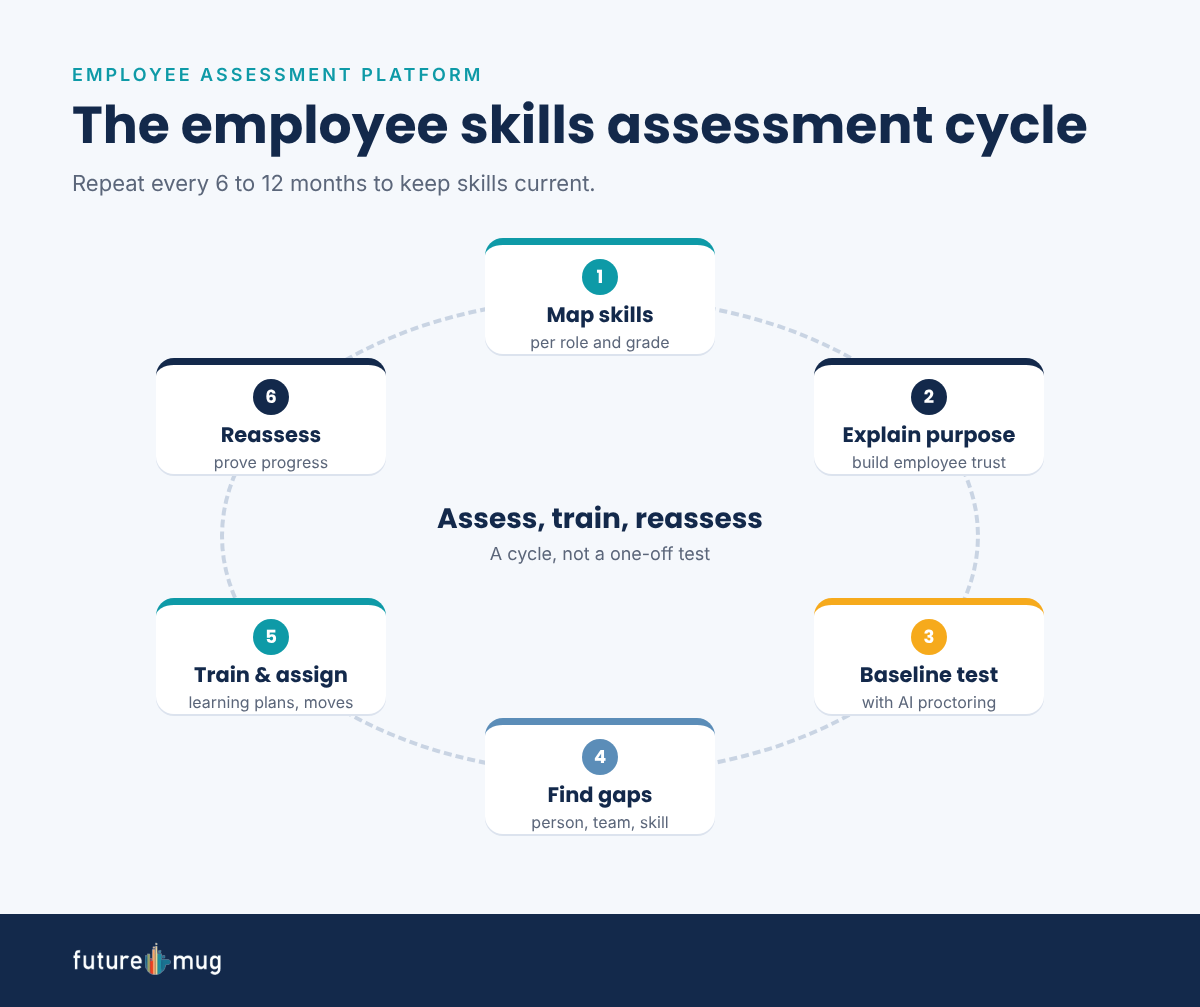
- Map the skills for each role. List the 5 to 8 skills that matter most for each job family, with the level expected at each grade.
- Explain the purpose to employees. Tell people why they are being tested, who sees the results, and that the goal is development. Trust drives honest effort.
- Run a baseline assessment. Test each team on its role skills, with AI proctoring for remote staff.
- Find the gaps. Compare scores against the expected level to see gaps for each person, team and skill.
- Train and assign. Build learning plans for the biggest gaps, and use top scorers for internal moves, promotions or mentoring.
- Reassess and report. Re-test after training to show progress, then report the change to leadership. Repeat every 6 to 12 months.
Features to Look for in an Employee Assessment Platform
| Feature | Why it matters for employees |
|---|---|
| Role-based test library + custom tests | Tests match the real job, not generic skills |
| AI proctoring | Remote results can be trusted for promotions and certification |
| Skill gap reports | Show gaps for each person, team and skill at a glance |
| Progress tracking over time | Proves training worked by comparing test rounds |
| Bulk invites and scheduling | Test whole departments without manual effort |
| Feedback reports for employees | Turn the test into a development conversation |
| Data export | Share results with your HRMS or LMS |
| Data privacy controls | Limit who sees individual scores |
futuremug’s online assessment platform covers aptitude, coding and domain tests with AI proctoring, and you can start for free. Ask our team about integrations with your HRMS or LMS during a demo.
Employee Assessments for Training Institutes
Training institutes use the same platforms to prove their courses work. A typical pattern:
- Entry test to place each learner at the right level.
- Module tests to track progress during the course.
- Final proctored test to certify learners and share verified scores with hiring partners.
Training institutes in India already use futuremug assessments this way, and can add AI video interviews so learners practise before facing employers.
Keeping Employee Assessments Fair
Employees will only take assessments seriously if they trust them. Follow these rules:
- Test job skills only. Every question should link to a skill the role needs.
- Use the same test for everyone in the same role and grade.
- Share results with the employee, not only with their manager.
- Never use one test as the only reason for a promotion or a negative decision. Combine it with performance data and a structured interview.
- Offer accessibility support such as extra time where it is needed.
- Protect the data. Limit access to individual scores and explain how long they are kept.
Conclusion
An employee assessment platform puts the same rigour you use in hiring into promotions, internal moves and training. Start with one team, run a baseline test, fix the biggest gaps and re-test to prove it worked.
Start with futuremug’s free assessment platform to test your team’s skills with AI proctoring, or talk to us about assessment outsourcing if you’d rather we run the programme for you.



Frequently Asked Questions
An employee assessment platform is software that tests the skills of current employees and turns the results into skill profiles and gap reports for promotions, internal moves and training.
Candidate assessment filters job applicants once. Employee assessment develops people already on your team, is repeated over time, and feeds training plans, promotions and internal mobility.
They are used for internal mobility, promotions, skill gap analysis for L&D, certification and compliance, and workforce planning.
Most companies assess once or twice a year, plus before and after major training programmes.
Yes. Online assessment platforms with AI proctoring let employees take tests from anywhere while keeping results trustworthy.
No. Use skills tests alongside performance data and structured interviews, so no single score decides someone's career.