
Large-Scale Candidate Evaluation: How to Screen Thousands Without Losing Signal
When you’re evaluating a few dozen candidates, you can afford depth on every one. When you’re evaluating thousands — an enterprise mass-hire, a campus drive — that depth collapses under the volume, and most teams fall back on a blunt keyword filter that scales beautifully and quietly rejects some of the best people. That’s the central problem of large-scale candidate evaluation: speed and signal pull in opposite directions. This is how to get both — the layered model that screens thousands, keeps signal at every stage, and spends human depth only where it counts.
| Quick answer: Large-scale candidate evaluation means screening thousands of applicants without letting quality collapse into a keyword filter. The way to do it is layered: a fair, valid wide screen narrows thousands to hundreds, a validated assessment narrows those to dozens, an AI-structured interview narrows further, and a human panel handles the finalists. Each stage costs more per candidate, so you spend depth only on those who’ve earned it — and you keep signal by using fair criteria, predictive tests, calibrated scoring, and anti-cheating measures at every level. |
The Scale–Signal Trade-Off
Every high-volume screening decision sits on a trade-off. Cheap, fast filters — keyword matching, a generic multiple-choice test — scale to any number of applicants, but they lose signal: they reject strong candidates who didn’t use the right words, and they pass weak ones who did. Deep evaluation — a human reading every resume, a full interview for everyone — keeps the signal but doesn’t scale past a few hundred without an army of recruiters.
“Losing signal” is the precise failure to watch for: it means your evaluation is no longer telling you who’s actually good. At scale, it shows up as good candidates filtered out before anyone looks, and as a shortlist that ranks on the wrong things. The whole art of large-scale evaluation is refusing the trade-off — scaling the volume without accepting the loss.
The Layered Evaluation Model
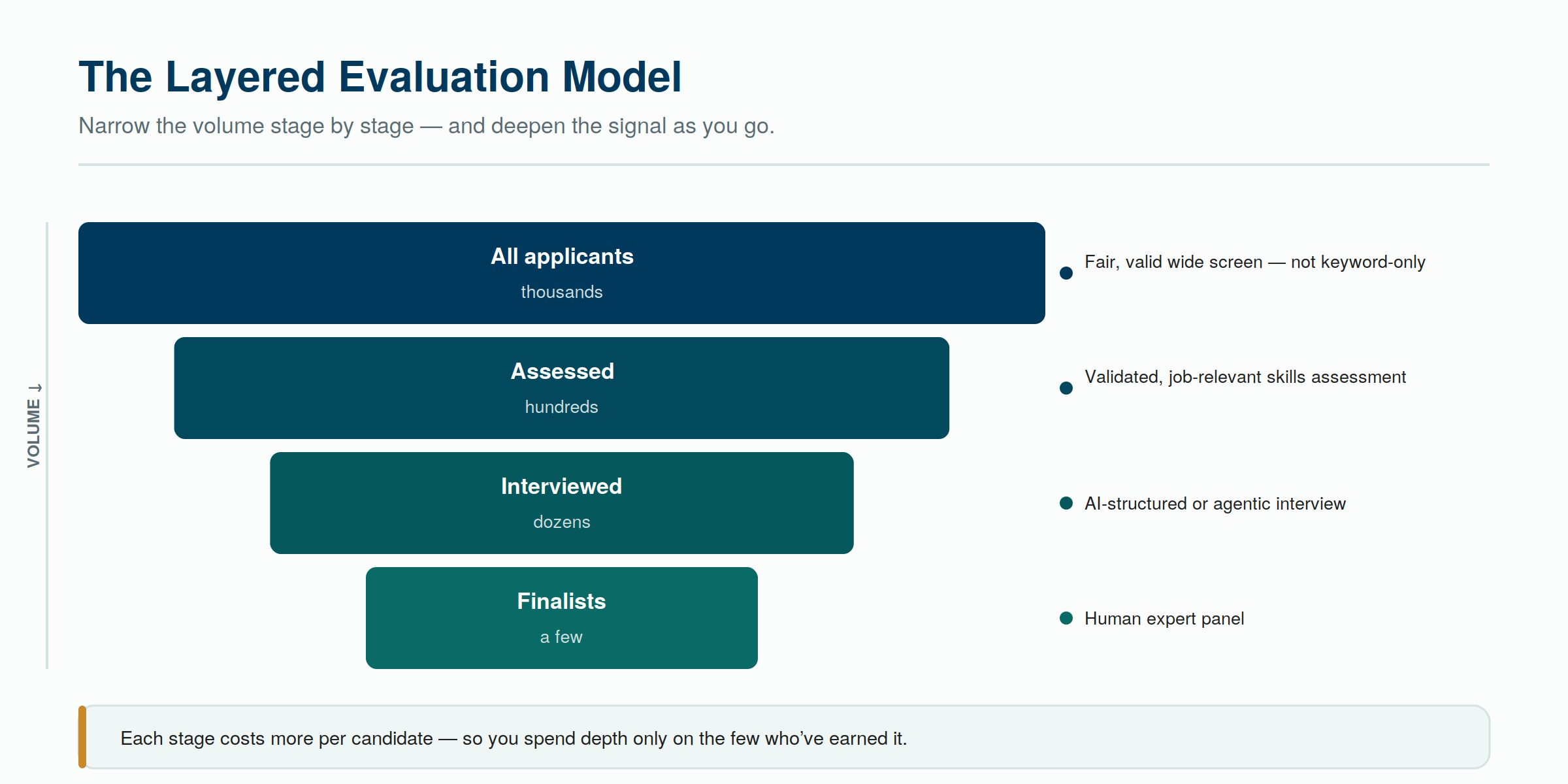
The way out is not one clever filter but a sequence of them, each narrowing the field and deepening the assessment. Think of it as a funnel where the cost per candidate rises as the numbers fall — so you only ever apply expensive evaluation to candidates who’ve already cleared a cheaper one.
A fair, valid wide screen takes thousands down to hundreds. A validated assessment takes hundreds to dozens. AI-structured or agentic interviews narrow further, and human expert panels handle the finalists. No single stage carries the whole weight, which is exactly why signal survives — each candidate is assessed at a depth appropriate to how far they’ve come.
How to Keep Signal at Each Stage
Layering only preserves signal if each layer is built to preserve it. A funnel of bad stages is just a slower way to lose good people. Here’s what “good” means at each level.
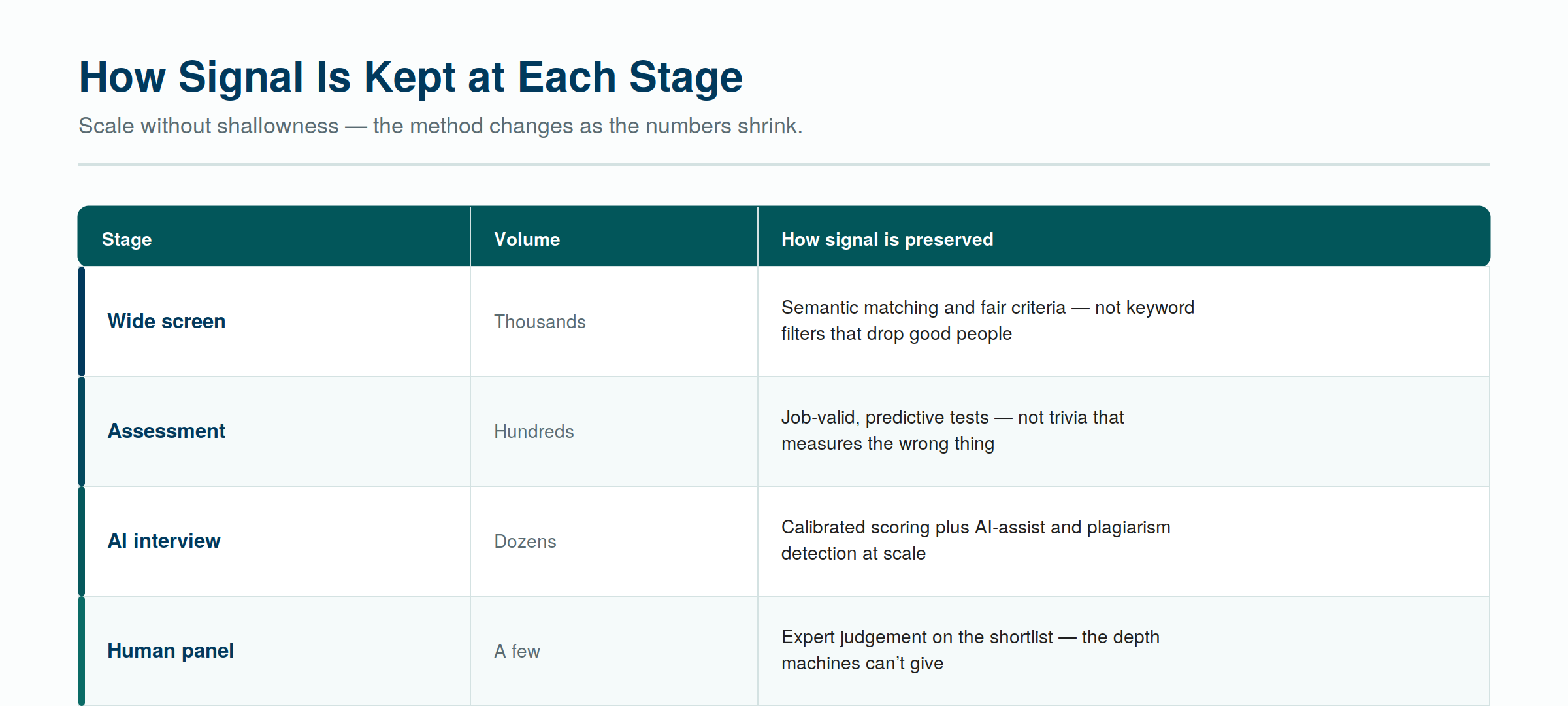
The wide screen must be semantic and fair, not a literal keyword filter that drops qualified people. The assessment must be job-valid and predictive, not trivia that measures the wrong thing. The AI interview must use calibrated scoring with anti-cheating built in, because cheating scales as fast as everything else. And the human panel does what no machine can — apply expert judgement to the shortlist. Get each layer right and the funnel concentrates signal rather than diluting it.
Where Signal Leaks (and How to Plug It)
Even a well-designed funnel springs leaks at scale. These are the five most common, and each has a specific fix — worth auditing your own process against.
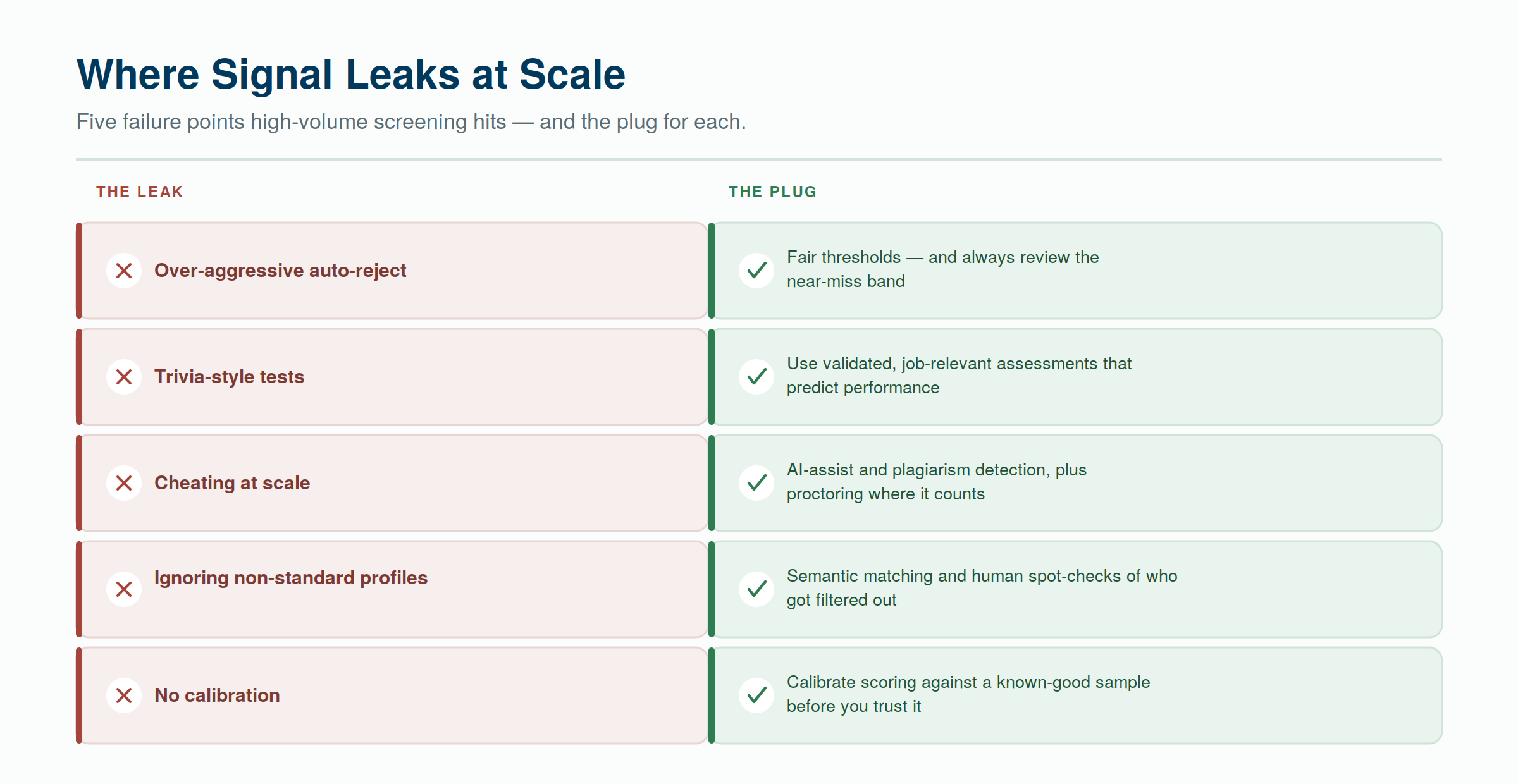
The leak that costs the most quietly is over-aggressive auto-rejection. When you’re cutting thousands to hundreds, the candidates just below the threshold are invisible — and that near-miss band is exactly where strong non-standard profiles hide. Review it. Checking who got filtered out, not just who got through, is the single most valuable habit in large-scale evaluation. The same discipline underpins how AI builds shortlists and how JD–resume matching is scored.
Large-Scale Evaluation in a Campus Drive
Nowhere is this more concrete than a campus placement drive: thousands of students, a compressed window, and outcomes that have to be fair and defensible. The layered model maps onto a drive almost one-to-one — here’s an illustrative shape.
| Drive stage | From → To | What runs |
| Registration & screen | 5,000 → 1,500 | Fair eligibility screen and semantic resume match |
| Online assessment | 1,500 → 300 | A validated, proctored skills assessment |
| AI interview round | 300 → 80 | AI-structured or agentic first interviews, at scale |
| Panel & offers | 80 → offers | Human expert panels for the shortlist |
The numbers are illustrative, but the structure holds: each stage cuts the field and raises the depth, so a drive that starts with five thousand registrations ends with a defensible set of offers — without a keyword filter deciding anyone’s future. Running that end to end at campus scale is its own operational challenge, covered in our campus hiring platform guide.
Large-scale candidate evaluation isn’t about finding one filter clever enough to handle thousands — it’s about layering fair, valid stages so the volume narrows while the signal deepens. Automate the wide, repetitive screening; reserve human depth for the finalists; keep every stage fair, validated, and calibrated; and always look at who got filtered out. Do that, and you screen thousands without the loss of signal that makes scale feel like a compromise — because, done right, it isn’t one.
futuremug is built for exactly this use case — fair semantic screening, validated assessments, AI interviews, and expert panels under one system, so signal carries from the first screen to the final offer. If you’re evaluating at enterprise or campus scale, that continuity is what keeps the funnel honest.



Frequently Asked Questions
It's the process of assessing a very high volume of candidates — thousands in an enterprise mass-hire or a campus drive — to identify the strongest fits. The challenge that defines it is doing so at volume without losing signal: cheap filters scale but wrongly reject good people, while deep evaluation keeps signal but can't cover thousands. Large-scale evaluation done well uses a layered approach that gets both.
Layer the evaluation. Start with a wide screen that's fair and valid rather than a literal keyword filter, then narrow with a validated assessment, then an AI-structured interview, then a human panel for finalists. Each stage handles fewer candidates and goes deeper, so you preserve signal where it matters and spend expensive human time only on the few who reach the top.
Five common leaks: over-aggressive auto-rejection that drops near-miss candidates, trivia-style tests that measure the wrong thing, cheating that goes undetected at volume, matching that ignores non-standard profiles, and scoring that was never calibrated against a known-good sample. Each is fixable — with fair thresholds, validated assessments, anti-cheating measures, semantic matching, and calibration.
Not if it's used as the wide part of a funnel with humans on the finalists. Automation is strongest at applying consistent, fair criteria across thousands — something no human team can do at that volume. Quality drops only when automation is treated as the whole process instead of the first, reviewable layer of it. The model is automate the volume, preserve the signal, keep humans on the decisions.
A campus drive is the textbook case: thousands of students, a fixed window, and a need for defensible outcomes. The layered model maps directly — a fair registration screen, a proctored assessment, AI-structured interviews, then panels for finalists. The operational side of running that at campus scale is covered in our campus hiring platform guide.
A fair, semantic screening layer; a validated, proctored assessment platform; AI interviews for high-volume rounds; and human panels for finalists — ideally under one system so signal and data stay consistent across stages. The key is that the stages connect: a candidate's evidence should carry forward, not restart at each layer.