
How AI Tools Create Candidate Shortlists and Where Humans Stay in the Loop
If you’ve watched an AI screening tool turn hundreds of applications into a ranked shortlist in seconds and wondered what actually happened in there, this is the plain-English version. No jargon, no hype — just how AI tools create shortlists, step by step, and the parts of the process where you, the recruiter, are still very much in charge.
| Quick answer: AI tools create shortlists in four steps: they parse each application into structured data, match that data against the role’s criteria, score and rank candidates by fit, and surface the top few with reasons. A human sets the criteria going in and reviews, audits, and decides coming out — the AI sorts and surfaces the list, but people still choose who to hire. |
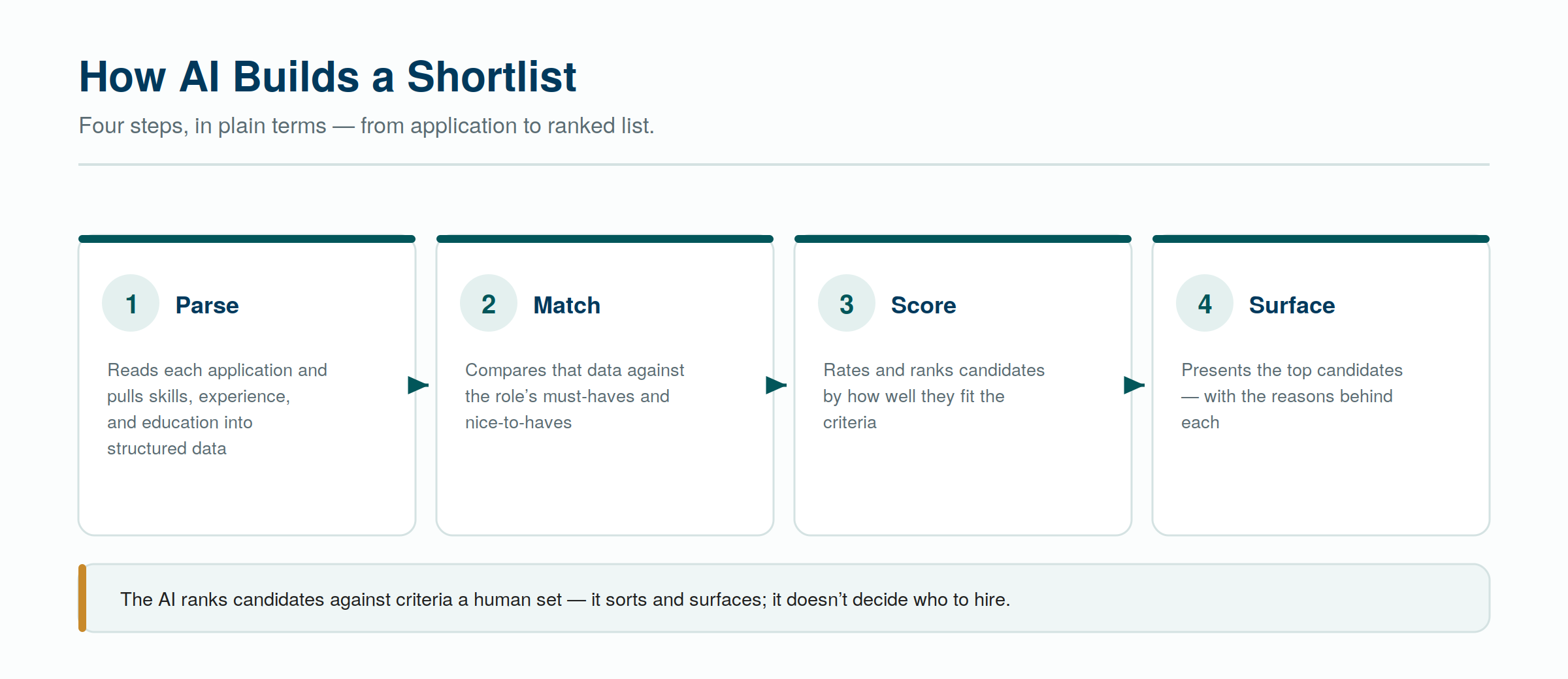
How AI Tools Create Shortlists, Step by Step
Under the hood, almost every AI shortlisting tool runs the same four steps. Knowing them takes the mystery out of the black box — and makes it obvious where the tool can go wrong and where you need to look.
1. Parse the applications
First, the tool reads each application — resume, form answers, profile — and extracts the useful parts into structured data: skills, years of experience, job titles, education, and so on. This is just turning messy documents into a tidy table it can work with. It’s also the first place errors creep in: an unusual resume format or a skill described in unexpected words can be misread here.
2. Match against the criteria
Next, it compares each candidate’s structured data against the role’s requirements — the must-haves and nice-to-haves. Crucially, those criteria come from a human. The tool isn’t deciding what matters; it’s checking candidates against what you told it matters. Good criteria produce a useful match; vague or wrong criteria produce a useless one, however clever the tool.
3. Score and rank
The tool then turns the match into a number — a fit or relevance score — and ranks candidates by it. This is what lets it sort hundreds of applicants in seconds. The score is a summary, not a verdict: two candidates a point apart are effectively tied, and a ranking is a starting order for review, not a finishing order for hiring.
4. Surface the shortlist
Finally, it presents the top candidates as a shortlist. The best tools show the reasons — which criteria each candidate met — so you can see why someone was surfaced rather than taking the ranking on faith. A shortlist with reasons is reviewable; a bare ranked list is not, and that difference matters more than the score itself.
Where Humans Stay in the Loop
Here’s the part that gets lost in the hype: AI shortlisting automates the tedious middle of the process, but people own both ends. The tool does the sorting no human wants to do by hand — it doesn’t do the judging.
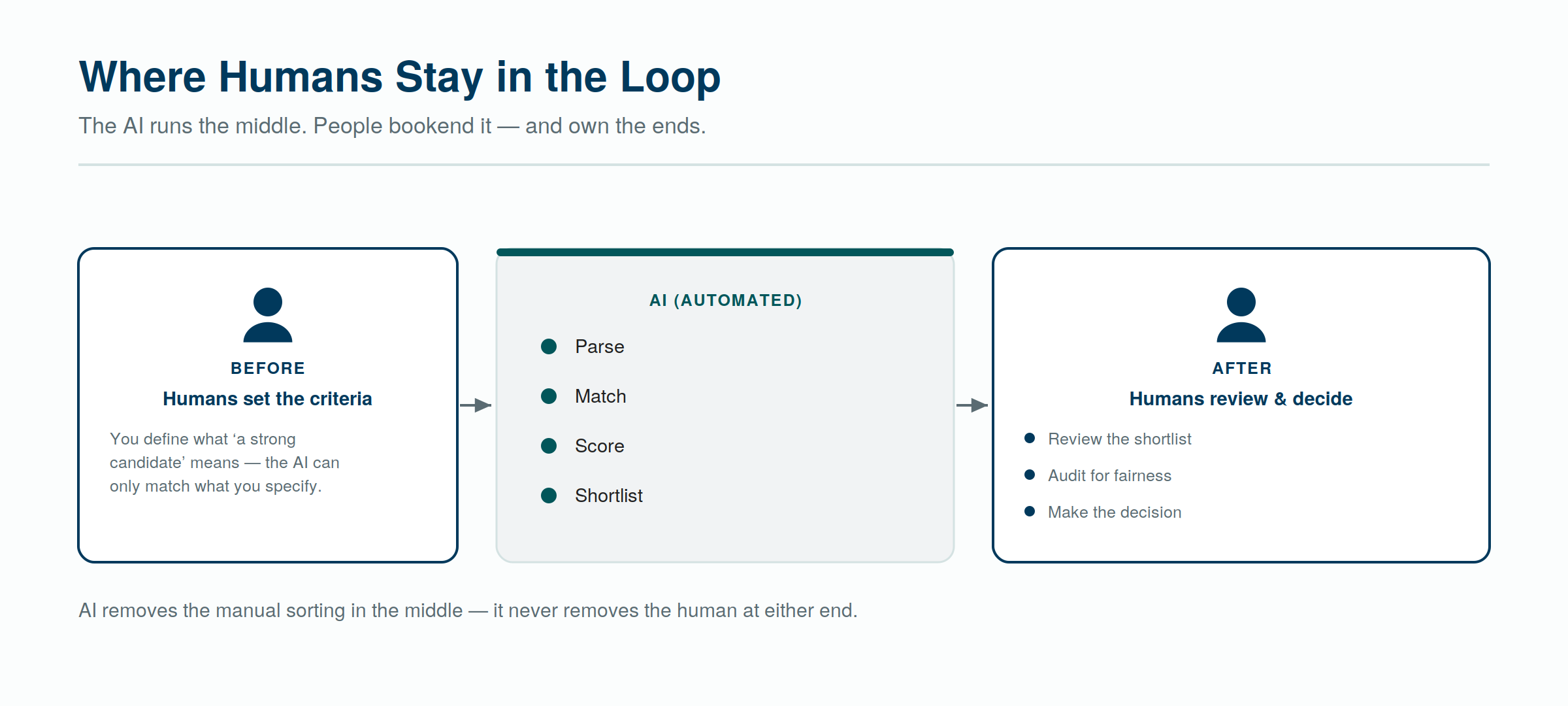
Going in, you define what a strong candidate looks like — and the tool can only match what you specify. Coming out, you review the shortlist, audit it for fairness, and make the actual decisions. The AI removes the manual sorting between those two points; it never removes the human at either one. That’s not a limitation to apologise for — it’s how the tool is meant to work.
What AI Is Good At — and What It Isn’t
Used honestly, an AI shortlisting tool is genuinely useful for what it’s good at, and genuinely risky where it isn’t. It’s good at speed, consistency, and volume — applying the same criteria to every one of a thousand applicants without tiring or drifting, which is something no human team can match.
What it isn’t good at is context and nuance. It can misjudge a career switcher whose past titles don’t match the role, misread a gap that has a perfectly good explanation, or over-weight a credential that isn’t actually necessary. And left unaudited, it can quietly reflect bias in its criteria or data. None of that makes it unusable — it makes human review non-negotiable.
What to Check Before You Trust a Shortlist
Before you act on an AI-generated shortlist, a quick four-point check keeps a fast shortlist a fair and accurate one.
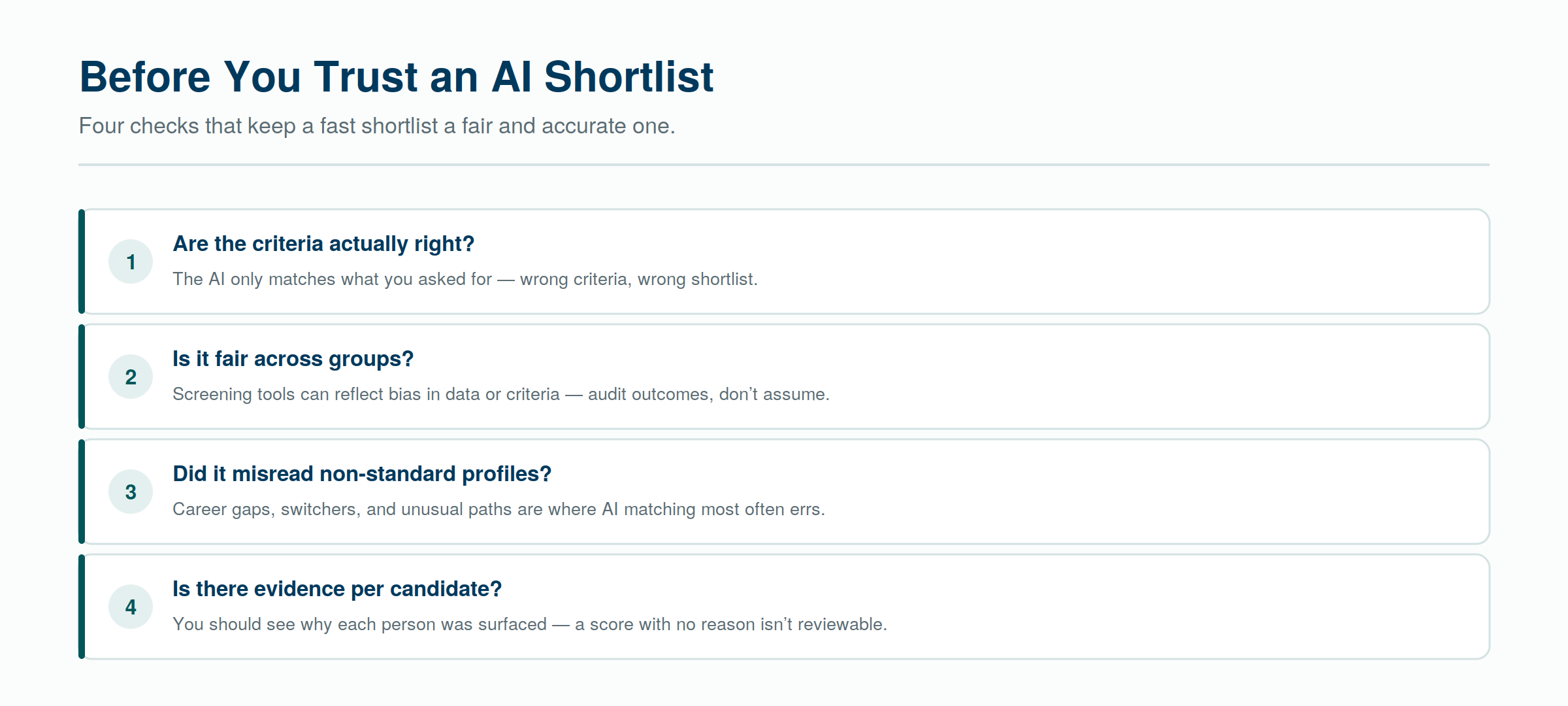
The habit that matters most: look at who got filtered out, not just who got surfaced. The candidates an AI wrongly rejects are invisible unless you go looking — and they’re often exactly the non-standard profiles worth a second look.
How AI tools create shortlists is no mystery: they parse applications, match them to criteria you set, score and rank the results, and surface the top few. They’re fast, consistent, and tireless at sorting — and blind to context, capable of bias, and prone to misreading unusual profiles. That’s exactly why the model is human-in-the-loop: the AI builds the list, and you set the rules, check the work, and make the call.
If you’re exploring AI in screening, the same principle carries into interviews. futuremug’s AI interviews handle the high-volume rounds that follow a shortlist, with the evidence and human oversight this piece argues for — so speed never comes at the cost of a fair look.



Frequently Asked Questions
In four steps. First they parse each application, extracting skills, experience, and education into structured data. Then they match that data against the role's must-have and nice-to-have criteria. Then they score and rank candidates by how well they fit. Finally they surface the top candidates, ideally with the reasons each was chosen. Throughout, they're matching against criteria a human defined — they sort and rank, they don't decide.
No. They rank candidates against your criteria and present a shortlist; the hiring decision stays with people. A recruiter sets what ‘good’ means going in, and reviews the shortlist, audits it for fairness, and decides who advances coming out. The AI removes the manual sorting in the middle — it doesn't remove the human at either end.
They can be, which is why human oversight matters. A screening tool matches on the criteria and data it's given, so it can reflect bias in either — for example, over-weighting a credential that isn't actually necessary. The responsible approach is to audit outcomes across groups rather than assume fairness, and to keep a human reviewing the list. Good tools also show why each candidate was surfaced, so decisions are reviewable.
Yes — most often on non-standard profiles. Candidates with career gaps, industry switchers, and unconventional paths are where AI matching errs most, because they don't fit the usual pattern. That's a key reason to treat the shortlist as a strong first pass to review, not a final answer, and to check who was filtered out as well as who was surfaced.
Four things: whether the criteria are actually right (wrong criteria produce a wrong shortlist), whether it's fair across groups, whether it misread any non-standard profiles, and whether there's evidence for why each candidate was surfaced. A score with no reason behind it isn't reviewable — and a shortlist you can't review isn't one you should act on blindly.
The shortlist is the start of the human part of hiring, not the end of the process. Shortlisted candidates typically move into interviews — increasingly AI-structured or agentic first rounds for volume, then human panels for depth — with people making the calls at each stage.