
eSkill Alternatives: 7 Assessment Platforms Worth Comparing in 2026
If you’re evaluating alternatives to eSkill, a ranked list of “best” platforms won’t get you far — because the best assessment tool for a company hiring developers is the wrong tool for one screening customer-support agents. What actually helps is knowing the real options, understanding which category each belongs to, and having a clear way to compare them for your needs. That’s what this guide gives you: seven alternatives worth comparing, the eight criteria to judge any of them on, and a checklist for switching without disrupting your hiring.
| Quick answer: There’s no single best eSkill alternative — the right one depends on what you’re testing for. Seven platforms are worth comparing in 2026, spanning coding-focused tools (HackerRank, Codility), broad test libraries (TestGorilla, iMocha, Vervoe), enterprise proctored assessment (Mercer | Mettl), and assessment joined to interviews (futuremug). Compare any shortlist on eight criteria — skills coverage, technical depth, proctoring, integrations, AI features, validity, pricing, and support — and run a paid pilot before you switch. |
Why Teams Look for an eSkill Alternative
eSkill is an established skills-assessment platform, and teams evaluate alternatives to it for the same ordinary reasons they re-examine any vendor — not because of any single flaw. Your role mix may have shifted and you need different test coverage. You might want deeper technical or coding assessment than your current setup offers. You may need tighter ATS integration, more modern AI or interview-integration features, or a pricing or support model that better fits how you hire now.
The useful first step isn’t to read reviews — it’s to write down which of these actually apply to you. “We’ve started hiring engineers and need real coding tests” points to a very different alternative than “we want testing and interviews in one place.” Naming your reason narrows seven options to two or three before you compare anything.
How to Compare Assessment Platforms
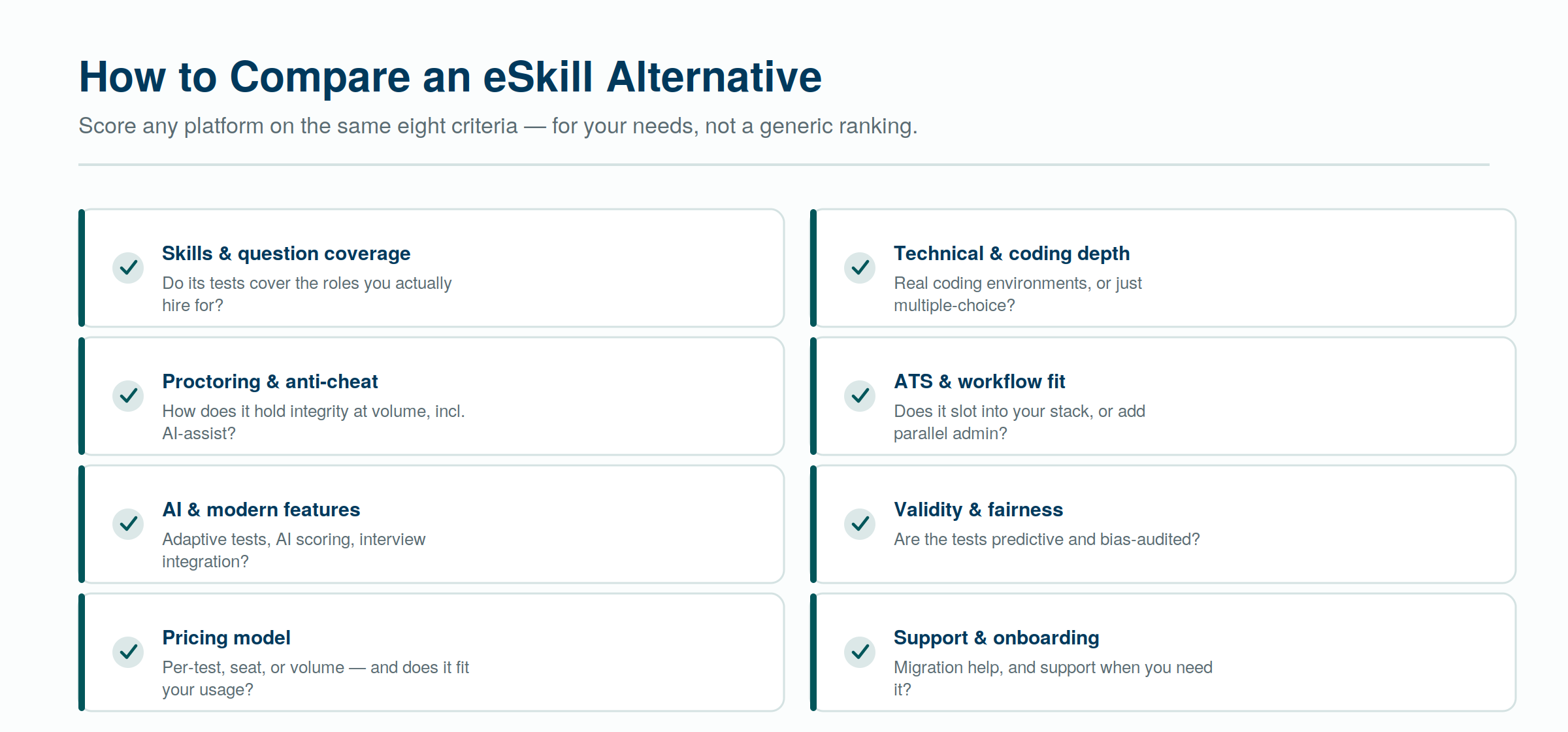
Once you know your reason, compare candidates on the same eight criteria so you’re weighing like with like. Not every criterion matters equally to you — weight them by your hiring — but each one is worth a deliberate look.
Skills and question coverage. Does its test library actually cover the roles you hire for, or just the common ones?
Technical and coding depth. Real coding environments and work-sample tasks, or multiple-choice about code?
Proctoring and anti-cheating. How does it hold integrity at volume — and does it detect AI-assisted answers, the live 2026 concern?
ATS and workflow integration, AI features, validity, pricing, and support. Whether it fits your stack, offers modern features like adaptive testing or interview integration, produces valid and fair results, prices in a way that suits your usage, and supports you through migration and beyond.
The 7 Alternatives Worth Comparing
Here are seven established options, grouped by what each is best known for. Treat this as a starting shortlist to evaluate against your own needs — not a ranking — and verify each platform’s current features and pricing directly, because both change.
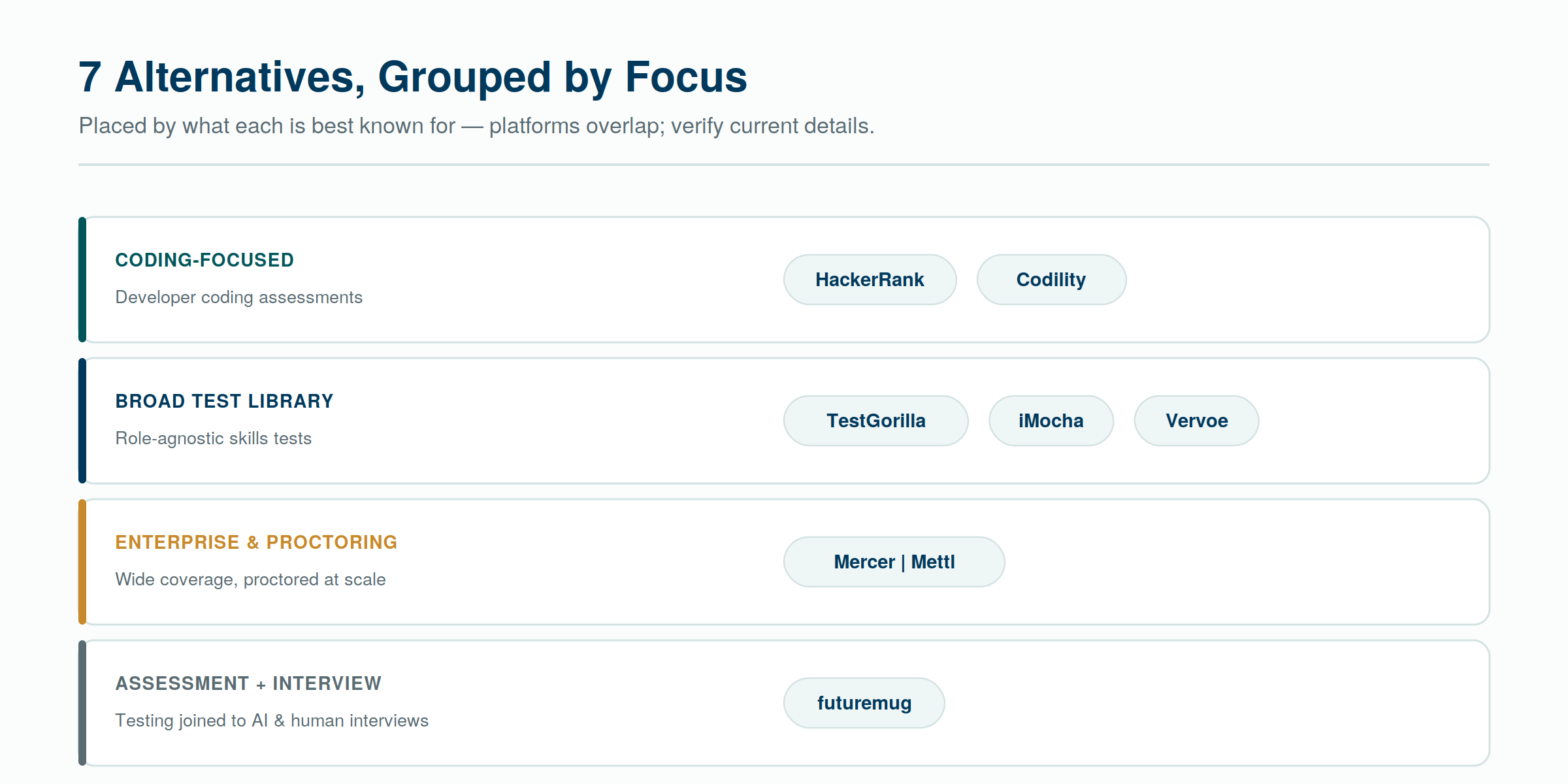
Coding-focused: HackerRank and Codility
Both are well known for developer and technical assessment — coding challenges in real environments rather than multiple-choice. The fit if engineering roles are the core of your hiring and code quality is what you most need to measure. Check how each handles the specific languages, seniority levels, and role types you hire for.
Broad test libraries: TestGorilla, iMocha, and Vervoe
These are known for wide, role-agnostic coverage — large libraries of tests across many job types, with Vervoe in particular associated with skills-based, AI-assisted grading. The fit if you assess many different roles and want breadth from one tool. Check whether the depth in your specific roles matches the breadth, and how each approaches validity and fairness.
Enterprise and proctoring: Mercer | Mettl
Known for broad assessment coverage with strong proctoring at enterprise scale. The fit if you run high-volume, high-stakes assessment where invigilation and integrity are paramount. Check the integration and support terms against your enterprise requirements.
Assessment joined to interviews: futuremug
In the interest of being clear about whose guide this is: futuremug is the option for teams who want assessment and interviewing in one system rather than a standalone test tool. It pairs skills assessments with AI-structured and human interviews, so a candidate’s screening evidence carries through to the interview stage rather than restarting. It’s a strong fit if you want screening-to-interview continuity, and a weaker fit if you only need a standalone test library — in which case one of the dedicated platforms above will serve you better.
Before You Switch: A Checklist
Choosing a platform is half the job; moving to it is the other half. Changing assessment vendors is a migration, and running it like one avoids the disruption that makes switching feel risky.
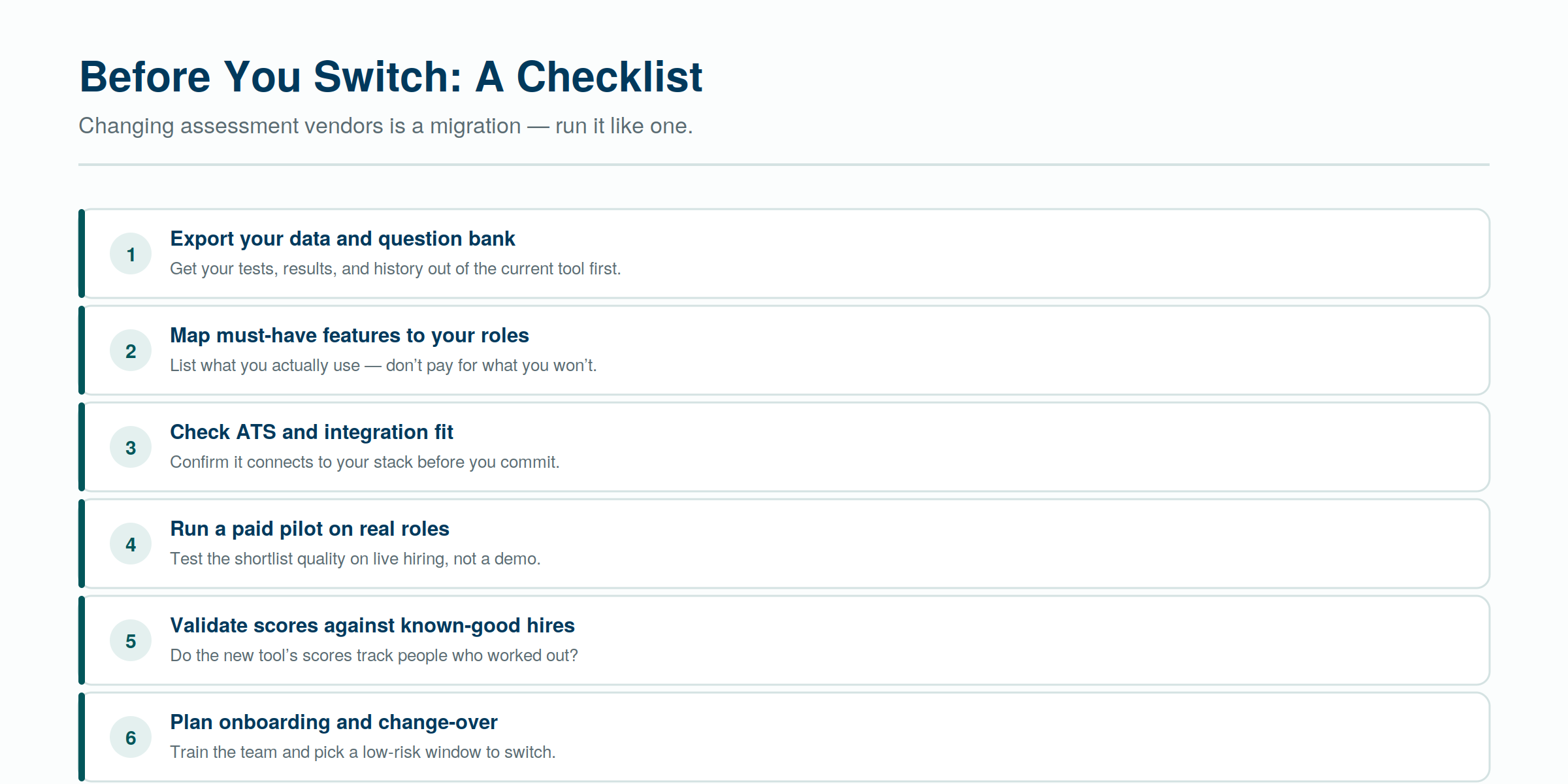
The step that de-risks everything is the paid pilot. Run the new platform on real, live roles — not a sample demo — and check whether its shortlists match the quality you’d expect, ideally validating its scores against people you’ve already hired who worked out. A tool that looks great in a sales demo can still miss your best candidates, and a pilot is the only way to find that out before you’ve committed.
The best eSkill alternative is the one that fits what you’re testing for — which is why the honest answer is a shortlist and a method, not a winner. Name your reason for switching, match it to the right category, compare your two or three finalists on the same eight criteria, and pilot before you commit. Do that, and you’ll switch to a platform that genuinely fits your hiring rather than the one with the best marketing.
If your reason for looking is that you want assessment and interviews working together rather than as separate tools, that’s where futuremug fits — and a pilot on your own roles is the fastest way to see whether it’s the right switch for you. If it isn’t, this guide has done its job either way.



Frequently Asked Questions
There isn't a single best one — it depends on your roles and priorities. If you hire developers, a coding-focused platform fits; if you assess many role types, a broad test library suits; if you need enterprise proctoring at scale, that's a different category; and if you want testing joined to interviews in one system, that's another again. Match the category to your need first, then compare the specific platforms on the same eight criteria.
For the same reasons teams re-evaluate any assessment vendor: their role mix has changed and they need different test coverage, they want deeper technical or coding assessment, they need better ATS integration, they're after modern AI or interview-integration features, or the pricing or support no longer fits how they hire. None of these is specific to eSkill — they're the normal triggers for reviewing any tool, and they're worth listing out for your own situation before you shop.
Eight criteria: skills and question coverage for your roles, technical and coding depth, proctoring and anti-cheating (including AI-assist detection), ATS and workflow integration, AI and modern features, validity and fairness, pricing model, and support and onboarding. Score your shortlist on the same list so you're comparing like with like — and weight the criteria by what actually matters to your hiring.
Treat it as a migration: export your data and question bank from the current tool first, map the features you actually use, confirm ATS and integration fit, run a paid pilot on real roles, validate the new tool's scores against people who worked out, and plan onboarding for a low-risk window. The pilot is the real test — a platform that demos well can still miss your best candidates.
It's an alternative for teams who want assessment and interviewing in one system rather than a standalone test tool. futuremug pairs skills assessments with AI and human interviews, so screening carries through to the interview stage. If you only need standalone tests, a dedicated assessment library may fit better — which is exactly the kind of honest match this guide is for.
Pricing varies widely by platform, model (per-test, per-seat, or volume), and your usage — and it changes over time — so compare current quotes directly rather than relying on any published figure. The more useful comparison is cost against value for your hiring volume: a cheaper tool that misses good candidates or doesn't integrate can cost more than it saves.