
How to Implement AI Based Interview Platform for a Modern TA Stack
What is an AI based interview platform?
- AI-assisted interviewer: The system helps a human interviewer prepare questions, follow a competency framework, capture notes, or summarize evidence.
- Automated first-round interview: The system conducts a defined screening conversation and produces a transcript, summary, or evaluation for review.
- AI-enhanced interview platform: The platform combines scheduling, video, coding, question libraries, dashboards, reports, and AI-generated insights.
- Agentic interview workflow: The system adapts questions or follow-ups based on a job description, candidate profile, and previous answer while following configured constraints.
- Hybrid hiring stack: AI handles repeatable screening and coordination while recruiters, hiring managers, and expert interviewers retain decision responsibility.
Why implementation matters more than the feature list
- Purpose: Which hiring problem is the platform solving?
- Fit: Which roles, stages, and candidate groups are suitable?
- Evidence: What information should the system collect and present?
- Governance: Who can review, override, audit, and improve the workflow?
- Measurement: How will the organization know that hiring quality and candidate experience are improving?
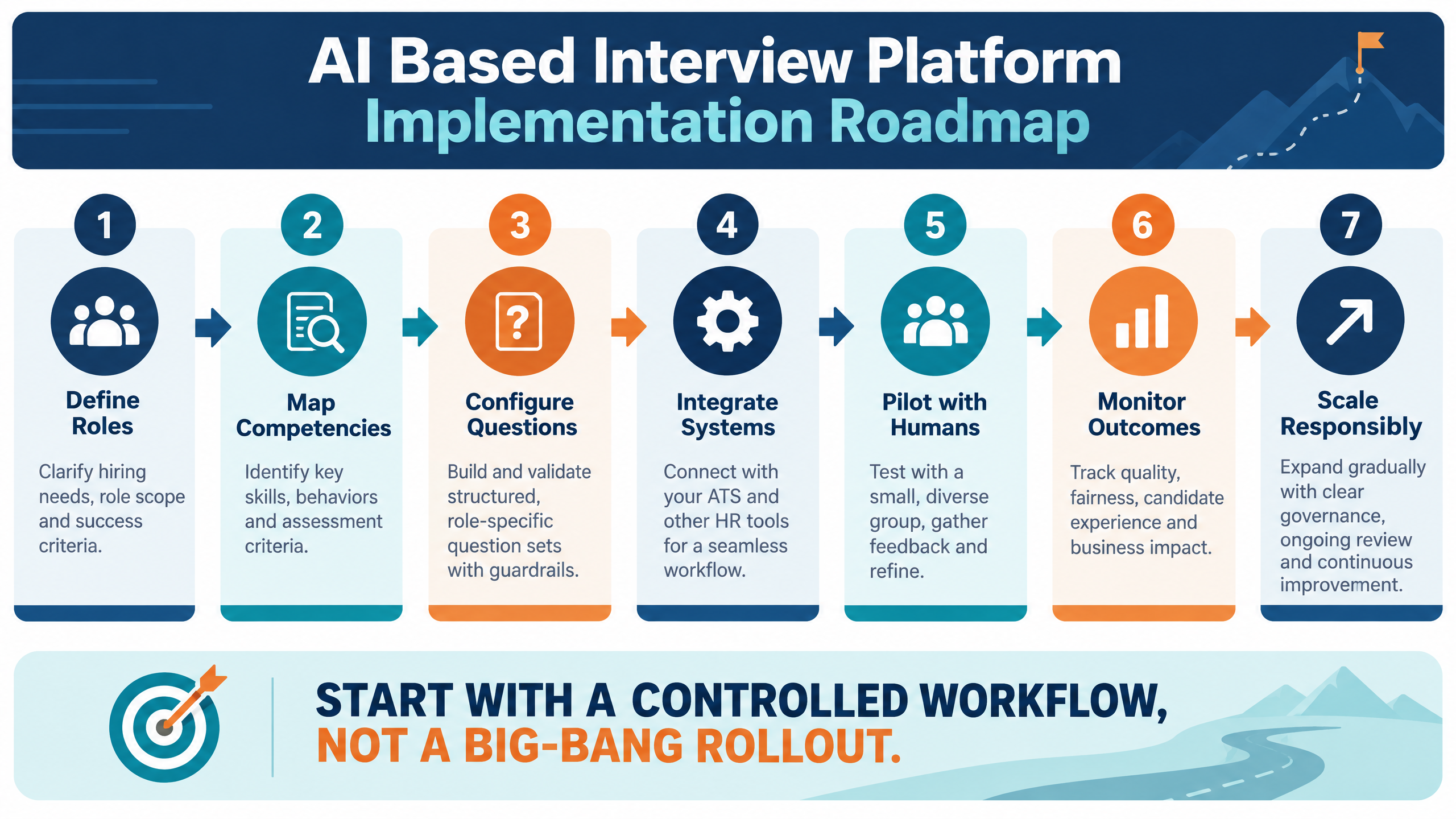
10 steps to implement an AI based interview platform
1. Define the hiring problem and implementation boundary
|
Implementation decision
|
Example definition
|
|
Target stage
|
First-round technical or behavioral screening.
|
|
Candidate group
|
Applicants for a defined role family and location.
|
|
AI responsibility
|
Ask approved questions, conduct follow-ups within boundaries, and summarize responses.
|
|
Human responsibility
|
Review evidence, handle exceptions, decide progression, and approve changes.
|
|
Excluded use
|
Fully automated final rejection without review.
|
|
Success measure
|
Faster screening with stable quality and acceptable candidate feedback.
|
2. Choose roles with a clear competency map
3. Map the interview plan to evidence
- Role and level.
- Competency or skill being evaluated.
- Core question.
- Permitted follow-up areas.
- Expected evidence.
- Scoring anchors.
- Disallowed or irrelevant topics.
- Escalation conditions.
- Human review requirement.
4. Configure questions, prompts, and scoring rules
5. Design the candidate experience before launch
6. Integrate the platform with the TA stack
|
Data area
|
Implementation question
|
|
Candidate identity
|
Which system is the source of truth for name, contact details, and application status?
|
|
Job and competency data
|
Which team approves job descriptions, skills, and interview criteria?
|
|
Interview status
|
How are invited, started, completed, paused, reviewed, and escalated states synchronized?
|
|
Recordings and transcripts
|
Where are they stored, who can access them, and how long are they retained?
|
|
Scores and reports
|
Which outputs are visible to recruiters, interviewers, managers, and candidates?
|
|
Workflow actions
|
Which events can schedule a next round, update the ATS, notify a manager, or send a candidate message?
|
|
Audit data
|
How are changes, overrides, reviewer decisions, and model versions recorded?
|
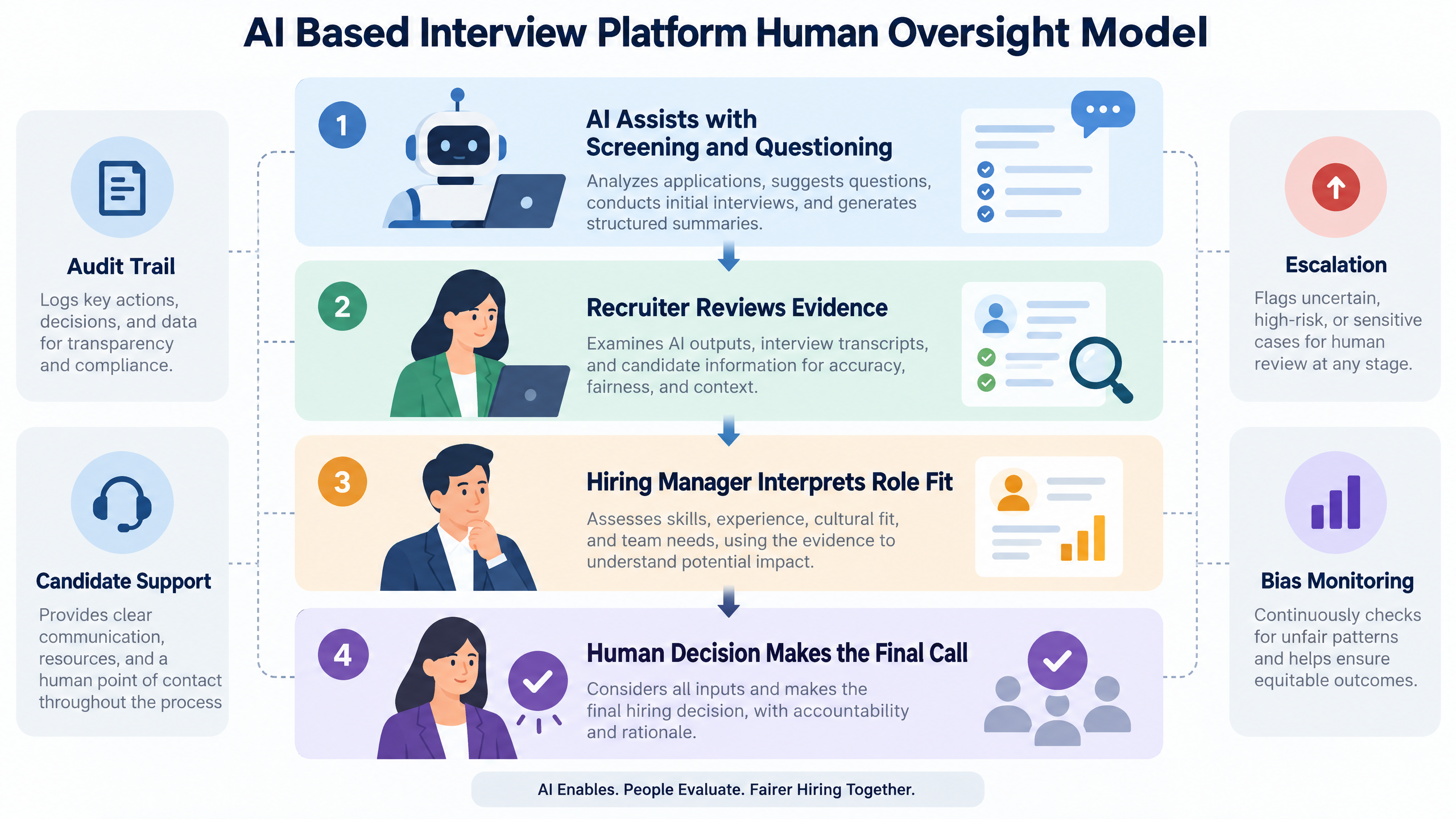
7. Establish human oversight and exception handling
- Accessibility or accommodation requests.
- Technical interruptions or poor recording quality.
- Candidate questions about the process.
- Conflicting evidence across interview stages.
- Nontraditional experience or career paths.
- Suspected scoring errors or irrelevant questions.
- Unusual language, communication, or device conditions.
- Candidate disputes or requests for clarification.
- High-impact recommendations that a reviewer cannot support.
8. Create a quality and governance operating model
- Approved use cases and excluded uses.
- Role and competency ownership.
- Question and prompt review.
- Scoring-anchor calibration.
- Data access and retention.
- Vendor security and subprocessor review.
- Candidate notice and support.
- Monitoring for quality and disparate outcomes.
- Incident response.
- Model or configuration changes.
- Audit and reporting cadence.
9. Run a controlled pilot with a human baseline
10. Monitor, recalibrate, and scale in stages
- Completion and abandonment by stage.
- Technical failures and support requests.
- Time from invitation to completion.
- Reviewer overrides and disagreements.
- Candidate feedback and complaints.
- Progression rates by relevant candidate segment.
- Quality of shortlist and downstream performance.
- Question relevance and scoring consistency.
- Access, retention, and audit events.
AI interview platform architecture for a modern TA stack
Candidate and job layer
Interview experience layer
Intelligence layer
Review and decision layer
Workflow and governance layer
Human oversight and responsible AI hiring
Review job relevance
Review evidence, not only summaries
Monitor patterns, not just individual cases
Preserve decision accountability
Make changes auditable
Candidate experience and accessibility requirements
- Understand why the interview is being used and what it measures.
- Know the expected time, format, device, browser, and preparation requirements.
- Access instructions, controls, captions, and errors clearly.
- Use keyboard navigation or assistive technologies where needed.
- Request an accommodation or alternate process.
- Recover from a connection, device, or browser failure.
- Reschedule or contact a human when the standard path does not work.
- Understand how recordings, transcripts, and interview data are used.
- Receive accurate status updates and next steps.
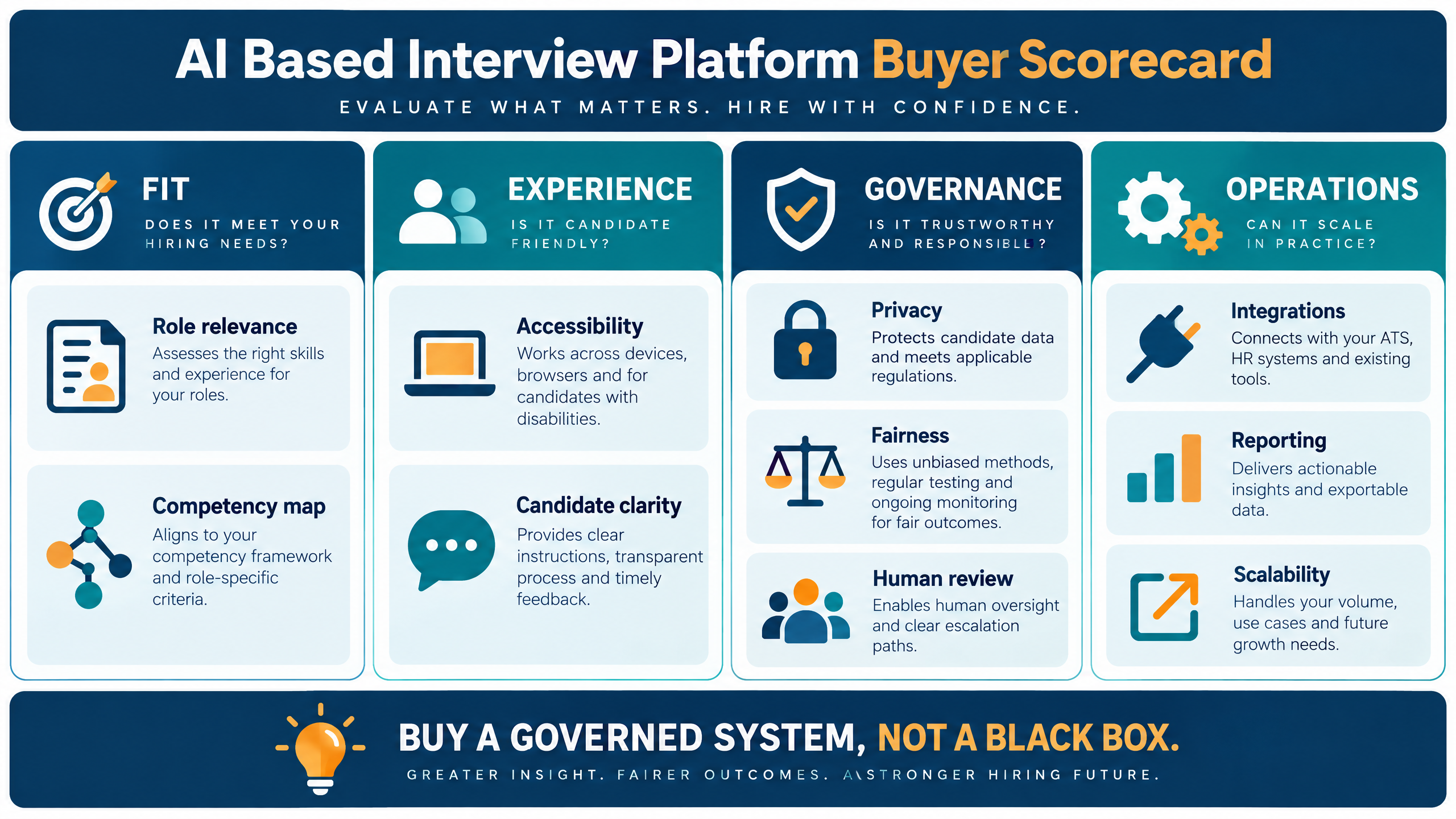
How to choose an AI based interview platform
|
Evaluation area
|
Questions to ask
|
Suggested weight
|
|
Role relevance
|
Can the team configure competencies, question plans, scoring anchors, and role-specific evidence?
|
20%
|
|
Human oversight
|
Can reviewers inspect evidence, override outputs, escalate cases, and document decisions?
|
20%
|
|
Candidate experience
|
Are instructions, accessibility, support, privacy, rescheduling, and recovery built into the journey?
|
15%
|
|
Governance and security
|
Are permissions, retention, audit, monitoring, incident response, and vendor controls clear?
|
15%
|
|
Workflow integration
|
Can it connect to ATS, calendars, communication channels, assessment tools, and hiring-manager workspaces?
|
10%
|
|
Reporting and evidence
|
Are transcripts, summaries, scorecards, source evidence, and exports available at the right level?
|
10%
|
|
Scalability and support
|
Can the provider support volume, time zones, implementation, change management, and service issues?
|
10%
|
How to run an AI interview platform pilot
Define the baseline
Select a controlled role
Set acceptance thresholds
Review sessions and decisions
Test exception paths
Report and decide
How futuremug fits into an AI hiring stack
- The roles and interview stages suitable for AI assistance.
- Role-specific competency and question configuration.
- Candidate notices, support, accessibility, and recovery.
- ATS, calendar, communication, and reporting integrations.
- Human review, escalation, and decision ownership.
- Data access, retention, security, and audit requirements.
- Pilot design, success measures, implementation timeline, and support model.
Request an AI interview platform demo



Frequently Asked Questions
An AI based interview platform uses artificial intelligence to support or conduct defined interview activities such as question generation, conversational screening, coding interviews, transcription, summarization, structured evaluation, scheduling, reporting, and workflow routing.
Define the hiring problem, select a suitable role, map competencies, configure questions and scoring, design candidate communication, integrate the TA stack, establish human oversight, run a controlled pilot, monitor outcomes, and scale in stages.
It can automate or support selected screening and coordination tasks, but human review remains important for context, exceptions, role interpretation, candidate support, and final decisions. The appropriate division depends on the role, jurisdiction, evidence, and risk.
It should evaluate job-related competencies and evidence defined by the role framework. Avoid vague traits, irrelevant personal characteristics, or criteria that cannot be explained and reviewed.
Standardized questions, role-relevant rubrics, consistent workflows, and structured evidence can reduce some sources of inconsistency. They do not eliminate risk. Teams should monitor outcomes, review exceptions, test the candidate experience, and retain human decision accountability.
Common integrations include an applicant tracking system, recruiting CRM, calendar, communication channels, assessment tools, identity provider, analytics, and hiring-manager workspace. The buyer should define data ownership, permissions, retention, status synchronization, and audit events for each integration.
Explain the purpose of the interview, the role of AI, what information is collected, how it will be used, expected duration, support options, accessibility or accommodation routes, and what happens after completion. Adapt communication to the organization’s policy and applicable legal requirements.
Track candidate completion, technical reliability, support requests, scheduling time, recruiter effort, reviewer agreement, overrides, shortlist quality, progression, candidate feedback, exception volume, and downstream hiring outcomes.
It can support high-volume screening, bulk scheduling, standardized questions, transcripts, summaries, and workflow triggers. High-volume use requires capacity planning, candidate support, quality monitoring, and human escalation.
Enterprise readiness includes role relevance, integration, permissions, security, privacy, auditability, accessibility, support, monitoring, configuration control, scalability, and a clear operating model for human review.
Ask the provider to demonstrate one real role from job-description intake through candidate invitation, interview, follow-up, transcript, scoring, human review, exception handling, ATS update, reporting, and next-step communication. Ask to see governance and audit controls as well as the candidate experience.