A Practical Guide to Campus Recruitment Process for Indian Campus Recruitment Teams

What is the campus recruitment process?

The campus recruitment process is the organized sequence employers use to attract, assess, interview, select, offer, and onboard students or early-career candidates from colleges and universities.
In India, the process often involves employers, colleges, Training and Placement Officers (TPOs), students, recruiters, hiring managers, interview panels, and HR operations teams. A successful process must coordinate these groups within short placement windows while keeping eligibility, communication, assessment, interviews, offers, and joining data aligned.
A complete campus recruitment process commonly includes:
  1. Hiring-plan and role definition.
  2. College and TPO engagement.
  3. Employer branding and pre-placement communication.
  4. Student registration and eligibility verification.
  5. Assessments or screening.
  6. Shortlisting and candidate communication.
  7. Technical, functional, behavioral, or AI interviews.
  8. Selection, offer, and documentation.
  9. Joining, pre-joining engagement, and outcome reporting.
The goal is not simply to process more applications. The goal is to create a fair, role-relevant, and measurable path from college outreach to job-ready talent.
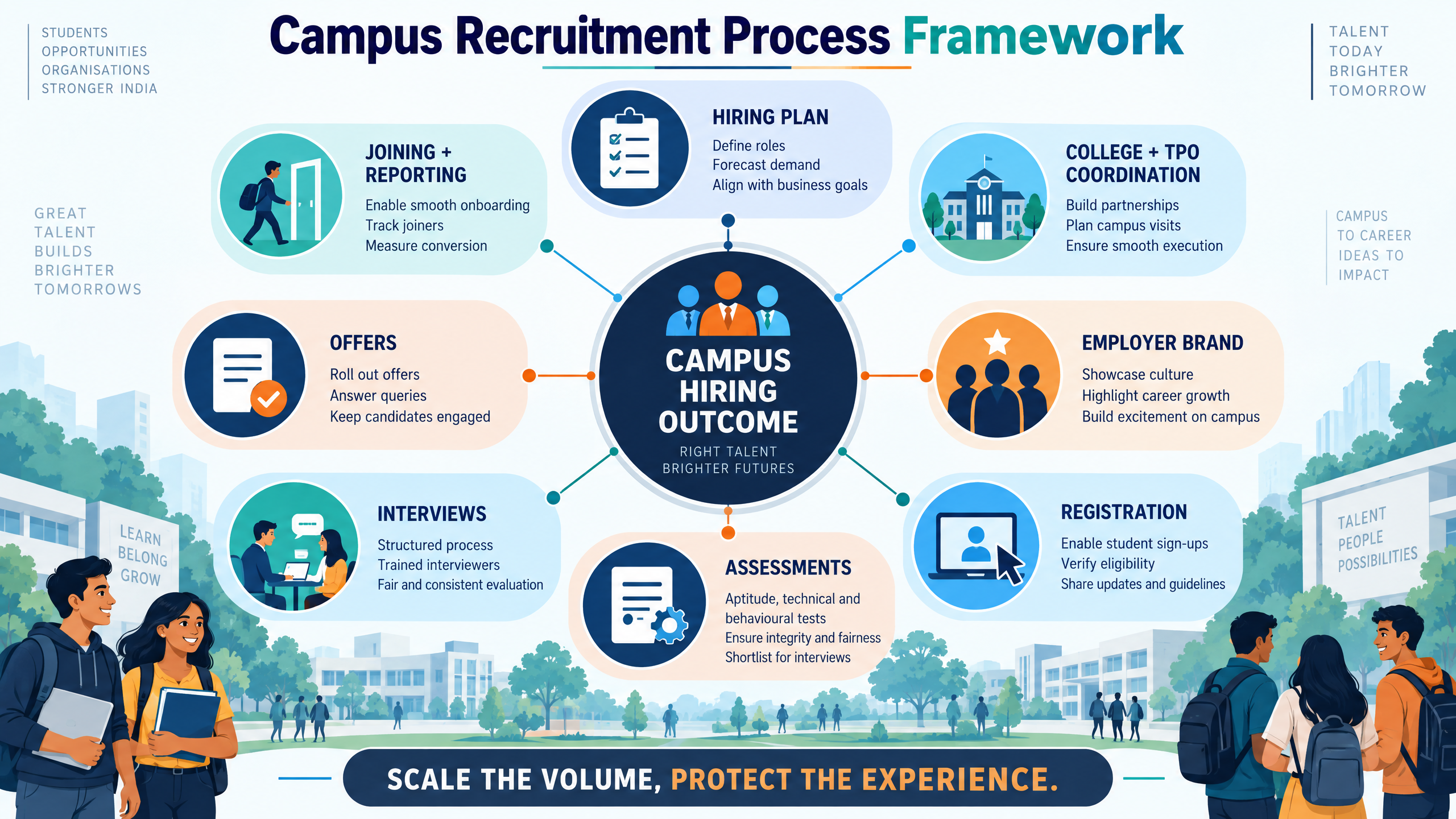
Campus recruitment process framework from employer planning and college outreach through assessments, AI interviews, expert panels, offers, and joining

Why campus recruitment needs a dedicated process

Campus hiring is a burst-workload operation. An employer may engage multiple colleges, receive large student cohorts, run assessments in the same time window, coordinate parallel interviews, and make offers before candidates accept competing opportunities.
A generic hiring workflow may store candidate records, but campus recruitment adds operational requirements:
  • College and TPO coordination.
  • Graduation-year and academic eligibility rules.
  • Large registration cohorts.
  • Concurrent assessment delivery.
  • Drive-day scheduling.
  • Candidate support and exception handling.
  • Panel capacity for technical and functional interviews.
  • Offer and joining follow-up.
  • College-wise and drive-wise reporting.
futuremug’s describes an AI and human-powered model covering assessments, interviews, TPO coordination, employer branding, resume screening, group discussions, video interviews, expert verification, and scheduling support.
The provider’s campus page also states that it works with a network of 2,000+ colleges and universities. Its interview-outsourcing page describes access to 5,000+ verified expert interviewers, 250+ IT domains, automated scheduling, AI-powered interview capabilities, and structured evaluation tools. These are provider-published claims and should be validated against the scope and service model of a specific engagement.

The 9-step campus recruitment process
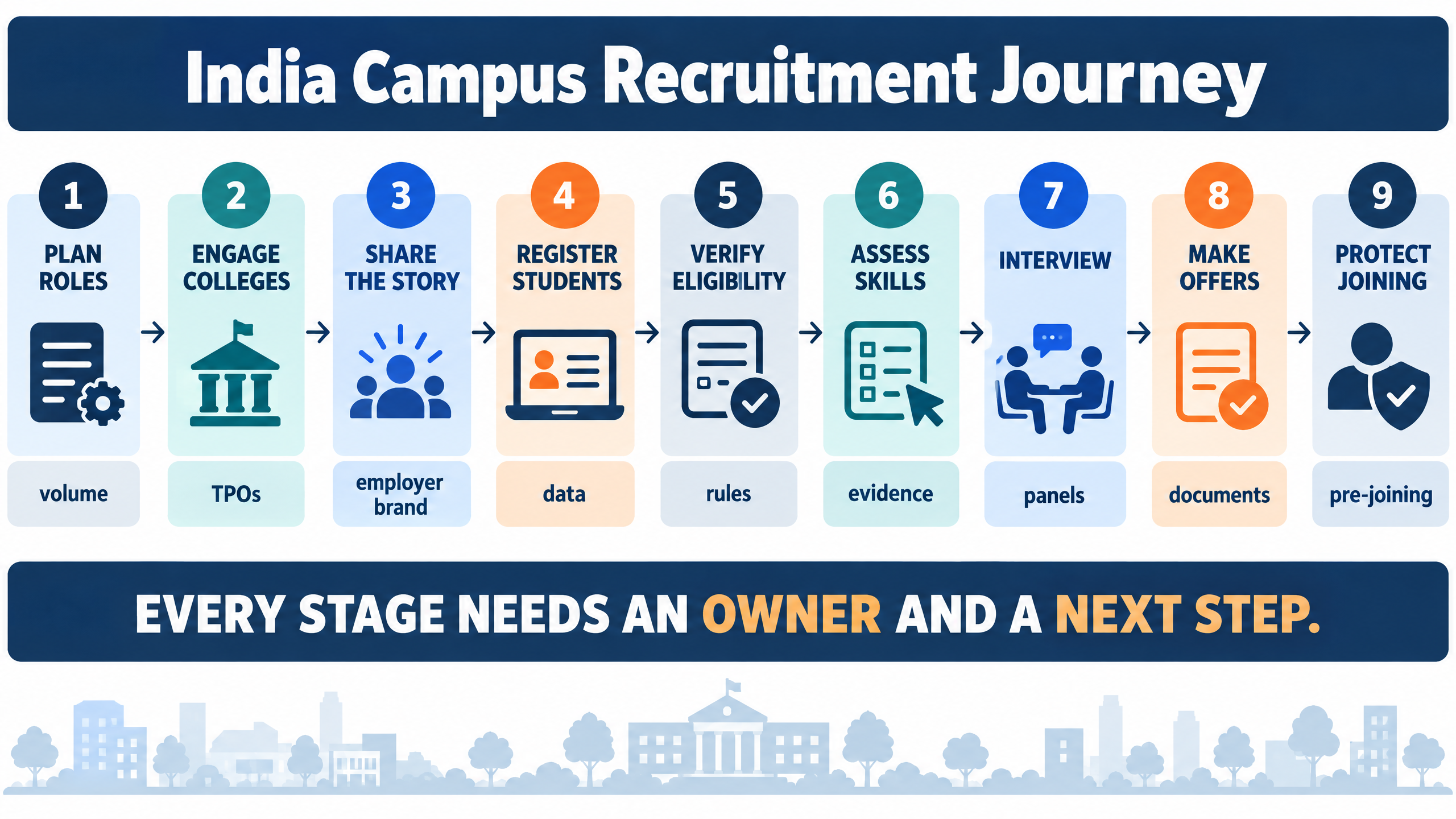
Campus recruitment process journey showing employer planning, college coordination, student registration, assessment, shortlisting, interviews, offers, and joining


1. Define the hiring plan

Start with the business outcome rather than the campus calendar. Confirm how many people the organization needs, which roles are open, where the hires will work, and when they must join.
Define:
  • Role family and job titles.
  • Number of hires and expected backup capacity.
  • Location and work model.
  • Graduation year and eligible programs.
  • Academic criteria and acceptable exceptions.
  • Technical, functional, and behavioral capabilities.
  • Compensation and joining timeline.
  • Assessment and interview stages.
  • Target colleges or regions.
  • Decision owners and approval path.
A clear hiring brief makes every later step more consistent. It informs employer content, college communication, assessment design, interview rubrics, shortlisting, and offer planning.
For early-career hiring, separate skills that must be present on day one from skills that can be learned after joining. Inflated requirements can reduce the relevant talent pool and make the assessment less connected to the actual job.

2. Build the college and TPO plan

College relationships are a core part of the campus recruitment process. Employers need to identify target colleges, understand placement calendars, confirm eligibility rules, exchange student lists, and agree on drive dates.
A practical college plan should record:
  • College and campus location.
  • TPO or placement-cell contact.
  • Approved role and eligibility information.
  • Expected student volume.
  • Registration deadline.
  • Assessment and interview dates.
  • Required facilities or online access.
  • Communication owners.
  • Escalation contacts.
  • Offer and joining coordination requirements.
Give TPOs a concise drive brief. It should include the employer, role, compensation, location, candidate eligibility, process stages, timeline, technical requirements, and support contacts.
Technology can automate reminders and status visibility. It cannot replace the relationship with the placement team. Keep human ownership for schedule changes, eligibility exceptions, student concerns, and sensitive communication.

3. Prepare the employer brand and role communication

Students compare employers before they register. The pre-placement story should help them understand the organization, the work, the team, the learning opportunity, the location, the selection stages, and the expected timeline.
Useful campus hiring content includes:
  • A role-specific employer page.
  • Pre-placement talk or webinar content.
  • Employee and early-career stories.
  • Project or customer examples.
  • Learning and mentorship information.
  • Work-model and location details.
  • Compensation and benefits information.
  • Interview and assessment instructions.
  • Candidate support and accommodation routes.
The message should match the experience. A promise about learning is weaker if recruiters cannot explain development paths. A promise about speed is weaker if students wait without updates. A promise about inclusion is weaker if the assessment and scheduling workflow does not support accessibility.

4. Open registration and verify eligibility

Registration is the data foundation of the campus recruitment process. It should collect enough information to run the drive without forcing students to submit the same details repeatedly.
Capture information such as:
  • Name and contact details.
  • College, department, and graduation year.
  • Academic record where relevant.
  • Resume and skills.
  • Work authorization or location preferences where relevant.
  • Consent and declarations.
  • Role-specific questions.
  • Accommodation or support requests.
Apply eligibility rules consistently. These may include graduation year, degree, department, academic thresholds, backlogs, location, work authorization, or other role-specific conditions.
Keep an exception path. A student may have a data error, a non-standard academic record, or an approved college-level exception. Automated filters should surface the case rather than silently deciding it when human review is needed.
Use duplicate detection and clear status messages. Students should know whether registration is complete, whether information is missing, and what happens next.

5. Run role-relevant assessments

Assessments help employers validate defined capabilities before investing in live interviews. The assessment format should match the job.
Possible campus assessment types include:
  • Aptitude and reasoning.
  • Coding and programming.
  • Domain knowledge.
  • Language and communication.
  • Case or work-sample exercises.
  • Descriptive responses.
  • Psychometric or behavioral measures where appropriate.
A high-volume assessment process should address:
  • Concurrent candidate load.
  • Mobile and browser support.
  • Clear timing and instructions.
  • Proctoring or integrity controls.
  • Question randomization where appropriate.
  • Accessibility and accommodation.
  • Technical issue handling.
  • Scoring and cutoffs.
  • Retake rules.
  • Candidate and college communication.
  • Employer-ready reports.
futuremug’s describes MCQ, descriptive, and coding formats, bulk candidate invitations, proctoring controls, live tracking, AI-assisted evaluation, reports, and configurable assessment rules. Confirm current limits, integrations, service levels, and plan-specific features before publishing or promising them to candidates.
Do not use a test simply because it is easy to administer. The assessment should produce evidence relevant to the work and should be one part of the selection process.

6. Shortlist with transparent criteria

Shortlisting converts registration and assessment data into the next candidate group. Use the criteria agreed during hiring-plan design.
A shortlist process should make it possible to answer:
  • Which criteria were applied?
  • Were the same rules used across colleges?
  • Which candidates were automatically advanced?
  • Which cases were sent for human review?
  • How were integrity flags handled?
  • What information was communicated to candidates and TPOs?
  • Which candidates need a different next step?
AI-assisted screening can help process large cohorts, identify skill signals, and organize candidate evidence. It should not be presented as a guarantee of fairness or fit. Review the inputs, criteria, and exception process.
Use a defined borderline queue. Students near a cutoff, students with unusual but relevant experience, and cases with incomplete evidence may require a human reviewer or a targeted follow-up rather than an automatic rejection.

7. Conduct structured interviews

Campus interviews should be structured enough to support consistent evaluation while giving students a fair opportunity to explain how they think and learn.
The describes job-related competencies, predetermined questions, and common rating standards as core features of a structured interview . The same principles are useful for Indian campus hiring teams designing comparable evaluations across large cohorts.
Create an interview rubric with:
  • Competencies to assess.
  • Questions or prompts.
  • Follow-up guidance.
  • Expected evidence for the role level.
  • Rating anchors.
  • Critical concerns.
  • Communication or teamwork indicators.
  • Technical problem-solving indicators.
  • Recommendation categories.
  • Next-stage verification rules.
Campus teams can use internal interviewers, external expert panels, AI interviews, or a hybrid approach. The choice depends on role complexity, candidate volume, engineering bandwidth, and the level of human judgment required.
futuremug’s interview-outsourcing service page states that it supports 5,000+ expert interviewers across 250+ IT domains, customizable interview formats, structured evaluation tools, AI-powered interview capabilities, automated scheduling, and reports. It also publishes measurable customer outcomes such as improvements in interview-panel efficiency, talent-review efficiency, and technical-interview process streamlining. Treat these as provider-published results, not universal guarantees; ask for the relevant case context and measurement definition.
For high-volume campus drives, the useful question is not only “How many interviewers are available?” It is also:
  • Can the panels be matched to the role and level?
  • Are they briefed on the same rubric?
  • Can they cover the required time window?
  • How are reports reviewed?
  • How are candidate questions and rescheduling handled?
  • What happens when a panelist is unavailable?

8. Make offers and manage documentation

Selection is not complete when a candidate is shortlisted. The offer stage determines whether the organization converts a campus decision into a joining commitment.
Coordinate:
  • Final approval.
  • Offer-letter generation.
  • Compensation and location details.
  • Joining date.
  • Required documents.
  • Verification steps.
  • Response deadlines.
  • College or TPO communication.
  • Candidate questions.
  • Pre-joining engagement.
Use clear status categories such as offer drafted, offer sent, accepted, declined, documents pending, verification pending, joining confirmed, and exception requiring human follow-up.
Automation can send reminders and collect documents. A human should handle compensation questions, competing offers, family or location concerns, disability accommodations, and other relationship-sensitive moments.

9. Protect joining and measure outcomes

Campus hiring teams often focus heavily on registration and assessment but underinvest in joining. This can reduce the return on the entire process.
Create a pre-joining plan with:
  • Regular status updates.
  • Joining reminders.
  • Documentation support.
  • Manager or buddy introductions where appropriate.
  • Learning and onboarding information.
  • Location and logistics support.
  • A route for candidates who may withdraw.
Measure the funnel from college outreach to joining. The results should help the team understand which colleges, messages, assessments, interview stages, and offer practices produce the strongest outcomes.

How AI and automation fit into campus recruitment

Campus recruitment automation is most useful for high-volume, rule-based work. It can support registration, eligibility checks, assessment delivery, scoring, interview scheduling, reminders, candidate updates, report generation, and funnel dashboards.
AI interview capabilities can support structured first-round conversations, question generation, transcription, summaries, skill signals, and shortlist insights. Human interviewers remain important for complex technical judgment, borderline decisions, final-round evaluation, candidate relationship-building, and exception handling.
A useful automation map is:
Stage
Appropriate automation
Human responsibility
College outreach
Reminders, status tracking, document sharing
Relationship, negotiation, exception decisions
Registration
Forms, deduplication, eligibility filters
Data corrections and approved exceptions
Assessment
Delivery, monitoring, scoring, reports
Integrity review and cutoff decisions
First-round interview
Scheduling, AI interview flow, transcripts, summaries
Calibration and borderline review
Final interview
Scheduling and reminders
Judgment, team context, and candidate selling
Offer operations
Documents, reminders, status tracking
Approval, negotiation, and sensitive conversations
Pre-joining
Communication cadence and check-ins
Renege prevention and relationship management
The principle is simple: automate the volume, not the trust. For a fuller stage-by-stage view, see futuremug’s .

Where human judgment remains essential

Human review should remain visible in the campus recruitment process.
Keep human ownership for:
  • College and TPO relationships.
  • Eligibility exceptions.
  • Accommodation requests.
  • Integrity or proctoring disputes.
  • Borderline assessment results.
  • Unusual but relevant candidate profiles.
  • Final-round hiring judgment.
  • Candidate questions about role, compensation, or location.
  • Competing-offer and pre-joining conversations.
  • Disposition or rejection communication in sensitive cases.
AI can organize evidence and reduce manual effort. It should not conceal the criteria, create an unreviewable decision, or prevent a candidate from reaching support.

How to measure the campus recruitment process
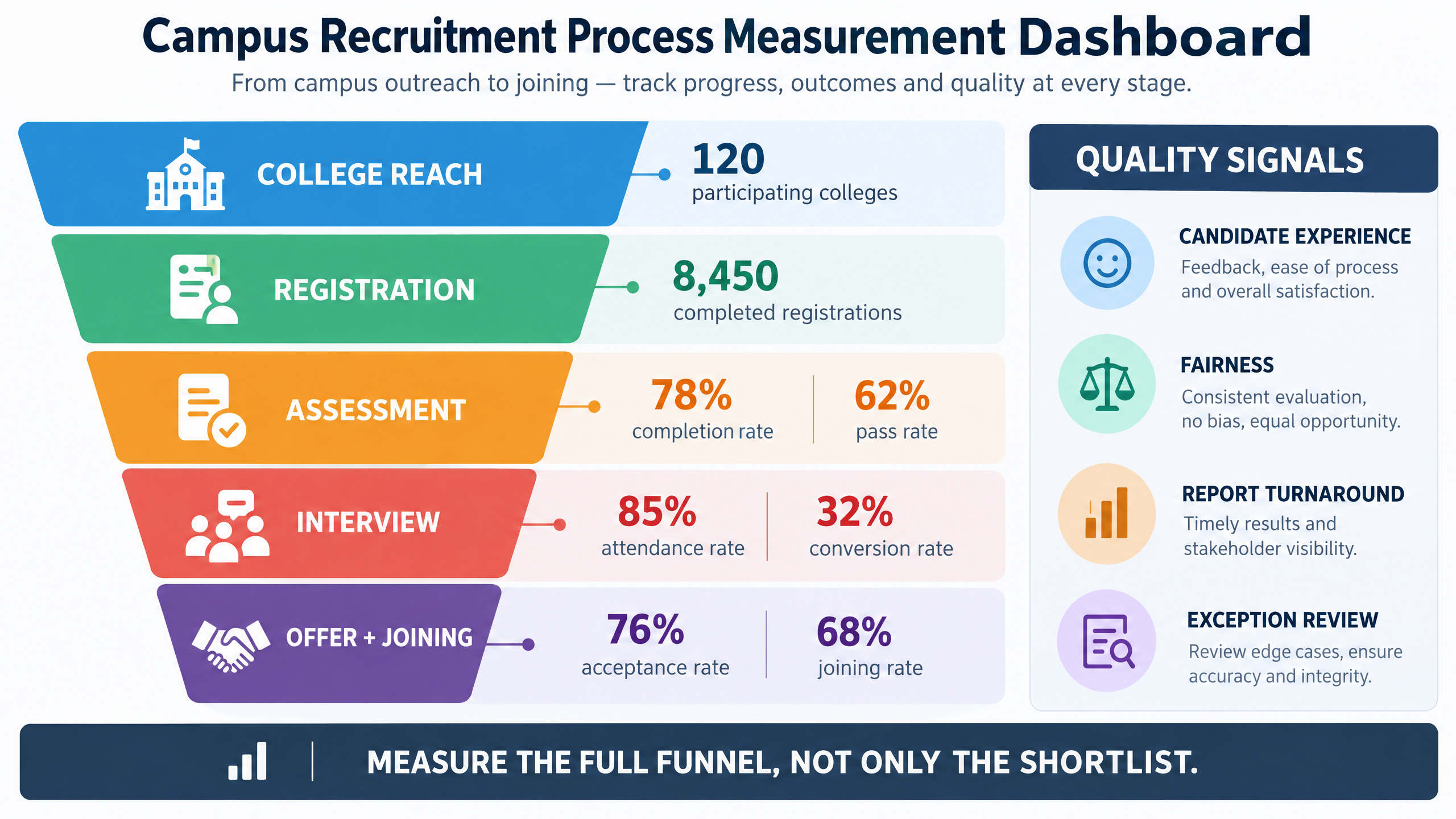
Campus recruitment process measurement dashboard showing college reach, registration, assessment completion, interview conversion, offers, acceptance, and joining


College and outreach metrics

Track target colleges contacted, colleges participating, student reach, registration rate, source quality, event attendance, and role-page engagement.

Registration and eligibility metrics

Track completed registrations, duplicate records, eligibility pass rate, exception volume, data corrections, and time from registration close to verified candidate list.

Assessment metrics

Track invitation delivery, start rate, completion rate, technical issues, integrity flags, score distribution, pass rate, and assessment-to-interview conversion.

Interview metrics

Track interview attendance, scheduling turnaround, no-show rate, rescheduling volume, panel utilization, report turnaround, interview-to-offer conversion, and candidate feedback.

Offer and joining metrics

Track offer acceptance, documentation completion, joining confirmation, reneges, time from selection to offer, time from offer to joining, and college-wise joining rate.

Quality and fairness signals

Review whether the same criteria were applied across colleges, whether exception rates differ unexpectedly, whether candidates receive consistent communication, and whether any stage creates avoidable drop-off.

Business outcome metrics

Connect campus activity to hiring quality, time to productivity, early attrition, manager satisfaction, and cost per joining. Do not claim that a single automation feature caused an outcome without a clear comparison or case context.

How futuremug supports campus hiring at scale

futuremug’s describes an end-to-end campus workflow that includes employer branding, college and TPO coordination, AI resume screening, skills assessment, group discussions, video interviews, expert verification, HR coordination, candidate insights, and reporting.
The platform page also describes a network of 2,000+ colleges and universities and campus workflows designed for on-campus and off-campus hiring. The offering is positioned for employers that need to manage high-volume early-talent recruitment without expanding operational workload linearly.
For the evaluation layer, futuremug states that it has access to 5,000+ expert interviewers across 250+ IT domains. The related interview service describes expert-led technical and functional interviews, customizable panels, 24/7 auto-scheduling, structured evaluation, AI-powered interview workflows, and consolidated reports.
The AI capabilities described across futuremug’s hiring pages include AI-assisted assessments, AI resume-to-JD matching, AI-generated interview questions, AI interview workflows, transcripts and summaries, and shortlist insights. Configure these capabilities around a role-specific rubric and keep human review for exceptions and consequential decisions.
futuremug also publishes measurable case outcomes, including a case describing 2,000+ interviews in two weeks for a rapid hiring surge. These results are case-specific. When evaluating the platform, ask how the relevant engagement compares in candidate volume, role mix, geography, process design, interviewer capacity, and outcome definition.
with one real hiring plan. Share the target colleges, role family, expected candidate volume, assessment design, interview stages, joining date, and current bottleneck. Ask for a workflow demonstration from TPO coordination to joining reports.

Frequently Asked Questions

What is the campus recruitment process? ▼

The campus recruitment process is the sequence employers use to hire students and early-career candidates through colleges or universities. It generally includes planning, college and TPO coordination, employer communication, registration, eligibility checks, assessments, shortlisting, interviews, offers, documentation, and joining.

What are the main stages of campus recruitment in India? ▼

The main stages are employer and role planning, college engagement, pre-placement communication, student registration, eligibility screening, assessments, interviews, selection, offer management, documentation, and joining follow-up. The exact stages vary by employer, role, college, and hiring volume.

What does a TPO do in campus recruitment? ▼

A Training and Placement Officer coordinates between the college, students, and employers. TPO responsibilities may include sharing hiring information, confirming eligibility, collecting student lists, communicating drive schedules, supporting assessments and interviews, and helping resolve college-side issues.

How can employers manage large campus hiring volumes? ▼

Use a workflow that combines structured registration, rule-based eligibility, scalable assessments, automated scheduling, clear candidate communication, expert or AI interview capacity, standardized reports, and human review for exceptions. College and TPO ownership must remain clear.

What assessments are used in campus recruitment? ▼

Employers may use aptitude, coding, domain, language, descriptive, case, psychometric, behavioral, or communication assessments. The assessment should measure capabilities relevant to the role and should be explained clearly to candidates.

How do AI interviews fit into campus recruitment? ▼

AI interviews can support high-volume first-round screening, structured questioning, transcription, summaries, and consistent evaluation signals. Human oversight remains important for calibration, accommodation, integrity disputes, borderline cases, final decisions, and candidate support.

Why use expert interview panels for campus hiring? ▼

Expert panels can add technical or functional interview capacity when internal engineering teams are unavailable or hiring volume spikes. Evaluate the panel’s role relevance, interviewer vetting, rubric calibration, report quality, candidate experience, and service-level support.

How does futuremug support the campus recruitment process? ▼

futuremug describes a campus hiring model that combines college and TPO coordination, employer branding, AI screening, assessments, interviews, expert panels, AI interview capabilities, scheduling, candidate insights, and reporting. Teams should validate the current configuration against their specific roles, colleges, volumes, and timelines.

How should campus recruitment success be measured? ▼

Measure the full funnel from college reach and registration to assessment completion, interview attendance, offers, acceptance, documentation, joining, quality, candidate experience, and early retention. Review results by college, role, cohort, and hiring stage.

Leave a Reply

Your email address will not be published.