
TPO Full Form in College and Jobs: Meaning, Role, and Responsibilities

TPO full form in college: the short answer
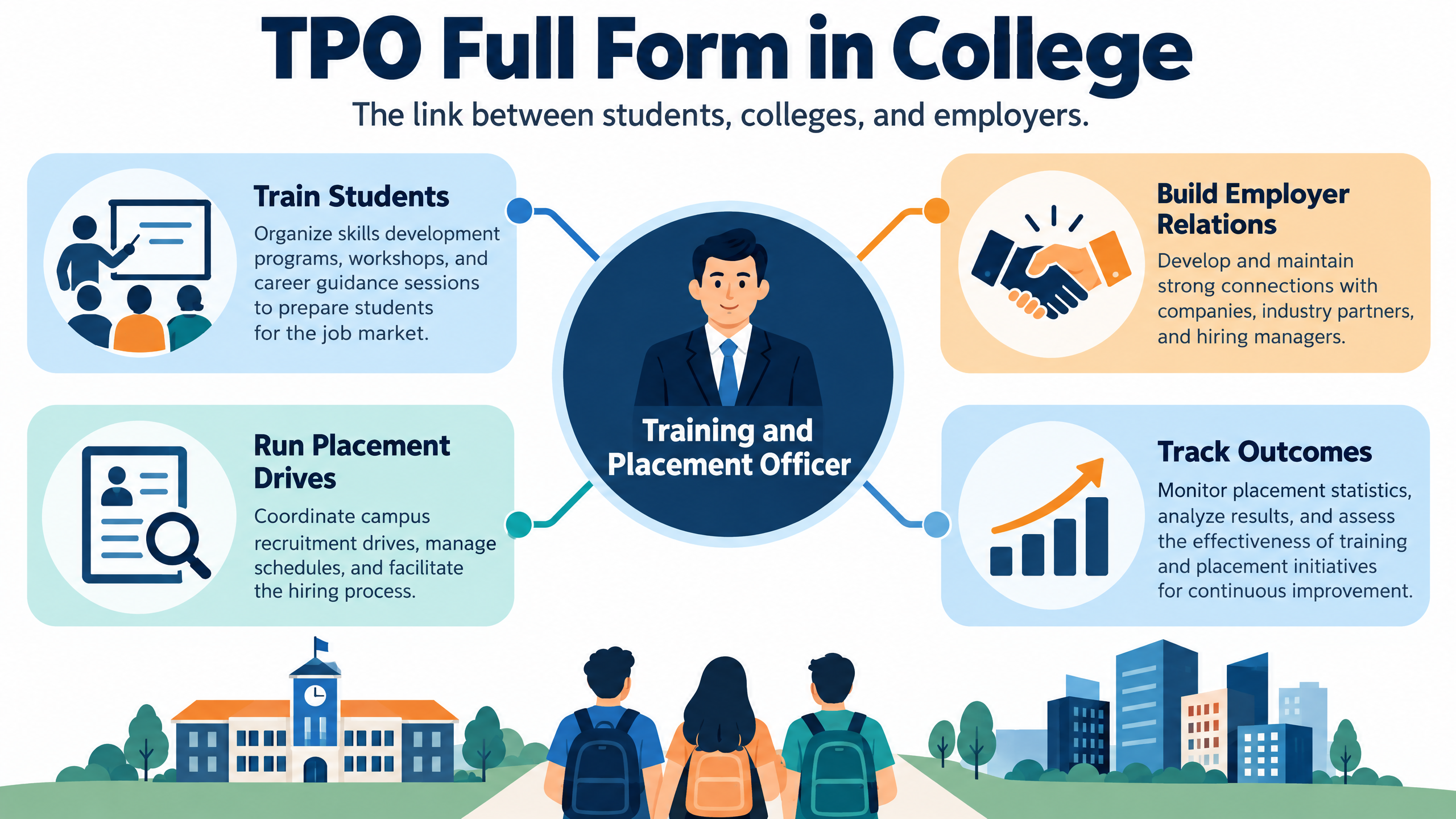
The TPO full form in college is Training and Placement Officer.
A Training and Placement Officer leads or coordinates the college’s training and placement function. The role connects students, academic departments, college leadership, employers, recruiters, and placement-support teams.
The “training” part refers to student readiness. It may include aptitude preparation, technical training, communication practice, resume support, group discussions, mock interviews, career guidance, internships, and employability programs.
The “placement” part refers to employer engagement and the hiring process. It may include building company relationships, inviting employers, sharing eligible student profiles, planning campus drives, coordinating assessments and interviews, tracking offers, and reporting outcomes.
A TPO is therefore more than a person who forwards job descriptions. The role combines career development, employer relations, event operations, candidate communication, data management, and outcome reporting.
In a small college, one faculty member may handle the TPO responsibility as an additional charge. In a larger institution, the TPO may lead a dedicated training and placement office with placement executives, department coordinators, student volunteers, and administrative support.
The structure varies by institution. The core accountability remains similar: help students become placement-ready, create relevant employer opportunities, and run the placement process fairly and reliably.
For a broader background on the role, see the existing . This article expands the definition for students, job seekers, colleges, and employers while adding a practical comparison of related roles.
TPO full form in college infographic showing Training and Placement Officer with responsibilities to train students, build employer relations, run placement drives, and track outcomes

What does TPO mean in jobs?

In college placement and campus-recruitment job listings, TPO usually means Training and Placement Officer. A TPO job involves managing the relationship between an educational institution and the employers who recruit its students.
A TPO may work for an engineering college, university, management institute, vocational institution, training organization, or other education provider. The job title may differ even when the responsibilities overlap.
Common title variants include:
  • Training and Placement Officer.
  • Placement Officer.
  • Head of Training and Placement.
  • Training and Placement Executive.
  • Career Services Officer.
  • Corporate Relations Officer.
  • Head of Corporate Relations.
  • Dean or Director of Career Services.
  • Placement and Industry Liaison Officer.
A job seeker should read the full job description rather than rely only on the title. Some institutions focus heavily on employer relationships and placements. Others expect the role to manage training calendars, student counseling, internships, alumni engagement, accreditation data, career events, and a team of coordinators.
The abbreviation TPO can have different meanings in other industries. For example, a company may use TPO for a technical or operational term unrelated to college placements. The surrounding words matter. When the context includes students, campus drives, employers, internships, training, or placement cells, Training and Placement Officer is the relevant meaning.

TPO full form in college versus TPO full form in jobs

Search phrase
Meaning in the college-placement context
What the reader usually wants to know
TPO full form in college
Training and Placement Officer.
Who manages training, employers, campus drives, and placement outcomes?
TPO full form in jobs
Usually Training and Placement Officer when the job is within an educational institution.
What does the job involve and what skills are required?
TPO job meaning
A role that coordinates student employability and employer hiring activities.
How to qualify, what to do daily, and how performance is measured.
TPO in campus placement
The operating link between the college, students, and recruiters.
How placement drives, eligibility, assessments, interviews, and offers are managed.
TPO office meaning
The college’s training and placement function or department.
Which team handles career readiness and recruitment operations?
This interpretation keeps the answer clear without assuming that every organization uses the abbreviation in exactly the same way.

What does a Training and Placement Officer do?

A TPO manages the student and employer lifecycle before, during, and after a placement drive. The work begins with understanding the skills employers need and ends with tracking offers, joining, feedback, and future improvements.

1. Build employer relationships

A TPO identifies suitable companies, contacts recruiters, understands job requirements, shares institutional information, and invites employers to participate in campus hiring.
Strong employer relations are built over time. The TPO should communicate student profiles accurately, explain college policies, coordinate drive logistics, and follow up after the process. An employer that receives reliable support is more likely to consider the college for future internships or placements.

2. Prepare students for employment

Training may cover aptitude, technical skills, communication, resume writing, group discussions, interview skills, professional behavior, and role-specific preparation.
A TPO does not need to deliver every session personally. The officer may coordinate faculty, trainers, alumni, employers, mentors, and external training partners. The responsibility is to ensure that preparation matches the roles and employers students are targeting.

3. Set eligibility and placement policies

Students need to know the rules before they register. A TPO may help define or implement eligibility criteria, attendance expectations, opt-in or opt-out rules, offer policies, document requirements, and conduct standards.
Clear policies reduce disputes during high-pressure drive days. Exceptions should have an approved review path so that decisions are consistent and properly recorded.

4. Plan and run placement drives

A placement drive may include employer briefing, student registration, eligibility verification, pre-placement talks, assessments, group discussions, technical interviews, HR interviews, offers, and joining updates.
The TPO coordinates the calendar, venues or online links, rooms, panels, student batches, communications, attendance, and escalation. The role requires detailed planning because one missed handoff can affect hundreds of candidates.

5. Coordinate assessments and interviews

TPOs may organize aptitude tests, coding assessments, domain tests, communication rounds, group activities, technical interviews, behavioral interviews, and HR discussions.
The TPO is responsible for making instructions available, tracking participation, coordinating schedules, communicating changes, and collecting outcomes. The actual evaluation may be completed by employers, faculty, external experts, or an interview-services partner.

6. Manage student communication

Students need accurate information about eligibility, deadlines, documents, assessment rules, interview links, reporting times, dress or preparation guidance, next steps, and results.
Communication should use approved channels and consistent language. A TPO should also provide a route for questions, technical issues, attendance problems, and exceptional circumstances.

7. Maintain placement records and reports

A TPO may track student registration, eligibility, participation, assessment completion, interview attendance, selection, offer acceptance, joining, employer, role, location, salary information where permitted, and student feedback.
The college may use the information for internal decisions, accreditation or institutional reporting, employer follow-up, student support, and placement-season planning. The definitions should remain consistent so that counts are comparable across departments and years.
The is one example of an official higher-education reporting context. Colleges should use their own approved definitions and applicable institutional requirements when preparing reports.

8. Manage employer feedback and future improvements

Employers can identify skill gaps, communication issues, curriculum needs, and process improvements. A TPO can convert that feedback into training priorities and stronger employer relationships.
Student feedback is equally important. It can reveal unclear instructions, scheduling conflicts, accessibility barriers, assessment concerns, or communication gaps.

9. Coordinate internships and industry engagement
The TPO role may include internships, industrial visits, guest lectures, live projects, apprenticeships, alumni engagement, and industry partnerships. These activities help students understand workplace expectations and can strengthen future hiring pipelines.
The exact scope depends on the institution. Some colleges assign internships or corporate relations to separate teams, while others place them under the training and placement office.
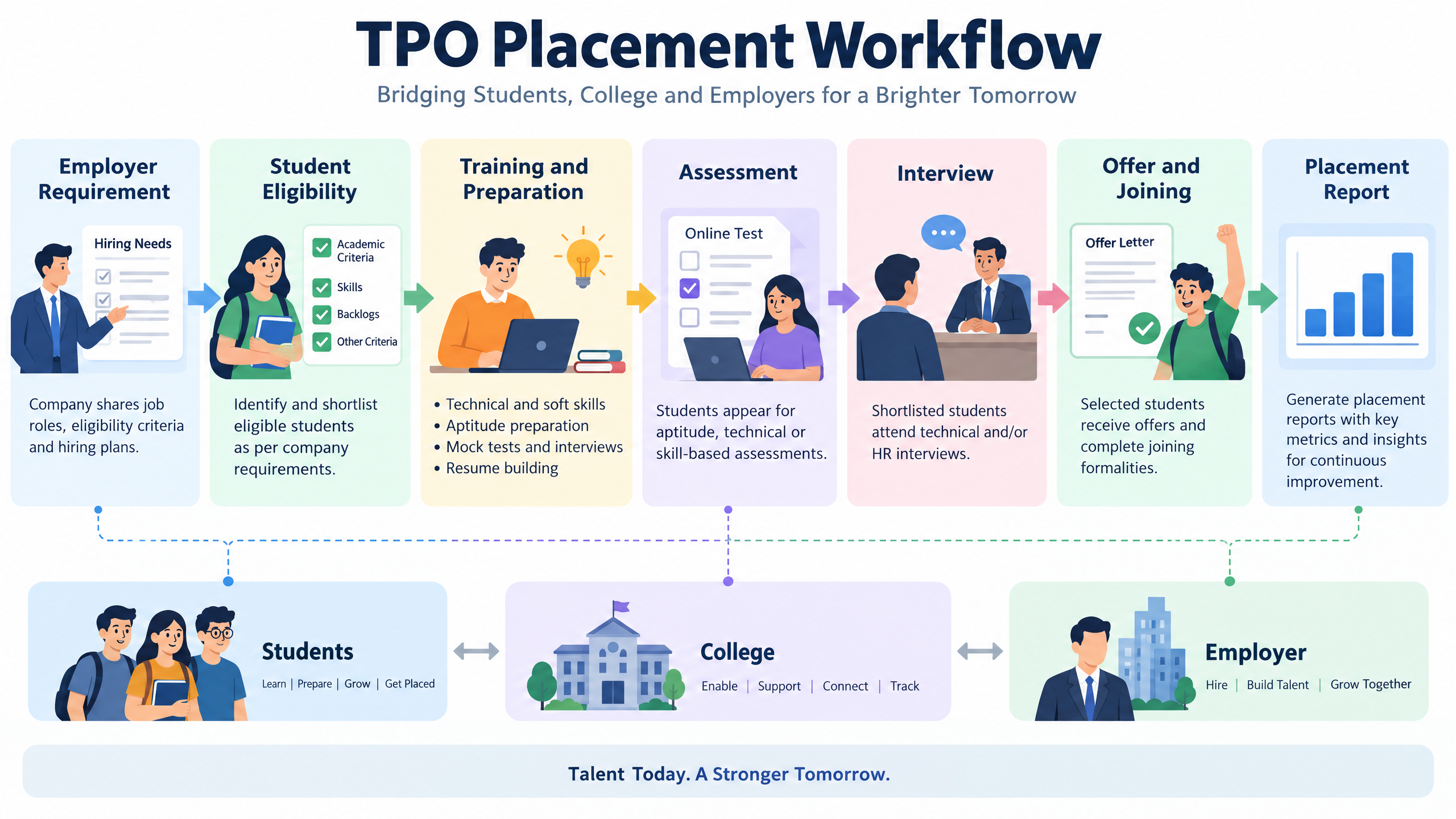
TPO placement workflow from employer requirement to student eligibility, training, assessment, interview, offer, joining, and placement report


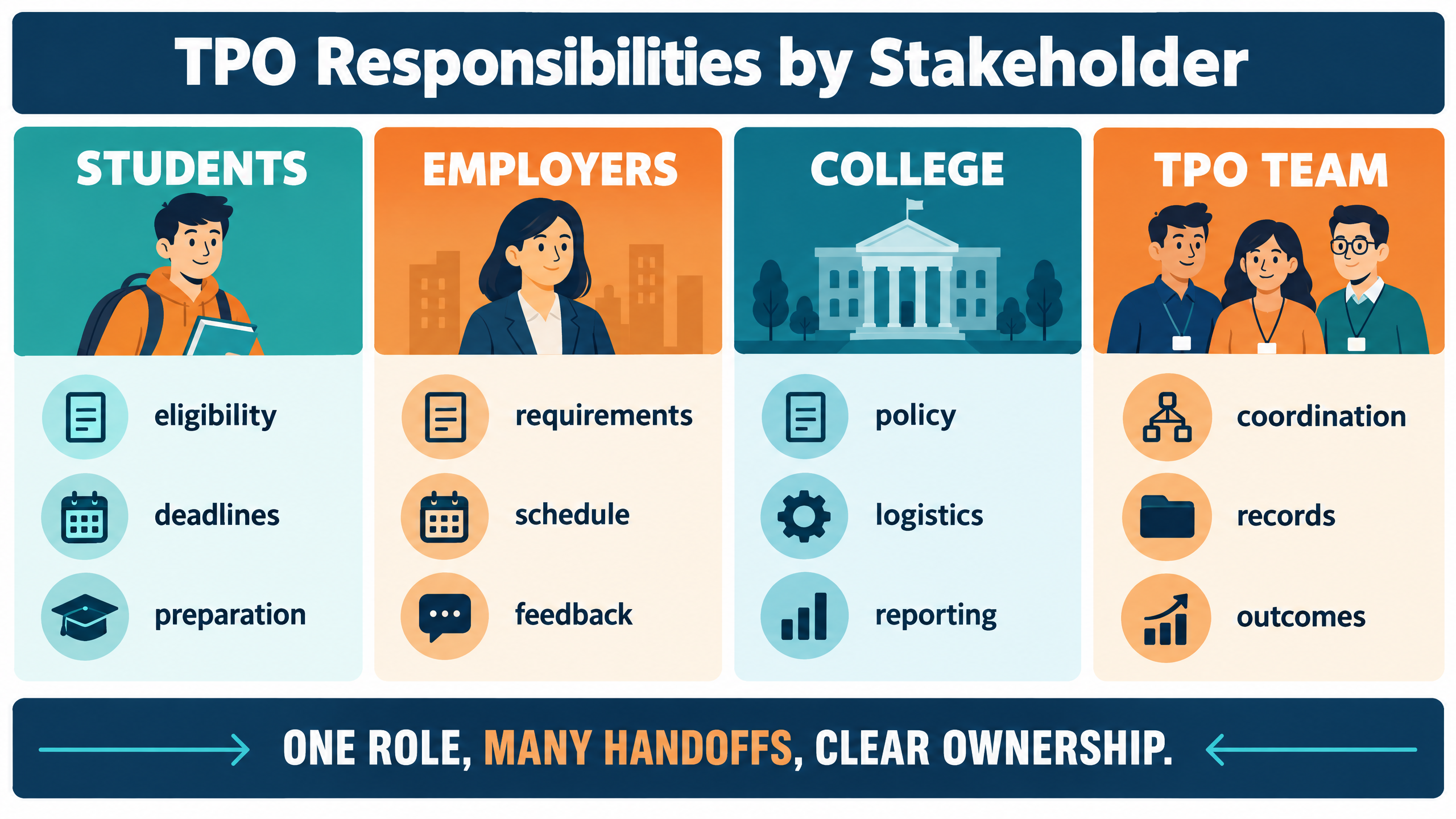
TPO responsibilities by stakeholder

TPO work becomes easier to understand when responsibilities are viewed from each stakeholder’s perspective.

Responsibilities toward students

Students expect fair access to information and relevant preparation. A TPO should communicate eligibility, deadlines, documents, selection stages, and outcomes. The placement office should also help students understand the expectations of different roles.
Examples include:
  • Explaining job descriptions and selection criteria.
  • Publishing drive announcements and deadlines.
  • Verifying eligible student lists.
  • Coordinating training and mock interviews.
  • Sharing assessment and interview instructions.
  • Tracking student attendance and status.
  • Providing a route for questions or concerns.
  • Recording offers, acceptance, and joining updates.

Responsibilities toward employers

Employers need relevant student profiles, accurate information, predictable coordination, and a professional campus experience.
A TPO may:
  • Understand the role, skills, location, compensation, and selection process.
  • Share college, batch, department, and candidate information accurately.
  • Coordinate the pre-placement talk and hiring calendar.
  • Arrange rooms, links, panels, and student batches.
  • Communicate changes quickly.
  • Collect assessment and interview outcomes.
  • Track offers and joining information.
  • Request feedback after the drive.

Responsibilities toward college leadership

College leaders need visibility into placement activity and outcomes. A TPO may report employer participation, department-wise engagement, student readiness, drive volume, selection, offers, joining, and operational risks.
Reports should distinguish participation from selection and selection from joining. These are different stages and should not be combined into one number.

Responsibilities toward faculty and departments

Faculty and department coordinators help verify students, resolve timetable or attendance issues, share announcements, support training, and coordinate local logistics.
The TPO should give them the information needed for their work while protecting student and employer data that they do not need to see.

Responsibilities toward the placement team
A central TPO often works with placement executives, student coordinators, department representatives, volunteers, and administrative staff. The team needs clear ownership for each drive stage.
TPO responsibilities by stakeholder showing students, employers, college, and TPO team


TPO vs placement coordinator vs placement cell vs RPO

These terms are related, but they do not mean the same thing.
Term
What it is
Typical scope
Example responsibility
Training and Placement Officer (TPO)
The officer who leads or coordinates training and placement.
Strategy, employer relations, student readiness, drive accountability, and reporting.
Approve the placement calendar and coordinate a major employer drive.
Placement coordinator
A faculty, staff, department, or student representative who supports placement work.
Department-level or drive-level execution.
Collect eligible student data and coordinate attendance.
Training and placement cell
The institutional unit that includes the TPO and support team.
Training, employer engagement, drives, records, and outcomes.
Run the full campus-placement season.
Career services office
A broader institutional function that may include counseling, internships, alumni, and employer relations.
Career development and transition support.
Connect students with internships and career resources.
Interview outsourcing provider
An external service that conducts or coordinates selected interview stages.
Technical, functional, behavioral, or expert-led evaluation.
Provide structured technical interviews when employer or college capacity is limited.
RPO provider
An external partner that manages part or all of an organization’s recruitment process.
Sourcing, screening, coordination, interviewing, and other agreed recruitment activities.
Support an employer’s recurring hiring operations.
The TPO is an institutional role. A placement coordinator supports that role. The placement cell is the team or function. Interview outsourcing and RPO are external service models that may support an employer or college under a defined scope.
This distinction helps answer a common question: Does a TPO get replaced by a platform or outsourcing provider? No. A platform or partner may reduce coordination work or add capacity, but the college still needs an accountable person or team to set policy, communicate with students, protect data, and manage institutional relationships.

TPO use-case examples

Use case 1: A single-company campus drive

An employer shares a job description and eligibility rules. The TPO verifies the student list, publishes the announcement, coordinates the pre-placement talk, manages the assessment, schedules interviews, records selections, and shares the required report.
The main risk is not volume. It is a missed deadline, unclear eligibility, or inconsistent communication. A checklist and named owners can prevent most avoidable issues.

Use case 2: A multi-company placement season

Several employers may run drives during overlapping weeks. The TPO needs a master calendar, student availability, department coordination, venue or virtual capacity, assessment and interview schedules, and a consistent offer policy.
A centralized record helps the team see which students are registered, eligible, participating, selected, holding offers, or awaiting joining confirmation.

Use case 3: A technical hiring drive

A technology employer may require resume screening, coding assessment, technical interviews, and an HR round. The TPO coordinates the student journey while the employer or expert panel evaluates technical evidence.
For the employer’s technical evaluation, colleges can link the process to when internal interview capacity is limited. The service model should be agreed with the employer and should not change the college’s responsibility for student communication and policy.

Use case 4: An off-campus or pooled drive

A college may work with a group of institutions or an external hiring partner to create a larger candidate pool. The TPO must clarify eligibility, data-sharing permissions, communication ownership, and how student status will be updated across institutions.

Use case 5: A student who needs support

A student may face a connectivity problem, accessibility requirement, timetable conflict, health issue, or misunderstanding about an assessment. A good TPO workflow includes a documented support route, an authorized decision-maker, and a record of the resolution.
Automation can help surface the issue. It should not make the student navigate an unresponsive system.

How TPOs manage high-volume placement drives

High-volume drives need standardization without losing human support. The TPO can use a repeatable operating model.

Before the drive

Define the role, employer, eligibility, stages, dates, owners, documents, communication channels, venue or links, data requirements, and exception policy. Confirm the employer’s expectations and the college’s approved rules.

During registration

Collect only the required student information. Verify eligibility consistently. Give students a clear deadline, confirmation, and route for questions.

During assessment

Publish the instructions, time limit, device requirements, permitted resources, support route, and next step. Track completion and handle technical issues through an approved process.

During interviews

Coordinate panels, time slots, rooms or links, attendance, reminders, feedback, and next-round decisions. Keep a live status view so the team can identify delays or missing outcomes.

After selection

Record selections, waitlists, offers, acceptance, withdrawals, joining, and employer updates separately. Communicate outcomes through approved channels and protect confidential information.

After the drive

Prepare a report with participation, completion, attendance, selection, offer, joining, feedback, and unresolved issues. Ask students and employers what should change before the next drive.

Skills and qualifications for a TPO job

There is no single universal qualification pathway for every TPO role. Institutions define their own requirements. A job seeker should read the specific vacancy and understand whether the institution expects a faculty background, HR experience, industry relations, student counseling, data reporting, or operations management.
Commonly valuable capabilities include:
  • Employer relationship management.
  • Student counseling and communication.
  • Campus recruitment knowledge.
  • Training and employability-program coordination.
  • Event and calendar management.
  • Assessment and interview coordination.
  • Spreadsheet, database, or placement-platform skills.
  • Report preparation and data accuracy.
  • Negotiation and stakeholder management.
  • Conflict resolution and escalation.
  • Understanding of confidentiality and data handling.
  • Ability to work during high-volume placement seasons.
A strong TPO combines relationship skills with operational discipline. Recruiters need confidence that the college understands the role. Students need confidence that the process is clear and fair. Leadership needs confidence that the numbers are accurate.

How to prepare for a TPO job interview

A candidate preparing for a TPO job should be ready to discuss how they would:
  • Build a recruiter pipeline.
  • Increase employer participation.
  • Prepare students for different role families.
  • Run a placement drive with several selection stages.
  • Handle overlapping schedules.
  • Resolve a student or employer complaint.
  • Track placement outcomes.
  • Improve weak student participation or readiness.
  • Use data to plan the next training cycle.
  • Protect candidate information.
Use examples with clear actions and outcomes. Explain how you balance student support, employer expectations, and institutional policy.

How technology supports TPO work

Technology should connect the placement workflow rather than create another isolated data store. Useful capabilities may include:
  • Centralized student profiles and eligibility.
  • Employer and job requirement records.
  • Drive calendars and stage tracking.
  • Announcements and reminders.
  • Assessment invitations and completion tracking.
  • Interview scheduling and attendance.
  • Feedback and result capture.
  • Offer and joining tracking.
  • Role-based access and audit history.
  • Placement dashboards and reports.
  • Integrations with assessments, interviews, or employer systems.
During evaluation, ask the vendor to demonstrate a complete drive from employer requirement to final report. Avoid judging a platform only by its dashboard or student registration form.
The existing covers the broader placement-management workflow. Use the pages together as a content hub: the present article answers meaning, role variants, and stakeholder responsibilities, while the existing guide can support deeper operational questions.

When colleges may use interview outsourcing or RPO support

A TPO may coordinate the college’s process while an external partner supports a specific capacity gap. The scope should be clear before the drive begins.

Interview outsourcing

Interview outsourcing is relevant when an employer or hiring program needs additional technical, functional, behavioral, or expert interview capacity. The external panel conducts agreed interview stages and returns structured feedback or reports.
The TPO or employer should define the role, interview type, rubric, schedule, data access, candidate communication, escalation, and report format. An external interviewer does not replace institutional ownership of student eligibility or placement policy.
Review futuremug’s for information about expert panels, role-specific frameworks, auto-scheduling, structured feedback, reports, and candidate coordination.

Recruitment process outsourcing

RPO is broader than interview outsourcing. A recruitment process outsourcing partner may manage agreed parts of an employer’s recruitment process, such as sourcing, screening, coordination, interviewing, reporting, or other operational activities.
For an employer using a campus channel, RPO support may complement the TPO’s institutional relationship. The college should still maintain clear communication with students and ensure that data sharing and drive policies are approved.
For the RPO definition and employer-side context, link to futuremug’s . Avoid presenting RPO as a substitute for the TPO role. They serve different owners and scopes.

Practical decision matrix

Situation
TPO-led response
Possible external support
What should remain with the college or employer
One employer, manageable volume
Coordinate the drive internally.
Optional assessment or interview support.
Eligibility, student communication, policy, and final employer decision.
Several employers at once
Use a central calendar and named coordinators.
Scheduling, assessments, interview panels, or reporting support.
Institutional rules, student records, and stakeholder ownership.
Employer lacks technical interview capacity
Coordinate candidate availability and process.
Technical interview outsourcing or expert panels.
Role requirements, rubric approval, decision accountability, and candidate support.
Employer hires continuously
Maintain college-employer relationship.
RPO or recurring recruitment operations.
Approved campus policy and student communication.
College has limited operations bandwidth
Standardize the placement workflow.
Campus hiring coordination or placement-management support.
TPO oversight, data governance, and institutional decisions.
The right model depends on volume, role complexity, interviewer availability, seasonality, geography, data requirements, and the responsibilities the institution is prepared to retain.

How futuremug supports campus hiring coordination

futuremug’s describes campus hiring support that combines coordination, assessments, interviews, candidate management, and TPO engagement.
The published workflow includes employer-brand support, college partnerships, resume screening, skills assessments, group discussions, video interviews, expert verification, and HR coordination. It also describes support for on-campus and off-campus outsourcing and engagement with a network of colleges and universities.
For employer-side technical evaluation, futuremug’s describes customizable interviews, expert panels, structured evaluation, auto-scheduling, candidate updates, and reports.
For colleges and employers that need a connected campus process, a useful discussion should cover:
  • Student registration and eligibility.
  • Employer requirement intake.
  • Drive and assessment coordination.
  • Interview scheduling and panel management.
  • Candidate communication and support.
  • Offer and joining tracking.
  • Role-based access and data handling.
  • Reports for employers and college leadership.
  • Implementation ownership and support.
to discuss placement coordination, assessments, interview outsourcing, TPO workflows, and high-volume campus hiring.

TPO checklist for a successful placement season

Before the season

  • Confirm the placement policy and approval process.
  • Define the student and employer data that will be collected.
  • Segment target employers and role families.
  • Build a training and readiness calendar.
  • Confirm placement-team and department responsibilities.
  • Prepare standard employer and student communication.
  • Set definitions for participation, selection, offer, acceptance, and joining.

Before each drive

  • Verify the job description and eligibility rules.
  • Confirm the employer’s selection stages and timeline.
  • Publish the announcement and deadline.
  • Confirm student registration and eligible lists.
  • Test assessment and interview links.
  • Confirm rooms, panels, schedules, and support contacts.
  • Explain next steps and exception routes.

After each drive

  • Record participation, completion, attendance, selection, offers, and joining separately.
  • Share approved outcomes with students and employers.
  • Resolve missing feedback or unclear status.
  • Collect student and employer feedback.
  • Update the employer relationship record.
  • Document process improvements for the next drive.

Frequently Asked Questions

What is the TPO full form in college? ▼

TPO stands for Training and Placement Officer. The TPO coordinates student training, employer relationships, campus placement drives, assessments, interviews, communication, offer tracking, and placement reporting.

What is the TPO full form in jobs? ▼

In an educational-institution job listing, TPO usually means Training and Placement Officer. The role manages student employability activities and employer recruitment relationships. The exact title and scope vary by institution.

What is the role of a TPO in college? ▼

A TPO leads or coordinates the training and placement function. The role includes preparing students, building employer relationships, organizing drives, coordinating selection stages, communicating with stakeholders, tracking offers, and reporting outcomes.

Is a TPO a teaching or non-teaching post? ▼

Both arrangements exist. A college may assign TPO duties to a faculty member or appoint a dedicated officer or executive. The institution’s policy and job description determine the employment structure.

What is the difference between a TPO and a placement coordinator? ▼

A TPO usually leads or owns the training and placement function. A placement coordinator supports execution for a department, batch, employer, or drive. Titles and reporting lines vary across colleges.

What is a placement cell? ▼

A placement cell is the college unit that manages training, employer relationships, placement drives, student communication, records, and outcomes. The TPO may lead the placement cell with support from faculty, staff, and student coordinators.

What qualifications are needed for a TPO job? ▼

Requirements vary. Employers may value education, HR, industry-relations, student counseling, recruitment, operations, communication, reporting, and stakeholder-management experience. Review the individual institution’s job description.

What skills should a TPO have? ▼

Important skills include employer relationship management, communication, event coordination, student support, training planning, assessment and interview coordination, data management, reporting, negotiation, conflict resolution, and confidentiality.

How does a TPO manage a high-volume placement drive? ▼

A TPO can use standardized eligibility rules, a central student record, a master calendar, clear announcements, assessment and interview tracking, reminders, named owners, exception handling, offer tracking, and a final drive report.

Can a college use interview outsourcing during campus placement? ▼

Yes, if the employer or college defines the scope, rubric, data access, candidate communication, scheduling, report format, and decision ownership. An external interview provider can add technical or functional interview capacity, but the TPO remains responsible for institutional coordination and student policy.

Is RPO the same as interview outsourcing? ▼

No. Interview outsourcing focuses on agreed interview stages. RPO is broader and may cover sourcing, screening, coordination, interviewing, reporting, or other recruitment-process activities. The service scope must be defined in the engagement.

What should a TPO ask during a hiring-platform demo? ▼

Ask the provider to demonstrate employer intake, student registration, eligibility, announcements, assessments, interviews, scheduling, feedback, selection, offer tracking, joining updates, reporting, permissions, support, and data handling. Use a real placement-drive scenario.

Where can employers get campus hiring support? ▼

Employers can work directly with college placement cells, campus hiring partners, interview-services providers, assessment providers, or broader recruitment partners. The right option depends on student volume, skills required, interview capacity, geography, and desired ownership model.

Leave a Reply

Your email address will not be published.