
What Is an Interview Outsourcing Company? 7 Ways to Hire Faster and More Consistently
What is an interview outsourcing company?
- Capacity: Can the provider supply suitable interviewers when the hiring team needs them?
- Evaluation quality: Can those interviewers assess candidates against a role-specific framework and produce evidence the hiring team can use?
How the model works
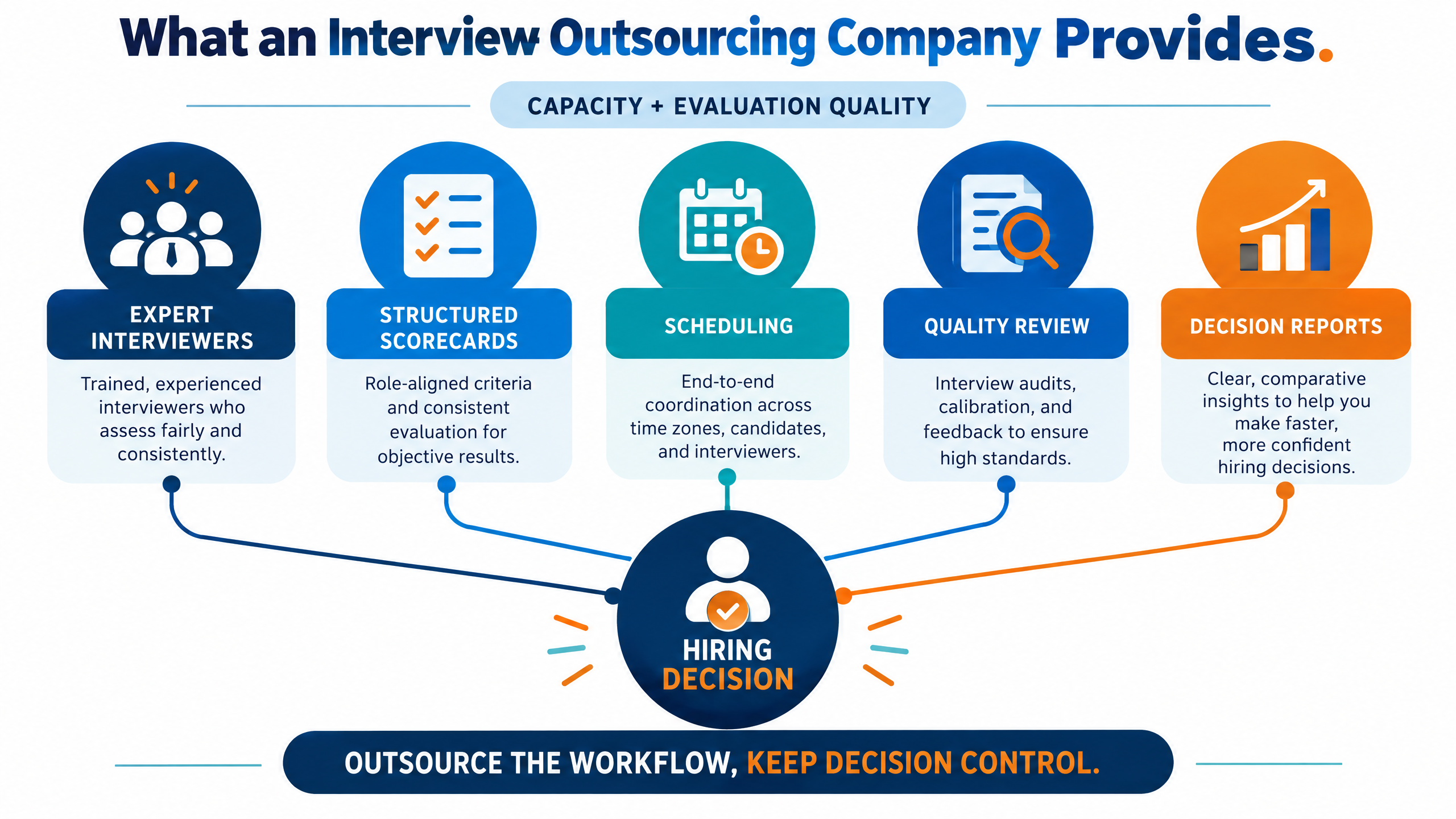
- Role intake: The provider reviews the job description, level, competencies, interview stages, and decision criteria.
- Interview design: The provider maps questions, practical exercises, and rating anchors to the role.
- Interviewer selection: The provider assigns interviewers with relevant technical, functional, or domain experience.
- Panel briefing: Interviewers receive role context, evaluation guidance, candidate information, and process instructions.
- Scheduling: The provider coordinates candidate and interviewer availability, reminders, rescheduling, and access details.
- Interview delivery: The candidate completes the live or asynchronous interview through the agreed format.
- Quality review: Notes, scores, recordings, transcripts, or reports are checked according to the service model.
- Decision report: The hiring team receives structured evidence, strengths, gaps, recommendations, and next-step context.
Interview outsourcing company vs platform vs RPO
|
Model
|
Primary value
|
Who conducts the work?
|
Best fit
|
|
Interview outsourcing company
|
External interviewer capacity and evaluation delivery
|
Provider’s interviewers or panels
|
Teams that need expertise, capacity, or faster technical evaluation
|
|
Interview platform
|
Workflow, scheduling, video, scorecards, reports, or AI-assisted evaluation tools
|
Client team, external panels, or both
|
Teams that want technology to run and track interviews
|
|
Recruitment process outsourcing (RPO)
|
Broader recruitment operations across sourcing, screening, coordination, and sometimes hiring delivery
|
An embedded or outsourced recruitment team
|
Organizations seeking wider talent-acquisition process ownership
|
|
Assessment provider
|
Skills testing, coding, aptitude, behavioral, or role-based validation
|
Platform, assessor, or both
|
Teams that need an earlier skills-validation stage before interviews
|
Why companies outsource interviews
Internal interview capacity is limited
Hiring volume changes quickly
Interview quality is inconsistent
Candidates wait too long for the next stage
The organization needs specialist coverage
TA leaders need evidence, not only opinions
7 capabilities to evaluate before choosing a provider
1. Role-specific interviewer expertise
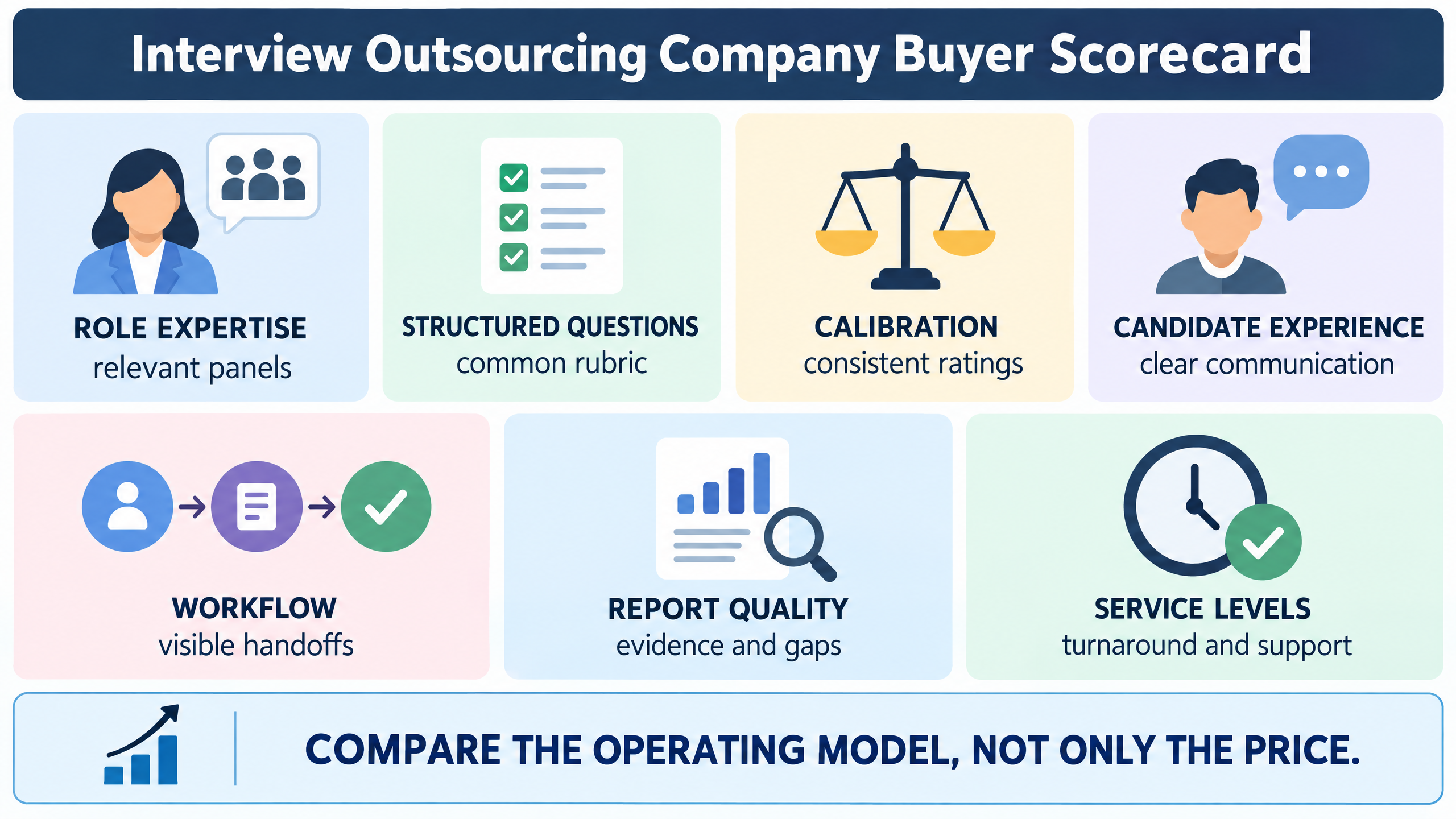
- Technical or functional domain experience.
- Seniority and interview scope.
- Experience with the role’s tools or operating environment.
- Ability to assess the target level.
- Availability across required time zones.
- Interviewer vetting and onboarding.
- Conflict-of-interest controls.
- Replacement process when an interviewer becomes unavailable.
2. Structured questions and scorecards
- Competencies to assess.
- Evidence expected at each level.
- Question types and follow-up rules.
- Practical exercises where appropriate.
- Rating anchors.
- Critical concerns or disqualifiers.
- Evidence required for a recommendation.
- Areas that should be verified in a later stage.
3. Interviewer calibration and quality control
- Interviewer onboarding.
- Role-specific briefing.
- Sample-answer calibration.
- Shadowing or reverse-shadowing.
- Review of completed reports.
- Quality scoring.
- Candidate and client feedback.
- Periodic interviewer revalidation.
- Escalation for ambiguous or unusual cases.
4. Candidate experience and communication
- Is the invitation clear?
- Does it explain the interview format and expected duration?
- Can the candidate ask for help?
- Are technical requirements provided in advance?
- Are reminders helpful rather than excessive?
- Is rescheduling straightforward?
- Are accessibility or accommodation requests supported?
- Does the interviewer explain the next step?
- Is the candidate informed when the process changes?
5. Assessment and interview workflow
- Resume or application screening.
- Online assessment.
- Coding or work-sample evaluation.
- Recruiter screen.
- Technical interview.
- Functional or behavioral interview.
- Hiring-manager review.
- Offer decision.
6. Reporting and decision-ready evidence
- Role and competency context.
- Questions asked.
- Evidence from the candidate’s responses.
- Ratings with definitions.
- Strengths.
- Gaps or risks.
- Uncertainty flags.
- Recommended follow-up.
- Overall recommendation and rationale.
- Interviewer identity and quality controls.
- Delivery time and revision process.
7. Service levels, security, and operating fit
- Interview request and scheduling turnaround.
- Coverage hours and time zones.
- Rescheduling and no-show policy.
- Replacement interviewer policy.
- Report turnaround time.
- Support contacts and escalation.
- Data retention and deletion.
- Recording and transcript controls.
- Access permissions.
- Integration options.
- Volume commitments.
- Minimums, bundles, or credits.
- Pilot terms and success criteria.
A practical interview outsourcing workflow
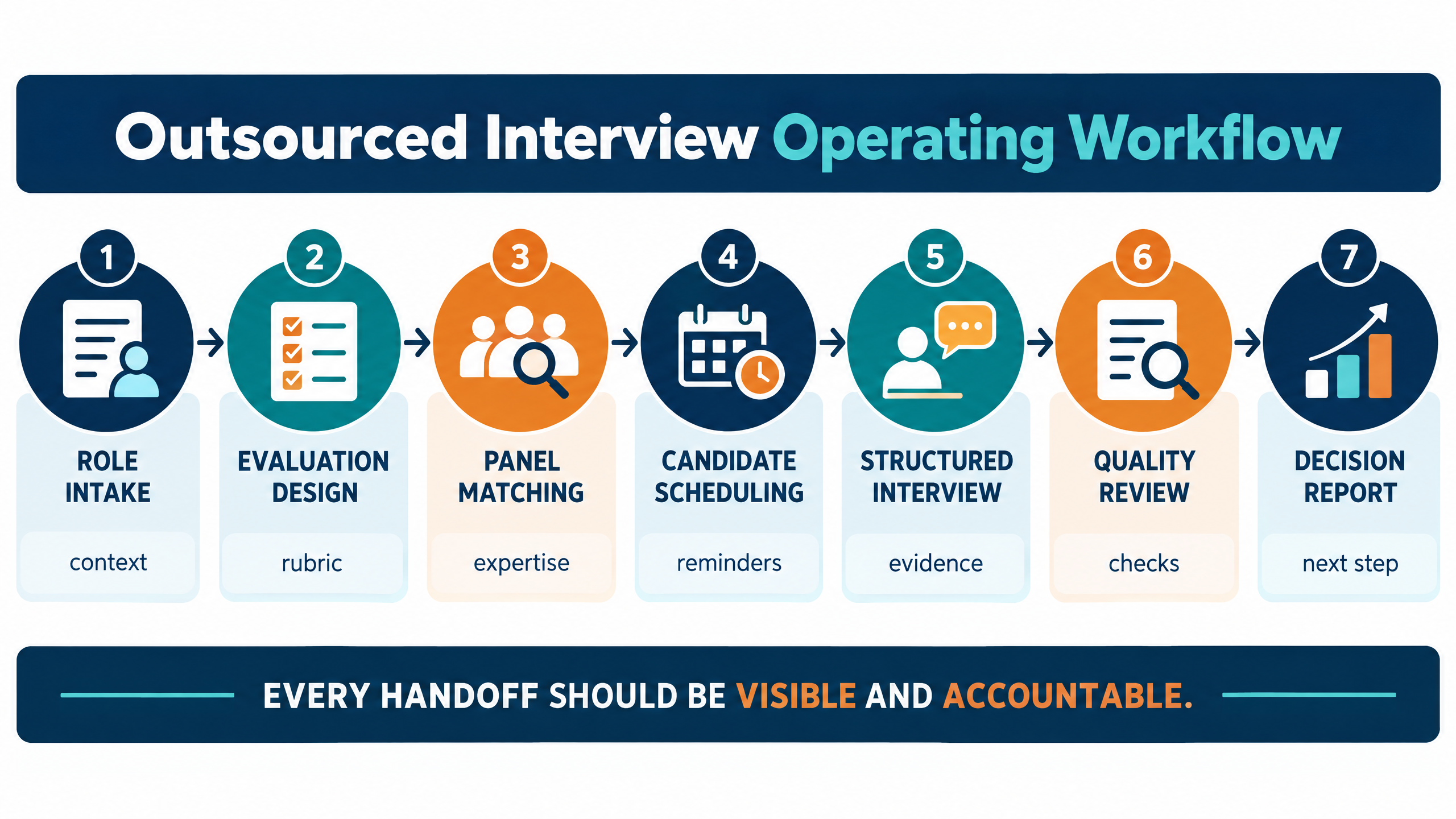
Step 1: Intake the role and hiring context
Step 2: Design the evaluation framework
Step 3: Match and brief interviewers
Step 4: Schedule and support the candidate
Step 5: Conduct and evaluate the interview
Step 6: Review the report and close the loop
Step 7: Learn from the data
How to connect interviews with assessments
- Define the role and evidence requirements.
- Use an assessment for the skills that benefit from standardized testing.
- Use a structured interview to explore reasoning, communication, and role context.
- Send uncertain or borderline cases to a targeted follow-up.
- Make the decision using multiple relevant evidence sources.
Cost and ROI questions to ask
- What counts as one interview.
- Whether interviewer matching is included.
- Whether the fee covers scheduling and reminders.
- Whether a no-show or reschedule is charged.
- Whether reports are included.
- Whether a quality review is included.
- Whether assessments are separate.
- Whether integration work is included.
- Whether urgent or weekend coverage costs more.
- Whether a pilot has minimum volume.
When interview outsourcing is a good fit
- Hiring volume exceeds internal interviewer capacity.
- Technical experts are unavailable or distributed across time zones.
- A team needs to launch a hiring campaign quickly.
- Interview quality varies across interviewers.
- Recruiters spend too much time coordinating panels.
- A company needs specialist expertise for a role family.
- The business wants a flexible model rather than permanent interviewer headcount.
- Candidate scheduling and feedback are creating bottlenecks.
- The organization needs structured reports for hiring-manager decisions.
Common risks and how to reduce them
Generic interviewer matching
Inconsistent scoring
Candidate confusion
Over-automation
Weak evidence
Data and privacy gaps
How futuremug supports outsourced interviews



Frequently Asked Questions
Companies use interview outsourcing to add technical or functional interview capacity, support high-volume hiring, access specialist expertise, reduce scheduling work, improve evaluation consistency, and move candidates through the process faster.
No. An interview outsourcing company primarily provides people and services for interview delivery. An interview platform primarily provides technology for scheduling, video interviews, scorecards, reports, or AI-assisted workflows. Some providers offer both.
Interview outsourcing focuses on interview delivery and related evaluation operations. Recruitment process outsourcing, or RPO, usually covers a broader part of recruitment, such as sourcing, screening, coordination, process management, and sometimes wider hiring delivery.
Review interviewer expertise, role matching, structured questions, rating anchors, calibration, report evidence, candidate feedback, quality review, turnaround time, and the provider’s handling of uncertain or exceptional cases.
Usually, the provider supplies evidence and a recommendation while the client retains hiring authority. The contract and operating model should state who owns the final decision and how disagreements or follow-up assessments are handled.