What Is AI Interview Software? A Smart Guide for Indian Enterprise Hiring Teams

What is AI interview software?
AI interview software is technology that automates or assists parts of the candidate interview and screening process. Depending on the product, it may match resumes to job descriptions, generate or recommend role-specific questions, conduct text or voice interactions, support video interviews, capture responses, create transcripts, evaluate defined competencies, and route candidates to the next hiring stage.
The software is most useful when it solves a clearly defined capacity problem. A talent acquisition team may have more applicants than recruiters can screen. Engineering leaders may need consistent first-round technical questions. A distributed enterprise may need interviews to happen across time zones without making every candidate wait for an interviewer’s calendar.
AI interview software should not be understood as a replacement for every human interviewer. A responsible deployment uses automation for repeatable work while preserving human review for context, exceptions, high-impact decisions, and final selection. The right buying question is therefore not simply, “Can the software interview candidates?” It is, “Which interview decisions can this software support, what evidence does it produce, and where does human accountability remain?”
For a broader view of the category, explore the , which connects AI-assisted screening with interview workflows, candidate management, and structured evaluation.
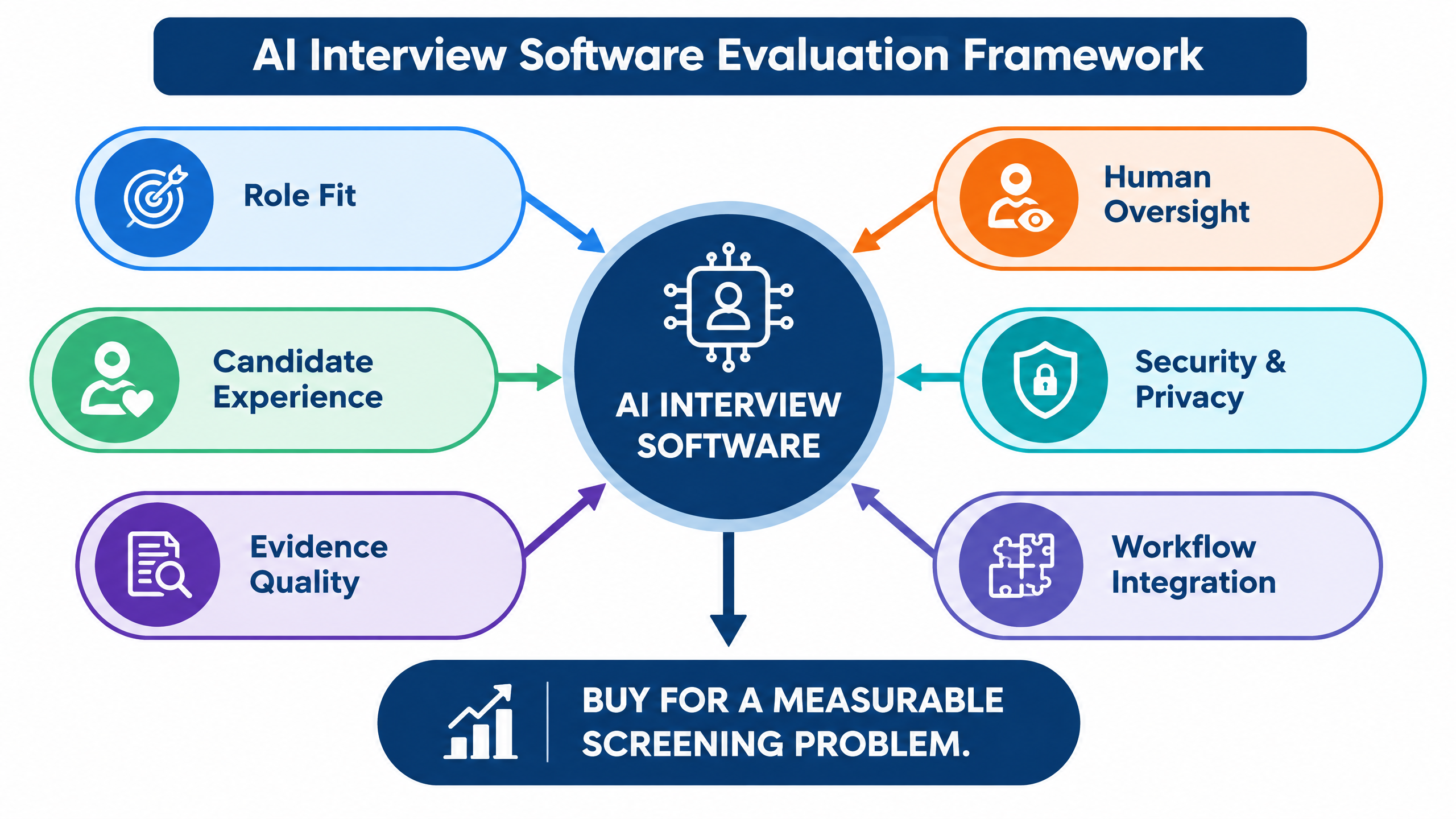
AI interview software evaluation framework for enterprise hiring teams

Why enterprise hiring teams are evaluating it

Enterprise hiring teams are under pressure to process more candidates without creating inconsistent or opaque experiences. Manual screening can consume recruiter time, while unstructured interviews make it difficult to compare candidates fairly. Scheduling becomes especially difficult during graduate hiring, bulk recruitment, urgent project hiring, and multi-location recruitment.
AI interview software can help with the repeatable parts of that process. It can deliver a consistent first interaction, ask questions mapped to the role, collect responses in a structured format, and make evidence easier for a recruiter or hiring manager to review. It can also reduce coordination work by automating invitations, reminders, rescheduling, and next-step triggers.
Speed alone is not a sufficient reason to buy. An enterprise workflow must also consider question relevance, candidate accessibility, privacy, security, auditability, explainability, and the ability to challenge or override an automated recommendation. The provides a useful external vocabulary for identifying, measuring, managing, and governing AI-related risk .
A strong evaluation measures four outcomes together: screening speed, evidence quality, candidate experience, and governance. Improving only one of these can create a fragile hiring process.

What AI interview software can do

The exact feature set varies by vendor and implementation. Buyers should separate capabilities that are available in a product from capabilities that have been tested successfully for their own roles.

Resume and role matching

The system can compare a candidate profile or resume with the job description and highlight relevant experience, skills, gaps, or questions for review. This can help recruiters prioritize attention, but it should not turn keyword similarity into an automatic rejection rule. Nontraditional experience and transferable skills still require human consideration.

Structured interview design

AI interview software may create questions from a job description, use a question library, or support recruiter-configured interview plans. The hiring team should be able to define competencies, difficulty, question types, follow-up rules, prohibited topics, and scoring criteria.

Text, voice, and video interviews

Some platforms support asynchronous text or voice interviews. Others add video interviews or conversational agents. The buyer should test audio quality, transcript accuracy, language support, interruptions, accessibility, device compatibility, and recovery from connectivity problems.

Technical screening and coding

For engineering roles, a useful workflow may combine coding questions, debugging prompts, technical discussions, and structured interviewer review. Ask how the platform captures code, handles different programming languages, runs test cases, and exposes evidence to a qualified reviewer.

Reports and decision support

Useful outputs can include transcripts, summaries, competency-level scores, coding results, strengths, gaps, red flags, and recommended next steps. These reports should help a recruiter decide what to review. They should not conceal the underlying response behind a single unexplained score.

Scheduling and workflow automation

The software may send invitations, reminders, and rescheduling options. It may also trigger an assessment, human interview, or recruiter task after a defined event. Review how the platform handles incomplete interviews, failed invitations, candidate withdrawal, manual review, and integration errors.
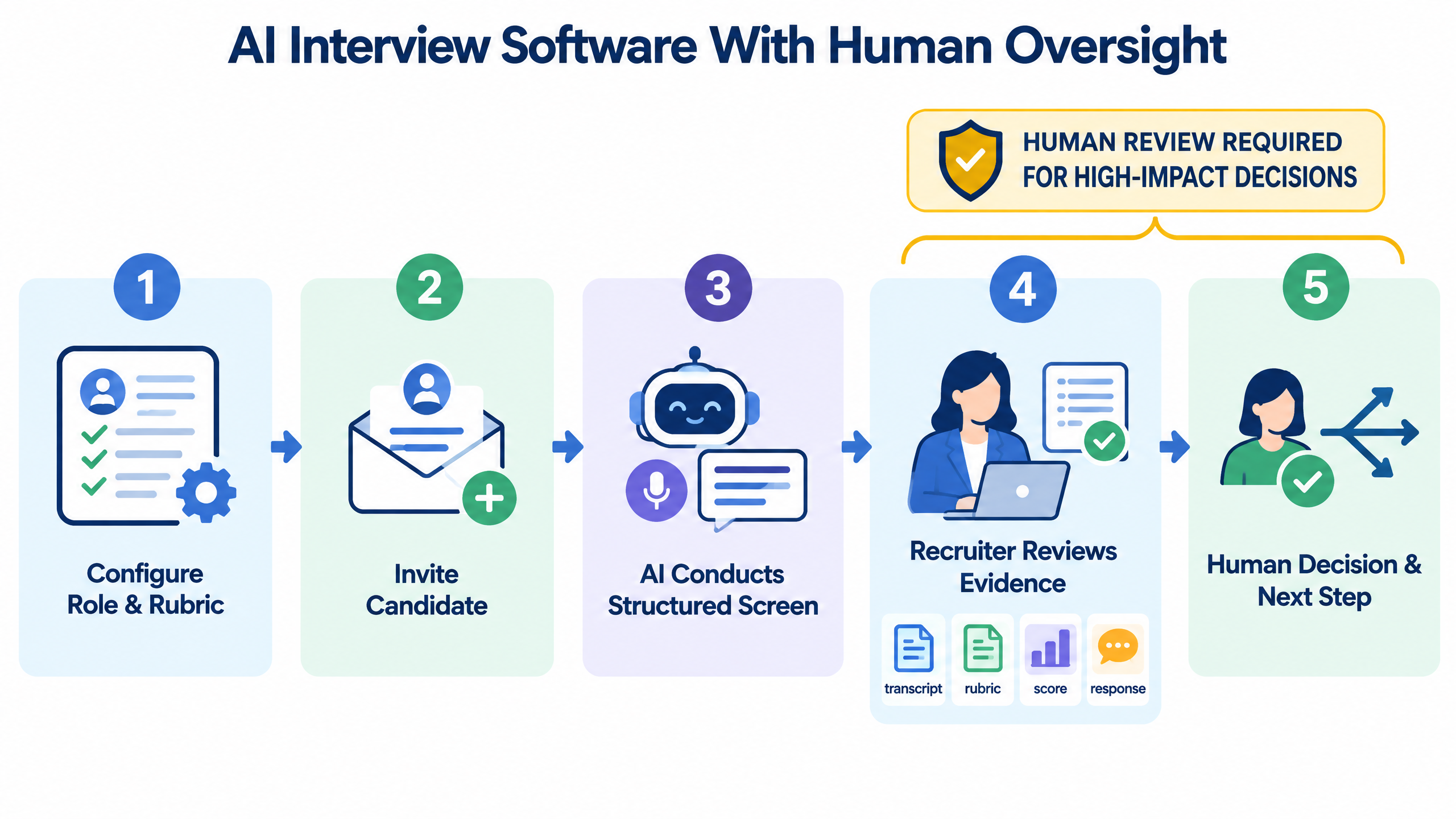
AI interview software process with human review and accountable next steps

7 smart checks before selecting a platform

1. Start with the hiring bottleneck

Document the current problem before looking at features. Is the main issue applicant volume, scheduling delay, inconsistent first-round questions, limited technical interviewer capacity, delayed feedback, or recruiter workload?
Define a baseline such as time from application to screen, recruiter hours per candidate, completion rate, interview-to-offer conversion, or time to deliver feedback. This makes it possible to judge whether the software creates a meaningful improvement.

2. Verify role and question relevance

Request a demonstration using one of your own job descriptions. Review whether the interview questions reflect the actual competencies required for the role. A software engineering screen should not evaluate only resume keywords. A customer-support screen should not rely only on generic communication prompts.
Ask whether the organization can approve, edit, reorder, or remove AI-generated questions. Confirm whether follow-up behavior is controlled and whether the system can avoid irrelevant, intrusive, or legally sensitive topics.

3. Inspect the evidence behind every score

A score is useful only when the team can understand what produced it. Ask to see the response, transcript, rubric, competency mapping, and scoring explanation behind a recommendation.
The report should distinguish observable evidence from model interpretation. Recruiters and hiring managers should be able to record an override, add context, and escalate a borderline result. This is particularly important for technical and leadership hiring, where a short automated interaction cannot represent every relevant capability.

4. Test the complete candidate journey

Candidate experience is part of hiring quality. The invitation should clearly explain why the candidate is being asked to complete an AI-supported interview, how long it will take, what device or browser is needed, how recordings or transcripts are handled, and what happens after submission.
Test the workflow on common devices and network conditions. Check keyboard navigation, captions or transcripts where relevant, language clarity, accessibility support, timeout behavior, and the availability of help. Monitor drop-off by stage instead of assuming every incomplete session is a candidate-quality problem.

5. Review human oversight and governance controls

Define which decisions the software can support and which decisions require a human reviewer. For example, the system may recommend a next step after an initial screen, while a recruiter or hiring manager confirms progression according to a documented policy.
Review consent, recording notices, retention, access control, audit logs, model monitoring, incident response, candidate correction, and deletion procedures. Ask how a candidate or recruiter can request another review when a result appears inaccurate or incomplete.

6. Check integrations and enterprise readiness

AI interview software should fit the existing hiring workflow. Review ATS or CRM integration, APIs, calendar connectivity, email or messaging notifications, webhooks, user permissions, reporting exports, and audit trails.
During a demonstration, show the complete path: create a role, invite a candidate, schedule or conduct the interview, review the evidence, record a decision, and trigger the next step. An isolated feature that requires manual re-entry may not deliver the expected operational benefit.
Also test volume. Ask about concurrent sessions, bulk invitations, rate limits, support response, uptime commitments, data residency, security controls, and implementation assistance.

7. Run a controlled pilot with measurable gates

Do not begin by deploying AI interview software across every role. Select one or two roles with clear competencies and a representative candidate cohort. Include edge cases such as incomplete answers, weak connectivity, unusual career paths, varied accents where voice is used, accessibility needs, and borderline scores.
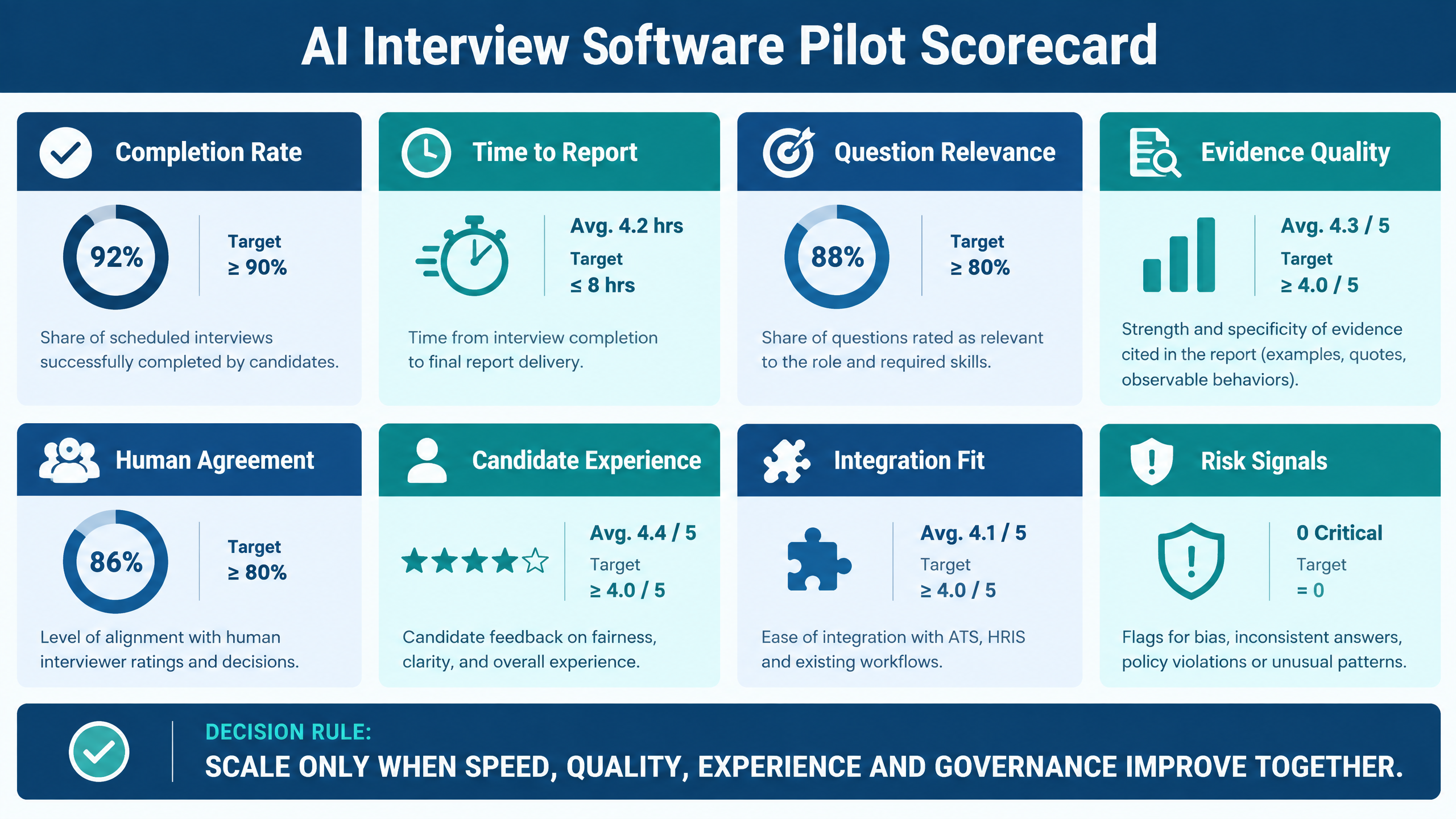
Use trained human reviewers to compare the AI-supported workflow with the current process. The pilot should produce evidence about speed, quality, candidate experience, human agreement, and risk. Scale only when the system improves the whole decision process rather than just increasing the number of interviews completed.

Governance and human oversight

Human oversight should be operational, not symbolic. Reviewers need access to the candidate’s underlying response and the rubric used to evaluate it. They should be able to override a recommendation, record why they did so, request additional evidence, and escalate a concern.
A practical governance model separates three types of decisions:
Decision type
Appropriate role for AI interview software
Human requirement
Administrative
Send invitations, reminders, scheduling options, and status updates.
Review exceptions and delivery failures.
Evidence collection
Ask structured questions, record responses, create transcripts, and organize reports.
Validate relevance and accuracy when material to the decision.
Hiring decision
Surface evidence and recommend a workflow next step.
Recruiter or hiring manager makes and documents the consequential decision.
Before launch, assign ownership for the job rubric, question approval, candidate communication, privacy review, security review, exception handling, and monitoring. Establish a regular review cycle for completion, overrides, complaints, disparities, transcript errors, and later-stage outcomes.
The organization should also communicate clearly with candidates. Transparency does not require a long technical explanation. It does require an understandable description of AI involvement, the information collected, the purpose of the interaction, and the available support or review route.

How to run an AI interview software pilot

A pilot should be designed like a controlled operational test rather than a product tour. Begin with a role that has a defined competency model and enough candidate volume to reveal workflow issues.
Pilot dimension
What to measure
Completion
Invitations opened, sessions started, completed interviews, and drop-off stage.
Speed
Time from invitation to completed report and time from report to recruiter decision.
Question quality
Relevance, difficulty, consistency, and alignment with the approved role rubric.
Evidence quality
Usefulness of transcripts, summaries, responses, coding results, and competency scores.
Human agreement
How often trained reviewers agree with, challenge, or override the recommendation.
Candidate experience
Clarity, accessibility, technical issues, fairness perception, and support requests.
Workflow fit
Integration reliability, permissions, notifications, exports, and next-step triggers.
Risk signals
Privacy incidents, unexplained results, inappropriate questions, complaints, and false positives or negatives.
AI interview software pilot scorecard for enterprise hiring decisions
At the end of the pilot, document what the software should automate, what it should assist, and what must remain manual. A bounded implementation makes governance easier and gives the hiring team a credible basis for expansion.

Use cases for Indian enterprise hiring

High-volume first-round screening

Organizations hiring for sales, support, operations, technology, or shared services may receive more applications than their recruiters can screen manually. AI interview software can handle a consistent early conversation and route stronger evidence to human reviewers.

Technical and engineering hiring

Engineering teams can combine coding assessments, technical prompts, structured interviews, and qualified reviewer input. The system should support evidence-based evaluation rather than treating an automated interview score as a substitute for technical judgment.
For skills validation before or alongside interviews, explore the and .

Graduate and campus hiring

Campus and fresher hiring often involves large cohorts, tight placement-season timelines, and coordination across colleges. AI-supported interviews can create a consistent first stage, provided that instructions, device support, accessibility, and human escalation are handled carefully.
The connects employer branding, college and TPO coordination, assessments, interviews, and candidate workflows for high-volume early-talent programs.

Distributed and multi-location recruitment

Asynchronous interviews and automated scheduling can help candidates participate across time zones and locations. Buyers should still test language support, consent, availability, connectivity, and local privacy requirements instead of assuming the workflow will perform equally in every hiring market.

Interview capacity support

Some organizations need software. Others need software plus expert interview operations. The is relevant when a team needs additional interviewer bandwidth, structured evaluation, scheduling support, or technical interview capacity alongside an AI-enabled workflow.

How futuremug supports AI-enabled hiring

futuremug positions its hiring technology around AI-powered interviews and assessments supported by structured workflows. Its describes capabilities including resume-to-job-description matching, automated scheduling, video interviews, an integrated coding environment, question libraries, transcripts, summaries, reports, and candidate management.
The describes automated interviews based on job descriptions and candidate profiles, transcripts, evaluations, bulk scheduling, voice capabilities, red-flag detection, and next-step triggers. Product pages describe intended capabilities; enterprise buyers should verify current functionality, integrations, security terms, pricing, and governance controls during a live evaluation.
A useful futuremug demo should use your own job description, hiring volume, competencies, candidate journey, review policy, and integration requirements. Ask the team to show both the automated experience and the human review layer.

Request an AI interview software demo

If your hiring team is losing time to repetitive screening, scheduling delays, inconsistent questions, or limited interviewer bandwidth, evaluate whether AI interview software can improve speed without weakening trust.
Bring one live job description, your competency rubric, expected candidate volume, current screening baseline, integration requirements, and governance questions to the conversation. A useful demonstration should show what the system automates, what evidence it produces, and where your recruiters and hiring managers remain accountable.
to review AI-assisted screening, interview workflows, assessments, structured reports, human oversight, integrations, and implementation fit.

Frequently Asked Questions

What is AI interview software used for?

AI interview software is used to automate or assist early-stage candidate screening through structured questions, text or voice interactions, video interviews, coding tasks, transcripts, summaries, scoring, scheduling, and recruiter workflows.

Can AI interview software replace human interviewers?

It can reduce repetitive first-round work, but it should not automatically replace human judgment for consequential hiring decisions. Human reviewers remain important for technical depth, context, exceptions, candidate concerns, final evaluation, and accountability.

Is AI interview software fair by default?

No. Fairness depends on the job requirements, question design, scoring rubric, data, workflow, monitoring, and human review. Standardization can improve consistency, but it does not remove the need to test for inappropriate proxies or unintended disparities.

How should human oversight work?

Define mandatory review points, give reviewers access to responses and supporting evidence, allow overrides, document reasons, and create an escalation route for candidates or recruiters. Oversight should change how decisions are made, not simply appear in a policy document.

What governance questions should we ask a vendor?

Ask about consent, recordings, transcripts, retention, access controls, security, scoring limitations, bias monitoring, question approval, audit logs, incident response, candidate correction, human review, deletion, and data processing locations.

How do we reduce candidate drop-off?

Explain the process clearly, keep the session relevant, provide time and device guidance, support accessibility, disclose AI involvement, make recovery possible, offer support, and tell candidates what happens after submission. Measure drop-off by stage and investigate content, technical, and communication causes separately.

What should an AI interview software demo include?

Request a complete scenario using your job description. The demo should show role configuration, question approval, candidate invitation, interview completion, transcript and score review, human override, report export, workflow integration, exception handling, and governance controls.

Can AI interview software support technical hiring in India?

Yes, when it includes role-relevant technical questions, coding or assessment capability, structured evaluation, and qualified human review. Engineering teams should inspect the evidence behind scores and validate the workflow with their own roles before scaling it.

Leave a Reply

Your email address will not be published.