Skills Assessment Platform for Hiring: Features That Matter by Role

Skills assessment platform: the short answer

A skills assessment platform helps an organization measure whether a candidate, employee, or learner can demonstrate a capability relevant to a role or development goal.
The important question is not whether a platform has the largest test library. It is whether the platform can turn a role requirement into a useful, fair, and reviewable signal.
For example, a software engineer may need to write and debug code. A sales representative may need to qualify an opportunity and respond to an objection. A data analyst may need to interpret a dataset and explain a recommendation. A new graduate may need a staged assessment of foundational reasoning, communication, and role-specific skills.
These roles require different evidence. The assessment format should follow the evidence need.
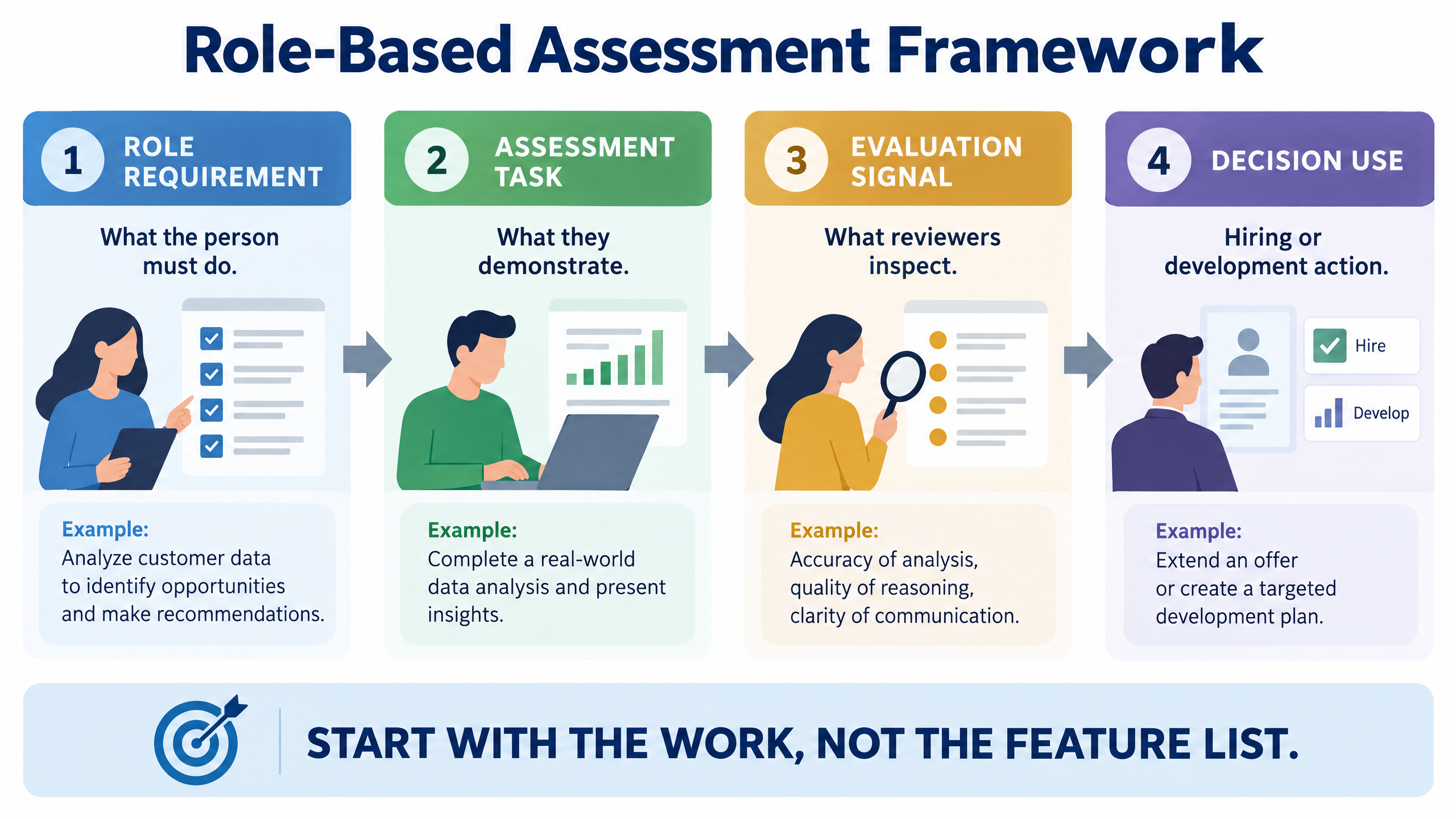
A strong buying decision evaluates four connections:
  1. Role requirement: What must the person do on the job?
  2. Assessment task: What can the candidate or learner demonstrate?
  3. Evaluation signal: How will the response be scored and reviewed?
  4. Decision use: What action will the result support?
The platform should make these connections visible to the people who create, review, and use assessments.
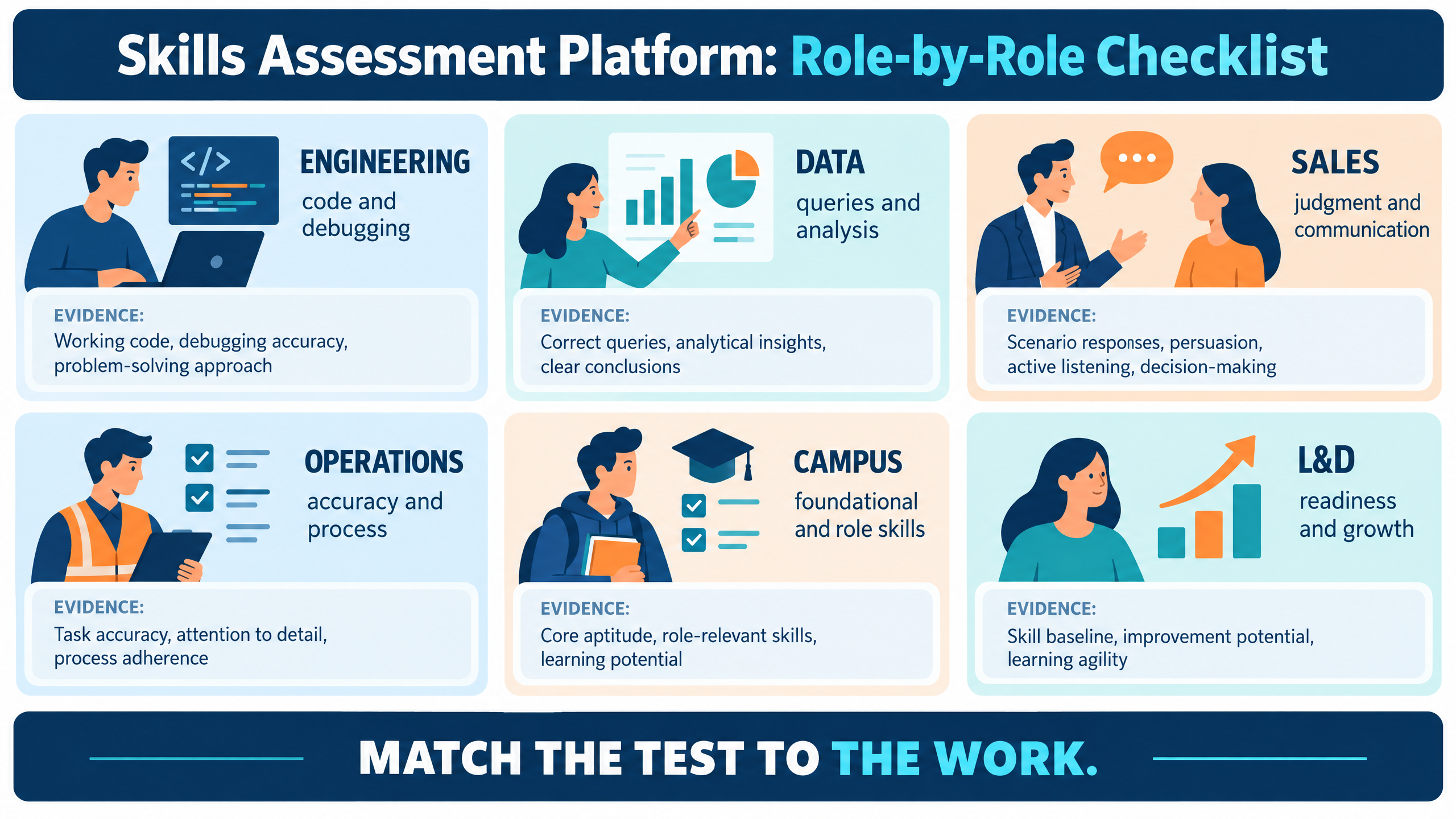
Skills assessment platform role-by-role checklist showing engineering, data, sales, operations, campus, and L&D assessment needs

How this guide differs from a general buyer checklist

The focuses on procurement workflow, governance, candidate experience, integrations, total cost, and vendor demonstrations.
This guide complements it with a different question: Which features matter for which role?
Use this page when your team needs to compare coding depth, work samples, communication tasks, business scenarios, aptitude tests, domain questions, scoring, or L&D assessments. It is designed to prevent a common buying error: selecting a platform because it supports a format that your role does not need.

The role-by-role assessment framework

Skills assessment platform role map showing role requirements, assessment formats, evidence signals, and hiring or development decisions
Role-map infographic: Start with the work, select the task, define the signal, and only then choose the platform feature.
Before comparing vendors, complete this four-part map:
Question
Example for a software engineer
Example for a sales representative
What must the person do?
Build, test, debug, and explain software.
Prospect, qualify, present value, and manage objections.
What should the assessment ask them to do?
Solve a coding task and explain trade-offs.
Prioritize leads and respond to a customer scenario.
What evidence should reviewers see?
Correctness, reasoning, code quality, and communication.
Judgment, clarity, listening, and commercial reasoning.
What decision will the result support?
Progress to a technical interview.
Progress to a role-play or hiring-manager round.
This map prevents teams from using generic aptitude scores as a substitute for job-relevant evidence.

Engineering and software development

Evidence that matters

Engineering hiring usually requires evidence of problem-solving, implementation, debugging, technical judgment, and communication. The exact mix depends on seniority and the engineering environment.
A junior role may need foundational coding, data structures, language basics, and debugging. A senior role may need system design, architecture, trade-offs, reliability, security, and the ability to explain decisions.

Assessment formats to consider

  • Coding questions with a suitable compiler or execution environment.
  • Practical coding tasks with test cases.
  • Debugging or code-review scenarios.
  • SQL or data-manipulation exercises.
  • Multiple-choice questions for targeted technical knowledge.
  • Descriptive responses for architecture or trade-off explanations.
  • Framework or domain questions where the role requires them.
A coding compiler is useful only when the assessment design reflects the work. Ask whether the candidate can use the required language, whether the platform supports test cases, whether partial results are visible, and whether reviewers can inspect the submitted code.

Platform features that matter

  • Language and framework coverage.
  • Built-in compiler or execution environment.
  • Private and public test cases.
  • Code output and error visibility.
  • Time and memory controls.
  • Plagiarism or similarity signals.
  • Code evidence in reports.
  • Manual review and reviewer notes.
  • Assessment variation for repeated hiring campaigns.
  • Skill and difficulty tagging.

What to avoid

Do not use a long algorithm test for every engineering role. Do not treat automated test-case success as a complete measure of engineering ability. A candidate can pass a narrow test and still need evaluation of code quality, design judgment, maintainability, and communication.

Demo question

Ask the vendor to create a role-specific coding assessment, invite a test candidate, show the completed code, review the test-case output, and produce a report that a hiring manager can use.

Data, analytics, and business intelligence

Evidence that matters

Data and analytics roles often require a combination of quantitative reasoning, data handling, interpretation, and communication. The assessment should reflect the tools and decisions used in the role.
An analyst may need to clean data, identify a trend, calculate a metric, explain a limitation, and recommend an action. A data engineer may need SQL, pipelines, data modeling, and reliability reasoning. A business-intelligence role may need dashboard interpretation and stakeholder communication.

Assessment formats to consider

  • SQL questions or query-writing tasks.
  • Data interpretation and chart-reading questions.
  • Spreadsheet or structured-data exercises.
  • Statistical reasoning.
  • Case-based analysis.
  • Descriptive explanations of findings.
  • Multiple-choice questions for targeted concepts.
  • Practical scenarios that test prioritization and data quality judgment.

Platform features that matter

  • Code or query execution where required.
  • Ability to combine objective and descriptive sections.
  • Dataset or image support.
  • Section-level and skill-level scoring.
  • Rubrics for explanation quality.
  • Report exports that preserve evidence.
  • Candidate instructions that define available tools and assumptions.
  • Flexible time controls for multi-step tasks.

What to avoid

Avoid measuring memorization when the job requires interpretation. Avoid hiding assumptions in a timed question. Avoid scoring a recommendation without showing the reasoning or evidence behind it.

Demo question

Ask the vendor to run a short dataset or SQL scenario. Review how the platform captures the answer, evaluates correctness, preserves the explanation, and reports the difference between a calculation error and a reasoning gap.

Sales, customer success, and support

Evidence that matters

Commercial and customer-facing roles depend on judgment, communication, listening, prioritization, and customer understanding. A generic aptitude score is rarely enough.
A sales representative may need to qualify a prospect, identify a business problem, respond to an objection, and decide on a next step. A customer-success manager may need to interpret account risk, communicate value, and prioritize intervention. A support role may need troubleshooting, clarity, patience, and escalation judgment.

Assessment formats to consider

  • Situational judgment questions.
  • Written customer-response scenarios.
  • Role-specific case studies.
  • Video or audio responses where appropriate.
  • Prioritization exercises.
  • Product or domain knowledge questions.
  • Descriptive responses assessed with a rubric.
  • Communication and language tasks designed for the actual role.

Platform features that matter

  • Flexible descriptive or media-response support.
  • Rubric-based human evaluation.
  • Custom scoring by competency.
  • Evidence capture for reviewer discussion.
  • Candidate instructions that define the customer context.
  • Review workflows for multiple evaluators.
  • Reports that separate communication quality from product knowledge.

What to avoid

Do not score communication without a clear rubric. Do not confuse accent, style, or speed with job performance. Do not ask candidates to perform a role-play without defining what good evidence looks like.

Demo question

Use one realistic customer scenario. Ask the vendor to show the candidate response, the rubric, the evaluator notes, and the final report. Check whether the report explains the outcome rather than reducing communication to one opaque score.

Operations, finance, and administrative roles

Evidence that matters

Operations and administrative roles may require accuracy, process judgment, organization, written clarity, numerical reasoning, and the ability to handle exceptions.
Finance roles may require accounting knowledge, reconciliation, spreadsheet fluency, financial reasoning, and control awareness. Operations roles may require prioritization, process adherence, data entry accuracy, and escalation judgment.

Assessment formats to consider

  • Numerical and quantitative reasoning.
  • Spreadsheet or data-entry tasks.
  • Process and policy scenarios.
  • Error-spotting exercises.
  • Work-sample simulations.
  • Descriptive explanations.
  • Role-specific knowledge questions.
  • Prioritization and exception-handling tasks.

Platform features that matter

  • Clear time and navigation controls.
  • Section-level results.
  • Negative marking only when it reflects the assessment purpose.
  • Configurable cut-offs.
  • Randomized questions where appropriate.
  • Audit-friendly report exports.
  • Candidate status and completion tracking.
  • Support for bulk assessment campaigns.

What to avoid

Avoid using speed as a proxy for accuracy unless speed is genuinely part of the job. Avoid tests that reward familiarity with a particular interface rather than the ability to perform the work.

Demo question

Ask the vendor to create a practical exception-handling task. Review whether the platform can capture the candidate’s decision, reasoning, time, and reviewer judgment in one report.

Graduate, fresher, and campus hiring

Evidence that matters

Graduate and campus hiring usually combines high volume with limited work history. The assessment should identify foundational capability without making the process unnecessarily complex for first-time candidates.
A staged approach can begin with broad reasoning or communication and move toward role-specific skills. Engineering cohorts may add coding. Customer-facing cohorts may add communication or situational judgment. Operations cohorts may add accuracy, numerical reasoning, or process scenarios.

Assessment formats to consider

  • Aptitude and logical reasoning.
  • Verbal or written communication.
  • Coding and technical fundamentals.
  • Domain or role-specific questions.
  • Situational judgment.
  • Structured descriptive responses.
  • Group or cohort-level evaluation where appropriate.

Platform features that matter

  • Bulk candidate upload and invitations.
  • Mobile-aware candidate delivery.
  • Clear instructions and status visibility.
  • Configurable cut-offs by role or cohort.
  • Proctoring and question randomization where justified.
  • Real-time tracking.
  • Candidate shortlisting.
  • Recruiter, TPO, or coordinator access.
  • Cohort and campaign reports.
For high-volume campus workflows, connect skills testing with the . The assessment should not be an isolated test if the hiring operation also needs eligibility, communication, interviews, and candidate coordination.

What to avoid

Do not use one generic test for every graduate role. Do not treat a single cut-off as a complete hiring decision. Do not overlook candidate support, device constraints, accessibility, or the clarity of next steps.

Demo question

Ask the vendor to import a sample cohort, send invitations, track completion, apply a role-specific cut-off, generate a shortlist, and export a report for recruiters or placement coordinators.

L&D, internal mobility, and reskilling

Evidence that matters

L&D and internal mobility assessments often have a developmental purpose. The result may identify a skill gap, recommend training, support certification, or show readiness for a new role.
The assessment should therefore produce useful feedback, not only a pass or fail. The person being assessed may need to understand what to improve and what evidence supports that conclusion.

Assessment formats to consider

  • Diagnostic knowledge tests.
  • Practical work samples.
  • Scenario-based judgment.
  • Role-readiness assessments.
  • Pre- and post-training comparisons.
  • Certification or recertification tests.
  • Descriptive reflections or explanations.
  • Repeat assessments with controlled variation.

Platform features that matter

  • Skill-gap reporting.
  • Individual feedback.
  • Cohort analysis.
  • Repeat-test controls.
  • Assessment versions.
  • Learning-path or workflow triggers.
  • Access separation between employee and manager views.
  • Reports that support development rather than only selection.

What to avoid

Do not reuse a recruitment cut-off as a developmental measure without reviewing its purpose. Do not expose sensitive employee results beyond the people who need them. Do not report a gap without explaining which skill or behavior the person should develop.

Demo question

Ask the vendor to compare pre- and post-training results and show how an employee, manager, and L&D administrator see different levels of information.

8 platform features that matter across roles
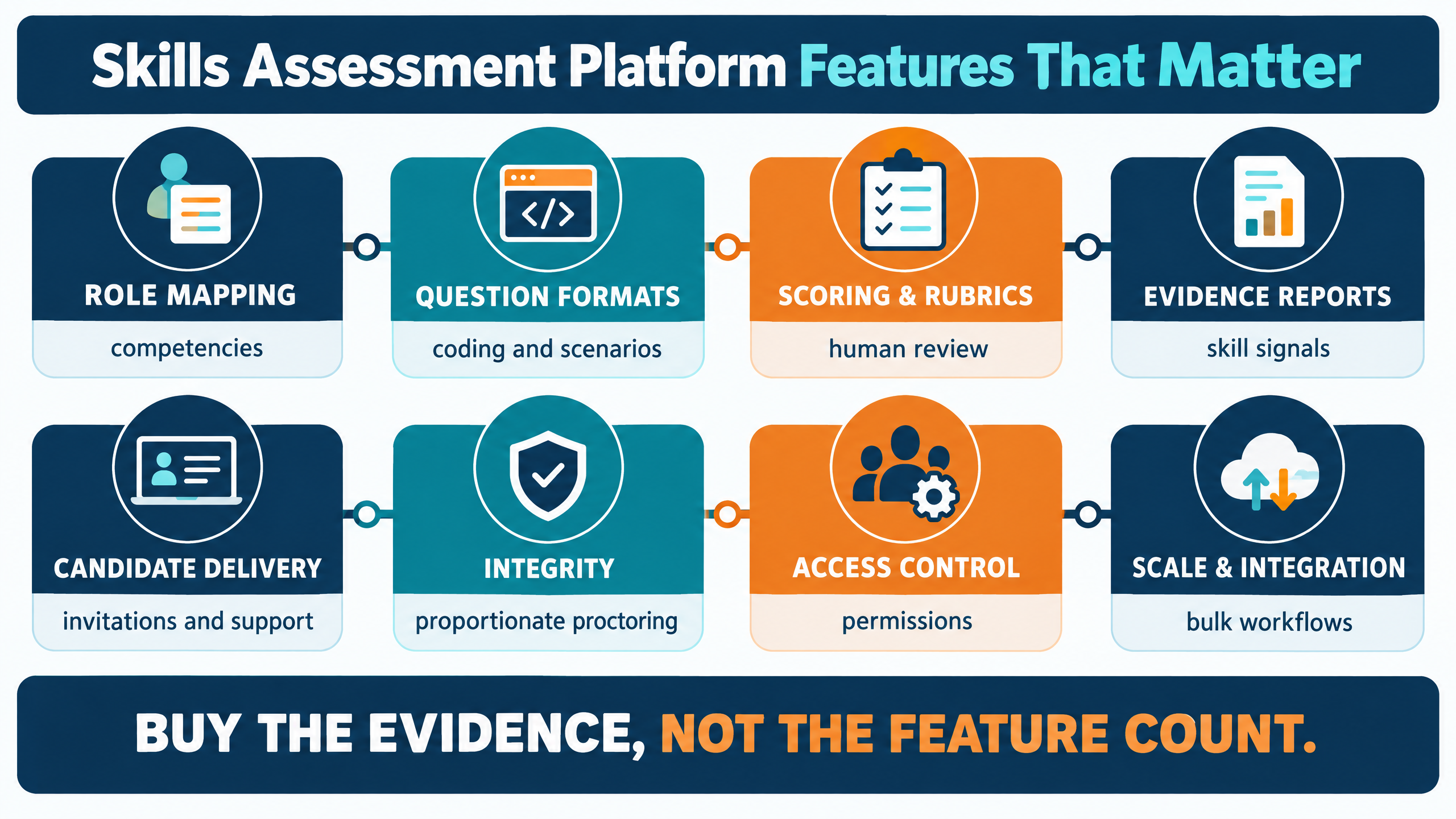
Skills assessment platform feature matrix showing question formats, role mapping, scoring, reporting, integrity, workflow, access, and scalability

1. Role and skill mapping

The platform should let the assessment owner describe the required skill, connect questions or tasks to it, and review the resulting evidence. Skill tags are useful only when they guide assessment design and reporting.

2. Multiple assessment formats

Look for the formats your roles actually need. These may include MCQ, image-based questions, descriptive responses, coding, video, aptitude, domain, or scenario-based tasks.

3. Configurable scoring and rubrics

A platform should support objective scoring and structured human evaluation. Check whether reviewers can use a rubric, add notes, override a result with a reason, and preserve the original response.

4. Evidence-rich reporting

Reports should show more than a total score. They should preserve section results, skill signals, code or written evidence, evaluator notes, integrity events, and the next recommended action.

5. Candidate delivery and support

The platform should support invitations, reminders, clear instructions, device requirements, completion status, recovery from common errors, and a support route.

6. Integrity controls

Evaluate question randomization, timers, identity or attendance controls, off-tab monitoring, proctoring, and auto-disqualification rules. Confirm how false positives and exceptions are reviewed.

7. Collaboration and access control

Recruiters, hiring managers, SMEs, L&D teams, and coordinators may need different access. Review role permissions, workspaces, exports, audit history, and user administration.

8. Scale and integration

High-volume teams need bulk candidate upload, live tracking, repeatable templates, APIs, exports, and integrations. Small teams may value fast setup and pay-as-you-use economics. Match the platform to the operating model.

How to test a skills assessment platform in a demo

A product demo should include at least two roles. Choose one role that needs objective or technical evidence and one role that needs a descriptive, scenario, or developmental assessment.

Test 1: Build a role-relevant assessment

Give the vendor a current job description. Ask the vendor to identify competencies, choose formats, configure sections, set time controls, and define scoring.

Test 2: Complete the candidate journey

Invite a test candidate. Check the invitation, registration, instructions, timer, navigation, submission, and confirmation.

Test 3: Inspect the evidence

Review the response, score, rubric, report, and reviewer notes. Ask what a hiring manager or L&D manager can see without opening several separate systems.

Test 4: Trigger an exception

Simulate a connection interruption, incomplete response, suspected integrity event, or reviewer disagreement. Check whether the platform gives the operator a clear next action.

Test 5: Compare role workflows

Ask how the platform handles a coding assessment and a written scenario. A role-relevant platform should not force both into the same question or scoring model.

Test 6: Review the operating cost

Ask what effort is required to create content, manage candidates, review results, support users, export reports, and maintain integrations.

Role-based vendor scorecard

Dimension
Engineering
Data and analytics
Sales and support
Campus and graduate
L&D and mobility
Core evidence
Code, debugging, design
Query, analysis, explanation
Judgment, communication, prioritization
Foundational and role skills
Readiness and skill growth
Key formats
Coding, MCQ, descriptive
SQL, data, case
Scenario, descriptive, media
Aptitude, coding, domain
Diagnostic, work sample, repeat test
Critical feature
Compiler and code evidence
Dataset and section reporting
Rubric and response review
Bulk delivery and tracking
Feedback and cohort reporting
Main risk
Over-testing algorithms
Rewarding memorization
Subjective scoring
Generic one-size-fits-all test
Treating development as pass/fail
Demo proof
Review code and test cases
Inspect reasoning and output
Review rubric and response
Run a cohort workflow
Compare pre- and post-assessment
Use “not demonstrated” when a vendor cannot show the capability. A claim in a product presentation is not the same as a working workflow.

How futuremug fits the evaluation

futuremug’s presents a configurable assessment dashboard, question bank, MCQ, image-based, descriptive, and coding formats, timers, proctoring, bulk candidate invitations, reports, section-wise scores, role-based access, AI-generated questions, and AI-assisted evaluation.
The product page also describes a built-in coding compiler, question randomization, off-tab activity tracking, live candidate tracking, internal shortlisting, API-triggered tests, mobile-friendly assessments, and custom user roles. These are provider-published capabilities. Confirm current availability, limits, configuration, support, and commercial terms in the live product or a current proposal.
The product page presents a free entry plan and usage-based options. Because limits and pricing can change, use the live product page as the source of truth rather than embedding changing prices in this article or in Product schema.
For a role-based buying discussion, use the . Share one technical role, one non-technical or customer-facing role, and the expected candidate volume so the evaluation reflects your actual use case.

Frequently Asked Questions

What is a skills assessment platform? ▼

A skills assessment platform is software that helps organizations create, deliver, score, and report assessments of job-related or development-related capabilities. It may support coding, aptitude, domain, descriptive, scenario, video, or other assessment formats.

How does a skills assessment platform differ from an online quiz tool? ▼

A quiz tool may present questions and collect answers. A skills assessment platform adds role mapping, assessment creation, candidate or learner management, scoring, reports, integrity controls, permissions, and workflow support. Buyers should verify the actual capabilities instead of relying on the label.

What features matter most for engineering hiring? ▼

Engineering teams should evaluate coding environments, language support, test cases, debugging or practical tasks, code evidence, assessment variation, technical scoring, reviewer notes, and reports. They should also test whether the assessment measures the role rather than only algorithm speed.

What assessment formats work for sales and customer-support roles? ▼

Useful formats may include situational judgment, written customer responses, role-specific scenarios, prioritization, product or domain knowledge, and structured communication tasks. Use a clear rubric and separate communication quality from product knowledge where relevant.

Can the same skills assessment platform support L&D? ▼

Some platforms can support recruitment, L&D, internal mobility, and certification. The buyer should confirm whether the product supports feedback, skill-gap reporting, repeat assessments, cohort analysis, and separate access for employees, managers, and administrators.

Should a skills assessment platform use AI scoring? ▼

AI-assisted scoring can reduce repetitive work, but the buyer should understand the scoring logic, calibration, original response access, confidence or exception signals, and human-review process. AI should support accountable evaluation rather than make it opaque.

How do I choose a skills assessment platform by role? ▼

Start with the work the person must perform. Define the evidence that would demonstrate competence. Select the assessment format that produces that evidence. Then evaluate whether the platform supports the format, scoring, workflow, reporting, governance, and scale required.

Is proctoring necessary for every skills assessment? ▼

No. The right control depends on the assessment purpose, role risk, candidate population, and consequence of the decision. Use proportionate controls and define how flags and exceptions receive human review.

How should buyers compare skills assessment platform pricing? ▼

Compare the complete cost of candidate or learner volume, users, assessments, credits, managed services, content creation, candidate support, scoring, reporting, integrations, implementation, and internal administration. A lower unit price may create more manual work.

What should a vendor demo include? ▼

It should include two different role scenarios, assessment creation, candidate delivery, response evaluation, report review, an exception path, permissions, and a total-cost discussion. Ask the vendor to demonstrate the workflow rather than only list features.

Leave a Reply

Your email address will not be published.