Technical Interview Panel as a Service: What to Check Before You Outsource

Technical interview panel as a service: the short answer
A technical interview panel as a service gives your organization access to external technical interviewers who are assembled for a specific role, stack, level, and interview plan.
Instead of asking the same internal engineers to cover every technical round, you can outsource selected interview stages to a panel provider. The provider may match interviewers, coordinate schedules, conduct coding or system-design rounds, apply a structured rubric, and return evidence for your hiring team.
The hiring decision should remain with your organization unless the contract clearly states otherwise. The panel supplies relevant evaluation evidence. Your engineering and talent teams decide whether the candidate meets the role requirements and how the process continues.
The key buying question is not “How many interviewers are in the provider’s network?” It is “Can the provider repeatedly deliver a role-matched, calibrated, well-supported panel with decision-ready evidence?”
A strong service should solve interviewer bandwidth without lowering the technical bar. It should also protect candidate experience, reduce scheduling delays, and make evaluation more consistent.
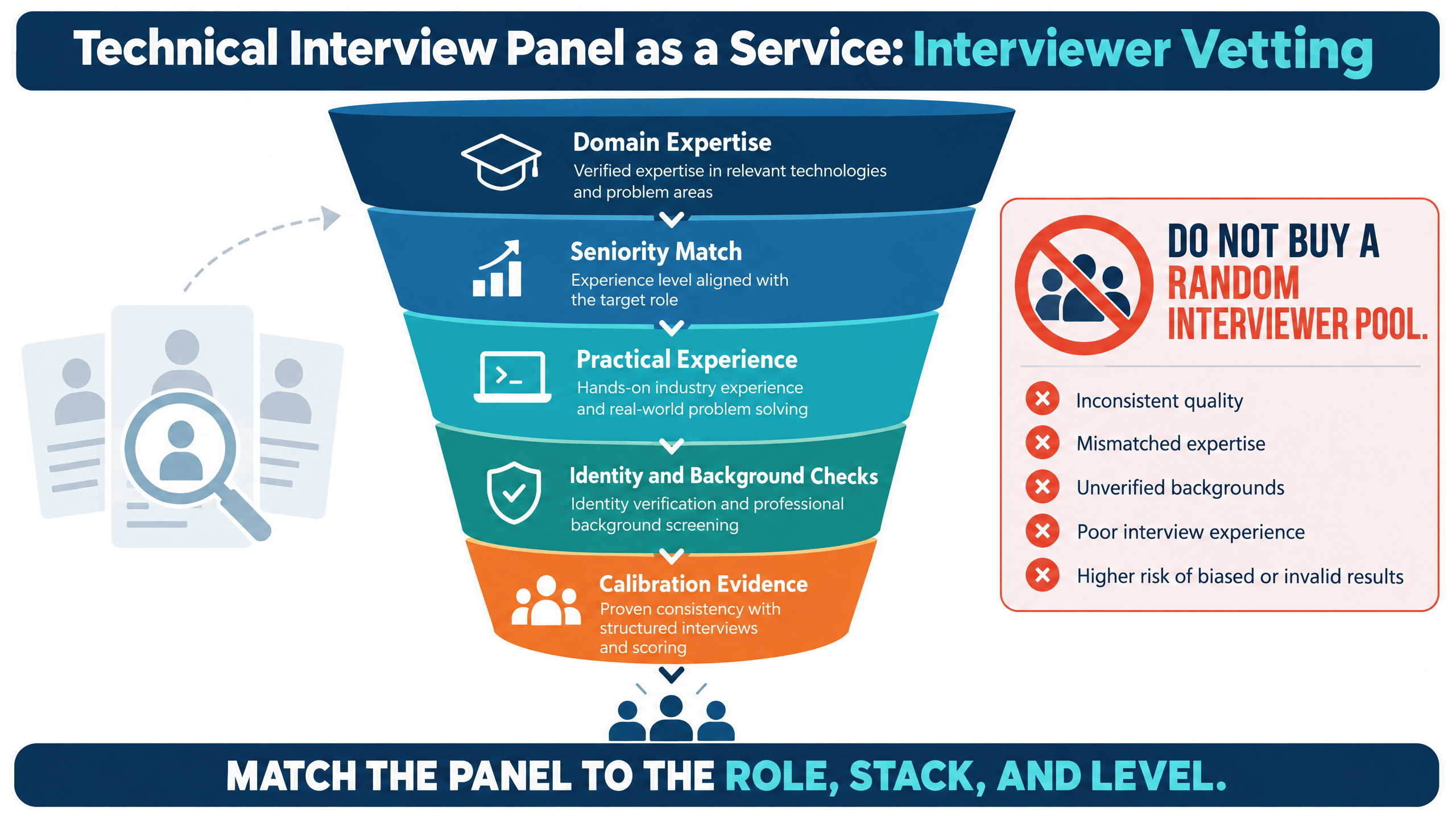
Technical interview panel as a service interviewer vetting funnel covering domain expertise, seniority match, practical experience, identity checks, and calibration evidence

What a technical interview panel as a service includes

A technical interview panel service can include some or all of the following:
  • Role and competency intake.
  • Interview-plan design.
  • Technical interviewer matching.
  • Coding, data structures and algorithms, system design, architecture, domain, or functional rounds.
  • Panel briefing and calibration.
  • Candidate scheduling and reminders.
  • Interview delivery through video, coding, whiteboarding, or other approved tools.
  • Structured scorecards and evidence capture.
  • Recordings, transcripts, code, or notes where permitted.
  • Quality review.
  • Consolidated interview reports.
  • Candidate status updates.
  • Rescheduling and escalation support.
  • Hiring-manager and recruiter dashboards.
The scope differs by provider. Some vendors provide only interviewer access. Others provide a managed interview operation with technology, scheduling, quality controls, reporting, and an account manager.
futuremug’s describe expert panels, customizable interviews, 24/7 auto-scheduling, predefined rubrics, structured evaluations, consolidated reports, multi-channel updates, and dedicated account support. The page also separates interview outsourcing from the futuremug platform and agentic AI interview options.

When outsourcing a technical panel makes sense

Outsourcing is useful when the hiring team has a clear role requirement but lacks enough internal interviewer capacity, specialist coverage, or scheduling flexibility.

1. Interviewer bandwidth is delaying candidates

Senior engineers are spending too many hours on interviews. Candidates wait for panel availability, and interview loops stretch beyond the team’s target timeline.
An external panel can add capacity while internal engineers focus on delivery, architecture, and team leadership.

2. The stack is specialized

The organization is hiring for a technology or domain that only a few internal engineers understand deeply. A matched external panel can cover the competency without requiring the company to build permanent internal expertise immediately.

3. Hiring volume is bursty

A launch, expansion, acquisition, campus program, or seasonal hiring campaign creates more interview demand than the internal team can absorb.
A flexible panel service can scale for a defined campaign and then contract when the demand falls.

4. Hiring is distributed across time zones

Global hiring requires interview coverage outside the availability of the internal engineering team. Evaluate whether the provider can schedule reliably across time zones while keeping the role bar consistent.

5. The company needs more consistent technical evidence

Different interviewers ask different questions, interpret the same answer differently, or submit incomplete feedback. A calibrated provider can help standardize competencies, score anchors, evidence requirements, and report structure.

6. The organization wants a hybrid model

Internal engineers may retain final, context-heavy, or team-specific conversations while an external panel conducts selected technical rounds. This often provides a practical balance between internal context and external capacity.

Technical interview panel vendor comparison matrix

Evaluation area
Internal panel
Interviewer marketplace
Managed technical panel service
Interviewer selection
Known internal engineers.
Candidate or buyer may choose from a pool.
Provider matches and briefs interviewers for the role.
Role context
Strong team and product context.
Varies by individual.
Depends on intake, briefing, and calibration quality.
Stack coverage
Limited to internal capability.
May be broad but inconsistent.
Should be demonstrated by domain and seniority coverage.
Calibration
Requires internal training and review.
Often buyer-managed.
Should include provider-led calibration and monitoring.
Scheduling
Depends on engineer availability.
Buyer may coordinate directly.
Provider may manage availability, reminders, changes, and escalation.
Evaluation format
Internal process.
May vary by interviewer.
Can use defined competencies, questions, rubrics, and reports.
Candidate support
Internal recruiter or coordinator.
Varies.
Should include clear instructions and a support path.
Evidence
Notes and scorecards, depending on discipline.
Often individual feedback.
Should return complete, structured, decision-ready evidence.
Scalability
Constrained by internal capacity.
Depends on supply and quality.
Depends on panel network, operations, and service levels.
Best fit
Stable volume and strong internal capacity.
Narrow, ad hoc expert access.
Recurring, specialized, bursty, or high-volume technical hiring.
The matrix is a starting point. Ask each provider to show the people, process, technology, and evidence behind every capability.

9 checks before you outsource

1. Interviewer vetting

Interviewer quality is the first vendor-selection test. Ask how the provider verifies that an interviewer has the relevant technical knowledge and practical experience.
A vetting process should address:
  • Technical domain and stack.
  • Seniority and scope of prior work.
  • Experience interviewing for the target level.
  • Communication and structured evaluation ability.
  • Identity and background checks where appropriate.
  • Conflicts of interest.
  • Availability and reliability.
  • Ongoing quality monitoring.
Do not accept “we have thousands of experts” as evidence of fit. Request an anonymized explanation of how a panel would be formed for one of your real roles.
futuremug’s public service page states that it offers a global pool of 5,000+ verified experts across 250+ IT domains. Treat that as a provider-published capability claim and validate the relevant domain, seniority, availability, and quality process for your role during procurement.

2. Role and panel matching

A panel should be matched to the role, not only to a keyword in the job description.
For a senior backend role, the panel may need different coverage for system design, coding and data structures, distributed systems, and domain context. For a security role, it may need application security, threat modeling, incident response, and practical architecture experience.
Ask the provider to document:
  • Required competencies.
  • Interviewer expertise for each competency.
  • Seniority match.
  • Interview-round ownership.
  • Question-plan ownership.
  • Escalation if no suitable interviewer is available.
The best panel may not be the largest panel. It should cover the required evidence without creating unnecessary candidate effort.

3. Calibration before live delivery

Calibration means aligning interviewers on what the role requires, how the rubric should be applied, what good evidence looks like, and how scores should be interpreted.
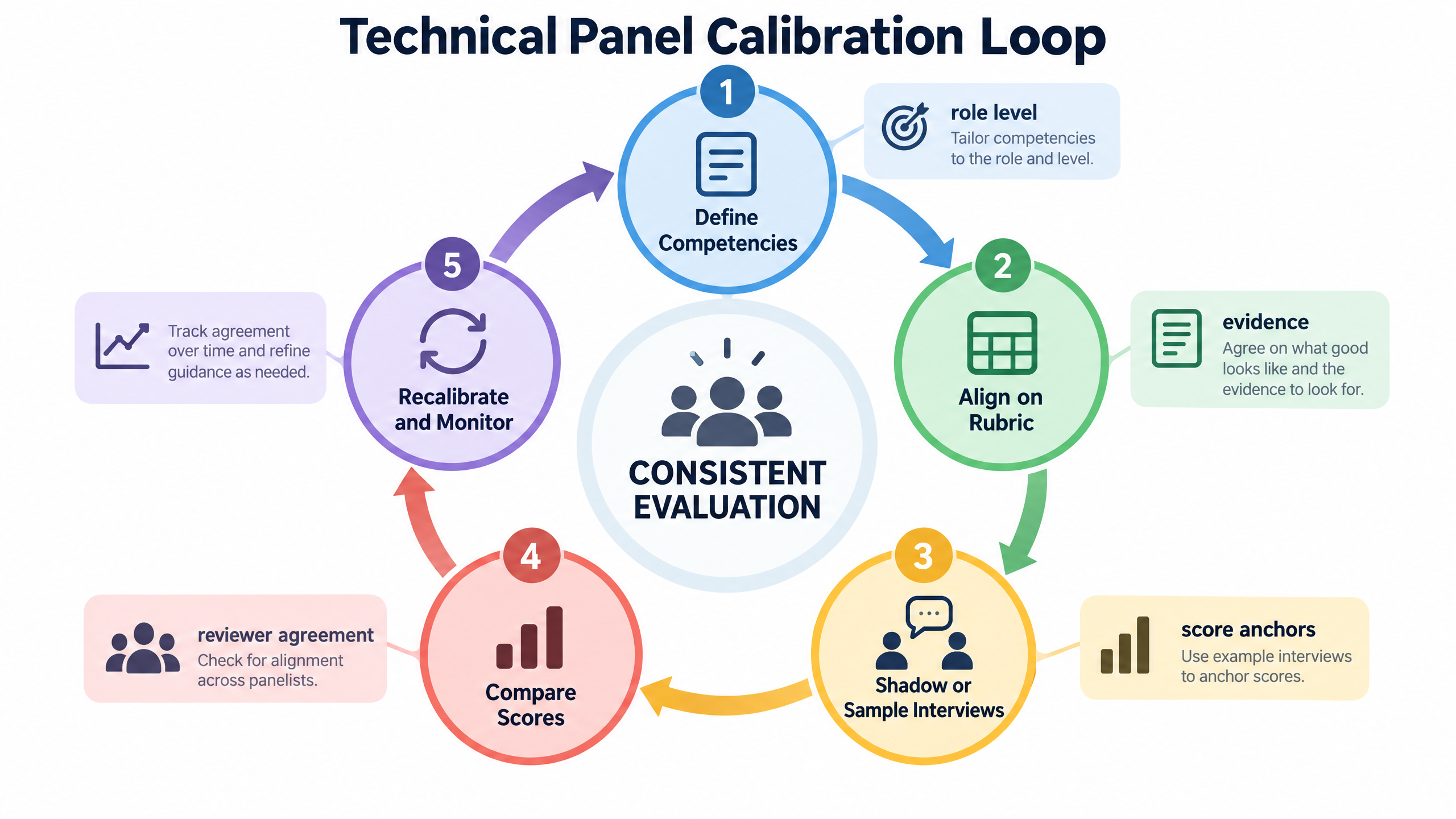
A practical calibration process includes:
  1. Define role competencies and level expectations.
  2. Agree on question themes and score anchors.
  3. Review sample answers or a sample interview.
  4. Compare scores across interviewers.
  5. Resolve disagreement before interviewing live candidates.
  6. Monitor score patterns and feedback quality during delivery.
The notes that greater structure is associated with higher validity, rater reliability, rater agreement, and less adverse impact . This does not mean structure removes all hiring risk. It means the design and consistency of the evaluation deserve deliberate attention.
Technical panel calibration loop showing define competencies, align on rubric, sample interviews, compare scores, and recalibrate

4. Technical depth and practical evidence

A technical interview should test the capabilities required by the job. Ask how the panel distinguishes memorized concepts from practical engineering judgment.
Depending on the role, evidence may include:
  • Code correctness and readability.
  • Problem decomposition.
  • Testing and edge-case handling.
  • System-design trade-offs.
  • Performance and reliability reasoning.
  • Security considerations.
  • Debugging approach.
  • Communication with stakeholders.
  • Technical decision-making under constraints.
A provider should be able to explain how questions and follow-ups are selected. Avoid panels that use generic question banks without adapting the interview to the role, level, and hiring context.

5. Structured scorecards and reports

A useful scorecard links the candidate’s response to a competency and a defined level of performance. It should not reduce a complex technical interview to a single unexplained number.
Review whether the provider captures:
  • Competency-level scores.
  • Evidence for each score.
  • Positive signals and gaps.
  • Coding or practical results.
  • Interviewer notes.
  • Candidate questions or clarifications.
  • Confidence or completeness indicators.
  • Reviewer comments.
  • Recommendation and rationale.
  • Any limitations or follow-up needs.
futuremug’s describes integrated coding, panel dashboards, centralized reporting, transcripts, summaries, personalized reports, and candidate management. Ask for a sample report using a role similar to yours.

6. Candidate experience

An outsourced panel is still part of your employer brand. Candidates may not distinguish between your company and the provider during the interview.
Check the full candidate journey:
  • Clear invitation and role context.
  • Simple joining instructions.
  • Information about interview duration and format.
  • Device, browser, and connectivity requirements.
  • Recording or transcript notice.
  • Rescheduling process.
  • Support contact.
  • Reasonable accommodation process.
  • Professional interviewer behavior.
  • Timely status and next-step updates.
For digital interview workflows, use the as a useful accessibility reference . Test the actual candidate experience rather than relying only on a vendor’s general compliance statement.

7. Service levels and operating coverage

Service levels convert a promise into an operating expectation. Define them before signing.
At minimum, discuss:
  • Time to acknowledge a panel request.
  • Time to propose or confirm interviewers.
  • Time to schedule a candidate.
  • Rescheduling response time.
  • Candidate-support response time.
  • Interview completion target.
  • Feedback submission deadline.
  • Report turnaround time.
  • Escalation response time.
  • Replacement process for unavailable or unsuitable interviewers.
  • Coverage during holidays and peak hiring periods.
Ask which metrics are measured, how they are reported, and what happens when a service level is missed.

8. Data, recordings, and AI governance

Technical interviews can generate resumes, contact data, recordings, transcripts, code, interviewer notes, and hiring recommendations. The provider should make the data flow and access model clear.
Ask about:
  • Data collection and purpose.
  • Candidate notices and consent.
  • Access by interviewers, recruiters, managers, and support staff.
  • Recording and transcript retention.
  • Code storage and export.
  • Deletion and correction requests.
  • Subprocessors.
  • Incident response.
  • Audit logs.
  • Cross-border processing.
  • Use of candidate data to train models.
  • Human review of AI-generated summaries or insights.
For AI-assisted interviewing, the provides a voluntary structure for considering trustworthiness and risk management . Ask the provider how human reviewers can inspect evidence, challenge an output, record an override, and monitor quality over time.

9. Integration and decision ownership

The panel should fit the hiring workflow. Confirm how candidate status, interview schedules, scorecards, reports, recordings, transcripts, code, and decisions move between the provider and your systems.
Define ownership clearly:
Decision or activity
Questions to resolve
Role definition
Who approves competencies, level, and interview plan?
Panel composition
Who approves the matched interviewers?
Candidate communication
Who sends instructions, reminders, and next steps?
Technical issue
Who supports the candidate during the interview?
Evaluation quality
Who reviews incomplete or inconsistent feedback?
Final decision
Who accepts, rejects, or requests another round?
Data access
Who can view recordings, code, transcripts, and reports?
Escalation
Who owns urgent issues and missed service levels?
The hiring decision should remain with your organization unless the agreement explicitly establishes another arrangement. A panel provider should supply evidence, not obscure accountability.

Use-case examples

A growing engineering team needs to protect senior-engineer time

The team is hiring backend and platform engineers. Engineering managers are conducting every technical screen, system-design round, and coding interview. Roadmap work is slipping.
A managed technical panel can cover defined technical rounds while internal leaders retain team-context, final, and culture-related conversations. The pilot should compare internal and external scores on the same candidates.

A company is hiring for a stack it does not yet have internally

The company is expanding into a new technical domain. It needs specialist evaluation before it has built an internal panel.
The provider should show how it verifies domain expertise, matches seniority, briefs interviewers, and handles a role-specific rubric. A generic “software engineer” label is not enough.

A product launch creates a six-month hiring spike

The organization needs a temporary increase in interview capacity. It wants consistent evaluation but does not want to add permanent interviewer headcount for a short campaign.
A panel-as-a-service engagement can be scoped to roles, volume, time period, interview rounds, and service levels. The contract should include a plan for reducing capacity after the spike.

A global company needs time-zone coverage

Internal interviewers are concentrated in one region, while candidates are distributed globally. The provider must support scheduling, candidate communication, interviewer availability, rescheduling, and report turnaround across the required time zones.

A high-volume campaign needs both assessment and interviews

For campus or bulk hiring, the interview panel may be only one part of the evaluation workflow. Link the panel service to assessment, candidate management, scheduling, and employer reporting so that candidates do not repeat information or experience disconnected handoffs.

How to run a panel pilot

A pilot gives the engineering and talent teams evidence before they commit to a large scope.

Choose one role with clear requirements

Select a role with a stable job description, defined competencies, and enough candidates to observe the workflow. Avoid starting with a role whose requirements are still changing.

Create a shared rubric

Define competencies, score anchors, required evidence, red flags, and decision rules. Include engineering and recruiting stakeholders before the first interview.

Compare matched evidence

Have the external panel interview a sample of candidates. Where practical, have an internal interviewer independently review the same evidence or conduct a shadow evaluation.
Compare:
  • Competency scores.
  • Evidence completeness.
  • Areas of agreement and disagreement.
  • Interviewer relevance.
  • Candidate feedback.
  • Report usefulness.
  • Time to schedule and report.

Include failure scenarios

Test a candidate cancellation, interviewer cancellation, rescheduling request, connectivity problem, incomplete feedback, unsuitable panel match, and urgent escalation. A service is defined by how it handles exceptions, not only by its successful interviews.

Set scale gates

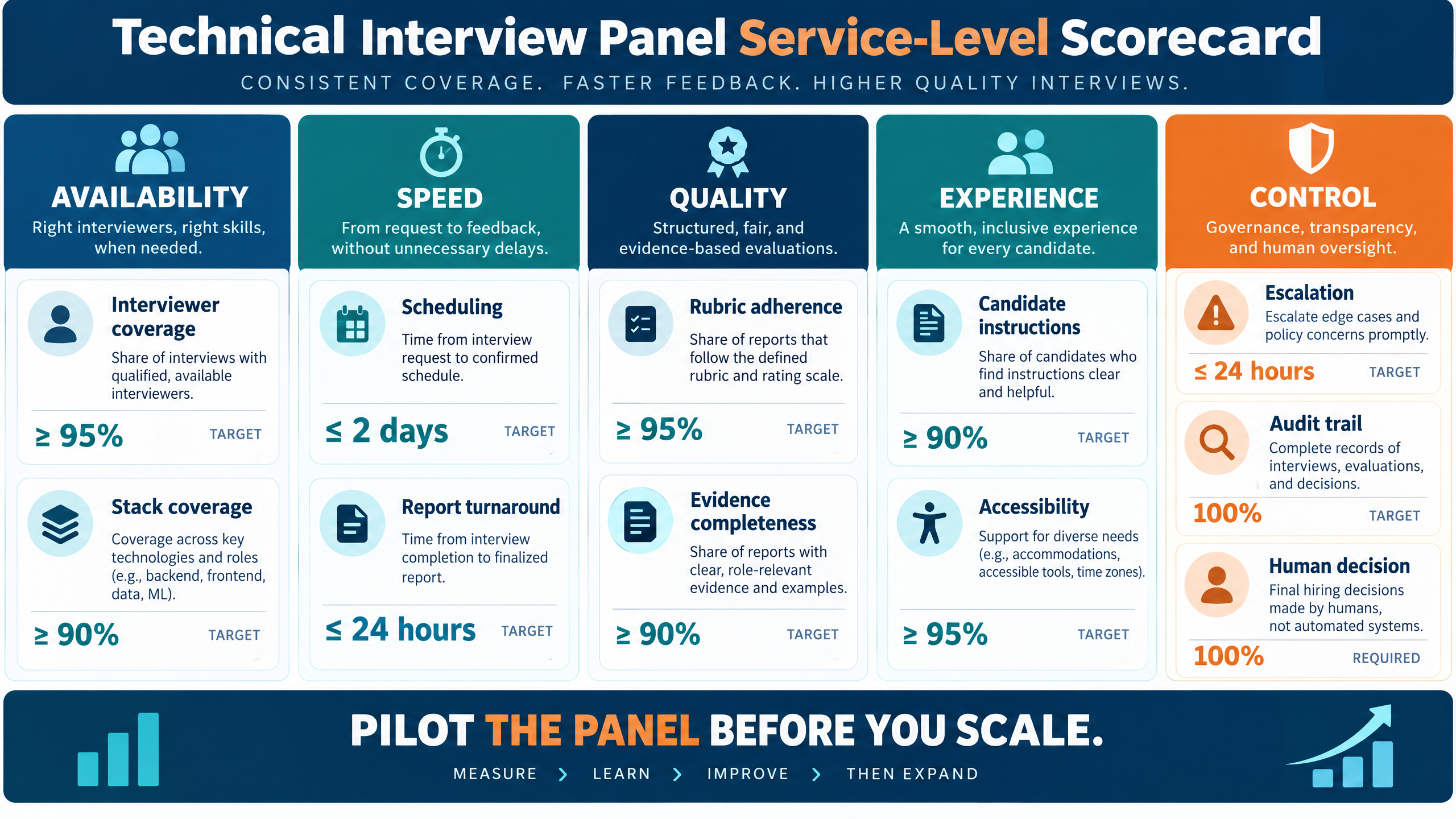
Agree on the thresholds required for expansion. These may include report turnaround, candidate satisfaction, interviewer quality, score agreement, completion rate, service-level attainment, and internal effort.

Document what remains internal

At the end of the pilot, record which rounds are outsourced, which remain internal, who owns candidate communication, how the ATS is updated, and who makes the final decision.

How to define service levels

A service-level agreement should describe measurable outcomes and the conditions that affect them.
Service area
Example requirement to define
Panel matching
Time to propose suitable interviewers after a complete role brief.
Availability
Required stack, level, geography, and time-zone coverage.
Scheduling
Target time from candidate readiness to confirmed slot.
Candidate support
Channel, response time, and escalation process.
Interview completion
Handling of cancellations, no-shows, and technical failures.
Feedback
Deadline for complete scorecards and evidence.
Reports
Format, recipients, and turnaround time.
Quality
Audit sample, calibration review, and replacement process.
Security
Access, retention, deletion, and incident obligations.
Governance
Review cadence, metrics, and scope-change process.
Do not define a service level that the buyer cannot observe. Each metric should have a data source, reporting frequency, owner, and escalation route.
Technical interview panel service-level scorecard showing availability, speed, quality, candidate experience, and control


How futuremug fits the panel-service decision

futuremug’s public positions technical interview panels as part of a broader managed interview workflow. The page describes a pool of verified experts, customizable interviews, panel selection, automated scheduling, structured rubrics, quality checks, consolidated reports, multi-channel updates, and account support.
The public describes a self-service workflow with video interviews, live coding, interviewer dashboards, question libraries, automated scheduling, centralized reporting, transcripts, summaries, and candidate management.
Those are different buying paths:
  • Choose managed panel support when you need external technical interviewers and coordination.
  • Choose a platform workflow when your team has interviewers but needs scheduling, coding, reporting, and management tools.
  • Choose a hybrid model when internal engineers should retain selected rounds while external experts cover defined technical competencies.
  • Consider broader recruitment support when the challenge extends beyond interviews into sourcing, screening, or end-to-end operations.
A futuremug consultation should clarify the role, stack, level, competencies, rounds, volume, time zones, interviewer requirements, data policies, report format, service levels, and pilot design.
to evaluate expert-panel delivery, interview platform support, or a hybrid model for your hiring workflow.

Buyer checklist

Before outsourcing a technical interview panel, confirm that you can answer these questions:
  • Which interview rounds are in scope?
  • Which competencies must each round measure?
  • What stack and seniority must the panel cover?
  • How are interviewers vetted and matched?
  • How will calibration be completed?
  • What evidence must the scorecard contain?
  • Who owns candidate communication and support?
  • What accessibility and accommodation process exists?
  • How are recordings, transcripts, code, and notes protected?
  • What happens when an interviewer is unavailable or unsuitable?
  • What scheduling and report turnaround is required?
  • Which rounds remain with internal engineers?
  • Who makes the final hiring decision?
  • What metrics will the pilot and service-level review use?
  • How can the scope expand, narrow, or end?

Frequently Asked Questions

What is a technical interview panel as a service? ▼

It is an outsourced panel of technical interviewers assembled for a specific role, stack, level, and interview plan. The provider may match experts, schedule interviews, conduct technical rounds, apply a rubric, and return structured evidence while the hiring organization retains the final decision.

Why outsource a technical interview panel? ▼

Common reasons include interviewer bandwidth, specialist stack coverage, bursty hiring volume, global time zones, inconsistent evaluation, and the need to protect senior engineers from excessive interview load.

How should a technical interview panel provider vet interviewers? ▼

The provider should verify domain expertise, practical experience, seniority, interviewing ability, identity where appropriate, conflicts of interest, availability, and ongoing quality. Ask how those checks are documented and refreshed.

What is interviewer calibration? ▼

Calibration aligns interviewers on role competencies, question themes, score anchors, evidence expectations, and decision rules. It should include sample or shadow interviews, score comparison, disagreement resolution, and ongoing monitoring.

How do I know whether an external panel understands our role? ▼

Provide a real job description and competency framework. Ask the provider to show how it selects panel seats, explains the role, adapts questions, and validates technical evidence. Run a pilot and compare the output with internal reviewers.

Should we outsource all technical interviews? ▼

Not necessarily. Many teams outsource selected technical rounds and retain final, team-context, or culture-related conversations internally. The right split depends on the role, risk, internal capacity, and decision responsibilities.

What candidate experience standards should a panel meet? ▼

Candidates should receive clear instructions, reasonable scheduling options, technical support, information about recording or data use, accessibility support, professional treatment, and timely updates about next steps.

What service levels should be in the contract? ▼

Define panel-matching time, scheduling turnaround, candidate-support response, interview completion, feedback deadline, report turnaround, quality review, replacement, security, and escalation requirements.

How is a technical interview panel different from a platform? ▼

A platform provides technology for running interviews. A technical panel service provides interview delivery capacity. Some providers combine both. Ask whether you are buying software, external experts, managed operations, or a combination.

Can AI replace a technical interview panel? ▼

AI can support structured screening, question generation, transcripts, summaries, or workflow automation. It does not remove the need to define job-related competencies, monitor quality, preserve human accountability, and evaluate whether the evidence is appropriate for the decision.

How should we compare technical panel pricing? ▼

Compare panel and interviewer fees, platform charges, setup, coordination, scheduling, reports, account support, integration, internal reviewer time, minimum volume, cancellation rules, and the cost of delayed or inconsistent hiring.

Leave a Reply

Your email address will not be published.