
TPO Full Form in College and Jobs: Meaning, Role, and Responsibilities
TPO full form in college: the short answer
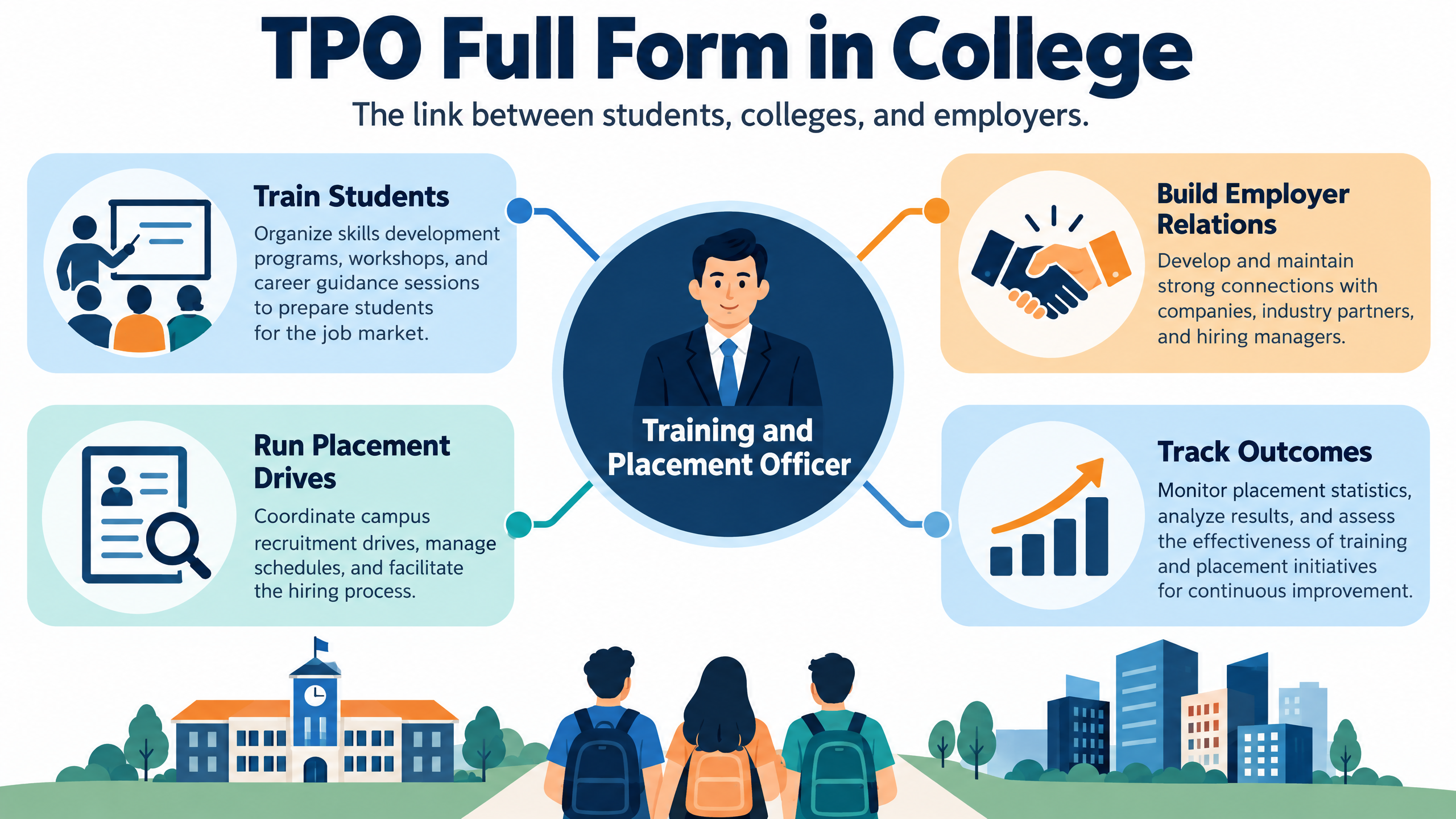
What does TPO mean in jobs?
- Training and Placement Officer.
- Placement Officer.
- Head of Training and Placement.
- Training and Placement Executive.
- Career Services Officer.
- Corporate Relations Officer.
- Head of Corporate Relations.
- Dean or Director of Career Services.
- Placement and Industry Liaison Officer.
TPO full form in college versus TPO full form in jobs
|
Search phrase
|
Meaning in the college-placement context
|
What the reader usually wants to know
|
|
TPO full form in college
|
Training and Placement Officer.
|
Who manages training, employers, campus drives, and placement outcomes?
|
|
TPO full form in jobs
|
Usually Training and Placement Officer when the job is within an educational institution.
|
What does the job involve and what skills are required?
|
|
TPO job meaning
|
A role that coordinates student employability and employer hiring activities.
|
How to qualify, what to do daily, and how performance is measured.
|
|
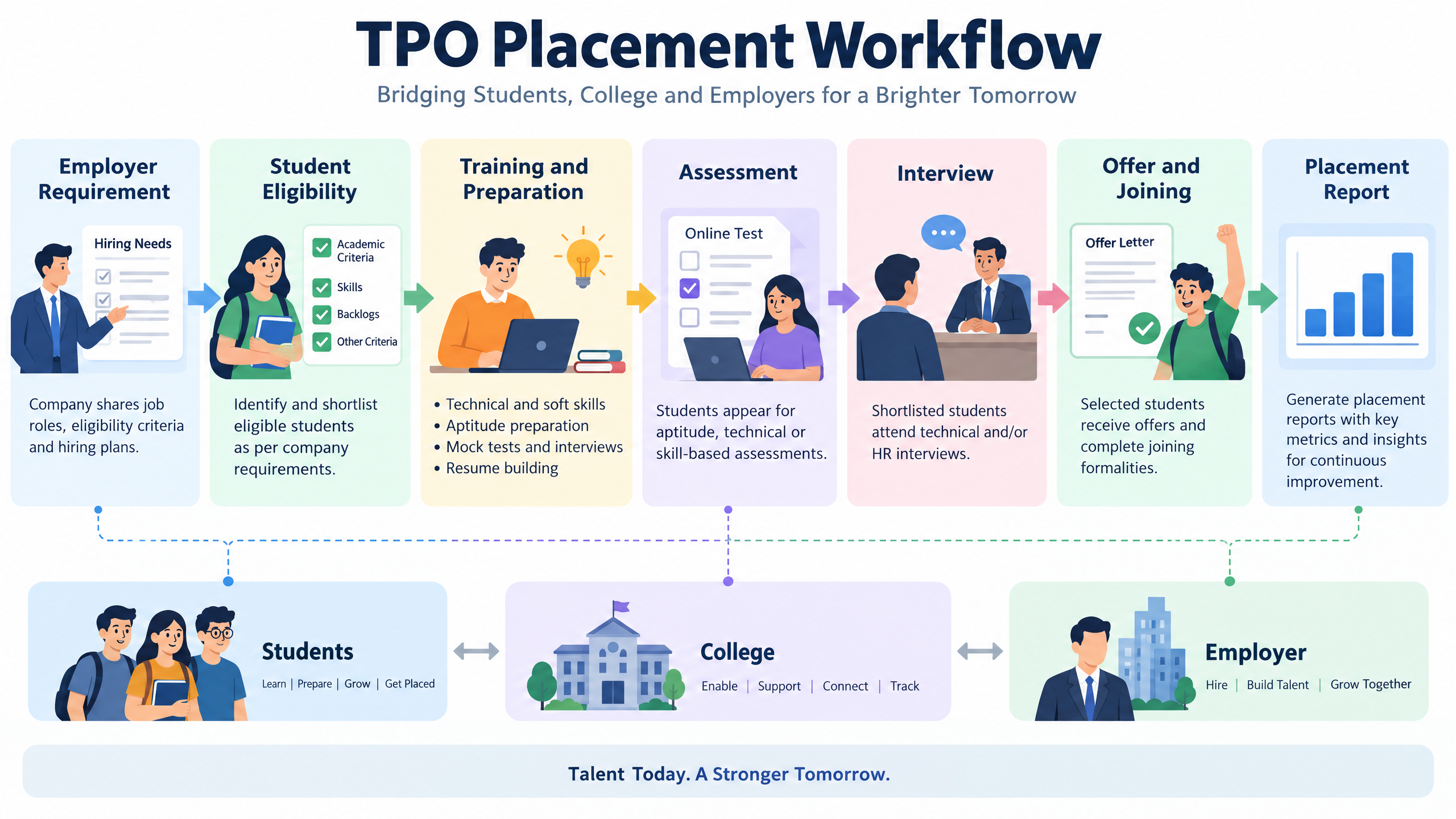
TPO in campus placement
|
The operating link between the college, students, and recruiters.
|
How placement drives, eligibility, assessments, interviews, and offers are managed.
|
|
TPO office meaning
|
The college’s training and placement function or department.
|
Which team handles career readiness and recruitment operations?
|
What does a Training and Placement Officer do?
1. Build employer relationships
2. Prepare students for employment
3. Set eligibility and placement policies
4. Plan and run placement drives
5. Coordinate assessments and interviews
6. Manage student communication
7. Maintain placement records and reports
8. Manage employer feedback and future improvements
9. Coordinate internships and industry engagement
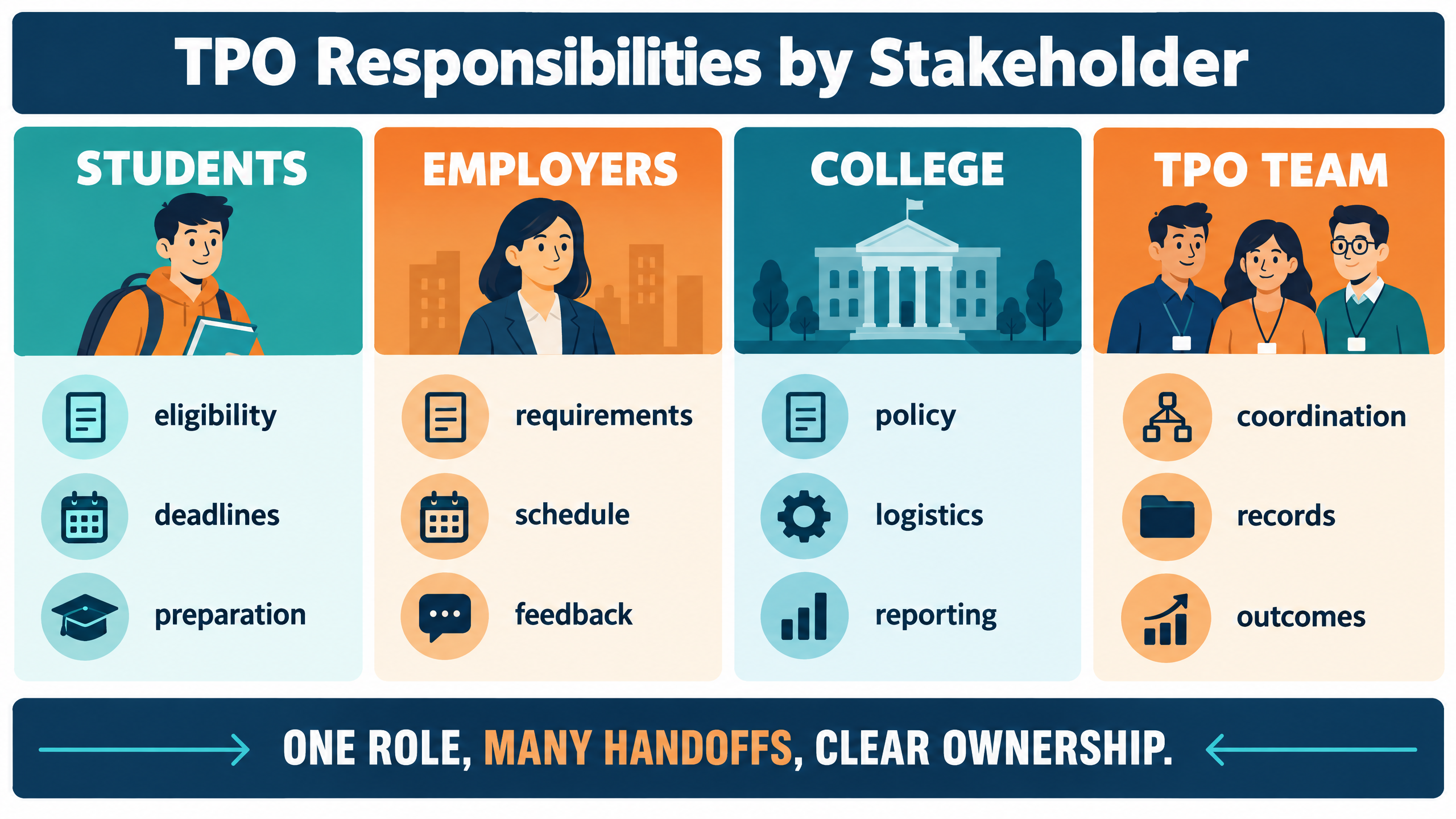
TPO responsibilities by stakeholder
Responsibilities toward students
- Explaining job descriptions and selection criteria.
- Publishing drive announcements and deadlines.
- Verifying eligible student lists.
- Coordinating training and mock interviews.
- Sharing assessment and interview instructions.
- Tracking student attendance and status.
- Providing a route for questions or concerns.
- Recording offers, acceptance, and joining updates.
Responsibilities toward employers
- Understand the role, skills, location, compensation, and selection process.
- Share college, batch, department, and candidate information accurately.
- Coordinate the pre-placement talk and hiring calendar.
- Arrange rooms, links, panels, and student batches.
- Communicate changes quickly.
- Collect assessment and interview outcomes.
- Track offers and joining information.
- Request feedback after the drive.
Responsibilities toward college leadership
Responsibilities toward faculty and departments
Responsibilities toward the placement team
TPO vs placement coordinator vs placement cell vs RPO
|
Term
|
What it is
|
Typical scope
|
Example responsibility
|
|
Training and Placement Officer (TPO)
|
The officer who leads or coordinates training and placement.
|
Strategy, employer relations, student readiness, drive accountability, and reporting.
|
Approve the placement calendar and coordinate a major employer drive.
|
|
Placement coordinator
|
A faculty, staff, department, or student representative who supports placement work.
|
Department-level or drive-level execution.
|
Collect eligible student data and coordinate attendance.
|
|
Training and placement cell
|
The institutional unit that includes the TPO and support team.
|
Training, employer engagement, drives, records, and outcomes.
|
Run the full campus-placement season.
|
|
Career services office
|
A broader institutional function that may include counseling, internships, alumni, and employer relations.
|
Career development and transition support.
|
Connect students with internships and career resources.
|
|
Interview outsourcing provider
|
An external service that conducts or coordinates selected interview stages.
|
Technical, functional, behavioral, or expert-led evaluation.
|
Provide structured technical interviews when employer or college capacity is limited.
|
|
RPO provider
|
An external partner that manages part or all of an organization’s recruitment process.
|
Sourcing, screening, coordination, interviewing, and other agreed recruitment activities.
|
Support an employer’s recurring hiring operations.
|
TPO use-case examples
Use case 1: A single-company campus drive
Use case 2: A multi-company placement season
Use case 3: A technical hiring drive
Use case 4: An off-campus or pooled drive
Use case 5: A student who needs support
How TPOs manage high-volume placement drives
Before the drive
During registration
During assessment
During interviews
After selection
After the drive
Skills and qualifications for a TPO job
- Employer relationship management.
- Student counseling and communication.
- Campus recruitment knowledge.
- Training and employability-program coordination.
- Event and calendar management.
- Assessment and interview coordination.
- Spreadsheet, database, or placement-platform skills.
- Report preparation and data accuracy.
- Negotiation and stakeholder management.
- Conflict resolution and escalation.
- Understanding of confidentiality and data handling.
- Ability to work during high-volume placement seasons.
How to prepare for a TPO job interview
- Build a recruiter pipeline.
- Increase employer participation.
- Prepare students for different role families.
- Run a placement drive with several selection stages.
- Handle overlapping schedules.
- Resolve a student or employer complaint.
- Track placement outcomes.
- Improve weak student participation or readiness.
- Use data to plan the next training cycle.
- Protect candidate information.
How technology supports TPO work
- Centralized student profiles and eligibility.
- Employer and job requirement records.
- Drive calendars and stage tracking.
- Announcements and reminders.
- Assessment invitations and completion tracking.
- Interview scheduling and attendance.
- Feedback and result capture.
- Offer and joining tracking.
- Role-based access and audit history.
- Placement dashboards and reports.
- Integrations with assessments, interviews, or employer systems.
When colleges may use interview outsourcing or RPO support
Interview outsourcing
Recruitment process outsourcing
Practical decision matrix
|
Situation
|
TPO-led response
|
Possible external support
|
What should remain with the college or employer
|
|
One employer, manageable volume
|
Coordinate the drive internally.
|
Optional assessment or interview support.
|
Eligibility, student communication, policy, and final employer decision.
|
|
Several employers at once
|
Use a central calendar and named coordinators.
|
Scheduling, assessments, interview panels, or reporting support.
|
Institutional rules, student records, and stakeholder ownership.
|
|
Employer lacks technical interview capacity
|
Coordinate candidate availability and process.
|
Technical interview outsourcing or expert panels.
|
Role requirements, rubric approval, decision accountability, and candidate support.
|
|
Employer hires continuously
|
Maintain college-employer relationship.
|
RPO or recurring recruitment operations.
|
Approved campus policy and student communication.
|
|
College has limited operations bandwidth
|
Standardize the placement workflow.
|
Campus hiring coordination or placement-management support.
|
TPO oversight, data governance, and institutional decisions.
|
How futuremug supports campus hiring coordination
- Student registration and eligibility.
- Employer requirement intake.
- Drive and assessment coordination.
- Interview scheduling and panel management.
- Candidate communication and support.
- Offer and joining tracking.
- Role-based access and data handling.
- Reports for employers and college leadership.
- Implementation ownership and support.
TPO checklist for a successful placement season
Before the season
- Confirm the placement policy and approval process.
- Define the student and employer data that will be collected.
- Segment target employers and role families.
- Build a training and readiness calendar.
- Confirm placement-team and department responsibilities.
- Prepare standard employer and student communication.
- Set definitions for participation, selection, offer, acceptance, and joining.
Before each drive
- Verify the job description and eligibility rules.
- Confirm the employer’s selection stages and timeline.
- Publish the announcement and deadline.
- Confirm student registration and eligible lists.
- Test assessment and interview links.
- Confirm rooms, panels, schedules, and support contacts.
- Explain next steps and exception routes.
After each drive
- Record participation, completion, attendance, selection, offers, and joining separately.
- Share approved outcomes with students and employers.
- Resolve missing feedback or unclear status.
- Collect student and employer feedback.
- Update the employer relationship record.
- Document process improvements for the next drive.



Frequently Asked Questions
TPO stands for Training and Placement Officer. The TPO coordinates student training, employer relationships, campus placement drives, assessments, interviews, communication, offer tracking, and placement reporting.
In an educational-institution job listing, TPO usually means Training and Placement Officer. The role manages student employability activities and employer recruitment relationships. The exact title and scope vary by institution.
A TPO leads or coordinates the training and placement function. The role includes preparing students, building employer relationships, organizing drives, coordinating selection stages, communicating with stakeholders, tracking offers, and reporting outcomes.
Both arrangements exist. A college may assign TPO duties to a faculty member or appoint a dedicated officer or executive. The institution’s policy and job description determine the employment structure.
A TPO usually leads or owns the training and placement function. A placement coordinator supports execution for a department, batch, employer, or drive. Titles and reporting lines vary across colleges.
A placement cell is the college unit that manages training, employer relationships, placement drives, student communication, records, and outcomes. The TPO may lead the placement cell with support from faculty, staff, and student coordinators.
Requirements vary. Employers may value education, HR, industry-relations, student counseling, recruitment, operations, communication, reporting, and stakeholder-management experience. Review the individual institution’s job description.
Important skills include employer relationship management, communication, event coordination, student support, training planning, assessment and interview coordination, data management, reporting, negotiation, conflict resolution, and confidentiality.
A TPO can use standardized eligibility rules, a central student record, a master calendar, clear announcements, assessment and interview tracking, reminders, named owners, exception handling, offer tracking, and a final drive report.
Yes, if the employer or college defines the scope, rubric, data access, candidate communication, scheduling, report format, and decision ownership. An external interview provider can add technical or functional interview capacity, but the TPO remains responsible for institutional coordination and student policy.
No. Interview outsourcing focuses on agreed interview stages. RPO is broader and may cover sourcing, screening, coordination, interviewing, reporting, or other recruitment-process activities. The service scope must be defined in the engagement.
Ask the provider to demonstrate employer intake, student registration, eligibility, announcements, assessments, interviews, scheduling, feedback, selection, offer tracking, joining updates, reporting, permissions, support, and data handling. Use a real placement-drive scenario.
Employers can work directly with college placement cells, campus hiring partners, interview-services providers, assessment providers, or broader recruitment partners. The right option depends on student volume, skills required, interview capacity, geography, and desired ownership model.