Why Hiring Teams Use an Interview as a Service Platform with Structured Evaluation

What is an Interview as a Service platform?
An Interview as a Service platform combines interview delivery, scheduling, evaluation workflows, reporting, and operational support in one managed or self-service model. Depending on the provider, the platform may give a hiring team access to expert interviewers, AI-assisted screening, coding environments, question libraries, candidate dashboards, automated notifications, structured scorecards, transcripts, and consolidated reports.
The service is designed for organizations that need more interview capacity, specialist coverage, faster coordination, or more consistent evaluation than their internal team can provide alone. The employer usually supplies the job description, role level, technology stack, competencies, interview stages, and decision criteria. The provider then configures the interview workflow, matches the round to an expert or AI-enabled process, coordinates candidates, captures evidence, and returns a structured output.
The employer keeps ownership of the hiring decision. This distinction matters. The purpose is not to outsource accountability. It is to make evaluation more scalable and reviewable by giving decision-makers relevant evidence in a consistent format.
An Interview as a Service platform can support technical screening, coding interviews, system-design rounds, domain interviews, behavioral interviews, managerial evaluations, first-round screening, campus hiring, and volume recruitment. The right scope depends on the role, candidate volume, seniority, risk, and internal interviewer capacity.
For a provider-led model, review . The page describes customizable interviews, expert panels, automated scheduling, structured evaluations, reports, and AI-enabled interview workflows.
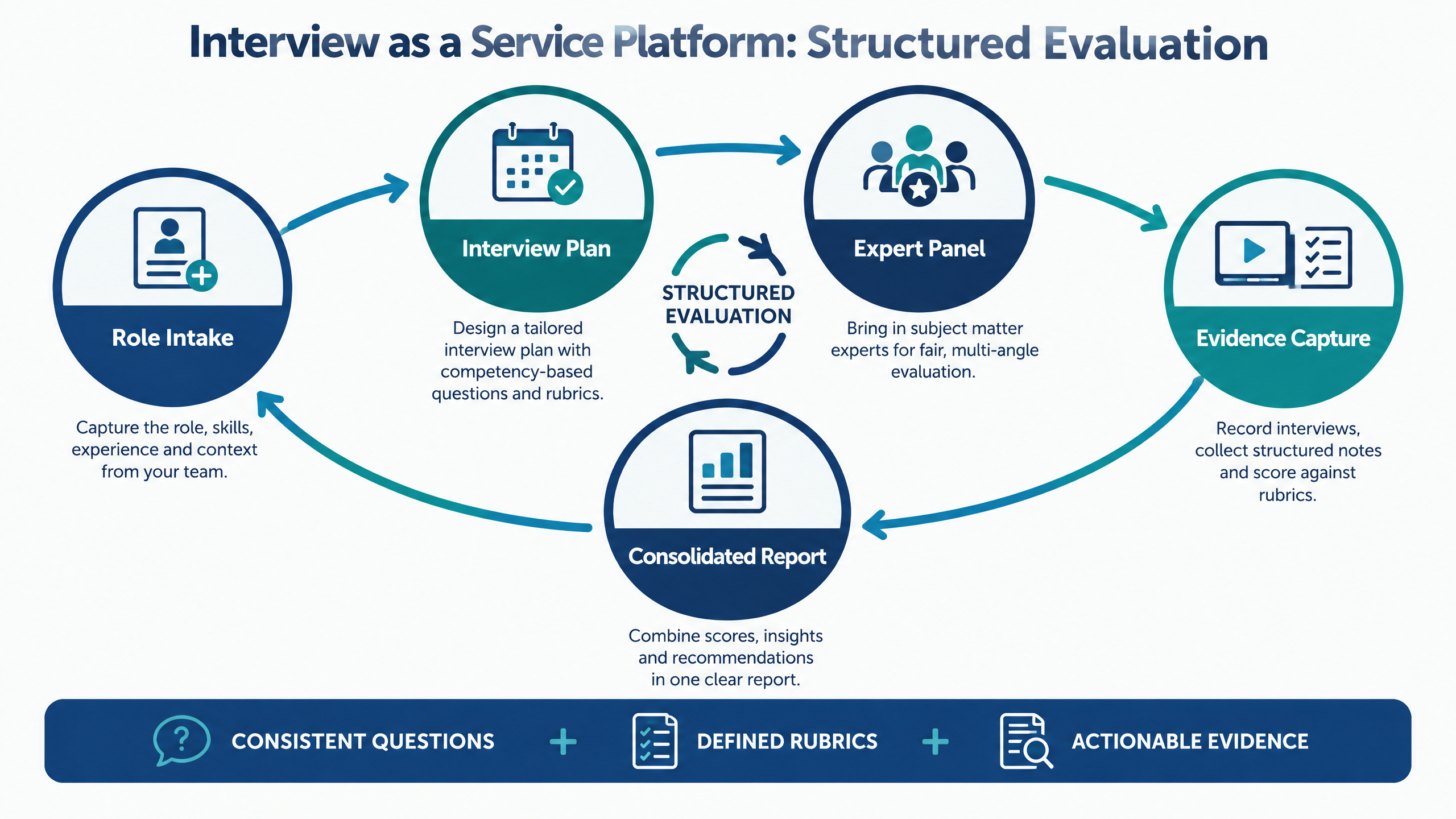
Interview as a Service platform structured evaluation workflow connecting role intake, interview planning, expert panels, evidence capture, and consolidated reports

Why hiring teams use the model

Hiring teams rarely use an Interview as a Service platform because they want interviews to feel less human. They use it because the current operating model cannot reliably deliver the interviews they need at the required speed and quality.
A senior engineer may need to prepare, conduct an interview, write feedback, join a debrief, answer recruiter questions, and help reschedule a missed session. This effort is manageable at low volume. During a hiring surge, it competes with product delivery and makes the candidate journey dependent on a limited number of calendars.
Hiring challenge
How an Interview as a Service platform can help
Limited interviewer bandwidth
Adds expert capacity without requiring every internal engineer to conduct every round.
Specialist skill gaps
Provides access to interviewers with relevant domain and technology experience.
Inconsistent evaluation
Uses shared rubrics, question structures, and reporting formats.
Scheduling delays
Coordinates availability, reminders, time zones, and rescheduling.
High candidate volume
Supports repeatable first-round screening and batch interview programs.
Delayed feedback
Consolidates scorecards, evidence, and recommendations for review.
Distributed recruitment
Enables remote interviews and structured digital evidence across locations.
Temporary hiring spikes
Adds elastic capacity without building a permanent panel for every skill.
The business objective is not to maximize the number of interviews. It is to ensure that the right candidates receive the right evaluation at the right stage, with enough evidence for a confident decision.

What structured evaluation means

Structured evaluation is a method of assessing candidates against defined competencies, questions, rubrics, and evidence requirements rather than relying only on an interviewer’s overall impression.
A structured interview still allows a natural conversation. It does not require the interviewer to read a script without listening. Instead, it establishes a consistent foundation:
  • The hiring team defines the competencies that matter.
  • The interview plan maps questions or exercises to those competencies.
  • The interviewer uses relevant follow-up questions to test understanding.
  • The scorecard defines what strong, acceptable, weak, and borderline performance looks like.
  • The report records the evidence behind the score.
  • The employer reviews the evidence and makes the decision.
A structured evaluation platform should make it easier to compare candidates fairly, calibrate interviewers, identify missing evidence, and understand why a recommendation was made. A score without rationale is difficult to audit and difficult to improve.
For technical roles, evidence may include code, debugging choices, architecture decisions, trade-offs, test cases, communication, and responses to follow-up questions. For behavioral roles, it may include specific examples, decision context, ownership, stakeholder management, and reflection. The evidence should reflect the role rather than generic interview activity.

10 smart benefits of an Interview as a Service platform

1. It expands interviewer capacity without expanding the internal panel

A platform can connect the hiring team to external experts or AI-assisted workflows when the internal panel is over capacity. This is useful during product launches, funded growth, delivery-center expansion, campus recruitment, or seasonal hiring.
The team can reserve internal interviewers for the rounds where context, leadership judgment, or team-specific knowledge is most important. External capacity can support structured first rounds, specialist screening, or overflow.

2. It creates a repeatable evaluation standard

Interview quality becomes difficult to compare when each interviewer uses a different structure, difficulty level, or definition of a strong answer. A platform can make the approved role rubric, question plan, scorecard, and evidence requirements visible to the people delivering the interview.
Consistency does not mean every candidate receives an identical conversation. It means every candidate is evaluated against the same essential bar, with relevant follow-up where needed.

3. It improves access to specialist expertise

Internal teams cannot maintain deep coverage for every framework, cloud environment, programming language, domain, or seniority level. A managed platform can provide access to experts who are matched by role requirements, technical area, level, availability, and interview type.
Buyers should ask how experts are vetted, how matching works, how conflicts are managed, how calibration is performed, and how quality is monitored over time. A large network is useful only when the relevant expertise reaches the right role.

4. It reduces scheduling and coordination work

Interview coordination often creates invisible operational cost. Recruiters exchange messages, compare calendars, reschedule candidates, chase feedback, and update stakeholders. Automated scheduling, reminders, notifications, and candidate self-service can reduce this work.
A strong workflow should handle time zones, multiple panel members, cancellations, interviewer unavailability, missed sessions, and escalation. The goal is not to create another calendar for recruiters to monitor. The goal is to remove avoidable coordination.

5. It produces evidence-linked reports

Hiring managers need more than “pass” or “fail.” They need to understand what the candidate demonstrated, where the evidence was strong, what gaps remain, and what next step is appropriate.
A decision-ready report can include competency-level scores, rationale, strengths, gaps, coding results, interviewer notes, transcripts, integrity signals, and a recommendation. The employer should be able to inspect the source evidence and add context before making a final decision.

6. It supports technical hiring at higher volume

Technical hiring can require several different interview types: coding, debugging, system design, domain depth, communication, and behavioral evaluation. A platform can organize these stages and route candidates according to the approved hiring plan.
For engineering leaders, the value is not only speed. It is the ability to preserve the technical bar while reducing the amount of internal engineering time spent on repeatable assessment work.

7. It makes quality review possible

When interviews are delivered through a shared platform, the hiring team can review turnaround, score distributions, feedback completion, candidate drop-off, interviewer utilization, and hiring-manager satisfaction. These signals can show whether the workflow is working as intended.
Quality review should look for drift. If scores become unusually generous, feedback becomes too brief, or certain questions produce weak evidence, the team can recalibrate before the issue affects a large candidate cohort.

8. It supports a hybrid human and AI operating model

An Interview as a Service platform may combine human expert panels, AI interviews, assessments, and internal review. This allows the organization to use automation where consistency and availability matter while preserving human depth for technical, senior, contextual, or final decisions.
The key is to define the boundary. Buyers should know which stage is automated, which stage is expert-led, what evidence is retained, and where a recruiter or hiring manager must review the output.

9. It improves candidate communication

Candidates need to know what the interview involves, how long it will take, what technology is required, how to request help, and what happens next. A centralized platform can support invitations, reminders, status updates, candidate links, and rescheduling.
A faster process can still be a poor experience if the instructions are unclear or candidates cannot reach a person when the automated workflow fails. Candidate support and escalation should be evaluated alongside scheduling speed.

10. It creates an operating model for changing demand
Hiring demand rarely remains constant. A company may need a small number of specialists one month and a large technical cohort the next. Building a permanent internal panel for every possible scenario is inefficient.
A service model can provide capacity when needed and reduce the burden when the hiring spike ends. The commercial evaluation should therefore consider normal volume, peak volume, role coverage, re-interviews, turnaround, support, and the ability to change the program without rebuilding it.
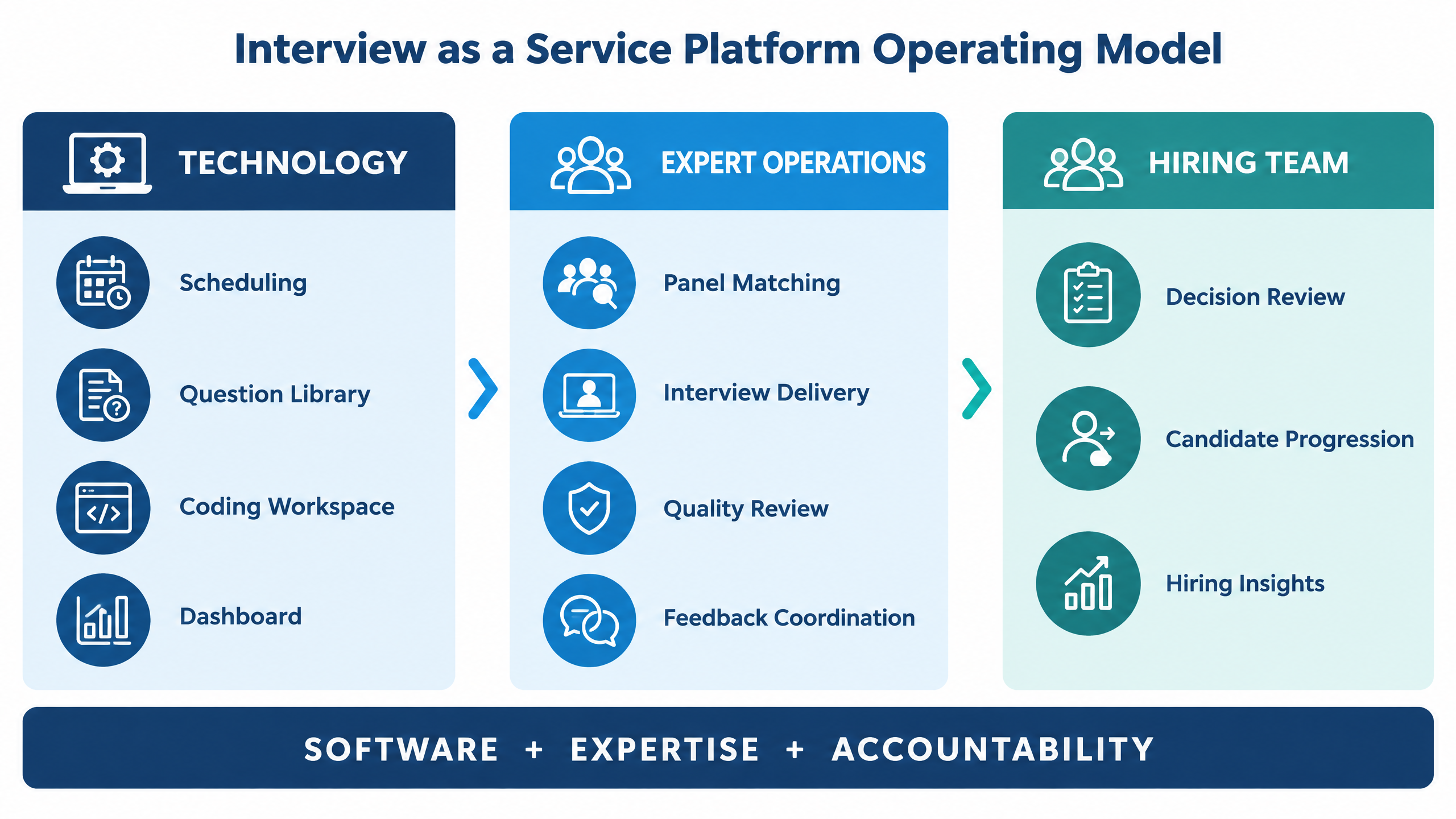
Interview as a Service platform operating model showing technology, expert operations, and hiring-team accountability

How the workflow works from role intake to decision

A credible Interview as a Service platform should make the workflow easy to explain to recruiters, interviewers, candidates, and hiring managers.

1. Role intake

The hiring team shares the job description, seniority, technologies, domain context, must-have and preferred skills, interview stage, candidate volume, turnaround expectation, and decision owners.
The provider should ask clarifying questions when the role is ambiguous. A platform cannot create a valid evaluation from an unclear hiring requirement.

2. Interview-plan design

The teams map competencies to questions, exercises, coding tasks, system-design prompts, behavioral topics, and scoring criteria. They decide which evidence is required and which issues should trigger additional review.
The plan should distinguish essential skills from trainable skills. It should also reflect the role level. A strong answer for a mid-level engineer may not meet the expectations for a staff or principal role.

3. Calibration

The employer and provider align on what strong, acceptable, weak, and borderline performance looks like. Calibration can use sample answers, mock interviews, or a review of historical candidates.
This step protects against consistent misunderstanding. If the provider and the hiring team disagree about the hiring bar, a polished workflow will only deliver the wrong evaluation more efficiently.

4. Expert or workflow matching

The platform matches the round to an expert interviewer, AI workflow, or hybrid model. Matching should consider technology, domain, level, interview type, time zone, language, availability, and conflicts of interest.
For human interviewers, ask how vetting and performance monitoring work. For AI-enabled stages, ask how questions are configured, how outputs are reviewed, and how candidates can request support or correction.

5. Candidate scheduling

The workflow coordinates candidate invitations, interviewer availability, time zones, reminders, calendar events, rescheduling, and status updates. The candidate should receive clear preparation guidance and a reliable way to join the session.

6. Interview delivery

The interview follows the approved structure. It may include technical screening, live coding, debugging, system design, behavioral questions, communication evaluation, a conversational AI screen, or a panel interview.
The structure should support relevant probing. The goal is consistent evaluation, not a mechanical conversation that ignores what the candidate says.

7. Evidence capture and scoring

The interviewer or system records competency-level evidence while the interview is fresh. Useful evidence may include code, design decisions, reasoning, responses to follow-up questions, communication, integrity signals, and areas that need further validation.

8. Quality review and reporting

The provider or platform checks whether the required scorecard is complete, whether evidence supports the ratings, and whether the report meets the agreed format. The employer receives a consolidated report with strengths, gaps, and next-step guidance.

9. Employer decision

The recruiter and hiring manager review the evidence and decide whether to advance, hold, reject, or conduct another round. The provider supports the decision. It should not obscure who owns it.

10. Continuous improvement

The teams review turnaround, completion, candidate experience, interviewer consistency, score distribution, conversion, hiring-manager confidence, and downstream outcomes. The rubric and workflow should change when the role changes or evidence shows that the process is not predicting performance well.

Expert panels, AI interviews, and hybrid delivery

There is no single delivery model for every role. The right model depends on candidate volume, seniority, role complexity, risk, required signal, and internal capacity.
Delivery model
Best suited for
Strengths
Buyer questions
Expert human panel
Specialist roles, technical depth, senior hiring, and nuanced judgment.
Domain knowledge, probing, context, and two-way discussion.
How are experts vetted, matched, calibrated, and monitored?
AI interview workflow
High-volume screening and repeatable first-round evaluation.
Availability, consistency, automated scheduling, and scalable reporting.
How are prompts, scoring, oversight, accessibility, and escalation managed?
Hybrid delivery
Multi-stage hiring where speed and expert judgment both matter.
Automation for volume plus human review for depth and final decisions.
Which stages are automated, who reviews the output, and what evidence is retained?
The describes automated scheduling, video interviews, live coding, question libraries, interviewer dashboards, AI-generated transcripts and summaries, candidate management, and centralized reporting.
The describes expert panels, auto-scheduling, customizable interviews, structured evaluation, candidate communication, and consolidated reporting. It also presents the option to outsource interviews or use the platform as a hiring tool.
A hybrid model may use an automated first screen, an expert technical interview, and an internal final round. This arrangement keeps high-value context with the employer while reducing repetitive work and improving capacity at earlier stages.

What to evaluate before choosing a platform

Interviewer quality and coverage

Ask how experts are sourced, vetted, matched, calibrated, monitored, and replaced when performance is inconsistent. Review coverage by technology, domain, role level, interview type, language, and location.

Role-specific customization

The platform should work from your job description and competency model. Confirm whether your team can approve the rubric, question plan, coding task, scoring thresholds, report format, and escalation rules.

Structured evaluation

Review how the platform links questions to competencies, prompts evidence capture, supports scoring, and identifies missing information. Ask to see a real report rather than a generic dashboard.

Scheduling and service levels

Test single and bulk setup, time zones, candidate self-service, reminders, interviewer notifications, cancellations, rescheduling, and escalation. Ask what the provider measures from request to confirmed slot and from interview completion to report delivery.

Interview formats

Confirm support for technical screening, coding, debugging, system design, architecture, functional skills, behavioral interviews, communication, managerial rounds, panel interviews, and specialist assessment.

Candidate experience

Review invitation clarity, expected duration, preparation information, browser and device support, accessibility, privacy notices, technical help, and human escalation. The candidate experience should be part of the buying scorecard.

Reporting and integrations

Ask whether reports can be exported or delivered to the ATS. Review candidate status, scorecards, transcripts, coding results, feedback completion, panel utilization, candidate drop-off, and outcome reporting.

Governance and security

Review consent, data retention, recordings, transcript handling, access control, audit trails, privacy terms, incident response, AI monitoring, and human review. For AI-enabled evaluation, the is a useful external reference for governance discussions .

Commercial flexibility

Understand pricing by interview, candidate, batch, project, monthly volume, or managed program. Ask about pilot fees, minimum commitments, peak demand, cancellations, re-interviews, report access, support coverage, and changes to the role or rubric.
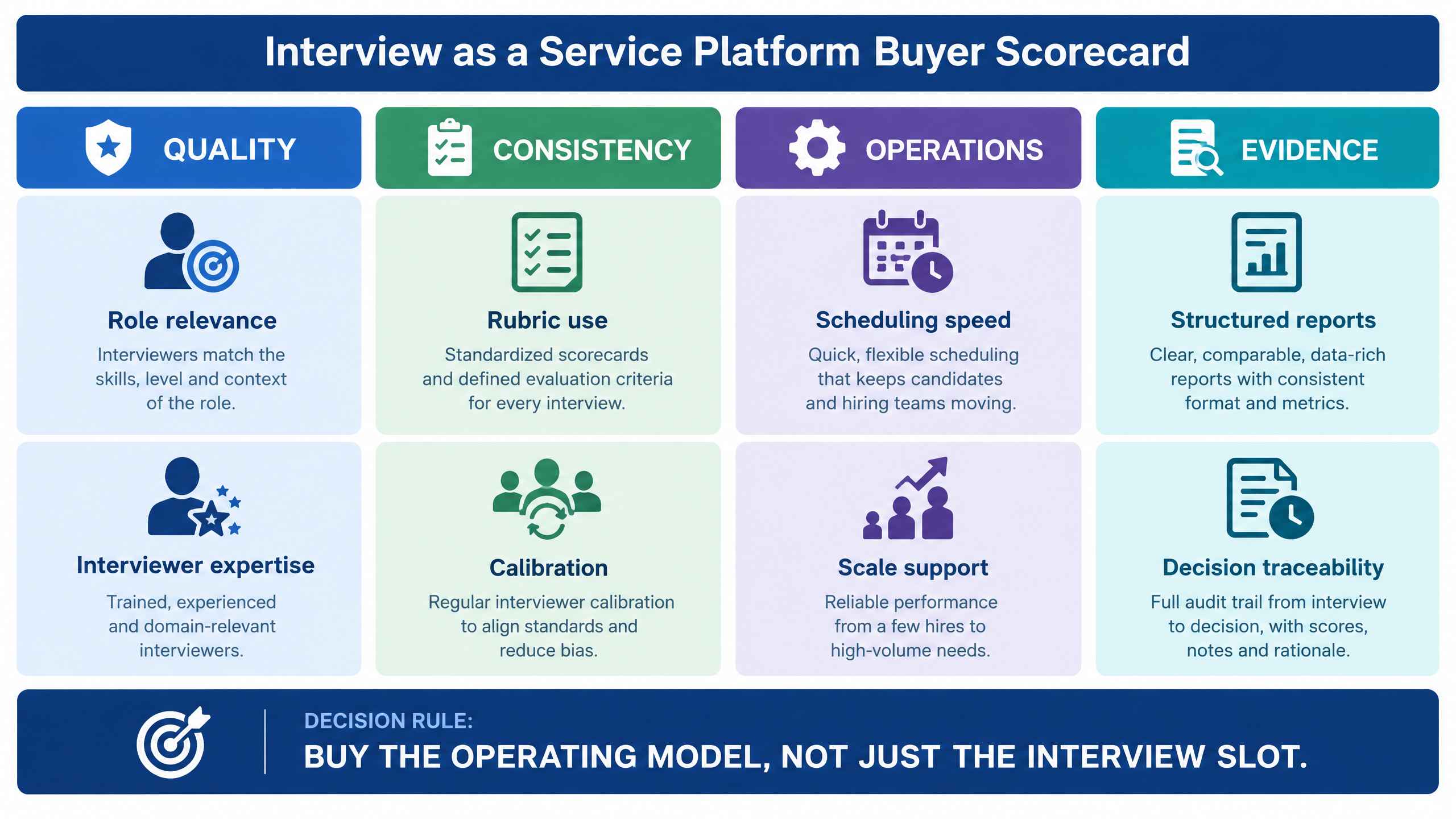
Interview as a Service platform buyer scorecard covering quality, consistency, operations, and evidence

How to run a practical pilot

A pilot should prove more than whether a provider can schedule interviews. It should show whether the platform delivers relevant evidence at an acceptable speed and quality.
Choose one role or skill family with a clear job description, defined competencies, realistic candidate volume, and an internal comparison group where possible. Agree the success criteria before the pilot begins.
Pilot dimension
What to measure
Role fit
Whether questions and exercises reflect the actual role and level.
Evaluation quality
Whether scores are supported by specific evidence and useful rationale.
Consistency
Whether candidates are assessed against the same essential bar.
Scheduling
Time from request to confirmed slot, rescheduling, and no-show handling.
Turnaround
Time from interview completion to report delivery and decision review.
Candidate experience
Clarity, accessibility, technical issues, support, and completion.
Human agreement
How often trained internal reviewers agree with or challenge the output.
Operational fit
Integration, status visibility, permissions, reporting, and escalation.
Commercial fit
Cost under normal volume, peak volume, and change scenarios.
Include edge cases such as incomplete answers, candidate rescheduling, interviewer unavailability, borderline performance, unusual backgrounds, connectivity issues, and requests for human support.
At the end of the pilot, document what should be automated, what should be expert-led, what must remain internal, and which controls are required before scaling.

How futuremug supports structured interview delivery

futuremug’s published hiring platform combines AI-powered interviews, assessments, expert-led evaluation, scheduling, candidate management, and structured reporting. Its describes a global pool of verified experts, customizable interview formats, automated scheduling, structured evaluation, AI-powered analytics, multi-channel updates, and consolidated reports.
The page also describes a workflow that begins with role requirements, aligns interview panels, uses predefined rubrics, cross-checks notes and recordings, and delivers actionable strengths, gaps, and recommendations. Enterprise buyers should verify current functionality, expert coverage, integrations, security terms, pricing, and service levels during a live evaluation.
For teams that prefer a self-service workflow, the describes automated scheduling, video interviews, a real-time coding environment, AI-generated questions, interviewer dashboards, transcripts, summaries, personalized reports, and candidate management.
A useful futuremug consultation should use your own job description, hiring volume, competency model, candidate journey, interview stages, internal review policy, and reporting requirements. Ask to see how the platform handles both the normal candidate path and exceptions such as rescheduling, incomplete evidence, manual overrides, and candidate support.

Request an Interview as a Service consultation

If your hiring team is losing time to interviewer scheduling, inconsistent technical screens, limited specialist coverage, or delayed feedback, an Interview as a Service platform may provide a practical way to add capacity without lowering the hiring bar.
Bring one live job description, your competency framework, candidate volume, current interview stages, turnaround expectations, reporting requirements, and governance questions to the conversation.
to review expert panels, structured evaluation, automated scheduling, AI-assisted interviews, candidate management, reporting, integrations, and a practical pilot plan.

Frequently Asked Questions

What is an Interview as a Service platform?

An Interview as a Service platform combines interview delivery, expert or AI-assisted evaluation, scheduling, candidate coordination, reporting, and operational support. It helps organizations add interview capacity and consistency while retaining ownership of hiring decisions.

Why do hiring teams use an Interview as a Service platform?

They use the model to address limited interviewer bandwidth, specialist skill gaps, scheduling delays, inconsistent evaluation, feedback bottlenecks, distributed hiring, and temporary volume spikes. The goal is to make the evaluation workflow faster, more scalable, and easier to review.

What does structured evaluation include?

Structured evaluation includes defined competencies, role-relevant questions or exercises, calibrated expectations, evidence-linked scorecards, consistent reporting, and human review of the final decision. It is more than assigning a score after an informal conversation.

Can an Interview as a Service platform support technical interviews?

Yes. Depending on the provider, it can support coding, debugging, system design, architecture, domain, behavioral, communication, and managerial interviews. Buyers should confirm role coverage, interviewer expertise, coding tools, evidence capture, and report quality.

Does Interview as a Service replace internal interviewers?

Not necessarily. Many organizations use a hybrid model. External experts or AI workflows support repeatable, specialist, or high-volume stages, while internal leaders retain final rounds, context-critical discussions, offer conversations, and consequential decisions.

How are candidates protected in an outsourced interview workflow?

Candidates should receive clear instructions, reasonable notice, expected duration, accessible technology, privacy information, a support route, and next-step communication. Providers should also explain how recordings, transcripts, code, reports, and personal information are handled.

What should a buyer ask about expert interviewers?

Ask how interviewers are vetted, matched, calibrated, monitored, scheduled, and replaced when needed. Review experience by role, technology, domain, level, language, and interview type rather than relying only on the size of the panel network.

How do I compare Interview as a Service providers?

Use a weighted scorecard covering interviewer quality, role coverage, structured evaluation, scheduling, candidate experience, reporting, integrations, governance, support, and commercial flexibility. Then run a pilot using a real role and measurable success criteria.

What should an Interview as a Service demo include?

The demo should show role intake, rubric setup, question or exercise configuration, interviewer matching, candidate invitation, scheduling, interview delivery, evidence capture, scorecard completion, report generation, human review, integrations, and exception handling.

Leave a Reply

Your email address will not be published.