
How to Build Campus Hiring Solutions for High-Volume Early-Talent Hiring

What are campus hiring solutions?
Campus hiring solutions are the processes, people, technology, and services employers use to attract, assess, interview, select, offer, and onboard students and early-career candidates from colleges and universities.
A complete solution supports more than a job post or an assessment link. It coordinates employer requirements, college relationships, Training and Placement Officer communication, student registration, eligibility, assessments, interviews, scheduling, offers, documentation, joining, and reporting.
Campus hiring is a burst-workload operation. An employer may need to reach many colleges, process thousands of applications, run assessments in a short window, schedule parallel interviews, and make decisions before candidates accept competing offers. The operating model must therefore combine throughput with trust, standardization with human judgment, and automation with strong candidate communication.
The best campus hiring solutions are designed around the complete early-talent funnel. They help employers understand where candidates came from, how they progressed, why they were selected, what they were offered, and whether they joined.
Campus hiring solutions connecting employers, colleges, TPOs, student registration, assessments, interviews, offers, and joining

Why early-talent hiring needs a different operating model

Graduate and campus recruitment differs from lateral hiring in volume, timing, candidate experience, and stakeholder coordination. The employer may be working with students who have limited interview experience, colleges that follow their own placement calendars, and large cohorts that move through the same stages together.
Campus hiring reality
Operational implication
Large candidate cohorts
Registration, deduplication, eligibility, and communication must work at scale.
Short drive windows
Assessments and interviews need reliable peak-time capacity.
Multiple colleges
Employer teams must coordinate TPOs, schedules, lists, rooms, and instructions.
Different student readiness levels
Assessments and interviews should measure role-relevant skills without unnecessary complexity.
Limited interviewer capacity
Early rounds may require expert panels, AI workflows, or a hybrid model.
High offer competition
Decisions, offers, documentation, and pre-joining engagement must move quickly.
Reputation-sensitive audiences
Transparent communication and respectful processes influence future campus access.
A generic applicant-tracking system may store candidates, but it may not handle the concurrency, college-side coordination, assessment integrity, drive-day logistics, and cohort-level reporting that early-talent programs require.

The building blocks of a high-volume campus hiring solution

1. Employer and role planning

Start with a precise hiring brief. Define the role, location, work model, graduation year, eligible degrees or departments, academic requirements, required skills, compensation, hiring stages, expected number of hires, and target colleges.
A role brief should also explain what success looks like in the first six to twelve months. This helps the employer create better assessments, interview rubrics, job descriptions, student communications, and selection decisions.

2. College and TPO coordination

College relationships are a core operating asset. Employers need a clear way to share role information, confirm drive dates, exchange eligibility rules, collect student lists, communicate changes, and resolve exceptions.
A useful campus hiring solution gives TPOs and placement coordinators the information they need without creating unnecessary administrative work. It should provide clear ownership, approved communication, status visibility, and a reliable escalation route.

3. Employer branding and student outreach

Students often compare employers before they register. A strong early-talent experience explains the company, role, learning opportunity, work environment, selection stages, location, timeline, and support available during the process.
Employer pages, webinars, campus sessions, employee stories, role previews, and transparent process information can help students make informed decisions. Branding should be supported by the actual experience students receive during registration, assessments, interviews, and offer communication.

4. Registration and eligibility

Registration should collect the information needed to run the drive without repeatedly asking students to complete different forms. Capture academic details, department, graduation year, contact information, resume, skills, consent, and role-specific declarations.
Eligibility rules should be visible and consistently applied. Where an exception is necessary, route it to an authorized human reviewer rather than allowing an informal change to create confusion across the cohort.

5. Role-mapped assessments

Assessments should measure the skills required for the role. Depending on the position, the process may include aptitude, coding, domain knowledge, language, psychometric, case, or communication assessments.
High-volume assessment requires more than a question bank. Evaluate concurrency, mobile and browser support, accessibility, proctoring or integrity controls, question rotation, scoring, cutoffs, retakes, exception handling, and report quality.

6. Structured interviews

Campus interviews should be structured enough to be fair and comparable, but flexible enough to let candidates explain their thinking. Interview rubrics should cover the capabilities the role actually needs, with expectations adjusted for early-career candidates.
Employers can use internal interviewers, external expert panels, AI interviews, or a hybrid approach. The choice should reflect the required signal, candidate volume, engineering bandwidth, and need for human judgment.

7. Offer, documentation, and joining

Selection is not the end of campus hiring. Offer communication, document collection, verification, joining updates, and pre-joining engagement protect the investment made in sourcing and evaluation.
The employer should know which candidates accepted, which documents are pending, which candidates have competing offers, and which students need a human conversation. Automation can manage reminders, but relationship-sensitive moments need people.

8. Analytics and reporting

A complete solution should show the funnel from registration to joining. Useful reporting includes college-wise registrations, assessment completion, pass rates, interview attendance, shortlist conversion, offer acceptance, documentation completion, joining, and drop-off.
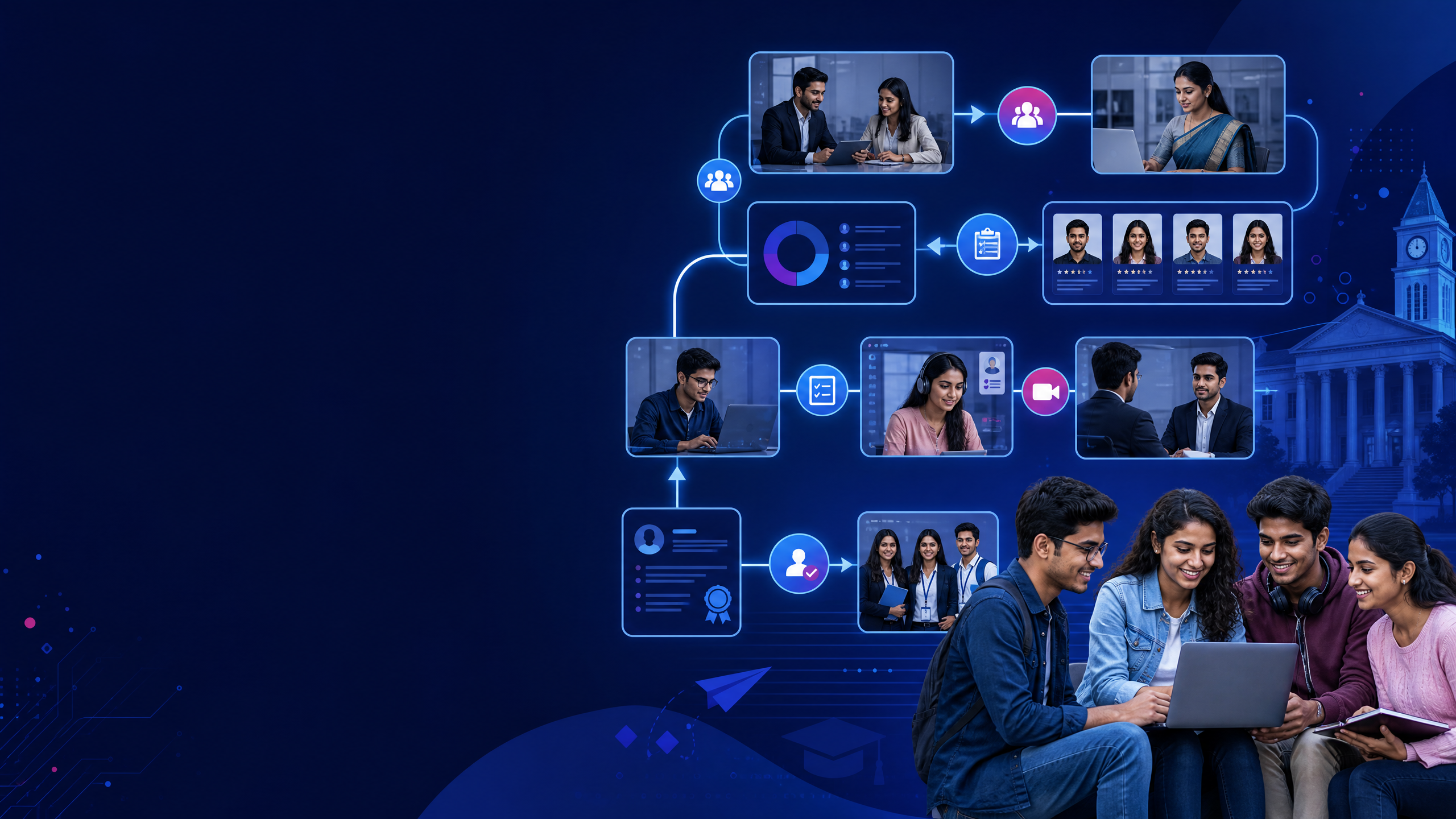
Campus hiring solutions workflow from college outreach and registration through assessments, interviews, offers, and joining

A step-by-step campus hiring workflow

Step 1: Define hiring outcomes

Agree on the number of hires, role families, joining timeline, locations, skills, salary range, candidate profile, and success measures. Decide which colleges and programs are likely to provide relevant talent.

Step 2: Build the college plan

Create a target-college list, map TPO contacts, understand placement calendars, confirm eligibility expectations, and prepare a drive brief. Use a consistent process while respecting college-specific requirements.

Step 3: Launch the employer story

Share a clear employer page or campaign that explains the work, learning, manager support, location, process, timeline, and candidate support. Avoid generic promises that the hiring process cannot deliver.

Step 4: Open registration

Provide one clear registration path. Use structured fields, duplicate checks, eligibility filters, and consent. Give students a confirmation and an easy way to find their next steps.

Step 5: Run assessments

Deliver the assessment at the agreed time, monitor completion, manage exceptions, apply integrity controls proportionately, and provide the employer with role-relevant reports.

Step 6: Shortlist transparently

Apply the approved criteria and route borderline cases to human review. Communicate status and next steps clearly. A shortlisting process should be explainable to the employer, college, and student.

Step 7: Conduct interviews

Schedule interview panels, send reminders, manage attendance, record feedback, and move candidates to the next stage without unnecessary waiting. Use structured rubrics and evidence-linked reports.

Step 8: Make and communicate offers

Coordinate selection decisions, approvals, offer letters, compensation information, document requirements, and response deadlines. Make the process easy for students to understand.

Step 9: Protect joining outcomes

Use a planned cadence of updates, role information, manager introductions, learning content, and check-ins. Escalate concerns that require a human conversation.

Step 10: Review the season

Compare colleges, roles, sources, stages, conversion, offer acceptance, joining, candidate feedback, and cost. Use the results to improve next season’s college strategy and process design.

What to automate and what to keep human

The strongest campus hiring solutions automate high-volume, rule-based work while preserving human ownership where trust, judgment, and relationships matter.
Stage
Good automation opportunities
Human responsibility
College outreach
Reminders, document sharing, status tracking, calendar coordination.
Relationship building, negotiation, and exception handling.
Registration
Forms, deduplication, confirmations, data validation.
Support for unusual cases and accessibility needs.
Eligibility
Rule-based filters, shortlist generation, notifications.
Policy interpretation and appeals.
Assessments
Delivery, timers, proctoring, scoring, ranking, reports.
Integrity review, cutoff decisions, and accommodations.
First-round interviews
Scheduling, structured questions, AI screening, transcripts, summaries.
Calibration, borderline reviews, and candidate support.
Final interviews
Calendar coordination, reminders, note templates.
Technical depth, leadership judgment, and selling the offer.
Offers
Document requests, reminders, status tracking, templates.
Negotiation, concern resolution, and relationship management.
Pre-joining
Information cadence, check-ins, task reminders.
Human intervention when a candidate may withdraw.
futuremug’s describes this principle clearly: volume can be automated, but college relationships, final-round judgment, offer conversations, and edge-case decisions require people.

How to design the employer and college experience

For employers

Hiring teams need visibility into progress, exceptions, candidate evidence, interviewer capacity, decisions, and joining. A product demo should show the employer’s view of the funnel, not only a candidate registration page.

For TPOs and placement teams

College teams need clear role details, eligibility, deadlines, student lists, schedule information, and a responsive support channel. If the platform increases manual work for the placement office, adoption will weaken even if the employer experience looks strong.

For students

Students need mobile-friendly access, clear instructions, predictable stages, practical support, reasonable timelines, and respectful communication. They should understand how assessments and interviews will work and what happens after every stage.

For interviewers

Interviewers need role context, candidate information, rubric guidance, available slots, easy feedback submission, and escalation options. A consistent interviewer experience supports better candidate evaluation.

How to evaluate campus hiring technology

Compare platforms using one real hiring scenario. Ask each vendor to demonstrate the workflow from college intake to joining rather than showing disconnected features.
Evaluation area
Questions to ask
Peak throughput
What candidate volume and concurrency can the platform support during a drive?
College fit
How do TPOs share eligibility, schedules, documents, and student status?
Assessment depth
Are coding, aptitude, domain, psychometric, and communication assessments supported?
Integrity
What proctoring, identity, browser, plagiarism, or AI-assistance controls are available?
Interview capacity
Can the system support internal panels, experts, AI interviews, or hybrid rounds?
Candidate experience
Are communications, reminders, scheduling, and status updates clear and mobile-friendly?
Offer operations
Can the platform track acceptance, documents, joining, and pre-joining engagement?
Reporting
Can the team compare college, role, stage, offer, joining, and cost outcomes?
Integrations
Can data move between the platform, ATS, calendars, communication tools, and HR systems?
Governance
Are permissions, consent, retention, audit history, accessibility, and human review defined?
Implementation
What onboarding, migration, training, support, and peak-drive coverage are included?
Commercial model
Is pricing based on candidates, assessments, interviews, drives, subscriptions, or services?
A vendor should be able to explain what is automated, what remains human, how exceptions are handled, and how the employer can audit a decision.

Metrics that matter in early-talent hiring

The right measurement framework follows candidates beyond offers. Joining is the outcome that matters for workforce planning.
Metric
Why it matters
College reach
Shows whether the employer is engaging the right institutions and programs.
Registration completion
Identifies friction in outreach, forms, eligibility, or communication.
Assessment completion
Reveals technical access, candidate interest, and process clarity.
Assessment-to-interview conversion
Shows whether shortlisting and role alignment are working.
Interview attendance
Highlights scheduling, reminders, technology, and candidate commitment.
Interview-to-offer conversion
Helps evaluate assessment quality, interview standards, and role fit.
Offer acceptance
Indicates competitiveness, communication quality, and candidate confidence.
Offer-to-join conversion
Shows whether pre-joining engagement and offer clarity are effective.
Time to decision
Measures operational speed during a competitive hiring window.
Cost per joined hire
Combines platform, panel, coordination, sourcing, and replacement costs.
Candidate experience
Protects employer brand and future access to early-talent communities.
Review these metrics by college, role, department, location, source, and hiring stage. Aggregate numbers can hide a weak conversion pattern in a strategically important campus or role family.

A practical implementation roadmap

Phase 1: Map the current process

Document the existing college, registration, assessment, interview, offer, and joining workflow. Identify spreadsheets, manual messages, approval points, duplicate entry, delays, and unclear ownership.

Phase 2: Choose one pilot drive

Select a representative role or campus cohort. The pilot should be large enough to reveal operational issues but controlled enough for the team to learn quickly.

Phase 3: Configure the rules and roles

Set up eligibility, stages, rubrics, communications, permissions, calendars, reports, escalation paths, and data-retention requirements. Include employer, TPO, interviewer, student, and leadership views.

Phase 4: Test edge cases

Run duplicate registration, ineligible candidate, late submission, reschedule, no-show, connectivity issue, integrity flag, accommodation request, offer withdrawal, and joining-delay scenarios.

Phase 5: Train every stakeholder

Give students, TPOs, recruiters, interviewers, and college coordinators short, role-specific guidance. Explain where to find information, whom to contact, and how exceptions are resolved.

Phase 6: Measure the pilot

Compare throughput, time, completion, candidate feedback, report quality, coordination effort, offer acceptance, and joining. Use the evidence to decide what to scale and what to redesign.

Phase 7: Expand by role or season

Create repeatable playbooks for future drives. Keep a human owner for college relationships, candidate escalations, final decisions, and pre-joining risk.

Explore futuremug campus hiring solutions

futuremug’s describes an AI- and human-powered model covering assessments, interviews, TPO coordination, employer branding, college partnerships, resume screening, group discussions, video interviews, expert verification, scheduling, and candidate insights.
The page is relevant for employers comparing an end-to-end service model. It describes support for on-campus and off-campus hiring, bulk drives, candidate management, AI assessments, expert and AI interview panels, and customized hiring strategies.
For assessment and interview stages, review the and . Together, these resources help employers evaluate how skills validation, structured interviews, reporting, and hiring operations can connect.
Campus hiring solutions dashboard showing student progress, college coordination, assessments, interviews, offers, joining, and analytics
Ready to compare your current process with a scalable workflow? . Share your target student volume, colleges, hiring timeline, role families, assessment needs, interview model, and reporting requirements so the demonstration can focus on your real operating challenge.

Frequently Asked Questions

What are campus hiring solutions?

Campus hiring solutions combine the processes, technology, and services used to recruit students and early-career candidates from colleges. They can cover college coordination, registration, eligibility, assessments, interviews, scheduling, offers, joining, and analytics.

How do campus hiring solutions support high-volume recruitment?

They centralize candidate data, automate rule-based stages, coordinate colleges and TPOs, support bulk assessments and interviews, provide reminders and status updates, and give employers visibility from registration through joining.

What is the difference between a campus hiring solution and an ATS?

An ATS manages recruiting workflows across many hiring contexts. A campus hiring solution is designed for burst-volume college recruitment, TPO coordination, student eligibility, drive-day operations, assessments, interviews, cohort offers, and joining analytics. Many employers use both.

Can campus hiring be fully automated?

No. Registration, eligibility, assessments, scheduling, reminders, reports, and some first-round interviews can be automated. College relationships, final hiring judgment, candidate support, exception decisions, offer negotiation, and pre-joining conversations still need human ownership.

How can employers improve student candidate experience?

Use clear role information, simple registration, mobile-friendly access, transparent eligibility, predictable stages, timely reminders, accessible assessments, respectful interviews, prompt status updates, and human support for exceptions.

Should campus interviews be outsourced or conducted in-house?

Many employers use a hybrid model. They outsource or automate repeatable early rounds when internal panels are constrained, then keep final technical, leadership, culture, and offer conversations in-house. The right choice depends on volume, risk, interviewer bandwidth, and required expertise.

What should a campus hiring platform demo include?

Ask the vendor to demonstrate college intake, employer branding, student registration, eligibility, assessments, interview scheduling, panel coordination, scorecards, offer tracking, joining status, reports, permissions, and exception handling using a realistic drive scenario.

How do employers measure campus hiring success?

Track registration, assessment completion, interview attendance, stage conversion, offer acceptance, offer-to-join conversion, time to decision, cost per joined hire, candidate experience, and college or role-level outcomes.

Leave a Reply

Your email address will not be published.