The Complete Guide to Interview as a Service India for Better Hiring Decisions

What is interview as a service India?

Interview as a service India is a hiring model in which an external specialist conducts some or all of a company’s candidate interviews on the company’s behalf. The provider works from the hiring team’s role requirements, interview stages, competency framework, and evaluation rubric, then returns structured feedback and evidence for the employer’s decision.
The service can cover technical interviews, coding rounds, system-design discussions, domain interviews, behavioral interviews, managerial rounds, screening calls, or high-volume first-round evaluation. Depending on the engagement, interviews may be conducted by vetted human experts, an AI interview platform, or a hybrid team that combines automated screening with human review.
The essential distinction is that the provider supplies interview capacity and calibrated evaluation. The hiring company keeps ownership of the hiring bar, final decision, compensation, and offer. A well-designed model does not outsource judgment blindly. It makes the judgment easier to exercise by giving the hiring team consistent, relevant, and reviewable evidence.
For companies hiring in India, the model is useful when engineering calendars are constrained, specialist skills are difficult to evaluate internally, candidates are distributed across locations, or hiring volume changes faster than the internal interview panel can adapt.
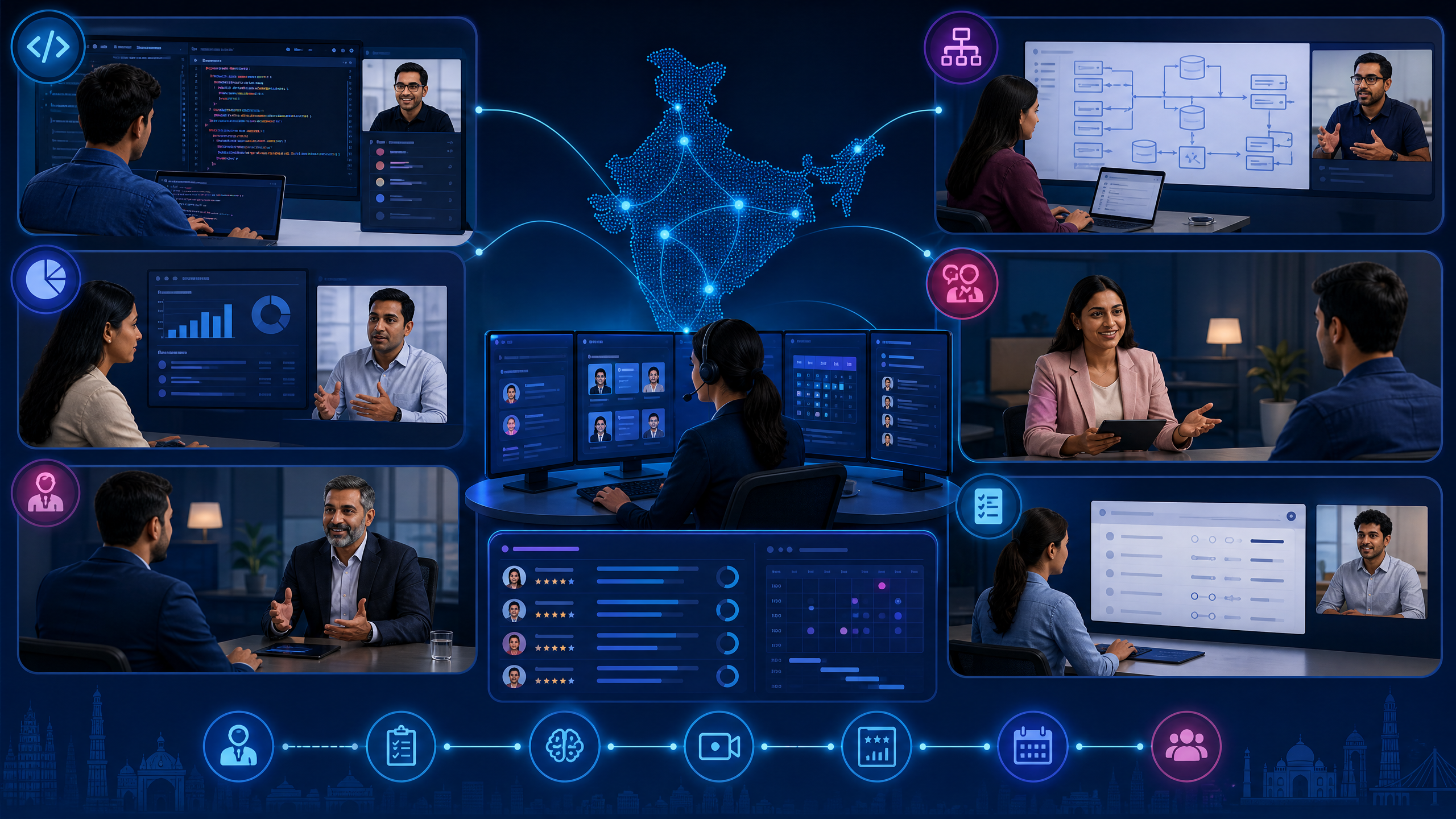
Interview as a service India workflow connecting recruiters, expert interviewers, AI interviews, technical evaluation, and hiring decisions

Why companies use interview as a service

Interviewing is often the most important and most capacity-constrained stage of technical hiring. A single technical round can occupy an engineer for an hour or more, followed by feedback, calibration, scheduling, and coordination. When the company is hiring several roles at once, the cost appears as delayed product work, slower decisions, inconsistent interviewer availability, and candidate drop-off.
An external interview partner can absorb selected rounds without requiring the organization to build a permanent panel for every skill area. The model is especially relevant for funded growth, new product teams, global delivery centers, campus or graduate hiring, seasonal demand, specialist roles, and short-term hiring spikes.
Hiring challenge
How interview as a service can help
Limited engineering bandwidth
Adds interview capacity without pulling every round into the product roadmap.
Specialist skill gaps
Provides access to interviewers with relevant technical or domain experience.
Inconsistent evaluation
Applies a shared rubric, interview structure, and reporting format.
Scheduling delays
Uses on-demand calendars, automated reminders, and centralized coordination.
High application volume
Adds structured first-round screening before scarce senior-panel time.
Distributed candidates
Supports remote interviews, coding environments, and digital evidence.
Feedback bottlenecks
Returns standardized scorecards, summaries, and decision-ready reports.
Hiring spikes
Scales capacity up for a project or batch and down after the demand passes.
The objective is not merely to conduct more interviews. It is to make the right interviews happen at the right stage, with a clear standard and a useful output.

What can be outsourced?

The right scope depends on the role, volume, seniority, and risk of a wrong hire. Most companies begin by outsourcing the rounds that are highly repeatable, capacity-intensive, or outside the internal team’s specialist coverage.

Technical screening

Technical screening can evaluate programming fundamentals, problem-solving, data structures, debugging, language knowledge, and role-specific basics. It is often suitable for high-volume hiring because a consistent first-round structure helps the internal team focus on candidates who have already met the initial bar.

Live coding

Live coding evaluates how candidates reason, communicate, test assumptions, and improve a solution in real time. A shared coding environment can preserve the candidate’s code and interviewer observations for later review.

System design

System-design interviews explore architecture, scalability, trade-offs, reliability, data flow, security, and communication. The rubric should be calibrated by seniority because a strong answer for a mid-level role differs from the expectations for a staff or principal role.

Domain interviews

Domain interviews can cover data engineering, machine learning, mobile development, DevOps, cybersecurity, quality engineering, cloud infrastructure, enterprise applications, or other specialist areas. Matching the interviewer to the required domain matters more than simply assigning a technically experienced person.

Behavioral and managerial rounds

Behavioral and managerial interviews can evaluate ownership, collaboration, communication, decision-making, conflict handling, stakeholder management, and people leadership. These interviews benefit from structured questions and evidence-based scoring rather than informal conversation alone.

First-round and volume screening

For graduate, campus, customer support, sales, operations, and other volume-hiring programs, an external provider can support initial screening, assessments, interviews, scheduling, and status updates. Later rounds can remain with the employer’s team.
Interview as a service India showing coding, system design, behavioral, domain, and managerial interview tracks

How the model works from kickoff to verdict

A credible interview-as-a-service engagement should be easy to explain. The following workflow creates alignment before the first candidate enters the process.

1. Kickoff and role intake

The hiring team shares the job description, role level, technologies, must-have skills, preferred skills, hiring stages, expected volume, turnaround expectations, candidate source, and decision owners. The provider should ask questions rather than accept an ambiguous role brief.

2. Rubric calibration

The teams agree what a strong, borderline, and weak performance looks like for each competency. The rubric should use observable criteria. For example, a system-design score may consider requirements clarification, architecture, trade-offs, scalability, reliability, and communication rather than simply assigning an overall impression.
Calibration is the step that protects signal. If the company and provider do not agree on the standard, consistent delivery will only create consistent misunderstanding.

3. Interviewer matching

The provider matches the round to an appropriate interviewer or AI workflow. Matching should consider technology, domain, seniority, interview type, language, time zone, and conflict-of-interest rules. For human panels, ask how interviewers are vetted and how their performance is monitored.

4. Candidate intake and scheduling

Candidates enter through the employer’s ATS, recruitment workflow, referral program, campus process, or provider-managed pipeline. The service should make interview availability visible, provide clear instructions, and send reminders through approved channels.

5. Interview delivery

The interview follows the agreed structure and rubric. Depending on the round, it may include live coding, a coding IDE, system design, video, structured questions, an AI-led conversation, or an expert panel. The candidate should know what to expect and how the evaluation will be used.

6. Scoring and evidence capture

The interviewer scores each competency and records evidence while the round is still fresh. Useful evidence can include code, design decisions, candidate explanations, follow-up responses, integrity flags, and interviewer notes. A score without evidence is difficult to calibrate or audit.

7. Review and verdict

The hiring team receives a scorecard, summary, and agreed supporting evidence. The recommendation may be hire, no-hire, borderline, or proceed to another round. The provider supplies signal; the company makes the hiring decision.

8. Quality review and improvement

The teams review interviewer consistency, candidate feedback, turnaround, score distribution, conversion, and hiring-manager satisfaction. Calibration should be revisited when the role changes, interviewers drift, or hiring outcomes suggest that the rubric is not predicting performance well.

Human panels, AI interviews, and hybrid delivery

There is no single delivery model for every role. The right choice depends on the type of signal required, candidate volume, seniority, risk, and available internal capacity.
Delivery model
Best suited for
Strengths
Questions to ask
Expert human panel
Technical depth, specialist roles, senior hires, and nuanced judgment.
Context, probing, domain knowledge, and two-way discussion.
How are experts vetted, matched, calibrated, and monitored?
AI interview platform
High-volume screening, structured first rounds, and repeatable workflows.
Consistency, availability, automated scheduling, and scalable reporting.
How are prompts, scoring, oversight, accessibility, and escalation managed?
Hybrid workflow
Multi-stage hiring where speed and expert judgment both matter.
Automation for volume plus human review for depth and final decisions.
Which stage is automated, where does human review occur, and what evidence is retained?
The describes automated scheduling, video interviews, live coding, interview question libraries, interviewer dashboards, AI-generated transcripts and summaries, candidate management, and centralized reporting. These capabilities can support teams that want a self-service platform rather than a fully outsourced service.
For a provider-led engagement, describes customizable interviews, expert panels, auto-scheduling, structured evaluation, multi-channel updates, candidate dashboards, and consolidated reports. This is relevant when the challenge is not only software but also interviewer capacity and operational execution.
A hybrid model can begin with an automated screen, move qualified candidates to an expert technical panel, and retain the employer’s final interview and offer discussion. This approach lets the company keep the highest-value human moments while reducing repetitive coordination.

How quality and fairness are protected

A buyer should not accept “AI-powered” or “expert-led” as a quality explanation by itself. Ask how the service protects validity, consistency, fairness, privacy, and human accountability.

Calibrated rubrics

The rubric should be agreed before volume delivery. It should distinguish essential skills from trainable skills and define expectations by level. Calibration sessions can compare provider scores with internal scores on sample candidates.

Interviewer vetting and matching

Human interviewers should be evaluated for technical or domain depth, interviewing ability, communication, reliability, and conflicts of interest. They should be matched to the role rather than assigned solely by availability.

Structured questions and probing

A structured interview does not mean a rigid conversation. It means each candidate is evaluated against the same essential competencies, while the interviewer can ask relevant follow-ups to test understanding and evidence.

Evidence-linked scorecards

Reports should show the competency, score, rationale, and evidence. For coding or system design, the employer should understand what the candidate did, why it mattered, and where the candidate’s performance was strong or incomplete.

Integrity controls

For coding and online interviews, ask about plagiarism detection, AI-assistance signals, identity checks, proctoring options, and human review of suspicious patterns. Integrity controls should be proportionate to the role and communicated transparently.

Human oversight

AI can support screening, question generation, summaries, scheduling, and pattern detection. It should not remove the employer’s responsibility for reviewing evidence, providing reasonable accommodation, handling appeals, or making the final hiring decision.

Candidate experience

Candidates should receive clear instructions, reasonable notice, accessible technology, expected duration, contact options, and next-step communication. A fast interview process that leaves candidates confused can still damage the employer brand.
Interview as a service India quality framework showing rubric calibration, human oversight, evidence-linked scorecards, and fair hiring decisions

When interview as a service India is the right fit

The model is usually worth evaluating when one or more of the following conditions exist:
Engineering leaders are spending too much time in repetitive first-round interviews.
Hiring volume is rising faster than the internal panel can support.
The company needs specialist interviewers for a technology or domain it does not cover well.
Candidate scheduling and feedback are delaying the funnel.
Interview quality varies significantly between teams or locations.
A new project requires temporary capacity without permanent headcount.
Campus, graduate, or bulk hiring creates a large number of similar rounds.
A distributed or global team needs interview availability across time zones.
TA operations need a standard report and audit trail for hiring decisions.
It may be less suitable when the role depends almost entirely on a relationship-led executive conversation, when the company has a highly specialized internal panel with ample capacity, or when the provider cannot explain how the service integrates with the existing process.

What to evaluate before choosing a provider

Use a real role and a real candidate journey during the evaluation. A polished product tour is not enough. Ask the provider to demonstrate intake, calibration, scheduling, interview delivery, scoring, reporting, escalation, and integration.
Evaluation area
Buyer questions
Role fit
Can the provider support our stack, seniority, domain, geography, and interview format?
Interviewer quality
How are interviewers sourced, vetted, matched, calibrated, and reviewed?
Rubrics
Can we define competencies and scoring standards by role and level?
Candidate flow
How do candidates enter, schedule, reschedule, receive reminders, and get support?
Interview evidence
Do we receive scorecards, recordings, transcripts, code, notes, and integrity signals?
AI governance
Where is AI used, where is human review required, and how can decisions be challenged?
Turnaround
What are the standard and peak-volume SLAs for interviews and reports?
Scalability
Can the service support a hiring spike without reducing interviewer quality?
Reporting
Can hiring managers compare candidates using consistent, role-specific reports?
Integration
How do data and status move between the service, ATS, calendars, and HR systems?
Security
What permissions, retention, confidentiality, consent, and data-protection controls apply?
Commercial model
Is pricing per interview, batch, project, subscription, or a combination?
Support
Who owns coordination, exceptions, candidate issues, and quality escalations?
Ask for a redacted sample report, a description of the calibration method, interviewer profiles for your actual roles, and a pilot plan with success criteria.

Cost, turnaround, and scalability

Pricing varies by interview type, seniority, geography, volume, delivery model, integrations, and reporting requirements. A per-interview price is easy to compare, but it does not show the complete cost of hiring.
Include the internal time required for scheduling, interviewer preparation, feedback chasing, rescheduling, quality review, and candidate communication. Also consider the opportunity cost when senior engineers are pulled away from product work or when a slow process causes qualified candidates to accept another offer.
A useful business case compares four areas:
Cost area
Questions
Direct service cost
What is included per interview, batch, or project?
Internal coordination cost
How many hours do recruiters and engineers spend outside the interview itself?
Delay cost
How does slower scheduling affect time to fill, candidate conversion, and project delivery?
Quality cost
What happens when inconsistent evaluation creates a bad hire or loses a strong candidate?
Request a pilot rather than committing from a feature list. Define the roles, number of candidates, interview types, rubric, turnaround, evidence, escalation process, and decision metrics before the pilot begins.

Implementation checklist

Before launch

Confirm the role scope, hiring stages, rubric, interview format, candidate volume, data flow, security terms, SLA, communication templates, and decision owners. Select a small group of internal stakeholders who can provide calibration feedback.

During the pilot

Track candidate attendance, schedule changes, interview completion, interviewer match, score distribution, report quality, turnaround, candidate feedback, internal review time, and decision conversion. Compare a sample with the company’s own panel where possible.

After the pilot

Review what should be automated, what should remain human-led, which roles are suitable for expansion, and how the provider will handle peak demand. Update the rubric and operating instructions before scaling.

At scale

Run periodic calibration, audit reports, sample recordings, candidate experience, integrity signals, and hiring outcomes. Treat the service as part of the hiring operating model rather than as a one-time vendor transaction.

Request an IaaS consultation with futuremug

If your TA or engineering team is spending too much time coordinating technical interviews, futuremug can help you compare a provider-led interview outsourcing model, a self-service interview platform, or a hybrid workflow.
The presents expert panels, customizable interviews, auto-scheduling, AI-powered interview workflows, structured evaluations, candidate updates, dashboards, and reports. The presents automated scheduling, live coding, question libraries, interview dashboards, AI-generated transcripts and summaries, and centralized reporting.
For a technical-first evaluation, read and . These resources can help your team decide which rounds to outsource, which to keep in-house, and what evidence to require.
Ready to evaluate the fit? and share your role types, hiring volume, technical stacks, interview stages, turnaround expectations, and current coordination challenges. A useful demo should use your process—not just a generic feature tour.

Frequently Asked Questions

What is interview as a service India?

Interview as a service India is a model in which an external provider conducts selected candidate interviews for an employer in India, using the employer’s role requirements and evaluation standards. The provider returns structured evidence and recommendations while the employer keeps the final hiring decision.

Which interviews can be outsourced?

Companies can outsource technical, coding, system-design, domain, behavioral, managerial, screening, campus, graduate, and volume-hiring interviews. The right scope depends on the role, seniority, required signal, and internal capacity.

Does interview outsourcing replace recruiters or engineering leaders?

No. A provider can reduce scheduling, interviewing, and reporting workload, but recruiters and engineering leaders remain responsible for role definition, calibration, candidate relationships, final evaluation, and hiring decisions.

Are AI interviews fair and reliable?

They can be useful when the workflow is structured, role-relevant, validated, monitored, and supported by human oversight. Buyers should ask how prompts and scoring are governed, how accessibility is handled, what evidence is retained, and how candidates can request support or review.

How do human expert panels improve outsourced interviews?

Expert panels add technical or domain depth, probing, contextual judgment, and communication. Their value depends on matching, vetting, calibration, and quality monitoring rather than simply having a large expert network.

How long does an interview as a service engagement take to start?

The setup depends on role complexity, rubric readiness, integration needs, interviewer availability, and candidate volume. A credible provider should explain the kickoff, calibration, pilot, and scale-up steps rather than promise a generic timeline.

How does pricing work?

Pricing may be per interview, candidate, batch, project, subscription, or a combination. Compare the complete operating cost, including internal coordination, engineering time, turnaround, reporting, integrations, and support.

How should a company test a provider?

Run a defined pilot using real roles and a representative candidate sample. Request a calibrated rubric, matched interviewer profiles, sample reports, evidence, SLA measurements, candidate feedback, and a clear escalation process.

What should remain in-house?

Many companies keep final interviews, bar-raiser rounds, culture and leadership discussions, compensation conversations, and final hiring decisions in-house. The ideal split depends on the organization’s risk, capacity, and desired candidate relationship.

Leave a Reply

Your email address will not be published.