
Interview Panel as a Service: How On-Demand Technical Panels Work
You don’t have to build and staff a technical interview panel to run one. If your problem is interviewer bandwidth — not enough qualified engineers to sit every panel, or too many of their hours going to interviews instead of the roadmap — you can bring a panel in on demand: expert interviewers, matched to your role and calibrated to your bar, assembled for as long as you need them. This is how an on-demand technical interview panel works, why bandwidth-short teams reach for it, and how it stacks up against building your own.
| Quick answer: A technical interview panel as a service gives you expert interviewers on demand, assembled into a panel matched to your role — by competency, stack, and seniority — and calibrated to your rubric. Engineering leaders use it when they’re short on interviewer bandwidth: when they can’t staff a panel for every stack, when panel seats pull senior engineers off the roadmap, or when hiring volume is bursty. You get the panel; the hiring decision stays yours. |
What a Technical Interview Panel as a Service Is
A technical interview panel as a service is on-demand access to vetted interviewers, composed into a panel for your specific role rather than staffed from your own team. Instead of pulling three senior engineers off delivery to interview a backend candidate, you get three matched experts — assembled per role, calibrated to your rubric, and available when you need them. It’s the panel-shaped form of interview outsourcing, aimed squarely at the bandwidth problem.
How an On-Demand Panel Is Composed
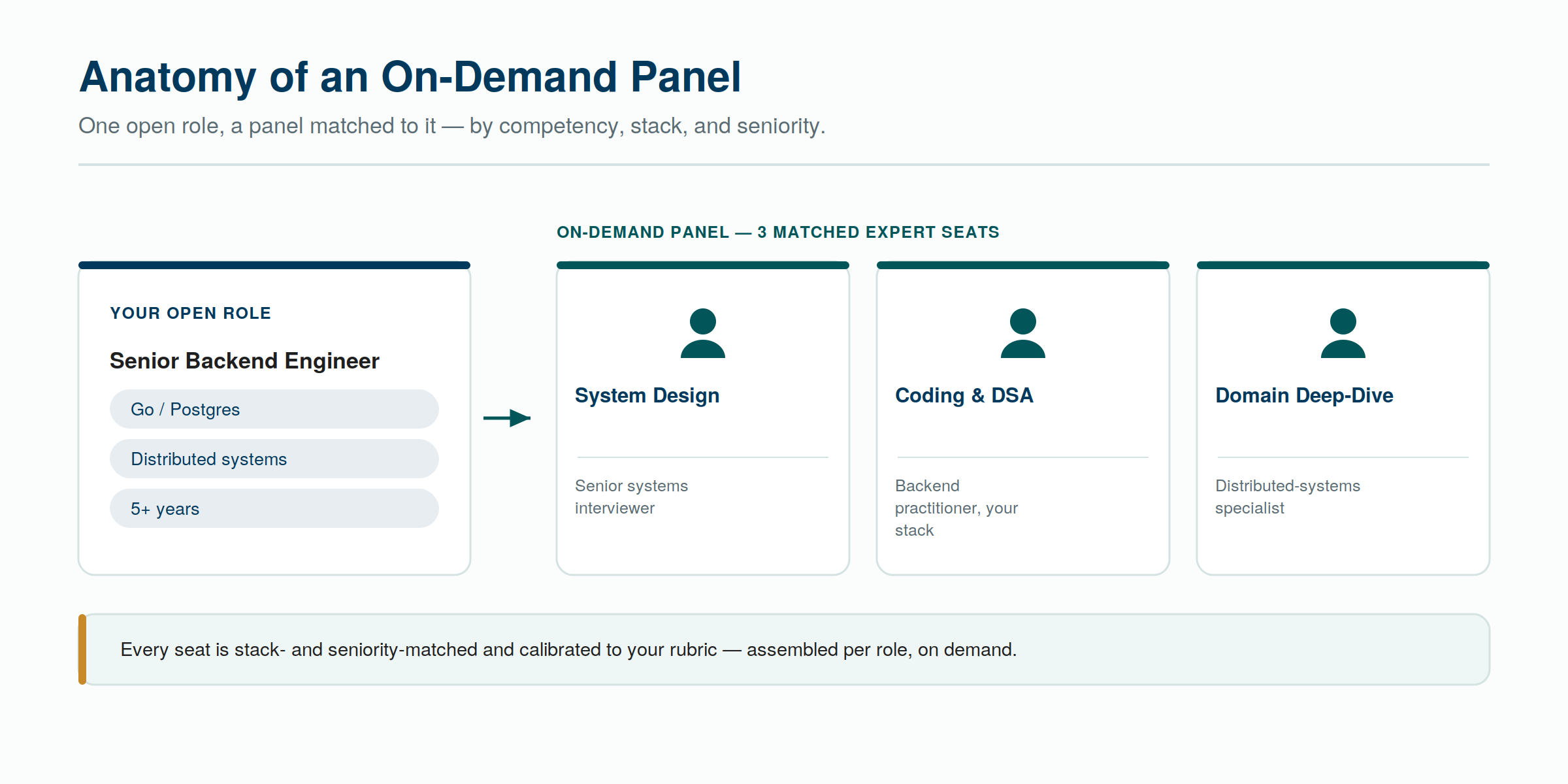
The value is in the matching. A good on-demand panel isn’t a random pool of interviewers — it’s assembled per role, with each seat covering a competency and matched to your stack and the seniority you’re hiring.
For a senior backend role, that might mean a system-design interviewer, a coding and DSA interviewer fluent in your stack, and a domain specialist — three expert reads rather than one. That composition is the point of a panel over a single interviewer: it covers more competencies, and it stops one person’s opinion from carrying the whole decision. Every seat is calibrated to your rubric before it runs, so the panel scores the way your own strong interviewers would.
Why Engineering Leaders Use On-Demand Panels
The reason is almost always bandwidth. Qualified technical interviewers are scarcer than open roles, and three specific versions of that scarcity push teams toward an on-demand panel.
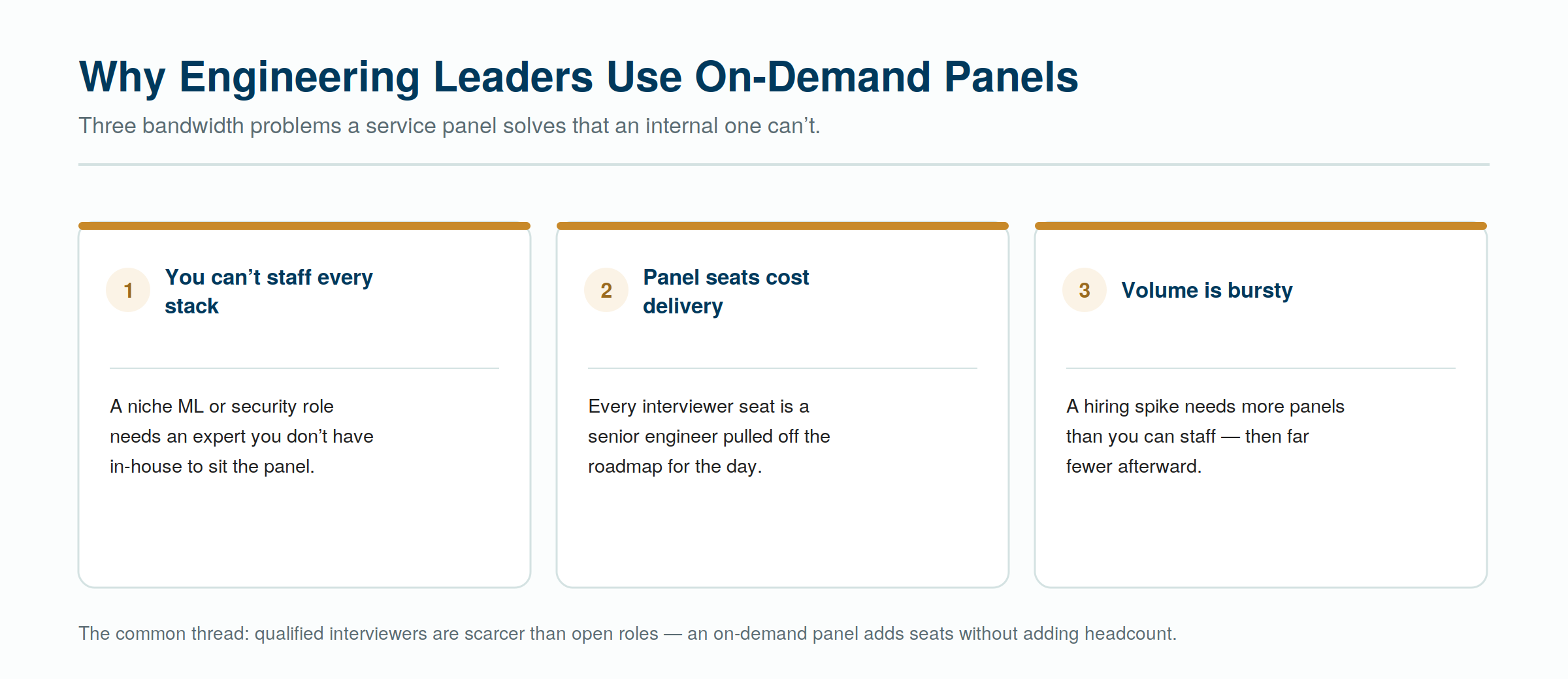
All three come down to the same thing: adding interviewer capacity without adding headcount, and without burning your senior engineers’ time. The engineering-time cost of interviewing — and how much a panel seat really costs — is quantified in our on-demand interviews analysis.
On-Demand Panel vs Building Your Own
An on-demand panel isn’t strictly better than an internal one — they win on different things, which is exactly why most teams use both. Here’s the honest split.
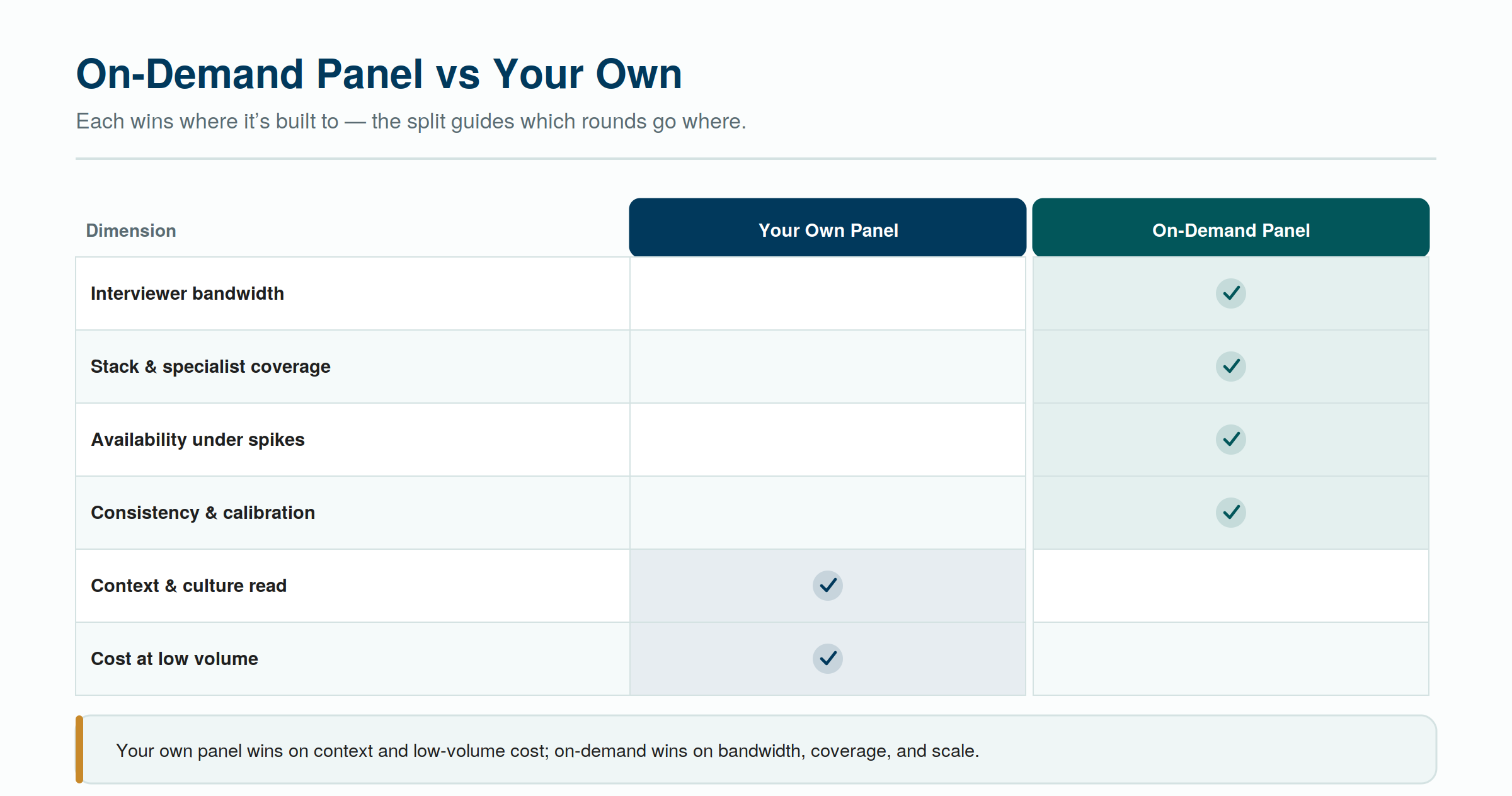
Your own panel is unbeatable on context — it knows the team and the codebase — and cheaper when interview volume is low and steady. An on-demand panel wins the moment bandwidth, stack coverage, or a hiring spike becomes the constraint. The productive move isn’t to pick one: it’s to run the technical rounds through the on-demand panel and keep the final and culture rounds in-house.
What Makes a Strong On-Demand Panel
Not every on-demand panel is worth using. A strong one is stack- and seniority-matched, calibrated to your rubric before it runs, staffed by practitioners who have actually done the job, and it returns evidence — a recording and rubric scorecard — rather than a bare verdict. In 2026, it also has a clear position on AI-assisted cheating, with detection and follow-up probing built in. Judge any panel provider on those, ideally in a pilot before you commit.
How to Start
The fastest way to evaluate an on-demand panel is to run one on a live role and shadow-score a sample against your own read. When you’re choosing a provider, our comparison of interview outsourcing companies covers the criteria, and our guide to what it costs covers pricing.
A technical interview panel as a service solves a bandwidth problem, not a capability one: you already know how to interview — you just don’t have enough qualified engineers to sit every panel without taxing the roadmap. An on-demand panel adds matched, calibrated expert seats exactly when you need them, and hands back evidence you can act on. Keep the context rounds in-house, run the technical rounds through the panel, and your senior engineers get their time back with the bar intact.
futuremug provides on-demand technical panels through expert human panels and, for high-volume screening, AI-structured interviews — matched to your role, calibrated to your rubric, and delivered with recorded evidence. A pilot puts a panel on one of your live roles so you can see the fit before you scale it.



Frequently Asked Questions
It's on-demand access to vetted technical interviewers, assembled into a panel for your specific role and calibrated to your rubric — rather than staffing that panel from your own engineers. The provider matches interviewers by competency, stack, and seniority, runs the rounds, and returns scored evidence. It's the panel-shaped form of interview outsourcing.
Three bandwidth reasons: you can't always staff a panel for a niche stack you don't have in-house, every panel seat pulls a senior engineer off delivery, and hiring volume spikes faster than you can add qualified interviewers. An on-demand panel adds interviewer seats without adding headcount — and without lowering the bar, if it's calibrated to your rubric.
By competency, stack, and seniority. For a senior backend role, a typical panel might pair a system-design interviewer, a coding and DSA interviewer on your stack, and a domain specialist — each vetted in the specific technology. The point of a panel over a single interviewer is coverage across competencies and more than one expert read, which reduces the weight on any one opinion.
An external panel assesses technical ability against your rubric well; what it can't do is read fit with your specific team and culture — that stays with you. Keep the final and culture rounds in-house and use the on-demand panel for the technical rounds. Our guide to what you can safely outsource draws the line.
Each wins where it's built to. Your own panel wins on context and on cost at low volume; an on-demand panel wins on interviewer bandwidth, stack coverage, availability under spikes, and calibrated consistency. Most teams blend them. Our outsourcing vs in-house comparison models the full trade-off.
Through a kickoff and a calibration round: you agree the rubric and role level, the provider interviews a small sample, and you compare their scores to your team's on the same candidates. This is what makes an outsourced panel's verdict trustworthy — the mechanics are covered in how technical interviews are run as a service.