
Agentic Interviewing: What It Means and How It Differs From AI Interviews
A new term is starting to appear in hiring-tech conversations: agentic interviewing. Like most emerging terms, it arrives wrapped in enough hype to obscure what it actually means. So here’s a clear, hype-free account for people who need to understand it before they have an opinion on it — what agentic interviewing is, how it genuinely differs from the AI interviews already in use, how it works, and where it helps and where to be cautious.
| Quick answer: Agentic interviewing is an AI interview that behaves like an agent — it pursues a goal (an accurate read of a candidate’s skill) and adapts to reach it, rather than reading out a fixed script. The difference from a standard AI interview is autonomy: a scripted AI asks the same questions to everyone and records the answers; an agentic one interprets each answer and decides its next move, probing, following up, and adjusting difficulty. In both, a human still makes the hiring decision. |
What Agentic Interviewing Means
The word doing the work is “agentic.” In AI, an agent is software that pursues a goal with some autonomy — it can plan, adapt, and choose its next action rather than following a fixed set of instructions. Apply that to interviewing, and you get an AI interviewer whose objective is an accurate read of a candidate’s competency, and which adapts its questions to reach that objective.
That’s the whole idea, and it’s worth stating plainly because the hype tends to inflate it. Agentic interviewing isn’t a robot that decides who to hire. It’s an interviewer that behaves less like a questionnaire and more like a skilled human interviewer — one who listens to an answer and asks a better next question because of it.
How It Differs From a Standard AI Interview
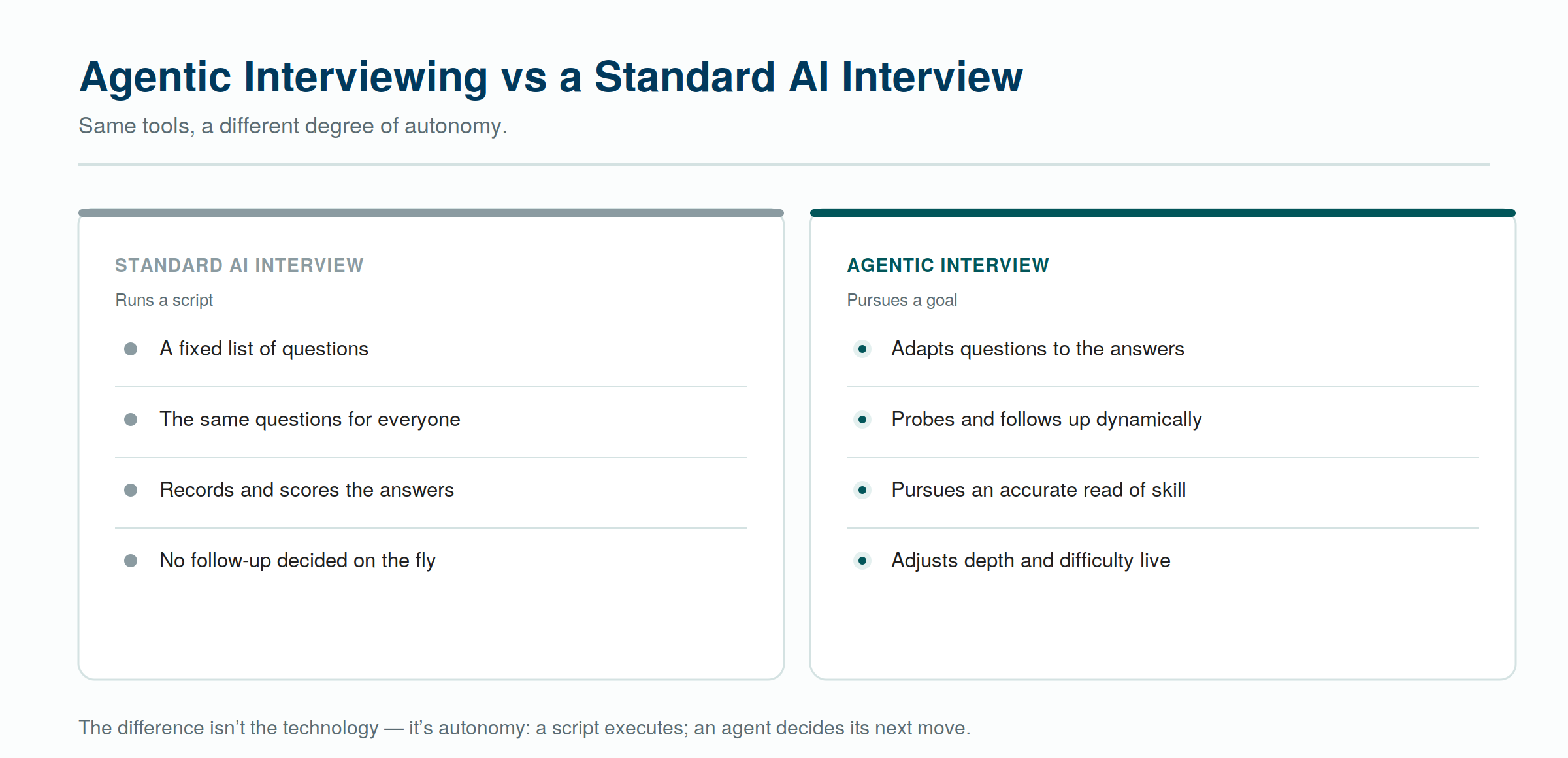
AI interviews already exist and work well, so the useful question isn’t “AI or not” — it’s what “agentic” adds on top. The difference is autonomy, and it shows up in four ways.
A script versus a goal. A standard AI interview runs a fixed question list — the same questions in the same order for every candidate. An agentic interview holds a goal instead of a script, and the questions are a means to it.
Fixed versus adaptive. The scripted interview can’t change course based on what it hears. The agentic one interprets each answer and adapts — the interview a strong candidate gets differs from the one a struggling candidate gets, the way a human interview would.
Recording versus probing. A scripted AI records and scores what’s said. An agentic interviewer follows up: it can probe a vague claim, chase a promising thread, or dig into a shortcut, surfacing signal a fixed list would miss.
Static versus calibrated difficulty. The agentic interview can adjust depth and difficulty in real time — easing off where a competency is clearly met, pressing where the read is still unclear.
How an Agentic Interview Actually Works
Underneath, an agentic interview runs a loop rather than a list. It asks a question, interprets what the answer reveals, and decides the most useful next move — then repeats, each cycle informed by the last.
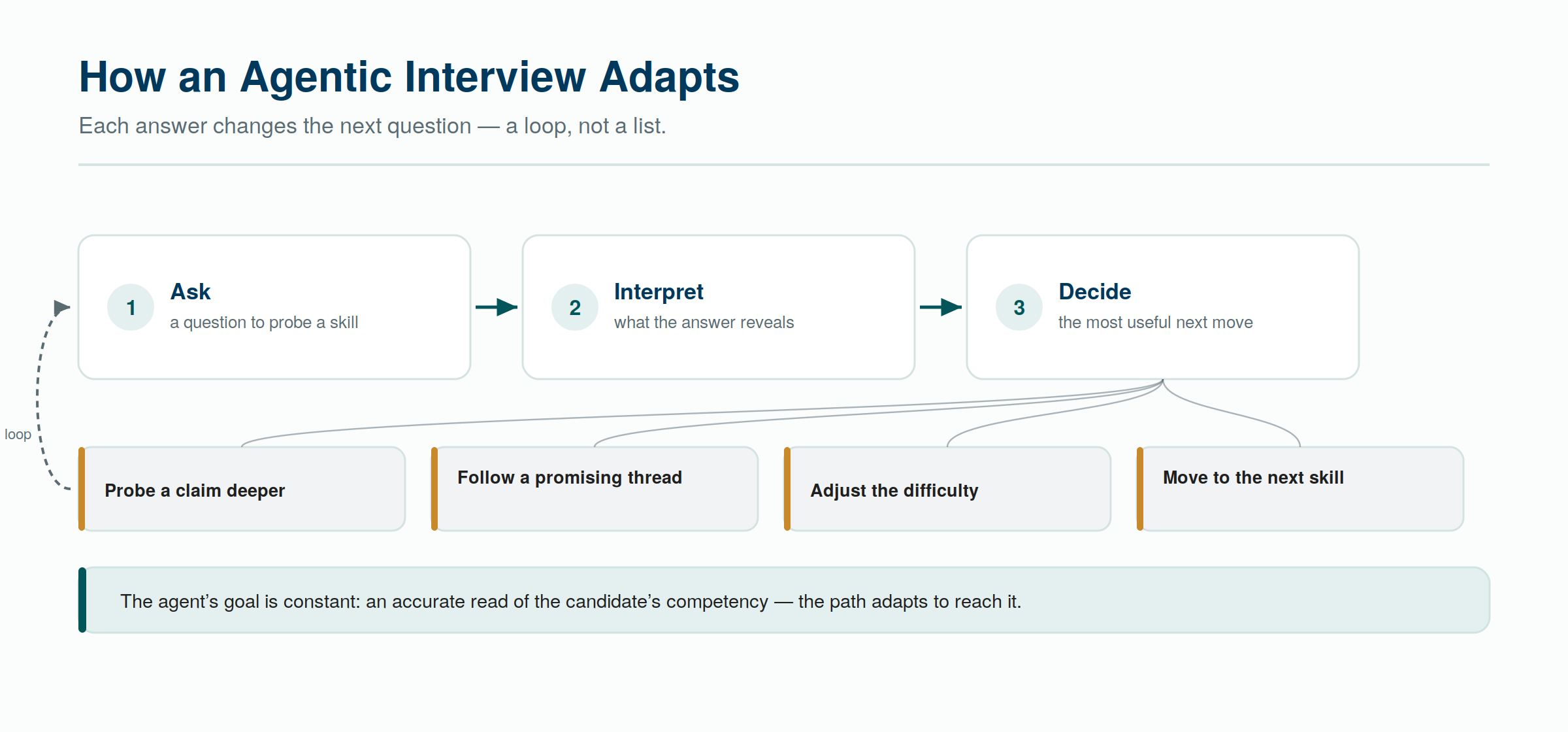
The goal never changes; the path to it does. That loop is what lets an agentic interview go deeper on a candidate’s actual strengths and weaknesses instead of marching through a checklist — and it’s why a memorised or AI-generated answer tends to fall apart, because the follow-up question was never on any script to prepare for.
Where It Fits — and Where to Be Careful
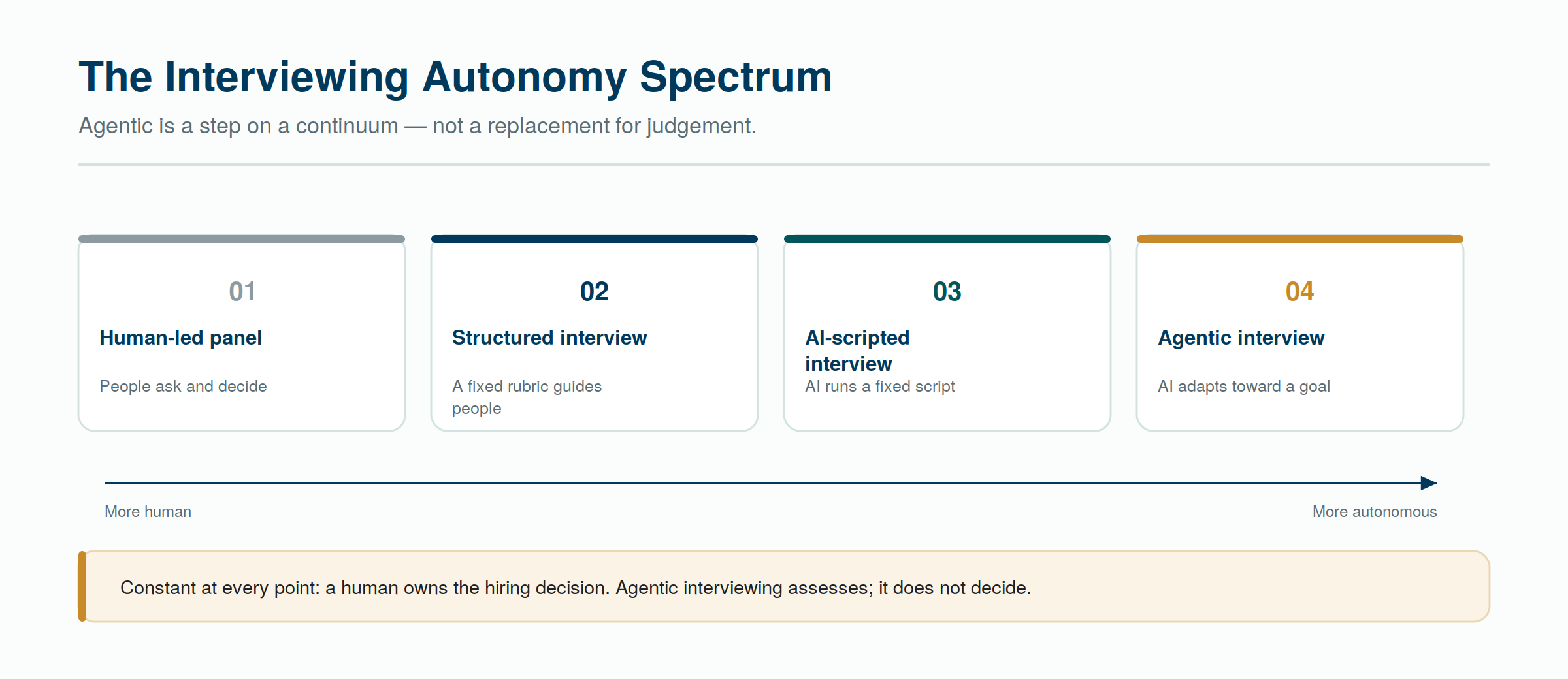
For all its capability, agentic interviewing is one point on a spectrum of interviewing autonomy, not a replacement for the whole of it. Placing it honestly is the difference between using it well and overreaching with it.
Where it helps: high-volume screening and first rounds, where adaptive probing at scale adds real value and there’s room to review the output. This is where it pairs naturally with standard AI interviews for throughput and human panels for the rounds that need a person.
Where to be careful: an agentic interviewer needs guardrails — validated scoring with human-agreement data, bias monitoring, plagiarism and AI-assist detection, and human review of borderline cases. Treat it as a capable assistant that must be checked, not an oracle. And keep the senior, culture-critical, and final rounds with people: agentic interviewing assesses, but it does not decide.
Agentic Interviewing and the Future of Hiring
The honest forward view is evolutionary, not revolutionary. Interviewing has been moving along the autonomy spectrum for years — from unstructured human panels to structured rubrics to scripted AI — and agentic interviewing is the next step, not a break. Its likely role is to take on more of the adaptive, high-volume assessment work at the top of the funnel, freeing human interviewers for the judgement-heavy rounds where they’re irreplaceable. For teams that want to try it in that role, agentic AI interviews are where the concept becomes a product.
Strip away the hype and agentic interviewing is a precise idea: an AI interviewer that pursues an accurate assessment and adapts to get there, rather than reading a fixed script. It differs from a standard AI interview in autonomy — it decides its next question instead of following a list — and it’s most useful for adaptive, high-volume screening, with guardrails and human oversight. The technology is real and worth understanding early; the discipline is remembering that it assesses candidates, while people still hire them.
If you want to see agentic interviewing in practice rather than in theory, futuremug’s agentic AI interviews put the concept to work on real screening — with the validation and human oversight this piece argues for built in.



Frequently Asked Questions
Agentic interviewing is the use of an AI agent — software that pursues a goal with a degree of autonomy — to conduct an interview. Rather than following a fixed question list, it works toward an accurate assessment of the candidate's competency, adapting its questions to the answers it hears. It's the interviewing application of agentic AI, and a human still owns the hiring decision.
By autonomy. A standard AI interview runs a script: the same fixed questions for every candidate, recorded and scored. An agentic interview interprets each answer and decides the most useful next move — probing a claim, following a promising thread, adjusting difficulty, or moving on. One executes a list; the other pursues a goal and adapts the path to reach it.
No. It's a step on a spectrum of interviewing autonomy, not the end of it — and the hiring decision stays human at every point. Agentic interviewing assesses candidates and produces evidence; people decide who to hire, read culture fit, and own the offer. It's best understood as augmenting the top of the funnel, not replacing the judgement at the end of it.
The adaptivity is real and genuinely useful — especially for probing beyond memorised answers — but it needs guardrails: validated scoring, human-agreement data, bias monitoring, and human oversight of borderline cases. Treat it as a capable assistant that must be checked, not an oracle. The honest position is that it's powerful for specific rounds and unproven as a wholesale replacement.
Mostly in high-volume screening and first rounds, where its ability to adapt and probe at scale adds the most value and the stakes allow for human review of the output. Senior, culture-critical, and final rounds stay with people. It pairs naturally with standard AI interviews for volume and human panels for depth.
It's harder than gaming a scripted one, which is part of the point. Because an agentic interviewer follows up and probes, a memorised or AI-generated answer tends to unravel under the second and third question. That said, it still needs plagiarism and AI-assist detection alongside the adaptivity — the follow-up is a strong defence, not a complete one.