
7 Mistakes Companies Make When Outsourcing Interviews
Interview outsourcing works well — when it is done right. The companies that regret it almost never regret the idea; they regret a handful of avoidable mistakes made while setting it up. Here are the seven that catch first-time buyers most often, each with the fix, so you can skip the expensive version of the learning curve.
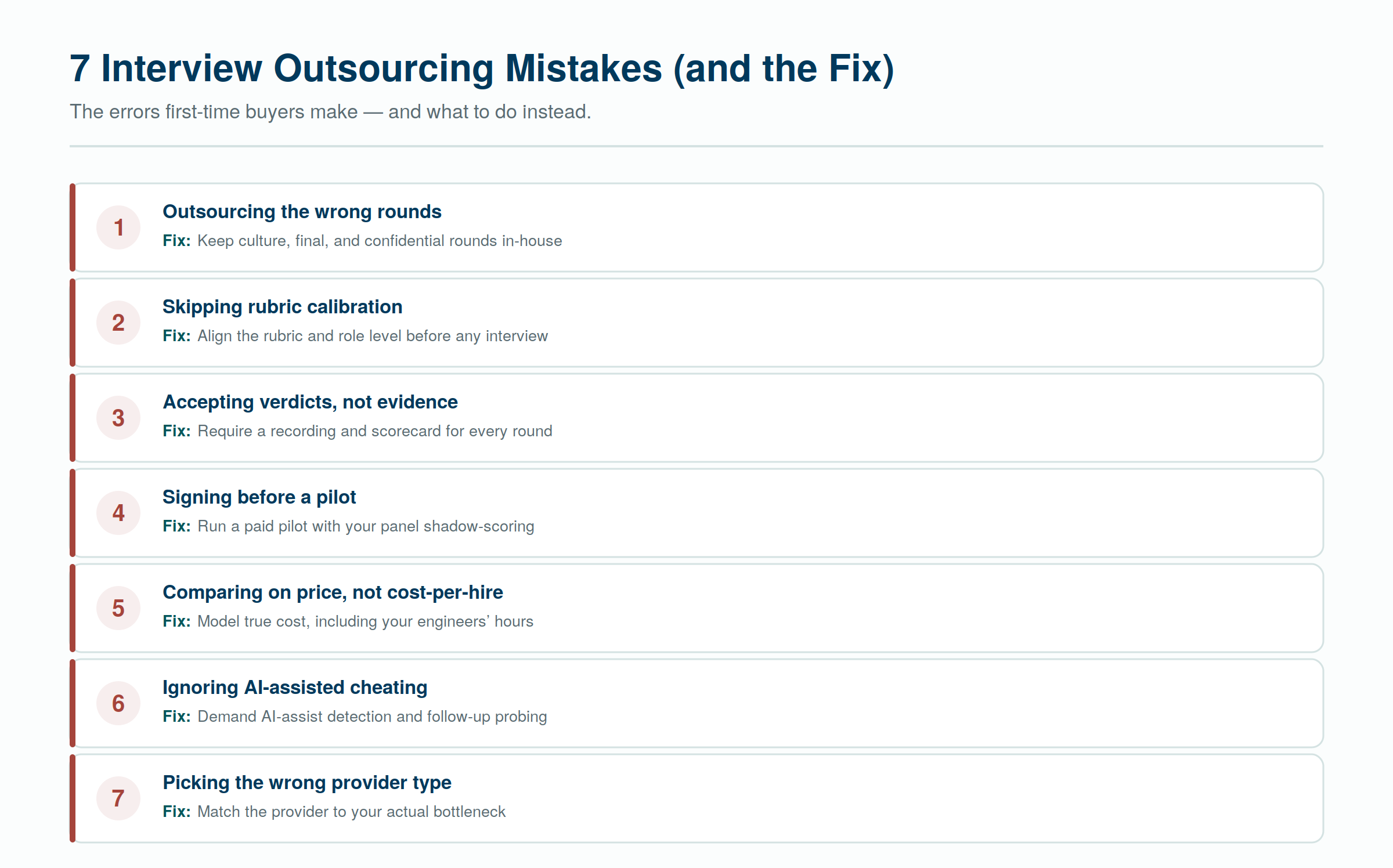
| Quick answer: The seven most common interview outsourcing mistakes are: outsourcing the wrong rounds, skipping rubric calibration, accepting verdicts instead of evidence, signing before a pilot, comparing on price instead of cost per hire, ignoring AI-assisted cheating, and picking the wrong provider type. Every one is avoidable — and most trace back to a single habit: buying an interview outsourcing platform on its promises rather than testing it on your rubric. |
Mistake 1: Outsourcing the wrong rounds
The most damaging error is handing off the rounds that should never leave your team — the final decision, the culture read, the offer. An external interviewer can assess skill against a rubric, but not fit with your specific team. Outsource the standardised, high-volume rounds; keep the context-critical ones. Our guide to what you can and can’t safely outsource draws the exact line.
The fix: Keep culture, final, and confidential rounds in-house; hand off first rounds and overflow.
Mistake 2: Skipping rubric calibration
Teams that hand a provider a job title and expect good scores are disappointed for a predictable reason: without a calibrated rubric, every interviewer applies their own bar. Calibration — agreeing the role level and observable criteria before any interview runs — is the step that makes outsourced scores mean the same thing as your own. It is built into how technical interview outsourcing works end to end.
The fix: Run a calibration session on your rubric and role levels before the first interview.
Mistake 3: Accepting verdicts instead of evidence
A provider that returns “pass” or “fail” with nothing behind it is asking for blind trust — and taking your control with it. You should receive a rubric-scored card and a reviewable recording for every interview, so you can audit any decision and overrule any score. This is also what keeps the control objection from being real: with evidence in hand, you never lose the decision.
The fix: Require a recording and a rubric scorecard for every round — evidence, not a verdict.
Mistake 4: Signing before running a pilot
Committing to a long contract off a polished demo is how buyers get surprised. A paid pilot — a small batch of real interviews with your own panel shadow-scoring a sample — reveals calibration in a way no sales conversation can, and contains the risk while you learn. The complete buyer’s guide lays out a 30-day evaluation with the pilot at its centre.
The fix: Pilot on one or two round types with shadow-scoring before any commitment.
Mistake 5: Comparing on price, not cost per hire
Headline price per interview is the wrong number. The comparison that matters is cost per quality hire — which, for in-house interviewing, hides the senior-engineer hours and lost sprint velocity that a per-interview fee replaces. Judge an interview outsourcing platform against your fully-loaded internal cost, not against zero. The cost cross-over model shows where each wins, and the engineering-time math shows what interviewing really costs your team.
The fix: Model cost per hire including your engineers’ hours — not the sticker price per interview.
Mistake 6: Ignoring AI-assisted cheating
In 2026, the live threat to interview signal is not a weak interviewer — it is a candidate with an AI assistant in another window. A provider without a clear position on plagiarism detection, AI-assist flags, and follow-up probing is behind the threat. Where AI interviews are used, ask for human-agreement data on the scores as well.
The fix: Demand AI-assist and plagiarism detection, plus probing questions a memorised answer can’t survive.
Mistake 7: Picking the wrong provider type
Not every provider is the same kind of thing. A staffing agency that also interviews, an assessment tool with a light interview layer, and a specialist interview platform solve different problems — and a mismatch wastes months. Match the provider type to your actual bottleneck. Our guide to choosing the best interview platform compares the types and the fit for each.
The fix: Diagnose your real bottleneck — pipeline, bandwidth, or depth — then match the provider type to it.
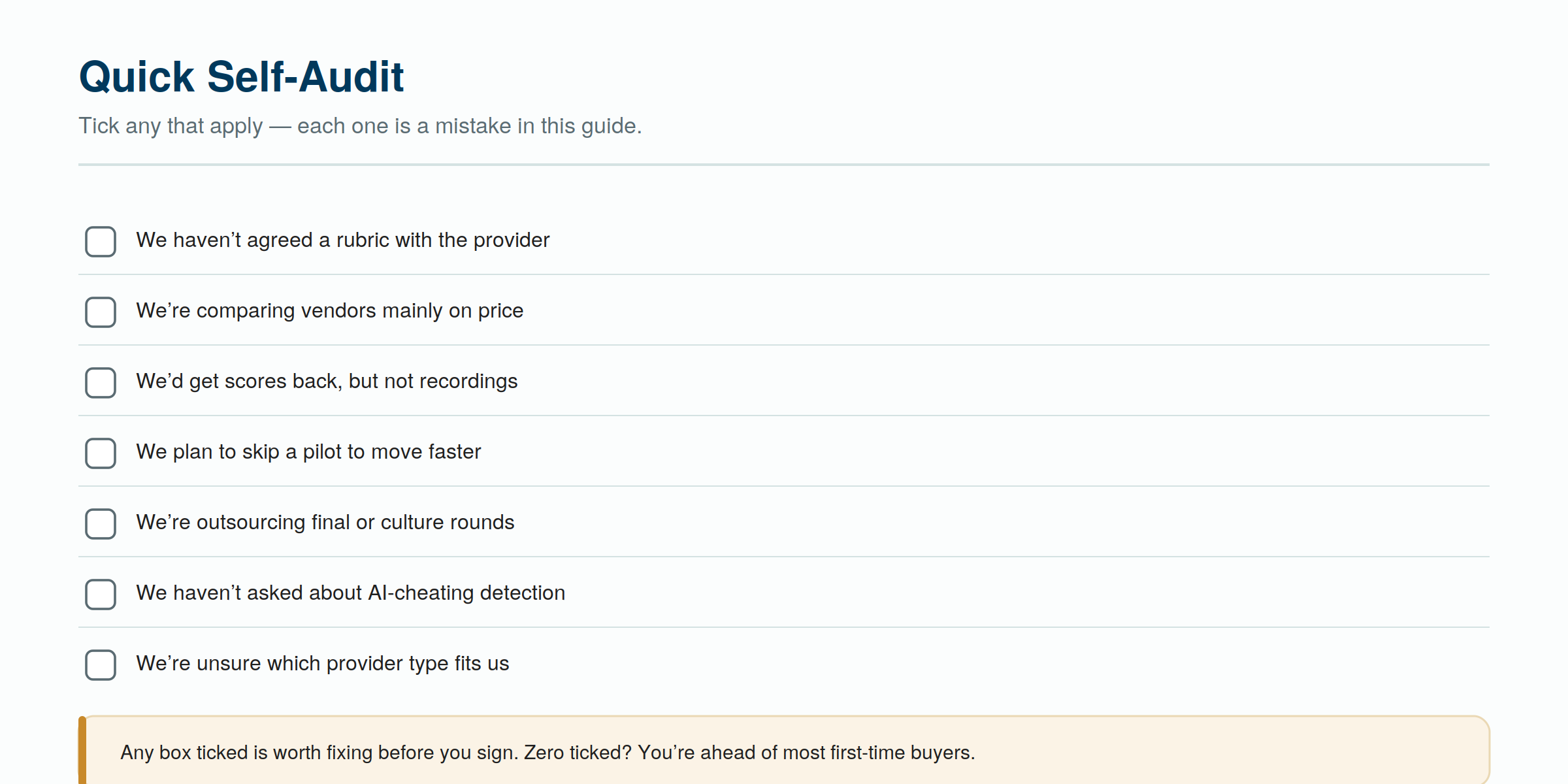
A Quick Self-Audit
Before you sign anything, run this check. Each statement maps to one of the seven mistakes — tick the ones that describe your current plan.
The Habit Behind Most Mistakes
Six of the seven mistakes share a root cause: comparing providers on the wrong things. First-time buyers over-weight price, brand names, and speed-to-start; the signals that actually predict a good outcome are cost per quality hire, calibration, evidence, and a reference at your scale.
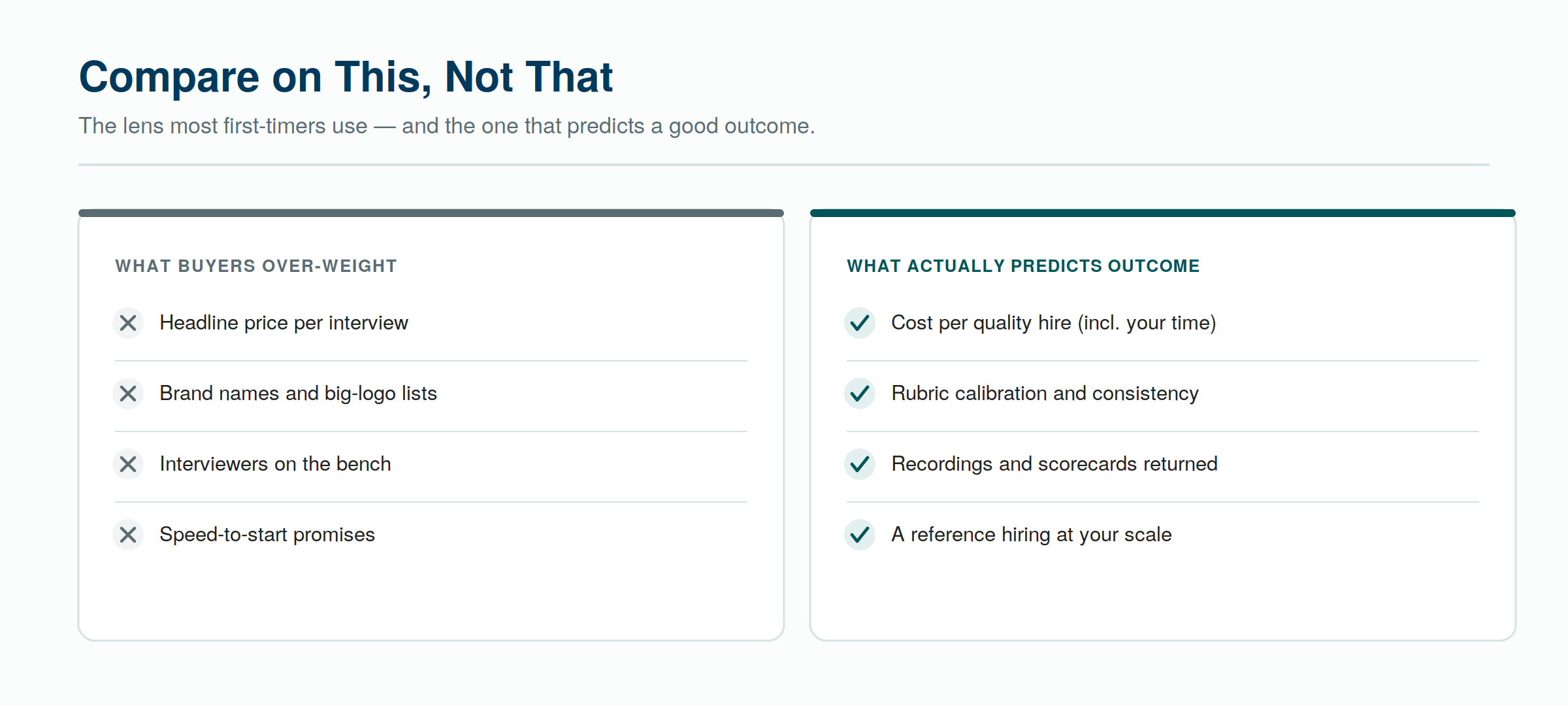
Shift your comparison to the right column and the mistakes mostly take care of themselves. You stop chasing the cheapest interview and start buying the most reliable signal — which is the entire point of outsourcing interviews in the first place.
Interview outsourcing mistakes are almost all mistakes of setup, not of concept. Draw the boundary on which rounds to hand off, calibrate before you start, insist on evidence, pilot before you commit, compare on true cost, guard against AI-assisted cheating, and match the provider to your bottleneck. Do those, and outsourcing gives your team its time back without any of the regret.
futuremug is built to be judged on exactly the signals that matter — calibrated expert panels and AI interviews with recorded evidence, clear data terms, and a pilot to prove it. If you’re avoiding these seven mistakes, a pilot is the natural next step.



Frequently Asked Questions
Outsourcing the wrong rounds — handing off the final decision, culture read, or offer conversation that should stay in-house. An external provider can assess skill against a rubric, but only your team can judge fit with your team. Keep those rounds, and outsource the standardised, high-volume ones.
Draw the boundary on which rounds to outsource, calibrate the rubric before starting, require recordings and scorecards, run a paid pilot with shadow-scoring, compare on cost per hire rather than sticker price, ask about AI-cheating detection, and match the provider type to your bottleneck. A quick self-audit against these seven catches most problems before they cost you.
Yes, for the rounds that scale and drain your team — provided the risks are managed. Every mistake in this guide is avoidable with calibration, evidence, and a pilot. The teams that regret outsourcing are almost always the ones that skipped those safeguards, not the ones that outsourced at all.
At minimum: interviewers vetted in your stack, a calibrated rubric, a recording and scorecard for every interview, clear turnaround times, AI-cheating safeguards where AI is used, and documented data terms. If a platform can't show these with artifacts rather than adjectives, keep looking.
Directly, a bad provider choice can waste a quarter and a contract. Indirectly, the bigger cost is a lowered hiring bar or a mis-hire from uncalibrated, unaudited scores. Both are far more expensive than the safeguards — a pilot and a calibration session — that would have prevented them.