
Can Interviews Be Outsourced? What You Can Safely Hand Off and What You Can’t
It is a fair question to ask with a raised eyebrow. Hiring is one of the highest-stakes things a team does, and the instinct that you shouldn’t just hand it to strangers is a healthy one. So here is a straight answer, not a sales pitch: yes, interviews can be outsourced — but only some of them, and knowing which is the whole game. This guide draws the line clearly, answers the real objections underneath the question, and shows how to outsource without taking on the risk you’re rightly worried about.
| Quick answer: Yes, interviews can be outsourced — but not all of them, and that limit is the point. You can safely hand off high-volume first rounds, standardised technical screening, specialist rounds you can’t staff, and all the scheduling around them. You should keep the final decision, the culture read, the offer conversation, and any confidential round in-house. Outsourcing interviews is a boundary, not a switch — and drawn correctly, it removes the risk the objection is worried about. |
The Short Answer: Yes, But Not All of It
The reason “can interviews be outsourced” feels uncomfortable is that it sounds like outsourcing the hiring decision — and that would be a bad idea. But that is not what interview outsourcing is. You outsource the conducting of interviews; you keep the deciding. An external provider runs a round against your rubric and hands back a scored, recorded evaluation. You read the evidence and make the call.
Once you separate the interview from the decision, the question stops being scary and becomes practical: which rounds are safe to hand off, and which should stay with your team? That line is the rest of this guide.
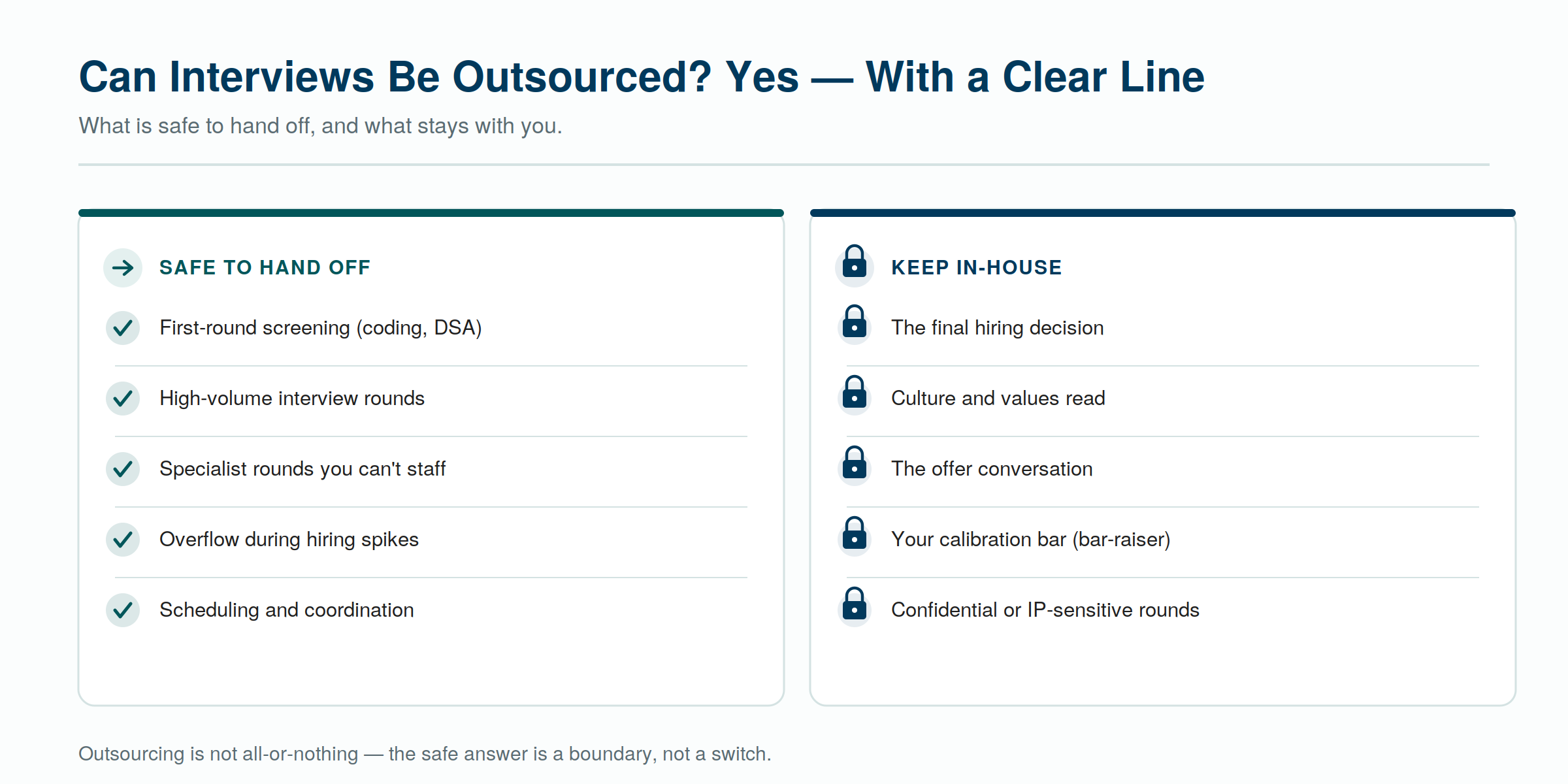
What You Can Safely Hand Off
These rounds share a trait: they are standardised enough that a calibrated external interviewer, working from a clear rubric, produces reliable signal — and they are the ones eating the most of your team’s time.
High-volume first rounds. Initial coding screens and DSA rounds are the highest-volume, most standardised interviews you run, which makes them both the safest to outsource and the biggest drain to keep in-house. This is the clearest win.
Specialist rounds you can’t staff. When you’re hiring for a skill you don’t have in-house to assess — a niche ML or security role — an outside expert who has done that job reads the signal better than a generalist on your team ever could.
Overflow during hiring spikes. A funded sprint or a campus batch can triple interview demand for a few weeks. Handing the overflow to expert interview panels or, at volume, AI-structured interviews protects your team from the surge without a permanent hire.
Scheduling and coordination. The admin around interviewing — booking slots, chasing panellists, collating feedback — is pure overhead and safe to offload entirely.
What You Can’t (and Shouldn’t) Hand Off
These rounds fail the standardisation test: the signal is your specific context, and no external party has it. Keeping them in-house is not a limitation of outsourcing — it is what makes the outsourcing safe.
The final hiring decision. Always yours. A provider supplies calibrated evidence; the hire, the level, and the offer are your call, every time.
The culture and values read. Whether someone will thrive on your team, in your specific culture, is something only your people can judge. Keep the culture round in-house — this is the honest core of the objection, and the answer is to agree with it.
The offer conversation. Closing a candidate is a relationship moment between them and their future team. It is not a round to delegate.
Your calibration bar. The bar-raiser exists to hold your standard steady across hires. Outsource rounds, never the standard itself.
Confidential or IP-sensitive rounds. Where an interview would expose sensitive systems or unreleased work, keep it inside. For everything else, contractual data terms do the job.
The Real Objections, Answered Honestly
Underneath “can interviews be outsourced” are five specific fears. Each deserves a straight answer — including the one where the fear is simply correct.
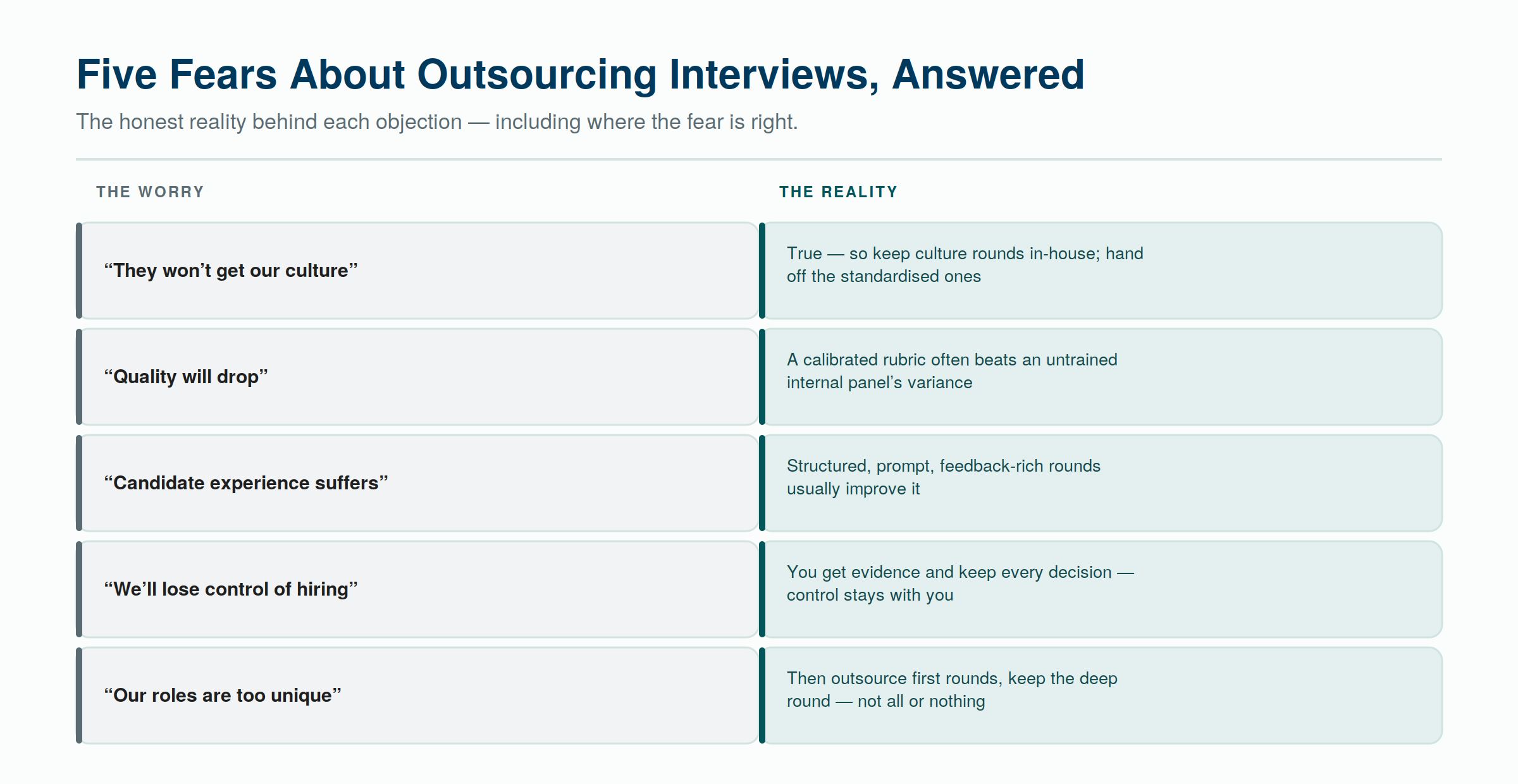
The pattern across all five: the fears are valid about the wrong thing. They describe what happens when you outsource the rounds you shouldn’t, or hire a vendor who returns verdicts instead of evidence. Draw the boundary correctly and choose a provider who hands back recordings and rubrics, and every one of them is answered — not by reassurance, but by design.
How to Outsource Interviews Safely
A yes is only as good as the safeguards behind it. Five turn a risky arrangement into a safe one.
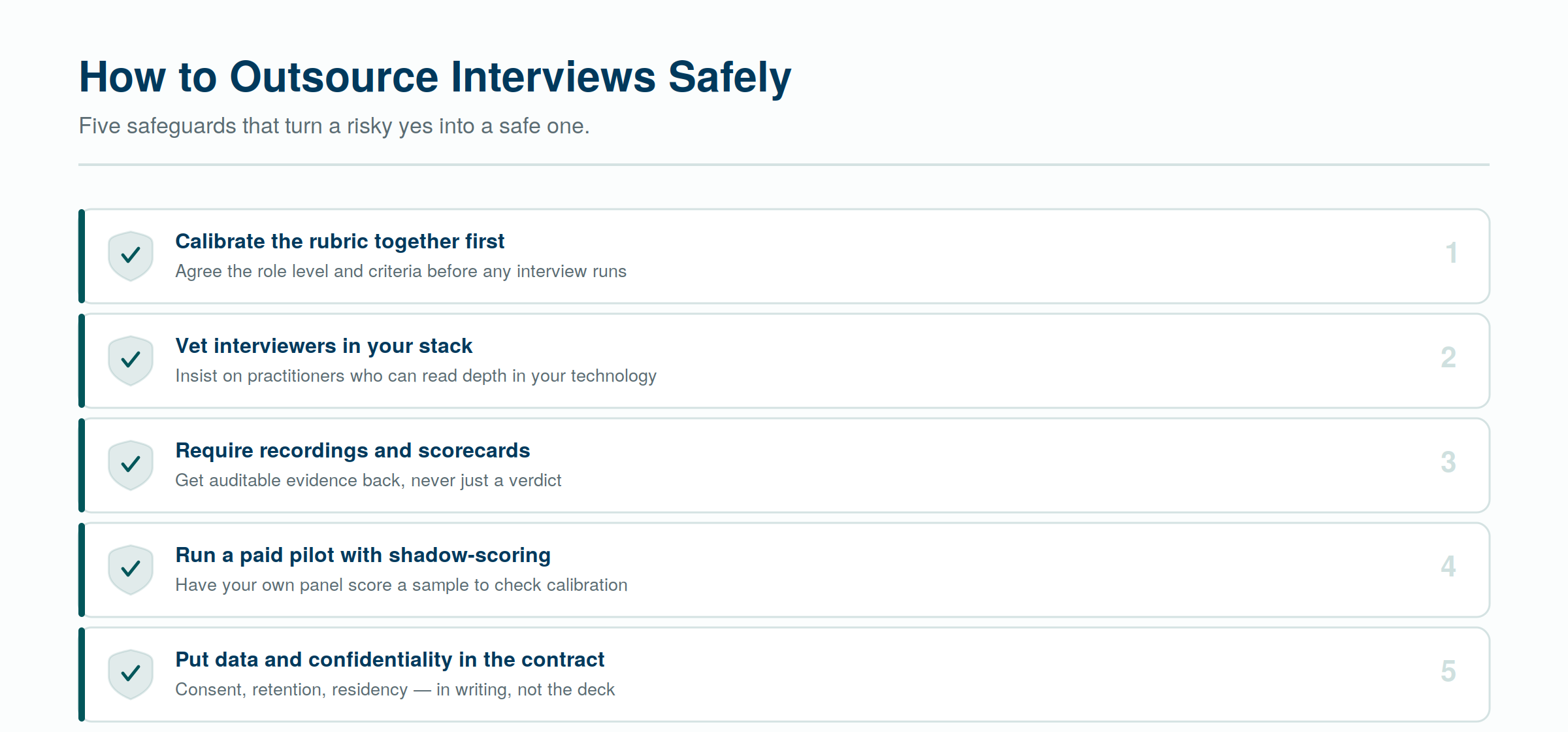
Start with a paid pilot. The last safeguard is the one that de-risks the whole decision: run one or two round types with your own panel shadow-scoring a sample. It reveals calibration in a way no demo can, keeps the risk to a small batch, and gives you real evidence to judge on. A provider comfortable being measured this way is the kind worth using.
Can interviews be outsourced? Yes — and the skepticism that brought you to the question is exactly what keeps the answer safe. Hand off the standardised, high-volume rounds that drain your team; keep the decision, the culture read, and the confidential rounds in-house; and insist on calibration, evidence, and a pilot. Drawn that way, outsourcing interviews is not a loss of control — it is your senior people getting their time back without lowering the bar.
futuremug is built for exactly this boundary — expert interview panels and AI interviews that take the rounds you can safely hand off, with the calibration, recorded evidence, and data terms that keep it safe. Your team keeps the rounds that need them. If you’re skeptical, a pilot is the right way to test it — which is exactly how we’d suggest you start.



Frequently Asked Questions
Yes — the interviewing, not the hiring. An external provider conducts your interview rounds against your rubric and returns recorded, scored evaluations, while you keep every hiring decision. The distinction matters: you are outsourcing the delivery of interviews, not the judgement about who to hire. This is the model behind interview outsourcing services.
It is a good idea for the rounds that scale and drain your team — high-volume first rounds, overflow, specialist screening — and a bad idea for the rounds where context and culture are the signal. Outsourcing everything is usually a mistake; outsourcing nothing leaves your senior people stuck in first-round screening. The right answer is selective.
They will — and that is exactly why you don't hand them the culture round. An external interviewer can assess coding ability, system design, or domain depth against a clear rubric, but reading fit with your team is your job. Keep culture and values rounds in-house and let the provider run the standardised technical ones; the concern is real, and the boundary answers it.
No, provided the provider returns evidence rather than verdicts. You should receive a rubric-scored card and a recording for every interview, so you can audit any decision and overrule any score. You set the bar, you see the evidence, and you make the call. Control is only lost if you let a vendor decide for you — which a good one never asks to do.
Confidential or IP-sensitive rounds are on the keep-in-house list for a reason. For everything you do outsource, the provider's data terms — consent, retention, deletion, and where data resides — belong in the contract. Handled properly, most interviewing carries no more confidentiality risk than any other vendor relationship; handled carelessly, it does. The safeguard is contractual, not hopeful.
Run a paid pilot on one or two round types, with your own panel shadow-scoring a sample of the results. It tells you more about calibration than any sales demo, contains the risk to a small batch, and gives you real evidence to decide on. If a provider resists a paid pilot, that is your answer.