
futuremug vs Intervue 2026: Automation-First or Expertise-First — Which Actually Fits Your Hiring?
Nearly every futuremug vs Intervue comparison published so far was written by one of the two companies — theirs. We’ll return the courtesy, with a rule they didn’t follow: we’ll tell you when the other side is the right choice.
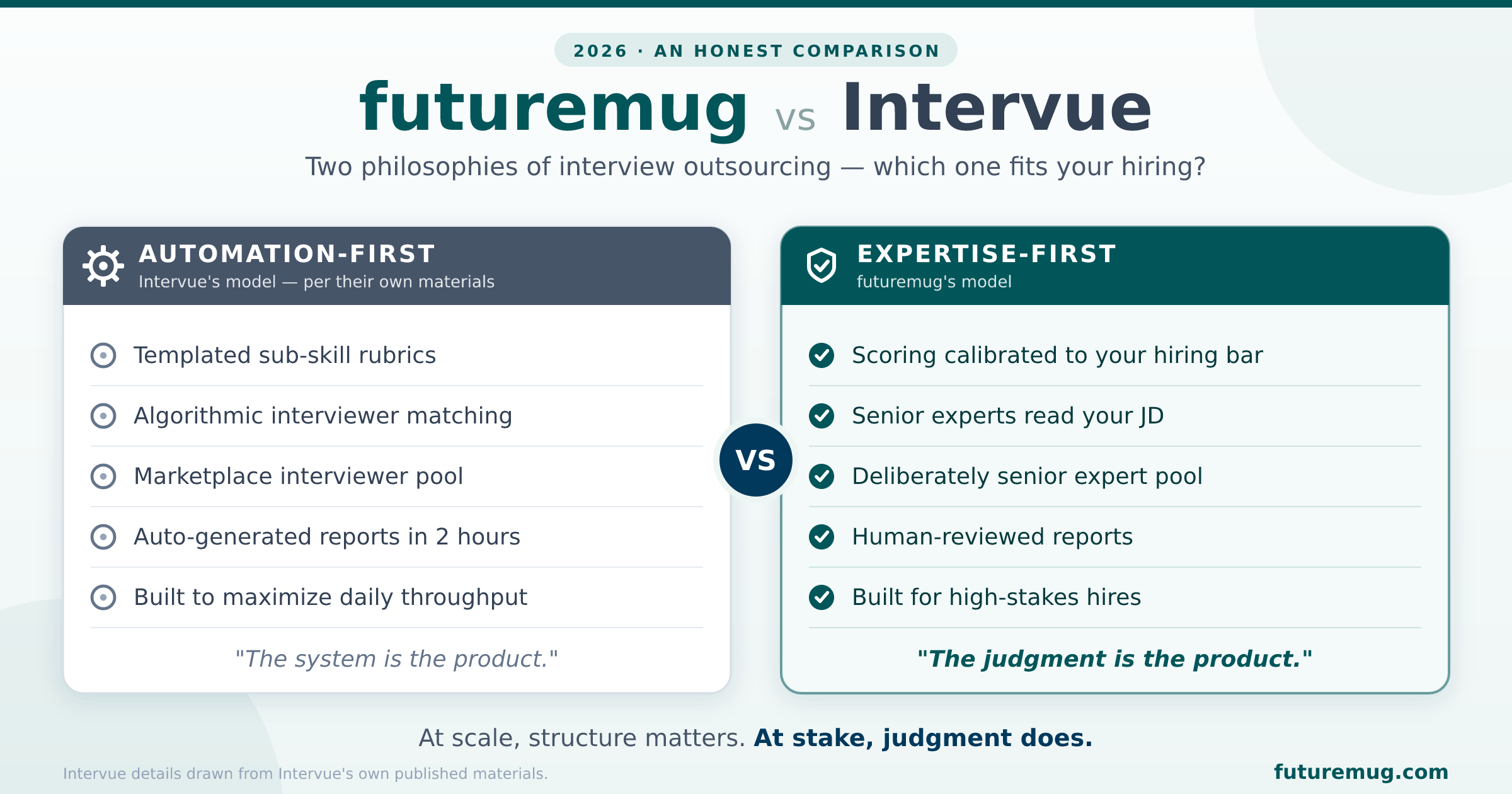
Because the honest core of this comparison isn’t cheap-vs-premium or old-vs-new. It’s two philosophies about what an interview is:
- Intervue is automation-first. By its own description: templated sub-skill rubrics, algorithmic interviewer matching, automated scheduling, reports in 2 hours, up to 1,000 interviews a day. The system is the product.
- futuremug is expertise-first. Senior industry experts as interviewers, structured scoring calibrated to your hiring bar, AI for proctoring and screening, human quality review before any report reaches you. The judgment is the product.
Both are legitimate designs. The question is which one your hiring actually needs.
futuremug vs Intervue: Side by Side
| futuremug | Intervue (per their own materials) | |
| Core model | Expert-led interview outsourcing with AI support | Automation-led interview platform |
| Evaluation | Standardized frameworks + structured scoring, calibrated to your bar | Predefined sub-skill rubric templates |
| Interviewer matching | Senior ops team reads your JD like a hiring manager | Algorithmic matching |
| Interviewer pool | 5,000+ deliberately senior-heavy industry experts | Marketplace of interviewers |
| Proctoring | AI proctoring + human review of every recording | Proctored environments |
| Roles | IT, non-IT, and leadership | IT and non-IT |
| AI screening | Agentic AI interviewer that adapts questioning in real time | Structured automated rounds |
| Assessments | Free self-serve platform + fully managed drives | Platform assessments |
| Campus hiring | Dedicated campus placement platform for India | — |
| Reports | Human-quality-reviewed, within 4 hours | Auto-generated, 2 hours |
| Headline scale | 400,000+ assessments delivered; 2,000+ interviews in 2 weeks for one client | “1,000/day” |
Now the parts a table can’t show.
1. Rubrics: Template vs. Calibration
Intervue’s central argument is that predefined sub-skill rubrics “remove ambiguity.” That’s true — and it’s also the trade-off.
A predefined rubric measures every company’s candidates against the same template. That works for high-volume standardized roles: junior developers, common stacks, repeatable screens. It strains exactly where hiring gets expensive — niche stacks, staff and principal engineers, sales leaders, domain-heavy non-IT roles — because the sub-skills that matter for your role aren’t the ones in anyone’s template.
futuremug’s answer isn’t “no structure” (whatever you may have read — every futuremug interview runs on a standardized evaluation framework with structured scoring). It’s structure plus calibration: before interviews begin, the framework is tuned to your must-haves, your good-to-haves, your bar. Two companies hiring “Senior Backend Engineer” are rarely hiring the same job. Your reports should know that.
Ask yourself: do you want candidates scored against an industry template, or against your bar?
2. Interviewer Matching: Algorithm vs. Judgment
Intervue automates interviewer-role matching and presents manual selection as a bottleneck. Flip it around: automated matching optimizes for availability and skill tags. Human matching optimizes for fit.
When futuremug’s ops team assigns a panel, a senior person has read your JD the way a hiring manager would — unwritten parts included. For a ₹40–80 LPA hire, “the algorithm found an available interviewer with matching tags” is not the assurance you want.
At true commodity volume, algorithmic matching is genuinely faster. That’s the honest trade: speed of assignment vs. quality of assignment. Know which one your role needs.
3. Proctoring: The Part Even They Concede
Interview integrity is the one area where Intervue’s own comparison acknowledges futuremug’s strength: AI proctoring with tab-switch detection and gaze tracking, plus full recordings reviewed by a human quality team — not just flagged by software. In an era of AI-assisted cheating, “an algorithm flagged nothing” and “a human reviewed the recording” are not the same sentence.
4. Scale: The 1,000-Interviews-a-Day Question
Intervue advertises 1,000 interviews a day. Impressive number. Now the practical question in any futuremug vs Intervue scale debate: how many interviews a day does your company actually run?
For the overwhelming majority of companies, the binding constraint is never raw daily throughput. It’s show-up rates, evaluation consistency, and whether the report can be trusted. futuremug coordinates scheduling across email, SMS, and WhatsApp with human follow-up layered in — because a reminder that gets answered beats an automation that gets ignored.
And when you genuinely have a bulk drive — campus season, mass assessment rounds — that’s precisely what managed assessment outsourcing and the campus platform are built for. The delivery record: 400,000+ assessments to date — including 50,000+ applications screened in four months for Quest Global and 2,000+ interviews in two weeks for WatchGuard. So much for the “100 a day” number floating around.
Ask yourself: are you buying throughput you’ll never use, or quality you’ll use every day?
5. Reports: 2 Hours Fast vs. Worth Reading
Intervue’s reports arrive in 2 hours. Speed matters, and credit where due.
But be precise about what you’re comparing. A report generated fast is not the same as a report reviewed before it reaches you. futuremug reports pass human quality review, because a hiring decision is rarely blocked by a few hours — and frequently broken by a shallow evaluation. futuremug reports arrive within 4 hours, human-reviewed — well under the “6 hours” their comparison claims. The two extra hours versus Intervue’s auto-generated output buy a human check on every single report.
The most expensive report is the fast one you can’t act on.
6. Pricing
futuremug runs a simple credit-based model: a pilot pack to start, flexible post-paid billing once you’ve seen the quality — no annual platform license, no seat-based lock-in. futuremug doesn’t publish a rate card — every engagement is scoped to role seniority, volume, and workflow, with pricing shared in one short call. Specific credit figures in third-party posts didn’t come from us.
Intervue’s pricing is likewise shared through their sales process. For a real comparison, get both quotes — and compare cost per confident hiring decision, not cost per interview. A cheap interview that produces an unusable signal is the most expensive item in your hiring budget.
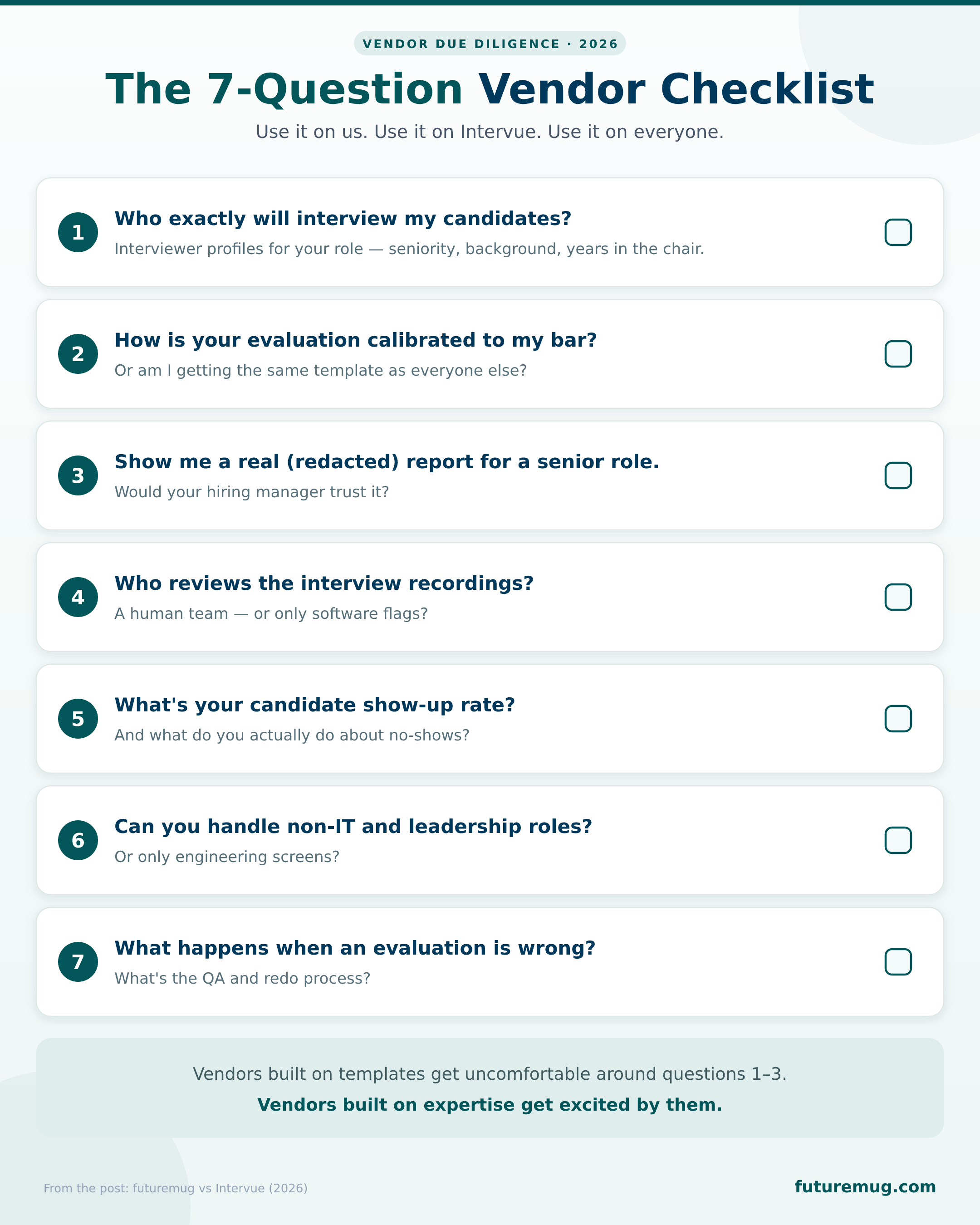
The Checklist: 7 Questions to Ask Any Interview-as-a-Service Vendor
Use this on us. Use it on Intervue. Use it on everyone:
- Who exactly will interview my candidates? Ask for interviewer profiles for your role — seniority, background, years in the chair.
- How is your evaluation calibrated to my bar — or am I getting the same template as everyone else?
- Show me a real report. Would your hiring manager trust it? Here’s ours: a live sample assessment report with section scores, question-level detail, and a full integrity analysis.
- Who reviews the interview recordings — a human team, or only software flags?
- What’s your candidate show-up rate, and what do you actually do about no-shows?
- Can you handle my non-IT and leadership roles, or only engineering screens?
- What happens when an evaluation is wrong? What’s the QA and redo process?
Vendors built on templates get uncomfortable around questions 1–3. Vendors built on expertise get excited by them. That reaction tells you most of what you need.
futuremug vs Intervue: The Honest Verdict
Choose Intervue if: you’re running enormous, standardized, high-volume screens for common roles, template-based consistency is sufficient for your bar, and maximum automation is the explicit goal. That’s the use case their system is built for, and we won’t pretend otherwise.
Choose futuremug if: the hires matter individually — senior, niche, non-IT, or leadership roles; you want your own bar calibrated into the evaluation; you want AI where it’s strong (screening, proctoring, adaptive AI interviews) and humans where it counts (panels, judgment, quality review); or you want interviews, assessments, and campus hiring from one partner. For the record, futuremug’s team culture holds a 4.6/5 rating on Glassdoor and the company profile is public on Crunchbase.
At scale, structure matters. At stake, judgment does. Most hiring worth outsourcing has both — which is why futuremug refuses to choose between them.



Frequently Asked Questions
Yes — 800+ companies already use futuremug, particularly those prioritizing senior interviewers, calibrated evaluation, and human quality review over pure automation. It covers IT, non-IT, and leadership roles with interviews, assessments, and campus hiring on one platform.
Yes. futuremug interviews follow standardized evaluation frameworks with structured scoring — calibrated to each client's specific hiring bar rather than applied as a fixed template.
Intervue advertises 2-hour auto-generated reports. futuremug reports are delivered within 4 hours after human quality review. For most hiring decisions, the review is worth more than the head start.
Both share pricing through a sales conversation. Get both quotes and compare the full picture: interviewer seniority, evaluation depth, QA process, and show-up rates — not just per-interview cost.