
Interview as a Service vs RPO: Which Hiring Model Fits Your Team?

Interview as a service vs RPO: the short answer
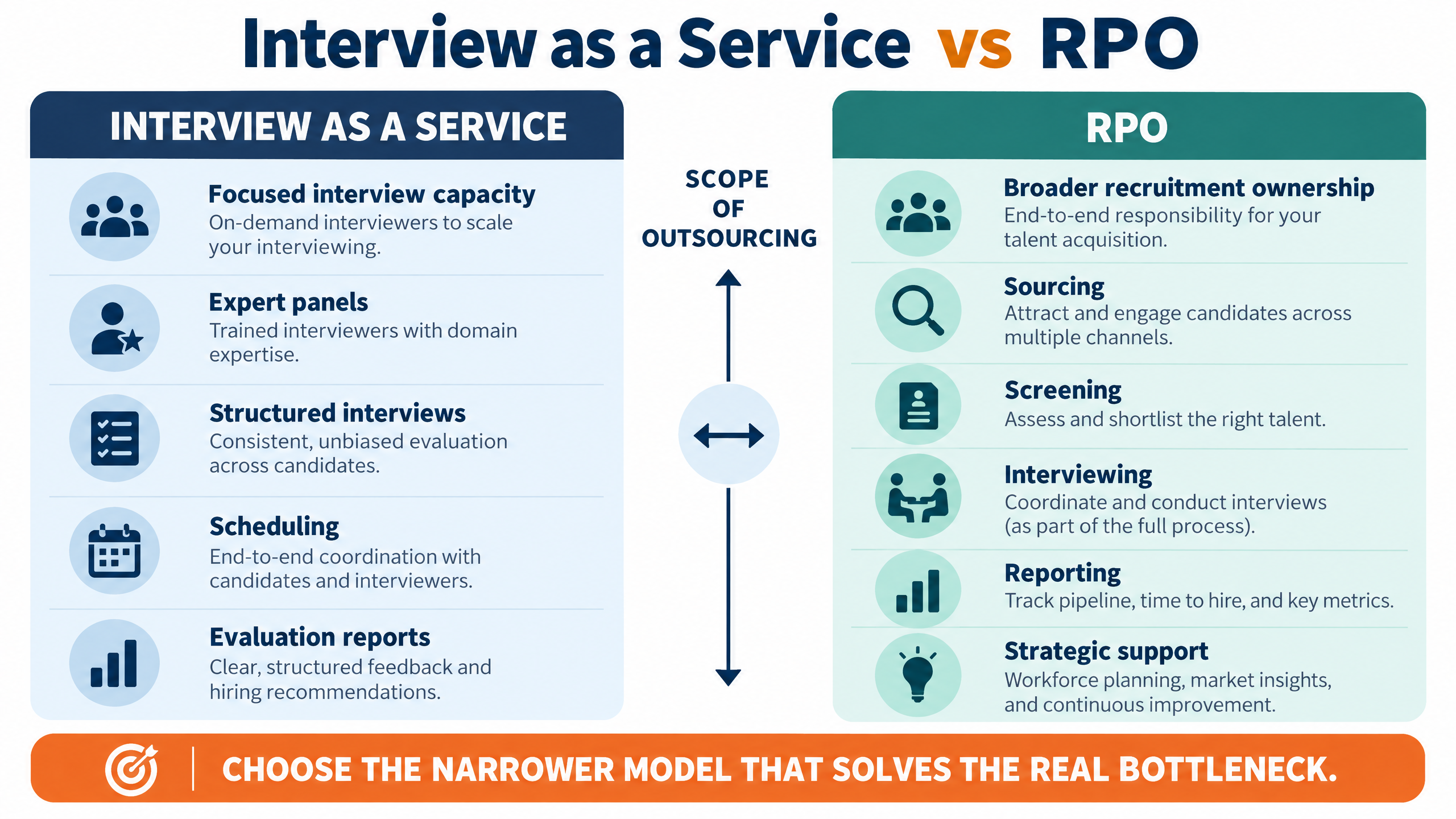
The difference between interview as a service vs RPO is mainly the scope of work you transfer.
Interview as a service gives your team external capacity for defined interview stages. The provider may supply expert interviewers, interview scheduling, role-specific questions, structured scorecards, feedback, recordings, or reports. Your team generally retains responsibility for the rest of the recruitment process.
Recruitment process outsourcing (RPO) transfers part or all of an organization’s recruitment function to an external partner. Depending on the agreement, the partner may support sourcing, screening, assessment, interviewing, scheduling, candidate communication, reporting, and other recruitment operations.
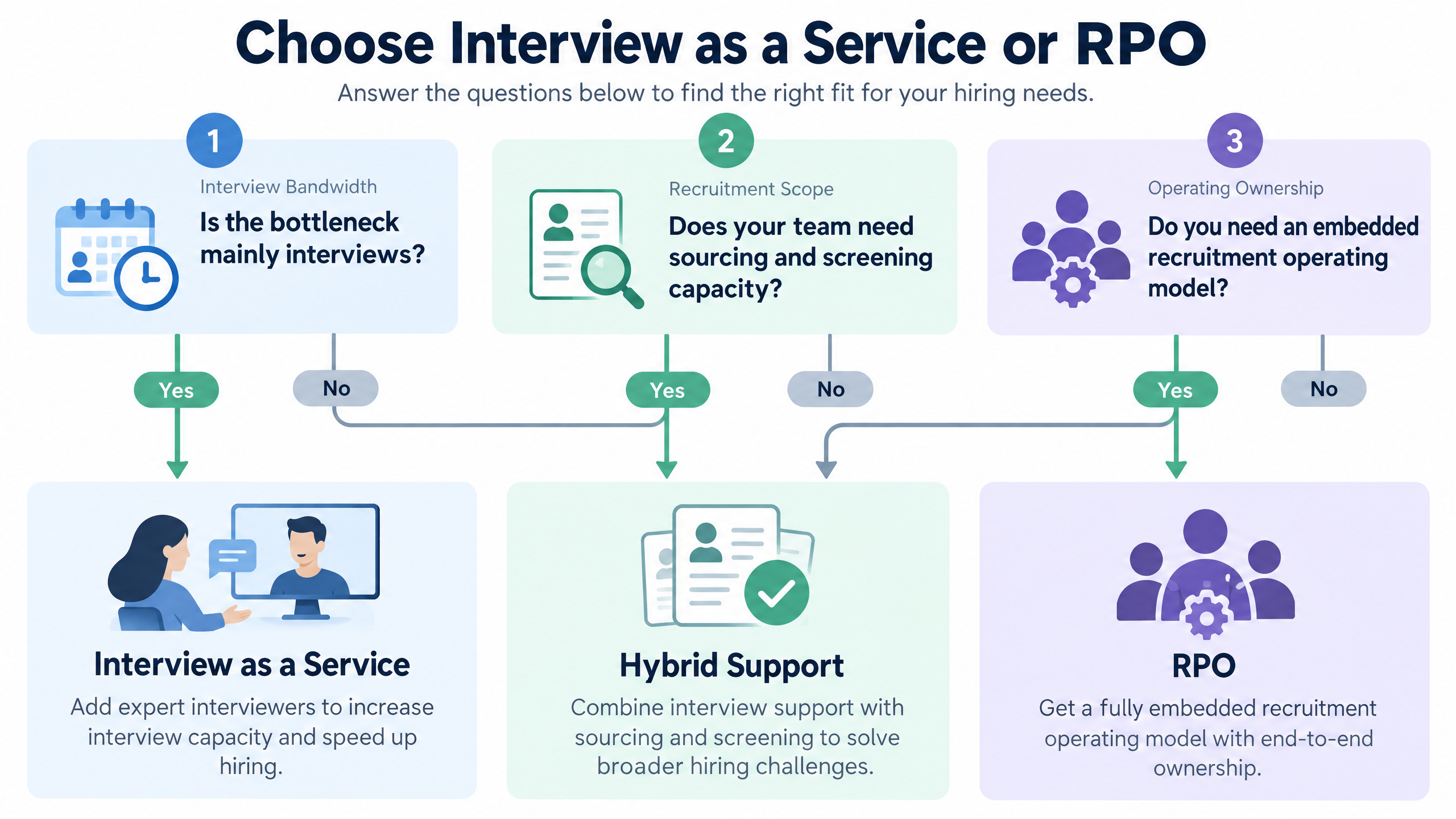
Choose interview as a service when the bottleneck is interview capacity or interview consistency. Choose RPO when the bottleneck is broader recruitment execution or the need for an embedded talent-acquisition operating model. Choose a hybrid model when you need a focused service now but may expand the scope later.
Neither model is automatically better. The right option depends on the stage that is slowing hiring, the amount of ownership you want to transfer, the roles and volume involved, and the internal capability you want to keep.
Interview as a service vs RPO comparison showing interview capacity, expert panels, and structured evaluation on one side, and broader recruitment ownership on the other

What is interview as a service?

Interview as a service is an outsourced model for one or more interview activities. It may also be called interview outsourcing, technical interview outsourcing, expert interview-panel support, or interview operations support.
A typical engagement may include:
  • Understanding the role, level, skills, and interview plan.
  • Selecting or assigning suitable interviewers.
  • Preparing role-specific questions or using an approved question framework.
  • Scheduling candidates and interviewers.
  • Conducting technical, functional, behavioral, coding, or panel interviews.
  • Capturing structured feedback against a rubric.
  • Reviewing notes, recordings, or reports.
  • Returning a consolidated candidate-evaluation report.
The service can be used for a single hiring campaign, a difficult role family, a seasonal spike, campus hiring, global time-zone coverage, or recurring interview capacity.
The organization normally retains ownership of job approval, employer brand, candidate strategy, final hiring decisions, offer management, and broader recruitment operations. The exact division of responsibility should be written into the scope of work.
futuremug’s describe customizable interviews, expert panels, role-specific evaluation, 24/7 auto-scheduling, structured feedback, interview reports, and the option to outsource interviews or use an interview platform. Buyers should validate current service levels, integrations, data controls, and delivery responsibilities during evaluation.

What is RPO?

RPO stands for Recruitment Process Outsourcing. It is a model in which a business outsources part or all of its recruitment function to an external partner.
Korn Ferry describes RPO as a model that can support full or blended outsourcing, project recruitment, flexible recruitment services, sourcing, screening, assessing, interviewing, and onboarding, depending on the client’s needs . The scope is not fixed. An RPO engagement may be broad and embedded, or it may focus on selected roles, regions, or stages.
An RPO partner may work with the internal TA team as an extension of the organization. That can include process design, recruiter capacity, sourcing, candidate pipelines, screening, interview coordination, hiring analytics, stakeholder communication, and continuous improvement.
RPO is therefore not simply a larger interview service. It changes the operating relationship. The provider may take ownership of agreed recruitment outcomes, workflows, team capacity, and process governance.
The exact boundary matters. A provider that only supplies interviewers should not be described as the organization’s full RPO partner. A provider that manages sourcing, screening, scheduling, interviews, reporting, and agreed recruitment operations has a broader scope.
For additional context, see the existing futuremug article on . This comparison focuses on how buyers choose between the models rather than repeating a provider list.

Interview as a service vs RPO comparison matrix

Decision area
Interview as a service
RPO
Primary purpose
Add interview capacity, expertise, consistency, or speed.
Transfer part or all of the recruitment function to an external partner.
Typical scope
Defined interview stages and related scheduling or reporting.
Sourcing, screening, assessment, interviewing, coordination, reporting, and other agreed recruitment work.
Main bottleneck solved
Too few interviewers, slow interview scheduling, inconsistent evaluation, or limited domain expertise.
Insufficient recruitment capacity, fragmented operations, recurring hiring demand, or need for an embedded TA partner.
Ownership model
Internal team owns the broader candidate journey and hiring process.
Provider owns agreed recruitment activities and works as an extension of the internal team.
Time to start
Often faster when the role and interview plan are already defined.
Usually requires deeper discovery, workflow design, governance, and transition planning.
Best fit
Urgent roles, technical bottlenecks, bulk interviews, specialized skills, or time-zone coverage.
Recurring hiring, multiple role families, new-market expansion, project recruitment, or overloaded TA operations.
Interviewer model
External experts, panels, or platform-supported interviewers.
RPO recruiters and operations teams may coordinate interviewers as one part of the process.
Recruitment stages
Usually interview-focused.
May cover sourcing through onboarding, depending on the statement of work.
Candidate communication
Interview invitations, reminders, scheduling updates, and next-step support may be included.
Broader candidate communication may include sourcing, screening, interview, offer, and onboarding stages.
Technology
Interview platform, scheduling, scorecards, recordings, transcripts, and reports.
ATS, CRM, sourcing, scheduling, assessment, interview, analytics, and workflow systems.
Commercial drivers
Interview volume, role complexity, panel expertise, turnaround, and reporting requirements.
Scope, hiring volume, team capacity, geography, role mix, technology, transition, and service levels.
Control retained by buyer
Usually high outside the interview stage.
Shared according to governance, process ownership, and escalation design.
Main risk
Treating interview support as a complete recruitment solution.
Transferring too much scope without clear governance, integration, or internal ownership.
The matrix is a starting point. A buyer should compare the actual statement of work, service levels, data responsibilities, escalation model, and decision rights before selecting a provider.

Nine differences buyers should evaluate

1. Scope: one stage versus a recruitment system

Interview as a service is usually a stage-level solution. It addresses the part of hiring that requires interview capacity or expertise.
RPO is a process-level solution. It can address multiple stages and connect them into a more complete recruitment operating model.
If your team has a healthy sourcing pipeline but cannot interview candidates quickly, a stage-level service may be enough. If sourcing, screening, scheduling, interviewing, reporting, and stakeholder coordination are all overloaded, RPO may be more appropriate.

2. Ownership: support layer versus embedded partner

With interview outsourcing, the provider generally supports your interview plan. Your team decides how the role is approved, which candidates enter the process, and what happens after the report.
With RPO, the provider may become an embedded extension of the TA team. The contract should specify who owns pipeline creation, candidate communication, hiring-manager updates, process performance, and escalation.
The question is not only “Who conducts the interview?” It is “Who is accountable for the work around the interview?”

3. Speed: rapid capacity versus structured transition

Interview as a service can often begin quickly when the job description, competencies, panel requirements, and schedule are ready.
RPO can also support urgent hiring, especially through project or blended models. However, a broader engagement usually needs discovery, process mapping, system access, transition planning, governance, and reporting design.
Do not compare only the provider’s advertised turnaround. Compare the time required to prepare your internal process and make the engagement operational.

4. Expertise: specialist interviewer versus recruitment capability

Interview outsourcing is valuable when the buyer needs expertise in a technical domain, function, level, or geography. The provider can match candidates to interviewers or panels and apply a defined rubric.
RPO may include interview coordination and recruitment expertise, but its value is broader. It may provide sourcing knowledge, recruiter capacity, market intelligence, candidate operations, and process improvement.
If the central problem is “we cannot assess this skill reliably,” focus on interviewer expertise and evaluation quality. If the problem is “we cannot run this hiring engine,” evaluate RPO capability.

5. Technology: interview workflow versus connected TA stack

A strong interview-as-a-service solution may include scheduling, video or coding interviews, question banks, scorecards, reports, recordings, transcripts, and notifications.
An RPO solution may need to connect those tools to the ATS, CRM, sourcing channels, assessment platform, calendars, communication systems, dashboards, and workforce reporting.
Ask whether the provider can work with your systems or expects you to adopt a new workflow. Integration should reduce duplicate work rather than create another disconnected record.

6. Candidate experience: interview clarity versus end-to-end continuity

Interview outsourcing can improve the interview experience through clearer scheduling, reliable reminders, flexible time slots, consistent instructions, and professional interviewers.
RPO can influence the full candidate journey from first contact to offer or onboarding. That makes the governance question broader: who owns the candidate relationship, employer-brand tone, accessibility, complaints, and candidate data across every stage?
The selected model should match the experience problem you are trying to solve.

7. Measurement: interview quality versus recruitment outcomes

Interview-as-a-service metrics may include scheduling time, interview completion, interviewer utilization, report turnaround, rubric adherence, reviewer agreement, candidate feedback, and progression quality.
RPO metrics may include source quality, pipeline conversion, time to slate, screening conversion, interview-to-offer ratio, time to fill, offer acceptance, candidate experience, diversity outcomes where lawful and appropriate, and hiring-manager satisfaction.
The model should not be judged only by speed. Faster interviews that create weaker shortlists can increase total hiring effort.

8. Procurement: modular engagement versus strategic partnership

Interview services are often easier to procure as a defined module with an interview volume, role scope, service level, and report format.
RPO procurement is usually more strategic. It may require stakeholder alignment across TA, HR operations, procurement, information security, legal, finance, hiring managers, and business leaders.
Procurement teams should compare not only per-interview or monthly pricing but also internal coordination effort, implementation cost, technology costs, transition risk, and the cost of unfilled roles.

9. Flexibility: narrow scope versus expandable operating model
Interview as a service can be highly flexible for specific roles and hiring spikes. It does not require the buyer to transfer every recruitment activity.
RPO can be flexible through project, selective, blended, or full-service models. Its flexibility comes from changing the external team and process scope, not simply adding a panel for one interview.
The best choice is the one that can expand or contract without creating unclear accountability.
Decision path for choosing interview as a service, hybrid support, or RPO based on interview bandwidth, recruitment scope, and operating ownership


Use-case examples

Use case 1: A growing engineering company needs technical interviews

The company has recruiters and a strong candidate pipeline. Engineering managers are spending too much time interviewing, and specialized roles are waiting for panel availability.
Best initial fit: Interview as a service.
The provider can supply domain experts, coordinate schedules, use a role-specific rubric, and return structured reports. The company retains sourcing, employer communication, offer management, and final hiring decisions.

Use case 2: A company is opening a new market

The company needs candidates in a new geography and does not yet have local recruiting capability. It needs sourcing, screening, candidate communication, scheduling, market knowledge, and interview coordination.
Best initial fit: RPO or project recruitment support.
The broader scope matters because the challenge is not only interview capacity. The company needs a recruitment engine that can operate in the new market.

Use case 3: A product launch creates a six-month hiring spike

The internal team can manage normal hiring but cannot absorb a temporary increase in requisitions. The roles are known, the process is stable, and the company wants to return ownership to the internal team after the project.
Best fit: Project RPO, interview outsourcing, or a hybrid model.
If sourcing and screening are healthy but interviews are the constraint, use interview support. If the spike affects the full funnel, use project RPO.

Use case 4: A recruitment team has a recurring interview backlog

Candidates are waiting several days or weeks for technical rounds. Interview quality varies by manager, and feedback is often incomplete.
Best initial fit: Interview as a service.
Focus the engagement on interviewer capacity, structured evaluation, scheduling, feedback quality, and report turnaround. Revisit the wider recruitment process if the backlog is caused by sourcing, screening, or hiring-manager decisions.

Use case 5: An organization wants an embedded recruiting team

The company needs a partner to manage a recurring hiring program, coordinate stakeholders, improve funnel performance, and provide ongoing recruitment operations.
Best fit: RPO.
The buying team should define the operating model, integration requirements, service levels, decision rights, reporting cadence, and transition plan.

Use case 6: A company needs both volume screening and expert interviews

The company expects a high applicant volume and needs consistent screening before specialist interviews. It wants automation for repeatable steps but human experts for deeper evaluation.
Best fit: Hybrid support.
A combined model may use assessment or AI-assisted screening, interview as a service for technical rounds, and selected RPO support for sourcing or coordination. The interfaces between providers must be explicit.

When to choose interview as a service

Interview as a service is usually the better starting point when most of these statements are true:
  • Your candidate pipeline already exists.
  • Interview capacity is the main bottleneck.
  • You need specialist or technical expertise.
  • Candidates are waiting too long for interviews.
  • Interviewers use inconsistent questions or scorecards.
  • You need temporary, seasonal, or global time-zone coverage.
  • Your team wants to retain ownership of sourcing and candidate strategy.
  • You want a modular engagement with a clear beginning and end.
  • You need faster reports without redesigning the whole recruitment process.
The buying brief should define the role family, interview stages, expected volume, panel expertise, rubric, schedule, candidate communication, report format, and quality checks.

When to choose RPO

RPO is usually the better fit when most of these statements are true:
  • The recruitment team is overloaded across several stages.
  • Hiring demand is recurring or strategically important.
  • Sourcing and screening are as constrained as interviewing.
  • You need an embedded partner rather than a single service.
  • The company is entering a new location or market.
  • You need process redesign, reporting, and continuous improvement.
  • The TA team needs flexible capacity without building a permanent internal team immediately.
  • Multiple role families, hiring managers, or business units need coordinated support.
  • The organization is prepared to define governance and share operational ownership.
RPO is not a shortcut around unclear hiring requirements. The provider still needs role definitions, decision rights, access, stakeholder participation, candidate policies, and measurable service levels.

When a hybrid model makes sense

A hybrid model can be practical when the company wants to keep strategic ownership but outsource selected operational bottlenecks.
Examples include:
  • Internal recruiters own sourcing; an external partner conducts technical interviews.
  • An RPO partner owns sourcing and screening; an interview provider supports specialist final rounds.
  • The internal TA team owns the candidate relationship; a platform automates scheduling and reporting.
  • The company uses a project RPO for a hiring spike, then retains interview support for recurring technical roles.
Hybrid models can deliver flexibility, but they also create handoff risk. Define one owner for candidate status, one source of truth for data, one escalation route, and one reporting view across the engagement.

How to evaluate providers

A buyer should evaluate the operating model before comparing brand names or headline pricing.

Ask interview-as-a-service providers

  • Which role families and skills can the interviewer network support?
  • How are interviewers matched, briefed, and calibrated?
  • Can the rubric and question plan be customized?
  • How are interviews scheduled across locations and time zones?
  • What happens when a candidate or interviewer cancels?
  • How are notes, recordings, transcripts, and reports handled?
  • How is quality reviewed before feedback is shared?
  • How quickly are reports delivered?
  • What remains the buyer’s responsibility?
  • Can the service scale for bulk or recurring interviews?

Ask RPO providers

  • Which recruitment stages are included?
  • Will the partner source, screen, schedule, interview, report, or support onboarding?
  • Who owns candidate communication and employer-brand consistency?
  • How will the provider work with the ATS, CRM, calendars, and reporting tools?
  • What team structure and capacity will be assigned?
  • How is performance measured by role, source, location, and hiring manager?
  • What is the transition plan and expected time to steady state?
  • How are escalations, exceptions, and process changes governed?
  • How can scope expand or contract?
  • Which responsibilities remain with the internal TA team?

Compare the commercial model carefully

Do not compare a per-interview price with an RPO monthly fee as if the services were equivalent. They transfer different work.
Compare:
  • External service fees.
  • Implementation and transition cost.
  • Technology or integration cost.
  • Internal coordination time.
  • Hiring-manager time.
  • Cost of delayed hiring.
  • Candidate drop-off or rework.
  • Quality and downstream hiring outcomes.
  • Exit, renewal, and scope-change terms.
The buyer should calculate the total operating impact of each model rather than selecting the lowest visible unit price.
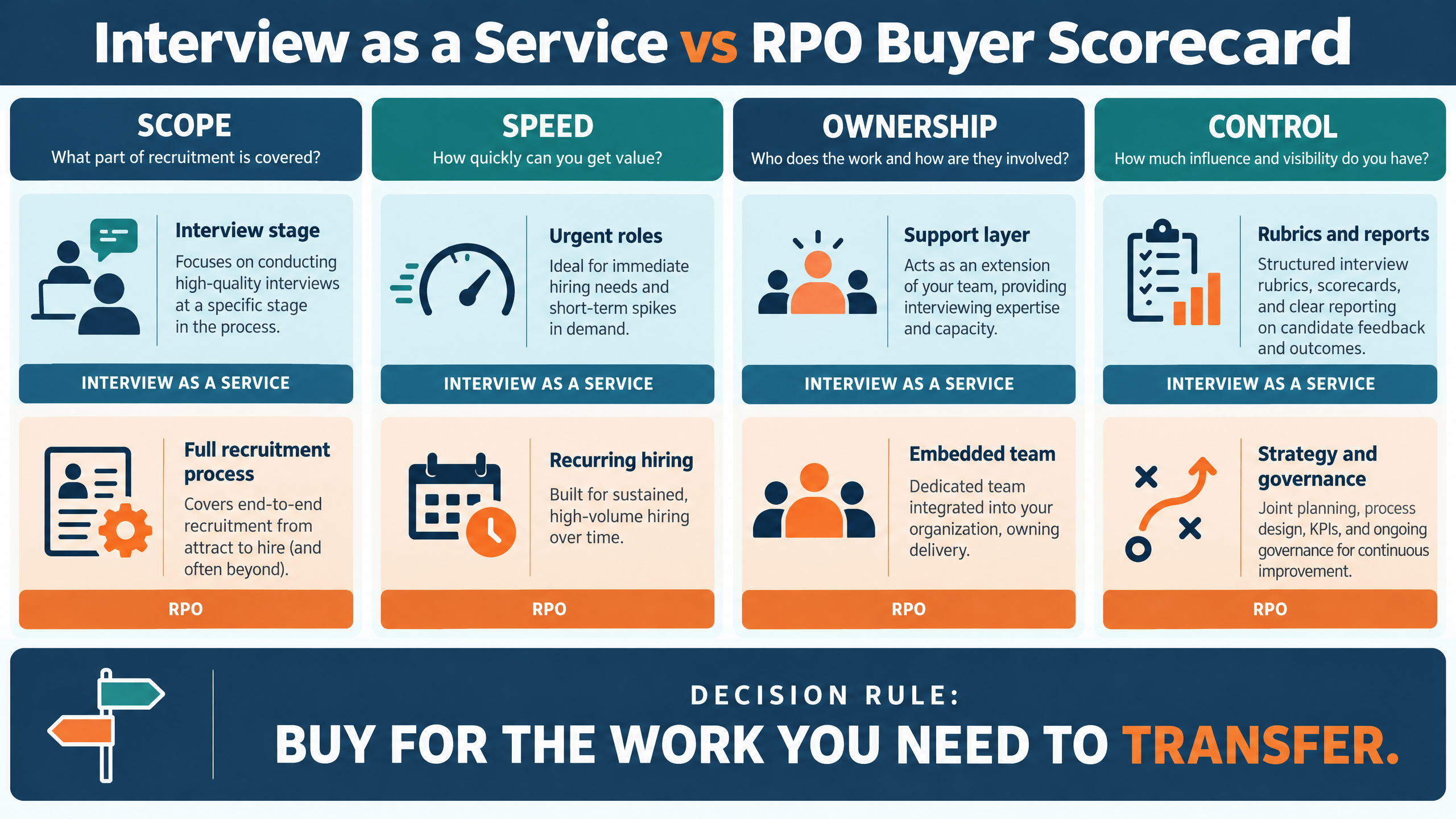
Interview as a service vs RPO buyer scorecard comparing scope, speed, ownership, and control


How futuremug fits the decision

futuremug’s are relevant when the hiring bottleneck is interview capacity, expert coverage, scheduling, structured evaluation, or interview reporting. The published service page describes a pool of expert panels, customizable interviews, 24/7 auto-scheduling, integrated interview tools, structured evaluation, AI-powered insights, multi-channel updates, and a dedicated account-management model.
futuremug also presents multiple delivery options: organizations can outsource interviews, use an interview platform, or explore agentic AI interviews. The right option depends on whether the buyer needs external interviewer capacity, software workflow, AI-assisted screening, or a combination.
For broader campus or high-volume hiring, futuremug’s describes coordination, assessments, interviews, candidate management, employer engagement, and TPO coordination. That can be relevant when the recruitment scope extends beyond interviews.
For the RPO side of the comparison, futuremug’s existing provides the relevant content-hub path. Buyers should confirm the current RPO scope, delivery team, systems, service levels, and contractual responsibilities directly rather than infer them from an interview-services page.
A useful futuremug consultation should clarify:
  • Whether the bottleneck is interview capacity or the full recruitment funnel.
  • Which role families, volumes, and geographies are in scope.
  • Which stages futuremug will own or support.
  • Whether expert panels, platform workflows, AI interviews, or RPO support are appropriate.
  • How candidates, interviewers, recruiters, and hiring managers will be updated.
  • Which reports and quality controls will be provided.
  • How the model will integrate with the existing ATS and TA process.
to compare interview as a service, interview outsourcing, platform-supported interviews, and broader recruitment support.

Buyer checklist

Before selecting a model, answer these questions:
  • What exact stage is slowing hiring?
  • Is the problem temporary, recurring, or strategic?
  • How many roles and candidates are in scope?
  • Which technical or functional expertise is required?
  • Do we need sourcing and screening support?
  • Who owns the candidate relationship?
  • Who owns the ATS record and workflow status?
  • Which decisions must remain internal?
  • What candidate experience should be delivered?
  • What reports and quality evidence will we review?
  • What integrations and permissions are required?
  • How will the engagement scale or contract?
  • What is the exit plan if the model does not fit?
A buyer that can answer these questions is more likely to choose the right scope and avoid purchasing a broad solution for a narrow problem—or a narrow service for a broad recruitment challenge.

Frequently Asked Questions

What is the difference between interview as a service vs RPO? ▼

Interview as a service usually provides support for defined interview stages, including interviewers, scheduling, structured evaluation, and reports. RPO can cover part or all of the recruitment function, including sourcing, screening, interviewing, coordination, reporting, and other agreed activities.

Is interview as a service a type of RPO? ▼

It can be included within an RPO engagement, but a standalone interview-as-a-service engagement is not automatically RPO. The distinction depends on the scope, operating ownership, and responsibilities transferred to the provider.

Is RPO more expensive than interview outsourcing? ▼

Not necessarily in every situation, but RPO usually covers more work and therefore has different cost drivers. Compare scope, implementation, internal effort, technology, hiring volume, service levels, and outcomes rather than comparing one unit price.

When should a growing company choose interview as a service? ▼

Choose it when sourcing and screening are working but interviews are delayed, inconsistent, or difficult to staff. It is also useful for specialized skills, technical hiring, global time zones, bulk interviews, or temporary capacity gaps.

When should a company choose RPO? ▼

Choose RPO when the recruitment challenge spans multiple stages or requires an embedded operating partner. RPO can be suitable for recurring hiring, new-market expansion, project recruitment, and overloaded TA teams.

Can interview outsourcing and RPO be used together? ▼

Yes. A company may use RPO for sourcing, screening, and coordination while using specialist interview support for technical or functional rounds. The parties should define handoffs, candidate ownership, data synchronization, reporting, and escalation.

Does interview as a service include hiring decisions? ▼

Usually it provides evaluation evidence and recommendations against an agreed rubric. The buyer normally retains responsibility for the final hiring decision unless the engagement explicitly states otherwise.

Does RPO replace an internal TA team? ▼

RPO may supplement, extend, or manage agreed parts of an internal TA function. It does not have to replace the whole team. The operating model should state what remains with internal recruiters, hiring managers, HR, and the external provider.

What should procurement ask before signing? ▼

Procurement should ask about scope, service levels, roles, pricing, data protection, systems access, candidate communications, quality review, escalation, reporting, implementation, renewal, exit, and how the scope changes when hiring volume moves up or down.

What is the simplest decision rule? ▼

If the bottleneck is interviews, start with interview as a service. If the bottleneck is recruitment operations, consider RPO. If both are constrained, evaluate a hybrid model with one accountable operating owner.

Leave a Reply

Your email address will not be published.