
How to Scale With Interview as a Service Companies to Reduce Interview Bottlenecks
What are interview as a service companies?
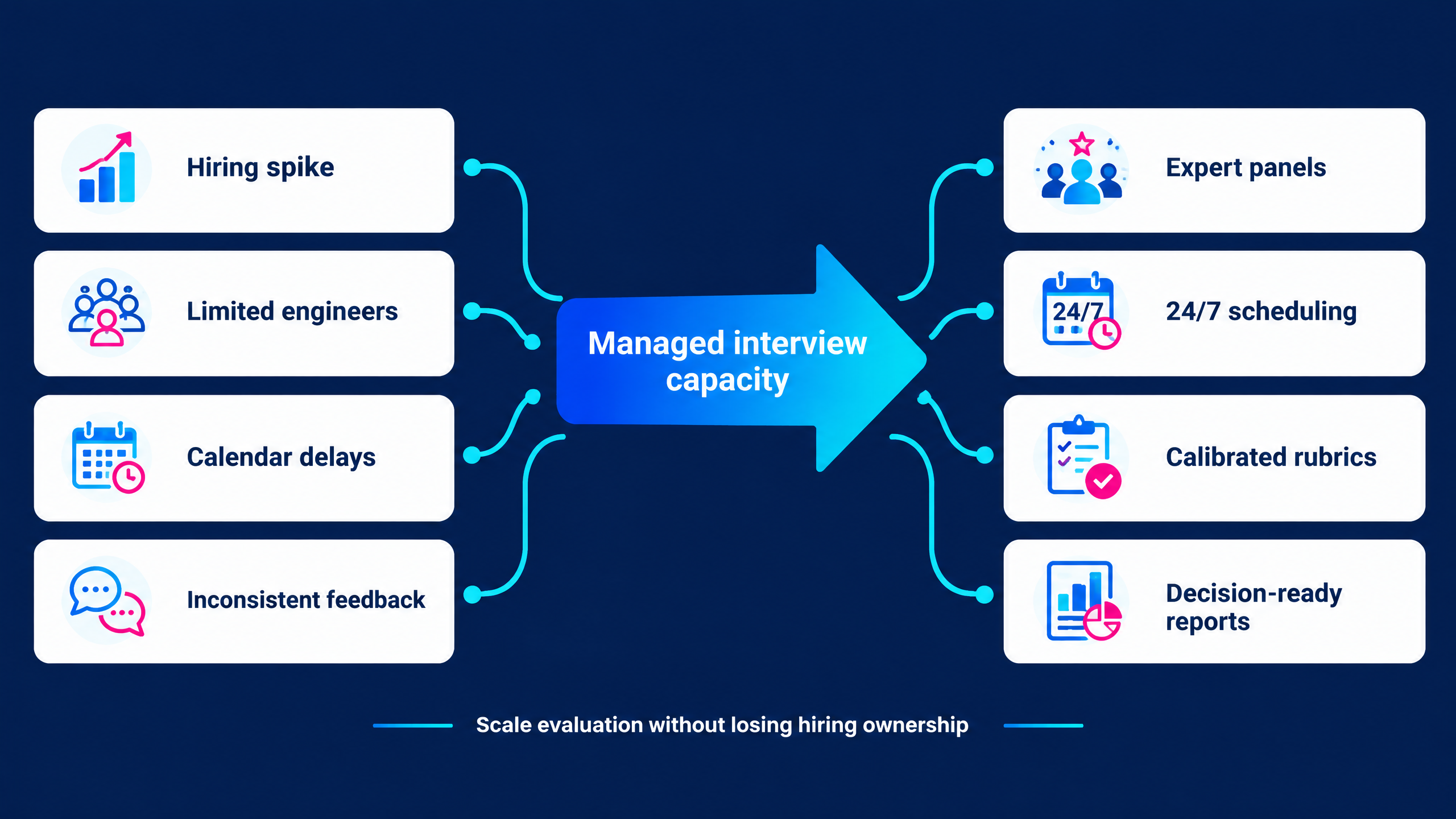
Why interview bottlenecks appear
|
Bottleneck
|
Operational effect
|
Business consequence
|
|
Limited interviewer capacity
|
Candidates wait for an available engineer or specialist.
|
Slower hiring and lost candidate interest.
|
|
Calendar coordination
|
Recruiters exchange repeated emails and messages.
|
More administrative work and rescheduling.
|
|
Inconsistent questions
|
Different candidates receive different levels of difficulty.
|
Difficult comparisons and weaker confidence.
|
|
Delayed feedback
|
Interview notes remain incomplete or scattered.
|
Hiring managers cannot make timely decisions.
|
|
Niche skill coverage
|
The team cannot staff every technology or domain.
|
Specialist candidates move slowly through the funnel.
|
|
Hiring spikes
|
Existing panels cannot absorb sudden volume.
|
Quality drops or time-to-hire increases.
|
|
Distributed teams
|
Time zones and locations complicate scheduling.
|
More no-shows and candidate friction.
|
What an interview as a service workflow includes
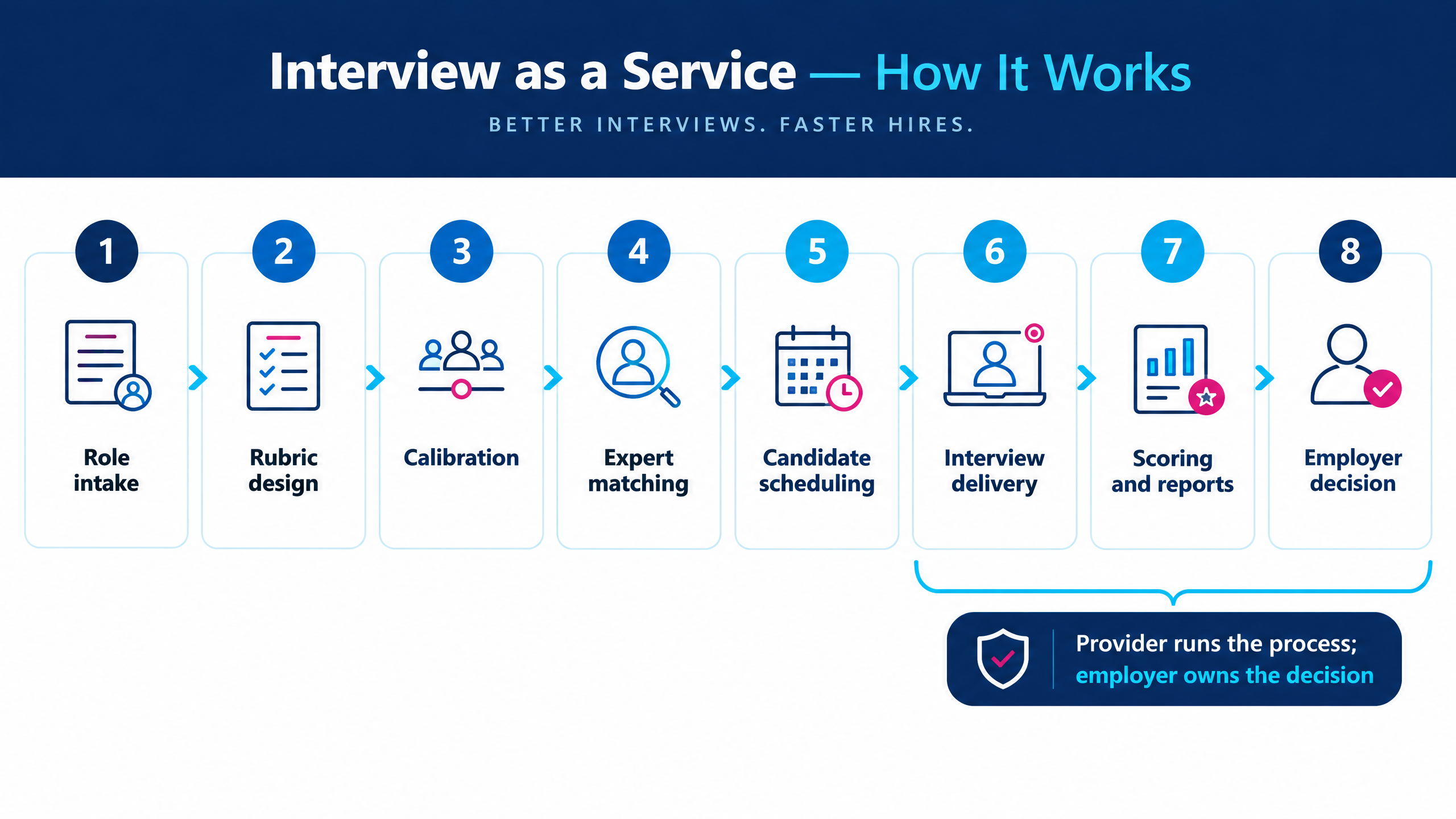
1. Role intake
2. Rubric and interview design
3. Calibration
4. Interviewer or workflow matching
5. Candidate scheduling
6. Interview delivery
7. Scoring and reporting
8. Employer decision
10 capabilities to evaluate
1. Interviewer quality and coverage
2. Role-specific customization
3. Scheduling and turnaround
4. Interview formats
5. Structured evaluation
6. AI and platform capabilities
7. Candidate experience
8. Reporting and integrations
9. Governance and security
10. Commercial flexibility
Interview as a service vs in-house interviewing
|
Consideration
|
In-house interviewing
|
Interview as a service
|
|
Cost at low volume
|
Often efficient when internal capacity is available.
|
May be more expensive per interview at very low volume.
|
|
Speed under load
|
Limited by internal calendars.
|
Adds elastic capacity after calibration.
|
|
Context and culture
|
Strong internal knowledge.
|
Requires careful briefing and role calibration.
|
|
Consistency
|
Depends on interviewer training and discipline.
|
Can be standardized through rubrics and QA.
|
|
Specialist coverage
|
Limited to available employees.
|
Can provide access to external experts.
|
|
Operational effort
|
Owned by recruiting and engineering teams.
|
Shared or managed by the provider.
|
|
Control
|
Direct internal control.
|
Requires clear governance and review paths.
|
|
Best model
|
Context-critical and final decisions.
|
Scalable, repeatable, or overflow rounds.
|
What to outsource and what to keep internal
Good candidates for outsourcing
Usually best kept internal
How to compare interview as a service companies
|
Evaluation area
|
Questions to ask
|
Suggested weight
|
|
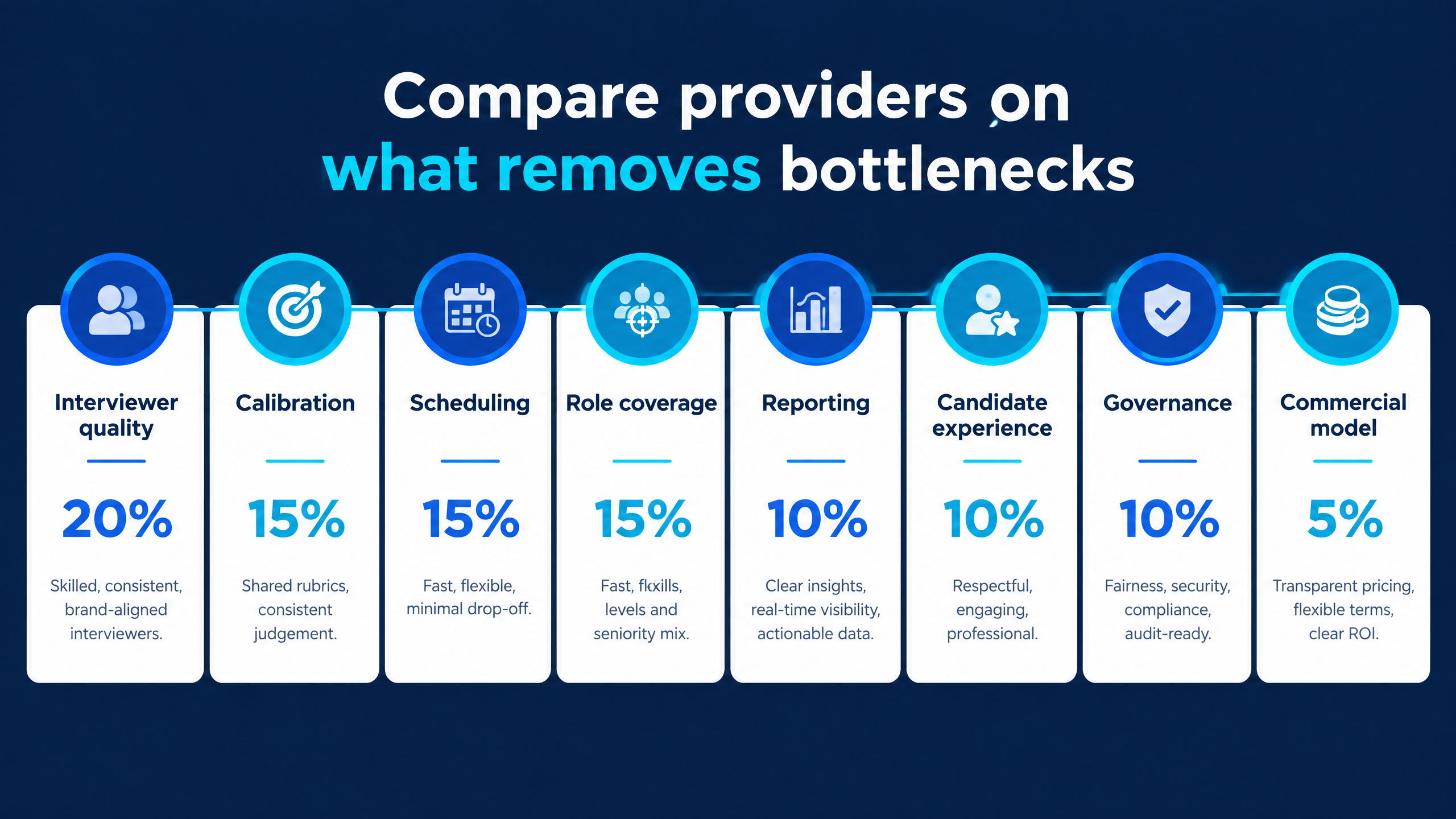
Interviewer network
|
How are experts vetted and matched?
|
20%
|
|
Quality and calibration
|
How is the hiring bar defined and monitored?
|
15%
|
|
Scheduling
|
Can the provider meet peak-volume SLAs?
|
15%
|
|
Role coverage
|
Which technologies, levels, and interview types are supported?
|
15%
|
|
Reporting
|
Are reports evidence-based and decision-ready?
|
10%
|
|
Candidate experience
|
How are instructions, support, accessibility, and escalation handled?
|
10%
|
|
Governance and security
|
Can you audit access, data, AI, and quality controls?
|
10%
|
|
Commercial model
|
Is pricing flexible enough for normal and peak demand?
|
5%
|
How to run a low-risk pilot
Define the pilot scope
Set a baseline
Agree on the rubric
Test the candidate journey
Review reports and recordings
Decide using agreed measures
Governance, fairness, and human oversight
Explore futuremug’s interview solutions
- Review futuremug interview outsourcing services for expert panels, scheduling, customizable interviews, structured reports, AI-enabled evaluation, and managed support.
- Read what is interview as a service for the IaaS workflow and use cases.
- Explore how interview outsourcing works for the kickoff-to-verdict operating model.
- Compare interview as a service versus in-house interviewing across cost, speed, quality, and the hybrid model.
- Review the AI interview platform for software-led screening, scheduling, interviews, coding workflows, transcripts, and reports.
- Explore agentic AI interviews for high-volume AI-assisted workflows.
Request an IaaS consultation or demo



Frequently Asked Questions
Interview as a service companies provide managed interview capacity through expert interviewers, AI workflows, scheduling coordination, structured evaluation, reporting, or a combination of these services. They help organizations scale candidate evaluation without placing every interview on internal engineering and recruiting teams.
No. An interview platform is primarily software for conducting or managing interviews. An interview as a service provider may add expert interviewers, calibration, scheduling, quality assurance, reporting, and operational execution. Some providers offer both models.
Consider it when technical hiring volume is high, interviewer capacity is constrained, scheduling is slow, specialist skills are difficult to cover, hiring spikes are expected, or evaluation quality varies across interviewers.
It should not. A provider may return scores, evidence, reports, or recommendations, but the employer should retain ownership of the hiring standard and final decision.
Yes. Managed interview capacity can support large candidate cohorts, parallel interview slots, standardized rubrics, automated reminders, and consolidated reporting. The model should still include human support for exceptions and candidate concerns.
Quality controls may include interviewer vetting, role matching, calibration, structured rubrics, recording or transcript review where appropriate, quality audits, feedback checks, and escalation for borderline or disputed cases. Ask each provider to explain its controls in detail.
Compare total cost rather than only the per-interview fee. Include internal interviewer hours, scheduling effort, engineering opportunity cost, re-interviews, quality assurance, reporting, platform access, support, and peak-volume requirements.
A pilot should last long enough to test setup, calibration, normal scheduling, exceptions, reporting, and decision cycles. The exact duration depends on volume, but the success criteria should be agreed before the pilot begins.