
A Practical Guide to Campus Hiring Platform for Indian Campus Recruitment Teams
What is a campus hiring platform?

Why campus recruitment teams need a unified platform
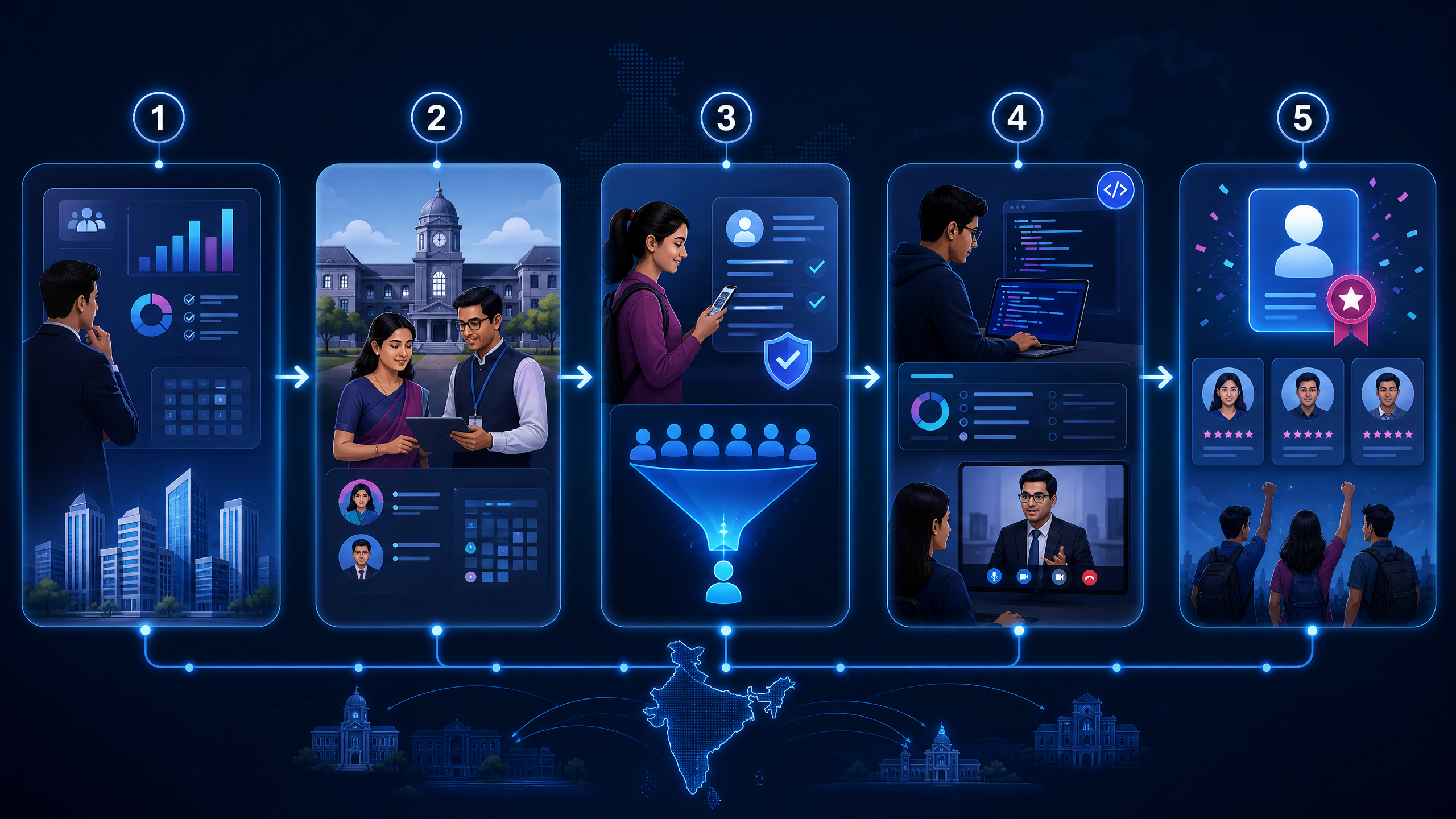
How a campus hiring platform works
|
Stage
|
Employer or placement-team activity
|
Platform outcome
|
|
1. Define the hiring plan
|
Set roles, locations, eligibility, skills, compensation information, hiring targets, and timelines.
|
A structured campaign brief and role configuration.
|
|
2. Build the campus pipeline
|
Identify institutions, contact TPOs, publish opportunities, and manage drive participation.
|
Centralized college, TPO, and campaign records.
|
|
3. Showcase the employer
|
Share the company story, role details, culture, learning opportunities, and selection process.
|
A consistent employer-facing or candidate-facing experience.
|
|
4. Collect applications
|
Register students, import candidate lists, or accept applications through a shareable link.
|
A searchable candidate pool with required information.
|
|
5. Screen and assess
|
Apply eligibility rules and conduct aptitude, technical, coding, or domain assessments.
|
Candidate scores, status updates, and assessment reports.
|
|
6. Conduct interviews
|
Schedule group discussions, video interviews, technical interviews, or expert-led panels.
|
Coordinated interview slots and structured evaluations.
|
|
7. Shortlist and communicate
|
Review results, select candidates, notify students, and share next steps.
|
Clear decision records and candidate communication workflows.
|
|
8. Measure outcomes
|
Compare colleges, roles, stages, conversion rates, and hiring results.
|
Program-level dashboards and actionable reports.
|
Essential features for Indian campus recruitment
Employer branding and campaign pages
College and TPO coordination
Candidate registration and data management
Eligibility filters and AI-assisted screening
Assessments and coding tests
Group discussions and video interviews
Technical interviews and expert panels
Scheduling, reminders, and candidate communication
Reports and decision dashboards
Integrations, access controls, and data governance
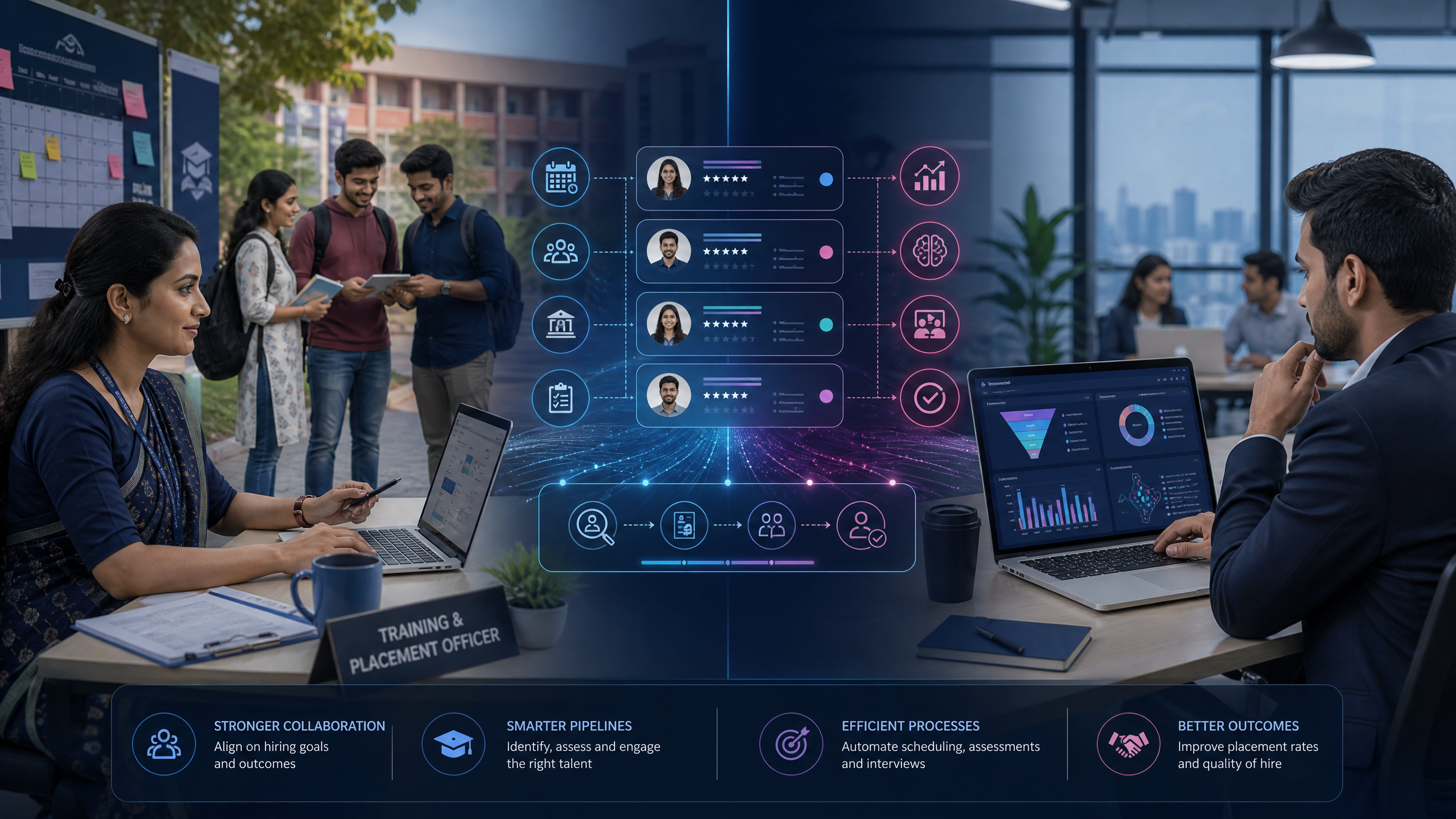
Campus hiring platform for employers
Campus hiring platform for colleges and TPOs
Campus hiring platform vs. spreadsheets, ATS tools, and recruitment agencies
|
Option
|
Strength
|
Limitation for campus hiring
|
|
Spreadsheets and email
|
Low initial cost and familiar to teams.
|
Fragmented records, manual coordination, weak reporting, and high error risk at scale.
|
|
General ATS
|
Useful for requisitions, applications, and hiring workflow.
|
May not provide deep college/TPO coordination or campus-drive operations.
|
|
Assessment software
|
Strong for tests, scoring, and candidate evaluation.
|
Usually does not manage employer branding, college relationships, or the full recruitment funnel.
|
|
Recruitment agency
|
Can provide sourcing and operational support.
|
Less direct process control and potentially less reusable platform visibility.
|
|
Campus hiring platform
|
Connects institutions, candidates, assessments, interviews, communication, and reporting.
|
Requires implementation, process ownership, and platform adoption.
|
|
Platform plus managed services
|
Combines workflow technology with operational and interviewer support.
|
Needs clear scope, service levels, governance, and commercial alignment.
|
How to evaluate a campus hiring platform
|
Evaluation area
|
Questions to ask
|
|
Coverage
|
Can the platform support on-campus, off-campus, internship, graduate, and bulk hiring programs?
|
|
College network
|
How are colleges and TPO relationships managed? Can the team track participation and communication?
|
|
Candidate scale
|
How does the system handle bulk registration, imports, invitations, and concurrent assessments?
|
|
Assessment depth
|
Are aptitude, MCQ, descriptive, coding, proctoring, and AI-assisted evaluation options available?
|
|
Interview operations
|
Can the provider support group discussions, video interviews, expert panels, and technical interview outsourcing?
|
|
Reporting
|
Can recruiters compare candidates, colleges, roles, stages, and outcomes?
|
|
Customization
|
Can teams customize forms, rules, messages, workflows, branding, and evaluation rubrics?
|
|
Security and governance
|
Are access controls, data handling, retention, and integrations clearly documented?
|
|
Support model
|
Is implementation support available for recruiters, students, interviewers, and TPOs?
|
|
Commercial model
|
Is pricing based on users, candidates, assessments, campaigns, services, or a combination?
|
Why futuremug for campus hiring?
Implementation plan for a campus hiring program
Phase 1: Map the current process
Phase 2: Define the target workflow
Phase 3: Configure and pilot
Phase 4: Measure and improve
Request a campus hiring platform demo



Frequently Asked Questions
The best platform is the one that fits the employer’s hiring model, college coverage, candidate volume, evaluation process, reporting needs, and service expectations. During evaluation, compare the full workflow rather than selecting based only on an assessment module or an attractive dashboard.
Yes. A well-designed platform should provide employer tools for campaign planning and evaluation, while also supporting college and TPO coordination, student registration, communication, eligibility, and drive status.
Many platforms support technical assessments, coding tests, structured interviews, and expert-led panels. Confirm the supported languages, question formats, evaluation rules, proctoring controls, interviewer expertise, and reporting depth before purchase.
Yes. The same workflow can support off-campus campaigns, graduate hiring, referral campaigns, pooled hiring, and other high-volume entry-level recruitment programs. The key requirement is flexible candidate intake and campaign management.
That depends on the platform model. Ask whether TPOs can access relevant employer opportunities, manage student participation, communicate updates, and track drive-level status without seeing information that should remain restricted.
Choose software when your team can own college coordination, candidate operations, assessments, interviews, and reporting. Choose managed services when you need additional operational capacity, interviewer support, or campaign execution. A blended model may be the most practical for peak hiring seasons.
Implementation time depends on the number of roles, colleges, workflows, integrations, data requirements, and services included. A focused pilot can usually begin sooner than a multi-region, multi-role rollout. Ask vendors for a phased implementation plan tied to your recruitment calendar.