
Resume-to-JD Matching: Common Screening Mistakes and How to Avoid Them
Resume to job description matching: the short answer
- What does the job require?
- What evidence does the resume provide?
- What evidence is still missing or uncertain?
- What should the next stage verify?
Why screening mistakes happen
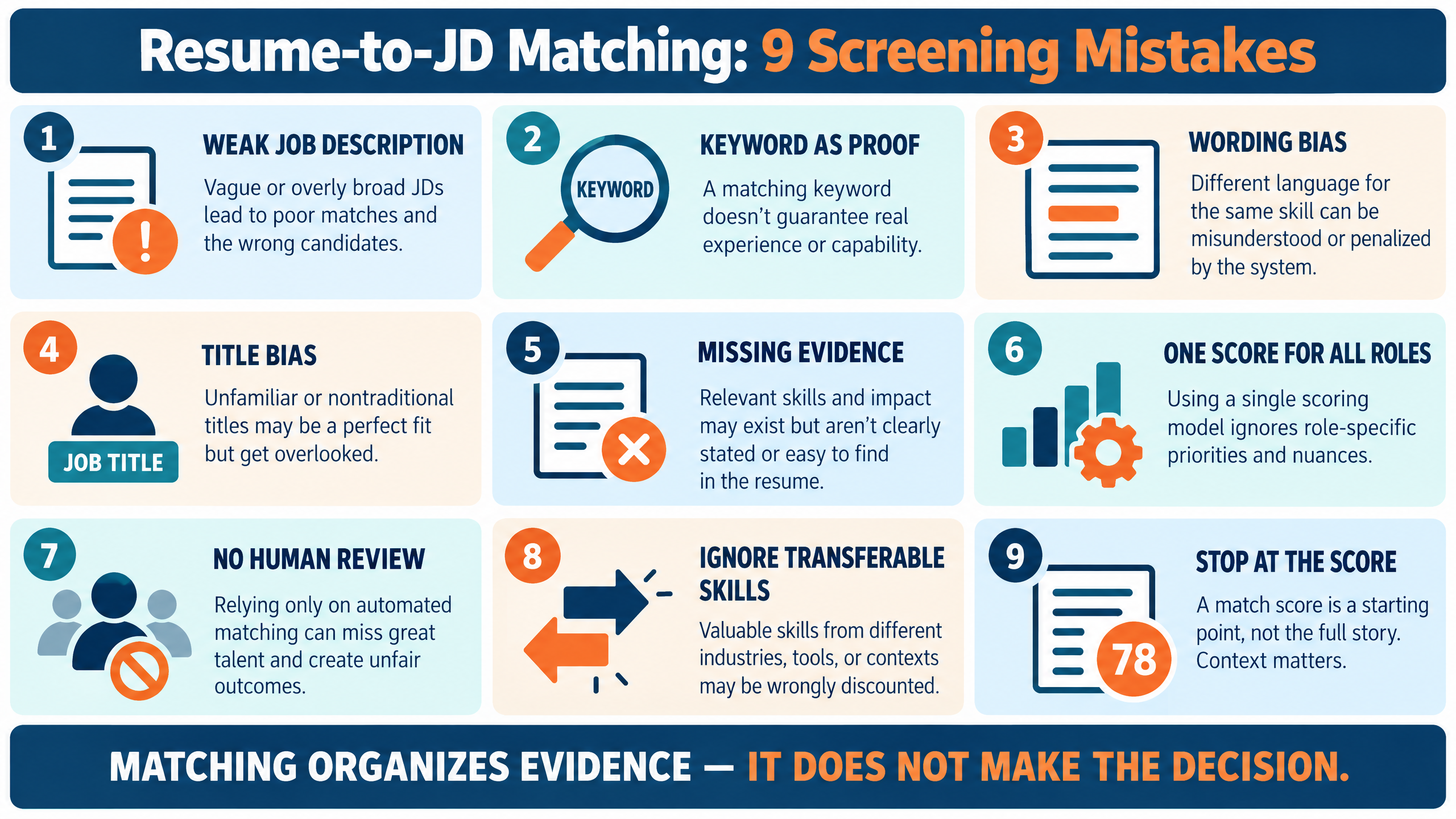
9 common resume-to-JD matching mistakes
1. Starting with a weak job description
How to avoid it
- Essential capabilities.
- Trainable or preferred capabilities.
- Minimum experience evidence.
- Role outcomes.
- Context-specific requirements.
- Requirements that should not influence selection.
2. Treating keywords as proof of skill
How to avoid it
|
Evidence type
|
What it can suggest
|
What it cannot prove alone
|
|
Skill keyword
|
Possible exposure.
|
Depth or independent proficiency.
|
|
Project description
|
Application in a context.
|
Quality or ownership without detail.
|
|
Outcome or metric
|
Potential impact.
|
Causation or repeatability.
|
|
Role history
|
Relevant environment.
|
The exact responsibilities performed.
|
|
Certification
|
Completed learning or exam.
|
Job-ready performance in context.
|
|
Assessment result
|
Demonstrated task performance.
|
Full job fit or future success.
|
3. Penalizing different wording
How to avoid it
4. Overweighting job titles and employers
How to avoid it
5. Confusing missing evidence with missing ability
How to avoid it
- Supported: the resume contains relevant evidence.
- Unclear: the resume does not provide enough evidence.
- Contradicted: the available information conflicts with the requirement.
6. Applying one score to every role
How to avoid it
7. Screening without a human review path
How to avoid it
- A score near the shortlist threshold.
- Strong evidence with a non-traditional title.
- A career break or transition.
- Transferable skills from an adjacent domain.
- A possible parsing or data-quality issue.
- A candidate question or appeal.
- A conflict between resume evidence and another assessment.
8. Ignoring career context and transferable skills
How to avoid it
- Required domain knowledge.
- Tool-specific experience.
- General problem-solving capability.
- Communication and collaboration.
- Learning ability.
- Evidence that can be verified quickly.
9. Stopping at the match score
How to avoid it
- Advance to a skills assessment.
- Ask a targeted recruiter question.
- Review the profile with the hiring manager.
- Request a work sample.
- Route to a structured interview.
- Hold for a second reviewer.
- Reject with an approved, role-related reason.
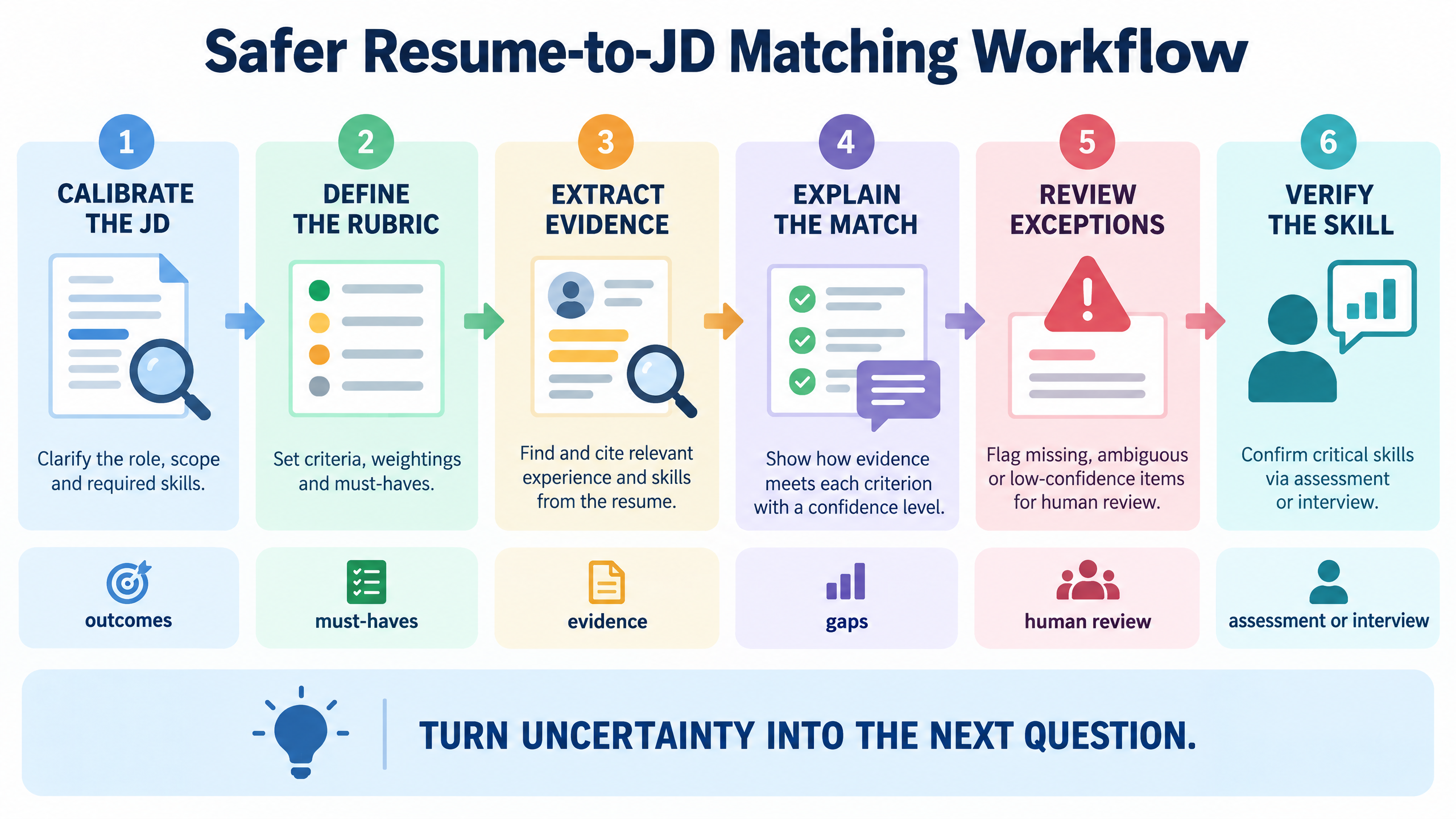
A safer resume-to-JD matching workflow
Step 1: Calibrate the job description
Step 2: Build the matching rubric
Step 3: Parse and normalize candidate evidence
Step 4: Generate a match explanation
Step 5: Review threshold and exception cases
Step 6: Verify the highest-risk assumptions
Step 7: Measure outcomes
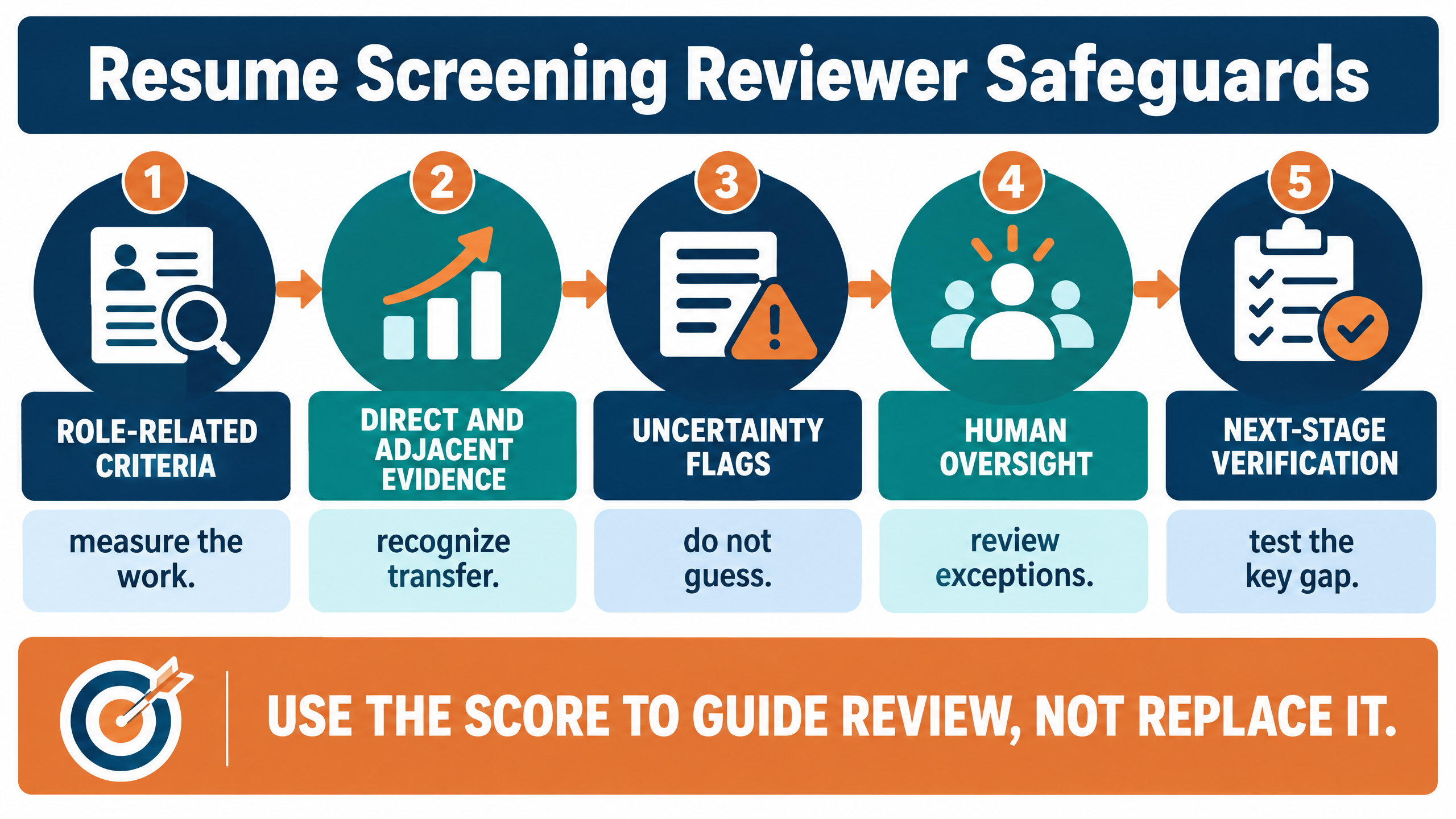
How to create a consistent shortlisting rubric
|
Category
|
Suggested question
|
Possible output
|
|
Essential capability
|
Does the resume show evidence of the core work?
|
Supported, unclear, or contradicted.
|
|
Relevant experience
|
Has the candidate performed related responsibilities?
|
Direct, adjacent, or not shown.
|
|
Outcome evidence
|
Are results, scope, or ownership described?
|
Strong, limited, or absent.
|
|
Transferability
|
Could the candidate’s skills transfer with reasonable support?
|
High, possible, or low.
|
|
Verification need
|
What must the next stage test?
|
Skill assessment, screen, or interview.
|
|
Decision
|
What is the next action?
|
Advance, review, hold, or reject.
|
Example: software engineering role
- Core programming evidence.
- Debugging or production troubleshooting.
- Relevant system or application context.
- Code ownership and delivery outcomes.
- Communication and collaboration.
- Skills that can be tested in a coding assessment.
Example: customer success role
- Customer communication.
- Account or workflow ownership.
- Problem-solving and escalation.
- Retention, adoption, or service outcomes.
- Product or domain learning.
- Skills that can be tested in a scenario exercise.
How futuremug can support resume and JD screening
- Matched skills and evidence excerpts.
- Missing or uncertain requirements.
- Skill-gap explanations.
- Role-specific scoring criteria.
- Threshold and exception controls.
- Human review and override history.
- ATS or export workflow.
- Data privacy and retention details.



Frequently Asked Questions
Resume to job description matching compares the skills, experience, responsibilities, and evidence in a resume with the requirements of a job description. It helps recruiters organize screening, but it should not be treated as a complete hiring decision.
No. A useful process can consider related skills, responsibilities, outcomes, domain relevance, dates, experience context, and transferable evidence. Keyword overlap is only one signal and can create false positives or false negatives when used alone.
A common mistake is treating the match score as proof of job fit. The score should lead to a review or verification step. It should not replace a role-specific rubric, human review, skills assessment, or structured interview.
Use a controlled skills vocabulary and map relevant synonyms or related concepts. Then review the underlying responsibilities and outcomes. Candidates should not be penalized simply because their resume uses different terminology from the job description.
No. The criteria should reflect the work. Engineering, sales, operations, customer success, and graduate roles require different evidence. Define must-have capabilities and verification steps for each role family.
AI does not automatically remove bias. It can standardize a process, but it may reproduce weak job requirements, biased historical data, or proxy signals. Use job-related criteria, transparent explanations, human review, exception handling, and outcome monitoring.
Route it to a defined human-review path. Check the evidence, consider transferable skills, identify the uncertainty, and choose a targeted next step such as a recruiter screen, skills assessment, or structured interview.
Track shortlist progression, assessment and interview outcomes, false negatives, false positives, reviewer agreement, time saved, candidate feedback, and the quality of the evidence shown to reviewers. Review results by role and hiring stage.
futuremug’s resume-to-JD matching page describes ATS integration and bulk resume workflows. Confirm the current integration method, fields, permissions, data retention, and export behavior for your ATS before procurement.
futuremug’s product page presents an AI resume-to-JD matching solution with automated sorting, candidate scoring, skill-gap insights, bulk screening, recruiter dashboards, and shortlisting support. Request a demo using a representative role and resume set.