
Interview as a Service: How to Choose the Right Platform in India
What is an interview as a service platform?
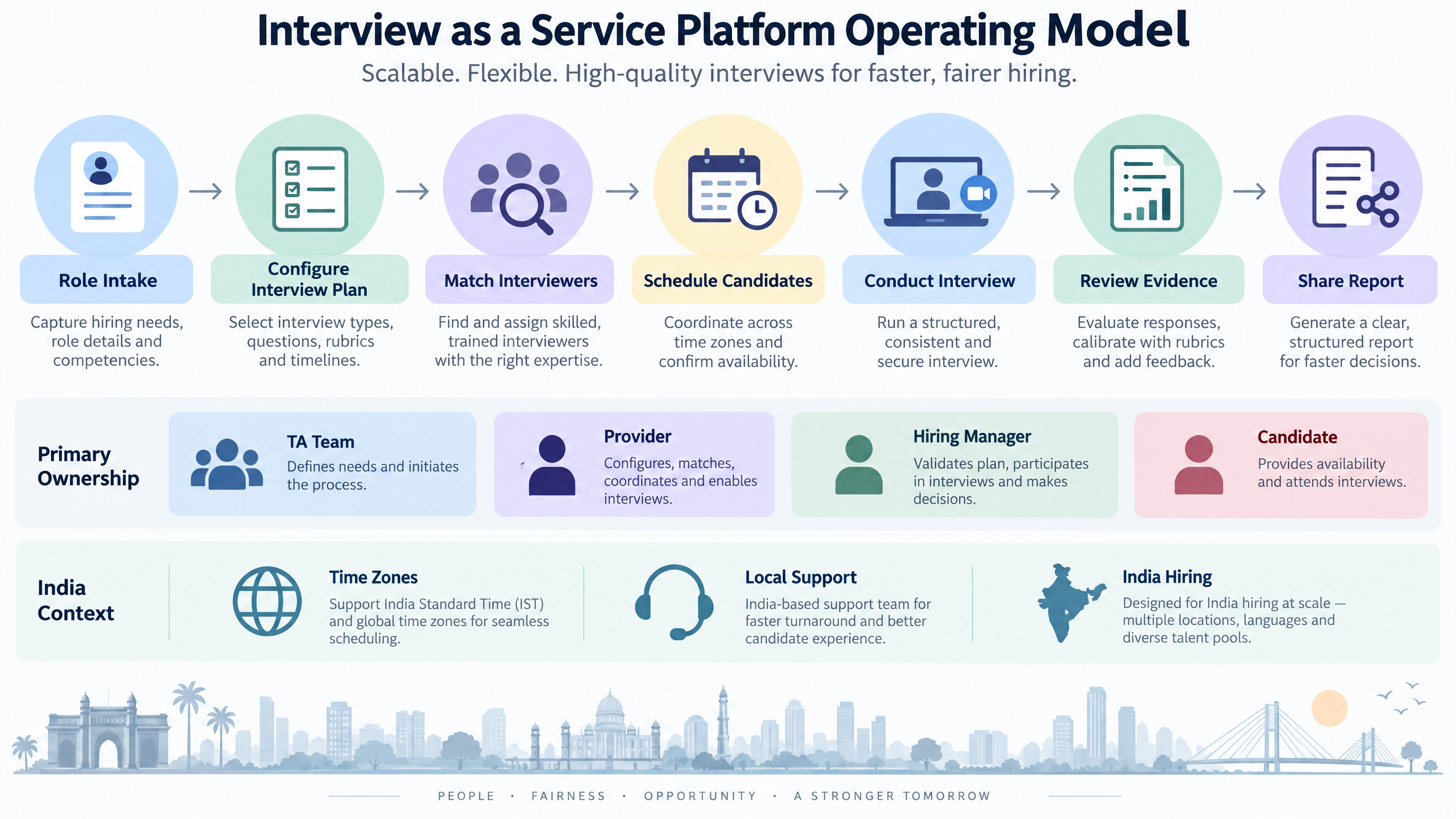
An interview as a service platform combines a digital interview workflow with interview delivery or coordination support. Depending on the provider, it may help a hiring team define an interview plan, select interviewers, schedule candidates, conduct technical or functional interviews, capture structured feedback, and review reports.
The phrase can describe several buying models:
- Software platform: Your own recruiters and interviewers use the technology to schedule, conduct, record, score, and report interviews.
- Interview outsourcing service: An external provider supplies interviewers or panels and manages agreed interview operations.
- Managed platform service: The provider supplies the platform plus coordination, interviewer matching, quality checks, reports, and account support.
- AI-assisted interview workflow: AI supports screening, question generation, transcripts, summaries, or next-step automation within defined controls.
- Hybrid hiring model: Internal teams retain decision ownership while external experts and platform workflows add capacity.
This distinction matters because two vendors can use the words “interview platform” while offering very different operating models. One may sell meeting software. Another may provide vetted technical interviewers, scheduling, rubrics, reports, and account management.
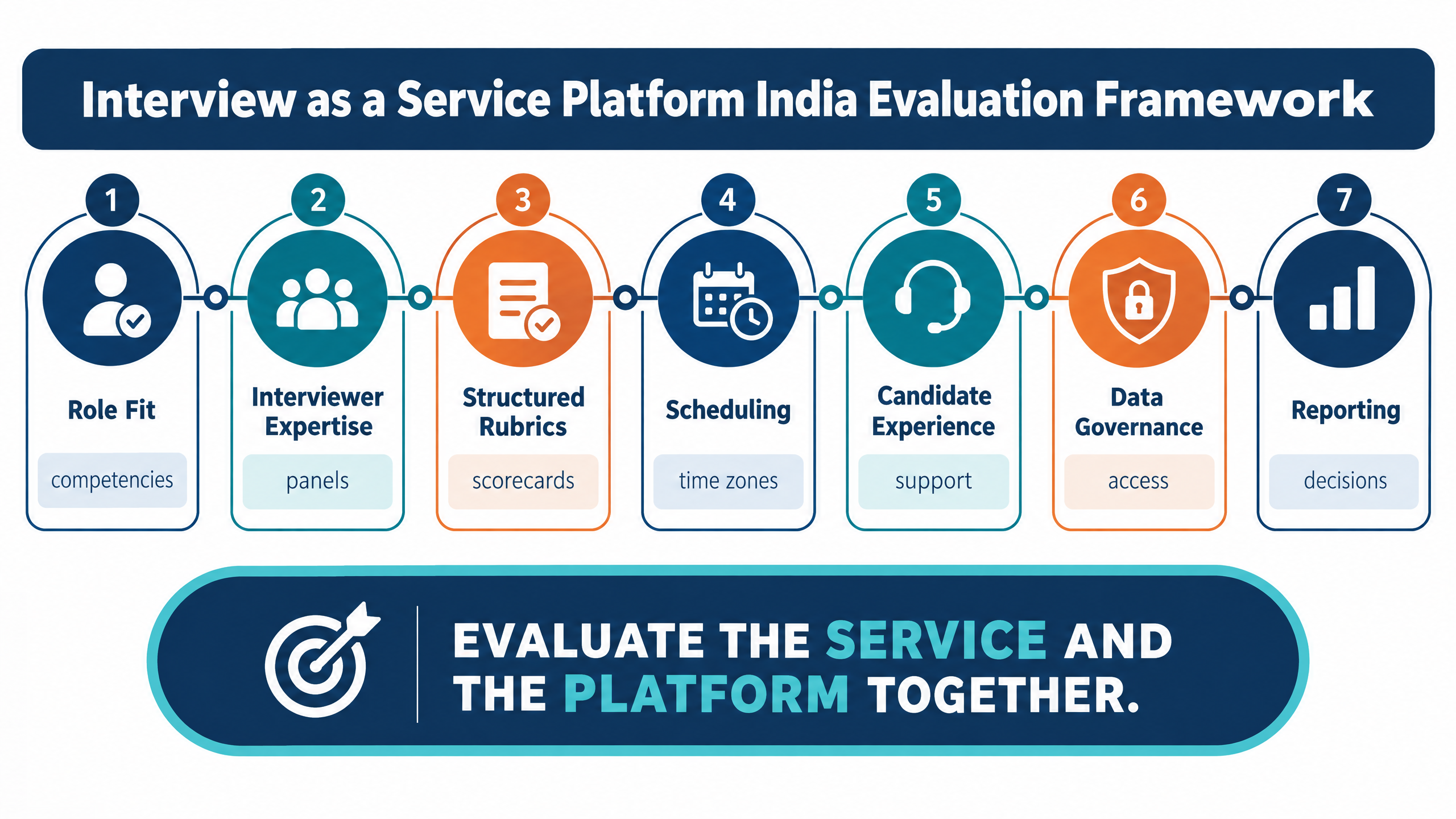
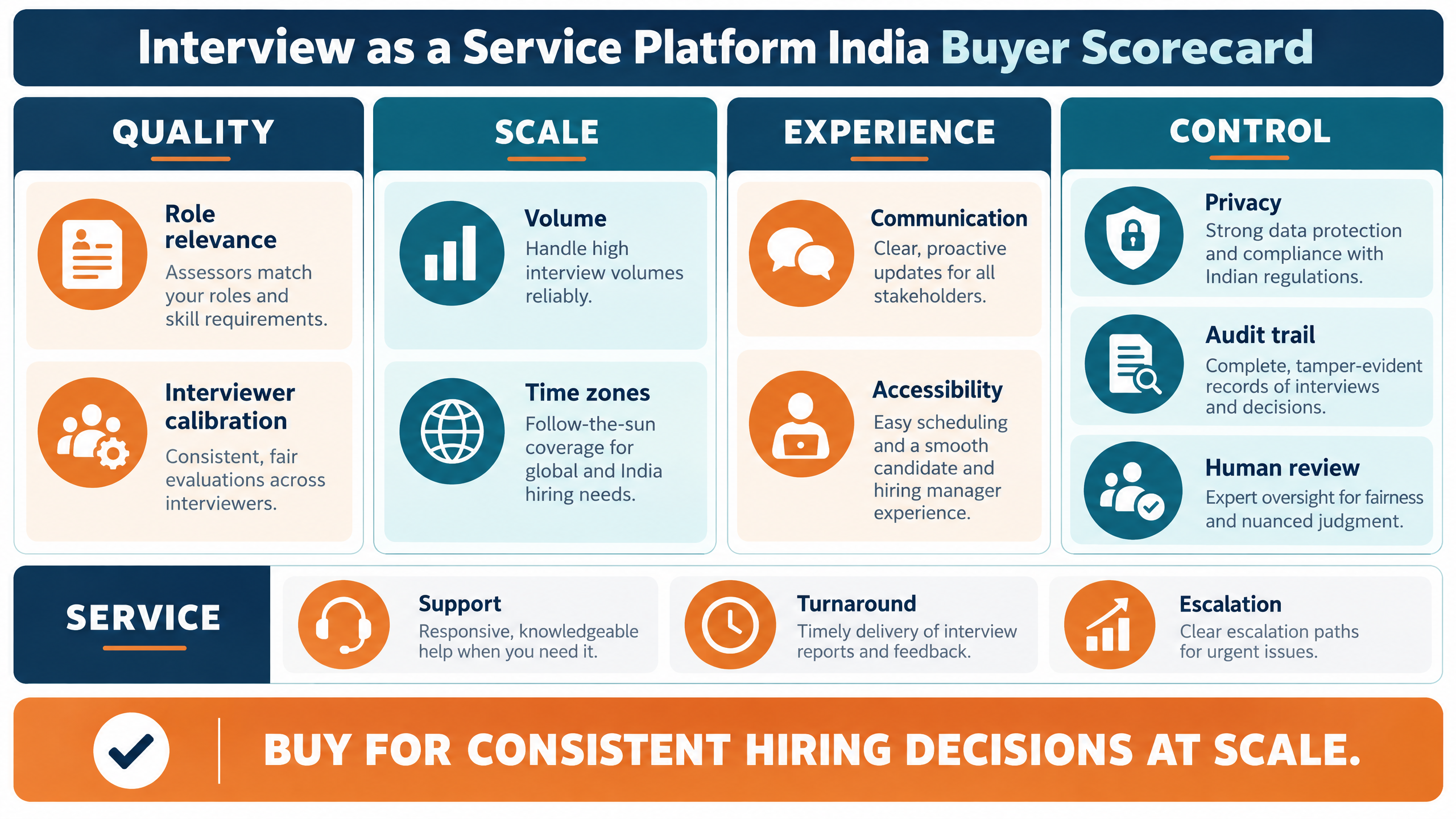
A buyer should therefore evaluate the service and the platform together. The software must work for recruiters, interviewers, hiring managers, and candidates. The service must deliver relevant expertise, consistent evaluation, dependable coordination, and usable evidence.
futuremug’s AI interview platform describes automated scheduling, video interviews, live coding, a question library, interviewer dashboards, centralized reporting, transcripts, summaries, personalized reports, and candidate management. Its interview outsourcing services describe expert panels, customizable interviews, structured evaluations, auto-scheduling, interview reports, and the option to outsource interviews or use a platform.
Platform, service, or RPO: what are you actually buying?
Before comparing vendors, decide which problem you want to solve.
A platform is a technology layer
A software platform helps your team run interviews. It may provide scheduling, video, coding, question banks, scorecards, dashboards, candidate records, reports, integrations, and workflow automation.
You still need interviewers, role expertise, quality calibration, candidate support, and internal process ownership. A platform can make those activities easier to manage, but it does not automatically create a reliable interviewer network or a complete hiring process.
Interview as a service adds delivery capacity
Interview as a service adds external experts, panel coordination, interview operations, structured feedback, or managed execution. It is useful when your organization has a candidate pipeline but lacks the time, skills, coverage, or consistency to conduct interviews internally.
The provider may operate the platform on your behalf or give your team access to the platform. The statement of work should clarify which activities are included.
RPO transfers broader recruitment work
Recruitment process outsourcing can cover part or all of the recruitment function. Depending on the engagement, an RPO partner may support sourcing, screening, assessment, scheduling, interviewing, reporting, candidate communication, and other agreed recruitment operations.
RPO is a broader operating model than an interview platform. The existing futuremug article on recruitment process outsourcing provides a separate RPO content path. This guide focuses on evaluating interview platforms without duplicating a full RPO comparison.
Why the distinction affects procurement
A platform-only purchase may have a lower visible price but require more internal interviewer and operations effort. A managed service may cost more per interview but reduce coordination and increase access to expertise. An RPO engagement may transfer more work and require deeper integration, governance, and transition planning.
Compare the work you are transferring, not only the software features or price per candidate.
Interview as a service platform comparison matrix
|
Evaluation dimension
|
Platform-only model
|
Managed interview as a service platform
|
RPO or broader recruitment partner
|
|
Primary value
|
Interview workflow technology.
|
Technology plus interview delivery and operational support.
|
Broader recruitment capacity and process ownership.
|
|
Interviewer access
|
Buyer supplies interviewers.
|
Provider may supply expert interviewers or panels.
|
Provider may coordinate recruiters and interviewers as part of the recruitment process.
|
|
Scheduling
|
Internal team manages setup or uses automation.
|
Provider may manage scheduling, reminders, cancellations, and time zones.
|
Scheduling is one part of a wider recruitment workflow.
|
|
Evaluation
|
Internal interviewers apply the rubric.
|
Provider helps deliver structured interviews and reports.
|
Evaluation is integrated with sourcing, screening, and recruitment operations.
|
|
Best for
|
Teams with interviewer capacity that need better workflow.
|
Teams with interview bottlenecks, specialist roles, or high volume.
|
Teams that need broader sourcing, screening, coordination, and hiring support.
|
|
Implementation effort
|
Configure the tool and train users.
|
Configure the tool, brief the provider, and align quality controls.
|
Map the recruitment process, systems, roles, governance, and transition.
|
|
Control
|
Highest direct control, highest internal workload.
|
Shared control with defined service responsibilities.
|
Shared or transferred control across a broader scope.
|
|
Typical reports
|
Interview status, scorecards, notes, recordings, or analytics.
|
Structured evaluation reports, quality checks, and delivery metrics.
|
Funnel, pipeline, source, time-to-fill, candidate, and hiring outcomes.
|
|
Main procurement question
|
Will our team use the software consistently?
|
Can the provider deliver quality interviews at the required scale?
|
Can the partner run the agreed recruitment operation?
|
|
Main risk
|
Buying software without solving interviewer capacity.
|
Unclear responsibility between buyer and provider.
|
Transferring broad scope without governance or internal ownership.
|
This matrix is not a substitute for a statement of work. Ask the provider to map each requirement to a product capability, service activity, owner, service level, and evidence of completion.
10 criteria for choosing an interview as a service platform in India
1. Role and competency fit
The platform should support the roles you actually hire. Review the provider’s coverage across technical domains, functional skills, job levels, languages, locations, and interview formats.
A general interviewer pool is not enough for specialized hiring. Ask how interviewers are selected, verified, briefed, calibrated, and monitored. If the provider cannot explain how a panel is matched to your role and level, the platform may be solving availability rather than evaluation quality.
Define the competencies before you compare vendors. A platform should let you connect questions and scorecards to role-relevant evidence.
2. Interviewer quality and calibration
The interviewer is part of the product. A polished dashboard cannot compensate for an interviewer who asks irrelevant questions, gives incomplete feedback, or applies an inconsistent standard.
Ask about:
- Interviewer screening and verification.
- Technical or functional domain coverage.
- Experience by role and seniority.
- Briefing before the interview.
- Scorecard and rubric training.
- Calibration across interviewers.
- Quality audits and reviewer feedback.
- Replacement and escalation when a panel is not suitable.
If your internal team supplies interviewers, ask how the platform helps them prepare, score, review evidence, and improve calibration.
3. Structured interview design
The platform should support a clear interview plan. Each round should have a purpose, competency coverage, question set, evidence expectation, time limit, and decision rule.
A structured interview does not have to be identical for every candidate. It should be consistent enough to support fair comparison while allowing reasonable follow-up and clarification.
Ask to see how the provider handles:
- Role-specific question plans.
- Technical and behavioral competencies.
- Follow-up questions.
- Coding or practical exercises.
- Score anchors.
- Required evidence.
- Red flags and escalation.
- Multiple interview rounds.
Avoid vague criteria such as “culture fit” unless the organization has defined job-related behaviors that can be explained and reviewed.
4. Scheduling and India operating coverage
Scheduling often creates the first visible bottleneck. Evaluate how the platform handles candidate invitations, interviewer availability, time zones, reminders, cancellations, rescheduling, no-shows, and last-minute changes.
For Indian hiring teams, ask about:
- Support for India Standard Time and global time zones.
- Candidate communication through email, SMS, WhatsApp, or other approved channels.
- Working-hour coverage and escalation.
- Support during campus or bulk hiring campaigns.
- Candidate access from common devices and browsers.
- Interviewer availability across cities and regions.
- Scheduling turnaround by role and volume.
futuremug’s public interview-outsourcing page describes 24/7 auto-scheduling, multi-channel updates, and a dedicated account-management model. Confirm current service levels and channel availability for your specific engagement.
5. Candidate experience and accessibility
The candidate should understand what the interview is for, how long it will take, what technology is required, how the output will be used, and where to get help.
Evaluate the complete candidate journey:
- Invitation and instructions.
- Login or secure-link access.
- Consent and recording notices.
- Device and browser compatibility.
- Video, audio, coding, or whiteboard experience.
- Rescheduling and recovery.
- Accessibility and accommodation support.
- Status updates and next steps.
- Candidate questions and complaints.
The W3C Web Content Accessibility Guidelines 2.2 provides recommendations for accessible web content . A vendor’s general accessibility statement is not a substitute for testing the actual interview workflow with your candidate population.
6. Reports and evidence quality
The output should help a recruiter or hiring manager make a decision. A single score without supporting evidence is difficult to trust and difficult to audit.
Review whether reports include:
- Competency-level scores.
- Evidence or examples from the response.
- Strengths and development areas.
- Technical results or code where relevant.
- Interviewer notes.
- Candidate questions or clarifications.
- Confidence or completeness indicators.
- Reviewer comments and overrides.
- Recordings or transcripts where permitted.
- A clear recommendation and its limitations.
futuremug’s AI interview platform page describes centralized dashboards, AI-generated transcripts and summaries, personalized reports, live coding results, candidate data, and interview-status notifications. Ask to see a sample report for your role rather than relying on a generic product screenshot.
7. Integrations and data flow
An interview platform should fit the hiring systems your team already uses. Common connections include the ATS, recruiting CRM, calendar, communication tools, assessment platform, identity provider, analytics system, and hiring-manager workspace.
Map the data flow before procurement:
|
Data or event
|
Buyer question
|
|
Candidate profile
|
Which system is the source of truth?
|
|
Job description
|
Who approves the role and competency framework?
|
|
Invitation
|
How is the interview status synchronized?
|
|
Scheduling
|
What happens after rescheduling or cancellation?
|
|
Recording and transcript
|
Where are they stored and who can access them?
|
|
Scorecard
|
Can the rubric and report return to the ATS?
|
|
Decision
|
Can the hiring manager record an override or next step?
|
|
Audit event
|
Are configuration changes and reviewer actions logged?
|
A platform that requires manual exports for every interview may create more work than it removes. Ask for an integration demonstration using a realistic candidate and job flow.
8. Privacy, security, and governance
Interviews can contain resumes, contact details, recordings, transcripts, code, assessment results, evaluator notes, and hiring decisions. The platform should make data responsibilities visible.
Ask about:
- Data collection and purpose.
- Access controls and role permissions.
- Encryption and secure authentication.
- Storage location and retention.
- Deletion and export processes.
- Subprocessors and vendor access.
- Incident response.
- Audit logs.
- Candidate notices.
- Cross-border transfers where applicable.
- AI model use and data-training policies.
India’s Digital Personal Data Protection Act and related rules may be relevant to how organizations collect and process digital personal data. Obtain legal and privacy guidance for the organization’s actual use case; do not treat a vendor checklist as legal advice.
For AI-supported interviewing, the NIST AI Risk Management Framework provides a voluntary structure for identifying, measuring, managing, and governing AI risks . Ask how human review, overrides, monitoring, and incident handling work in practice.
9. Scale, service levels, and support
A platform that works for ten interviews may not work for a bulk hiring campaign. Evaluate capacity, peak volume, interviewer coverage, candidate support, reporting turnaround, and escalation.
Define service levels for:
- Interviewer matching.
- Scheduling.
- Rescheduling.
- Candidate support.
- Interview completion.
- Feedback submission.
- Report delivery.
- Technical incidents.
- Quality review.
- Account-manager response.
Ask what happens when volume increases unexpectedly. The answer should include capacity planning, prioritization, communication, and a fallback plan.
10. Commercial fit and total cost
Compare the full cost of the model, not only the subscription or per-interview price.
Include:
- Platform or license fees.
- Interviewer or panel fees.
- Setup and configuration.
- Integration work.
- Implementation and training.
- Candidate communication.
- Account management.
- Quality assurance.
- Additional interview rounds.
- Data storage or retention.
- Internal recruiter and hiring-manager time.
- Minimum volume or commitment.
- Scope changes and exit terms.
A lower price may be unattractive if it requires your team to spend more time sourcing interviewers, rescheduling candidates, consolidating feedback, and correcting inconsistent reports.
Use-case examples for Indian hiring teams
Use case 1: A scaling technology company needs technical interview capacity
The company has recruiters and an active candidate pipeline. Engineering managers are overloaded, and candidates wait too long for technical rounds.
An interview as a service platform can provide expert interviewers, role-specific rubrics, scheduling, structured feedback, and reports. The internal team retains sourcing, employer-brand communication, offers, and final decisions.
Use case 2: An Indian company hires across multiple time zones
The company has candidates in India, the United States, Europe, and the Middle East. Internal panels cannot cover every time zone without delaying the process.
Evaluate interviewer availability, scheduling automation, communication channels, local support, rescheduling, and report turnaround. The most important capability may be reliable operations rather than a long feature list.
Use case 3: A campus or bulk-hiring campaign needs standardized interviews
The employer expects a large candidate volume and needs consistent first-level or technical interviews. Internal managers cannot conduct every round.
A managed interview service can combine external panels, structured rubrics, scheduling, reports, and candidate coordination. Connect it to the employer’s assessment and ATS workflow so the interview is not an isolated step.
For broader campus coordination, review futuremug’s campus placement and hiring platform, which describes employer coordination, assessments, interviews, candidate management, and TPO support.
Use case 4: A recruitment agency needs white-label interview operations
A recruitment company may need interview capacity that works within its own client process. Ask about white-label reports, client-specific rubrics, candidate communication, data separation, account permissions, and multi-client workflow management.
Use case 5: A company needs both live interviews and AI-assisted screening
The hiring team wants to automate repeatable first-level screening while reserving expert interviewers for deeper evaluation. Evaluate how AI transcripts, summaries, question generation, or shortlisting insights connect to human review.
Do not treat automated output as a final decision by default. Define how people inspect evidence, handle exceptions, and monitor quality.
Use case 6: A company may later need RPO support
The current problem is interviewing, but the company expects rapid growth and may need sourcing, screening, scheduling, and recruitment operations later.
Select a provider that can explain which services are modular, which integrations are reusable, how scope can expand, and who owns the candidate relationship. Keep today’s interview platform decision separate from a future RPO decision, but do not ignore the transition path.
Questions to ask during a platform demo
Ask the provider to demonstrate one real role from start to finish. A generic dashboard tour is not enough.
Role configuration
- Can we provide a real job description and competency framework?
- How are interview questions selected or generated?
- Can we define scoring anchors and required evidence?
- Can different roles, levels, and rounds have different plans?
Interviewer delivery
- Who conducts the interview?
- How are interviewers matched and verified?
- How are they briefed before the session?
- How are quality and calibration checked?
- What happens when an interviewer cancels or is not suitable?
Candidate workflow
- How does the candidate receive the invitation?
- Can the candidate reschedule?
- What help is available for technical or accessibility issues?
- How are recording, transcript, and data notices presented?
- What happens after the interview?
Reports and decisions
- Can we see the source evidence behind a score?
- Can reviewers override or comment on an evaluation?
- Can the report be customized for our hiring managers?
- Can transcripts, recordings, code, and scorecards be exported or integrated?
- How quickly is the report available?
India and enterprise readiness
- Which India and global time zones are supported?
- What support is available during Indian working hours and bulk drives?
- Which communication channels are available for candidates and interviewers?
- How are access, retention, deletion, and audit requirements handled?
- What integrations are available with our ATS and calendar?
- What service levels apply to scheduling, reports, support, and escalation?
How to run a controlled platform pilot
A pilot should test the complete operating model, not just the user interface.
Select one role family
Choose a role with a stable job description, sufficient candidate volume, clear competencies, and an available internal review group. Avoid starting with the most ambiguous or high-risk use case.
Define a baseline
Record the current interview scheduling time, completion rate, recruiter effort, interviewer hours, report turnaround, candidate feedback, progression rate, and hiring-manager satisfaction.
Test real workflows
Use a real invitation, real scheduling conditions, realistic candidate devices, actual interviewers, and the intended ATS or reporting workflow. Include a cancellation, reschedule, technical failure, and candidate support question.
Review evidence and quality
Sample transcripts, recordings, code, notes, scorecards, and reports. Compare the provider’s output with experienced internal reviewers. Check whether the rubric is applied consistently and whether the report supports a decision.
Set scale criteria
Define what must be true before expansion. Criteria may include scheduling turnaround, completion, report availability, reviewer agreement, candidate experience, support resolution, data controls, and acceptable internal effort.
Decide and document
At the end of the pilot, choose whether to scale, redesign, narrow the scope, or stop. Record what changed and who owns the next iteration.
Platform, interview outsourcing, and RPO decision guide
Use this simple decision logic:
|
If your main need is…
|
Start by evaluating…
|
Why
|
|
Better scheduling and interview workflow for internal panels
|
Platform-only software
|
Your team has interview expertise but needs coordination and reporting.
|
|
More technical or functional interview capacity
|
Interview as a service
|
The bottleneck is access to relevant interviewers.
|
|
Structured reports and consistent external evaluation
|
Managed interview service
|
You need delivery quality as well as software.
|
|
Sourcing, screening, scheduling, interviewing, and ongoing recruitment operations
|
RPO
|
The challenge spans the recruitment funnel.
|
|
AI-assisted screening plus expert interviews
|
Hybrid platform and service
|
Automation handles repeatable steps while people review deeper evidence.
|
|
Campus or high-volume employer coordination
|
Campus hiring or managed recruitment support
|
The process includes institutions, candidates, assessments, interviews, and reporting.
|
The right answer can change as the company grows. Procurement should ask whether the provider supports a controlled expansion without forcing the team to redesign the entire process.
How futuremug fits the evaluation
futuremug’s public AI interview platform describes a self-service interview workflow with automated scheduling, integrated video interviews, real-time coding, a question library, interviewer dashboards, candidate management, centralized reports, transcripts, summaries, personalized reports, and interview-status notifications.
Its interview outsourcing services describe a managed model with expert panels, customizable interviews, 24/7 auto-scheduling, structured evaluation tools, AI-powered insights, multi-channel updates, reports, and account support. The page also distinguishes between outsourcing interviews, using the futuremug platform, and exploring agentic AI interviews.
For employers that need a wider recruitment operation, use the RPO content path to understand the broader model. Confirm the current service scope, ownership, systems, and commercial terms directly during a consultation.
A futuremug platform evaluation should cover:
- Role and competency configuration.
- Interviewer expertise and calibration.
- Candidate scheduling and support.
- Technical, functional, behavioral, coding, and panel formats.
- Scorecards, transcripts, reports, and evidence.
- ATS and calendar workflow.
- Privacy, security, access, retention, and audit.
- AI-assisted features and human review.
- India and global time-zone support.
- Pilot design, service levels, and expansion path.
Request a futuremug interview as a service platform demo to compare platform-only, managed interview, expert-panel, and broader recruitment-support options.
Buyer checklist
Before shortlisting an interview as a service platform, confirm that you can answer these questions:
- What hiring problem are we solving?
- Do we need software, interviewers, managed coordination, or all three?
- Which roles, levels, locations, and volumes are in scope?
- What competencies must each interview measure?
- Who owns the candidate relationship?
- Who owns the final hiring decision?
- How are interviewers selected and calibrated?
- How are scheduling failures and candidate issues handled?
- What evidence will appear in the final report?
- Which ATS, calendar, communication, and assessment integrations are needed?
- How are recordings, transcripts, code, and scorecards protected?
- What AI features are used, and where does human review occur?
- What service levels apply in India and across global time zones?
- How will success be measured in the pilot?
- How can the engagement scale, narrow, or end?