How to Implement AI Based Interview Platform for a Modern TA Stack

What is an AI based interview platform?

An AI based interview platform uses artificial intelligence to support or conduct defined parts of the interview and candidate-evaluation process. Depending on the product and configuration, it may help with resume-to-job-description matching, interview-question generation, conversational or voice screening, coding interviews, scheduling, transcripts, summaries, structured scoring, reporting, and next-step workflow triggers.
The phrase can describe several operating models:
  1. AI-assisted interviewer: The system helps a human interviewer prepare questions, follow a competency framework, capture notes, or summarize evidence.
  2. Automated first-round interview: The system conducts a defined screening conversation and produces a transcript, summary, or evaluation for review.
  3. AI-enhanced interview platform: The platform combines scheduling, video, coding, question libraries, dashboards, reports, and AI-generated insights.
  4. Agentic interview workflow: The system adapts questions or follow-ups based on a job description, candidate profile, and previous answer while following configured constraints.
  5. Hybrid hiring stack: AI handles repeatable screening and coordination while recruiters, hiring managers, and expert interviewers retain decision responsibility.
An AI based interview platform is not the same as an automated hiring decision. The implementation should make the boundary clear. AI may organize evidence or recommend a next step, but the organization must define how people review evidence, handle exceptions, support candidates, and make final decisions.
futuremug’s describes automated scheduling, video interviews, live coding, a question library, interviewer dashboards, candidate management, AI-generated transcripts and summaries, personalized reports, and interview insights. Its describe context-aware questions, follow-up questioning, transcripts, evaluations, and workflow triggers.
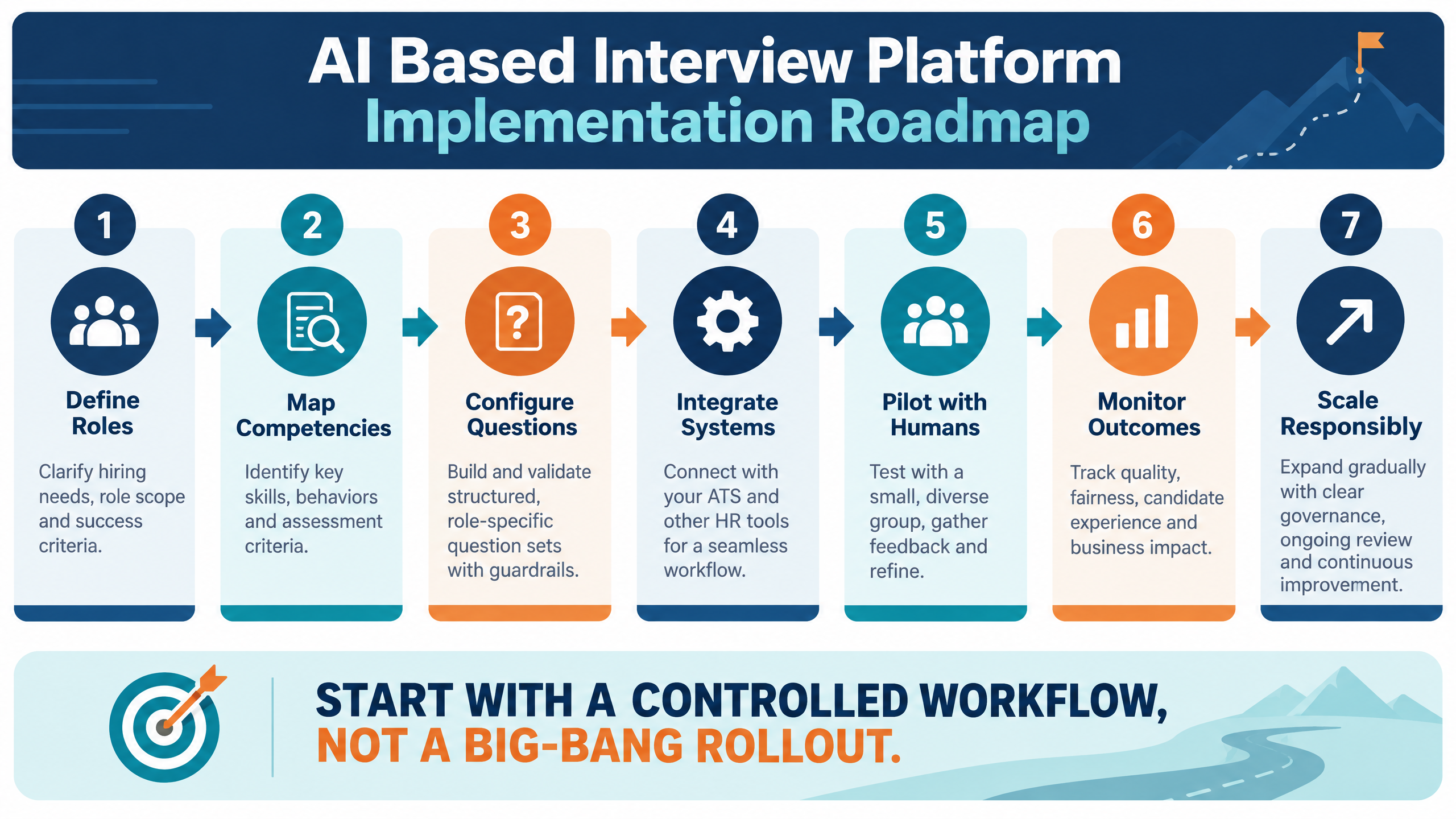
AI based interview platform implementation roadmap showing define roles, map competencies, configure questions, integrate systems, pilot with humans, monitor outcomes, and scale responsibly

Why implementation matters more than the feature list

Buying an AI interview product is only one part of the change. The hiring team still needs to decide which roles are suitable, what evidence matters, how candidates are informed, who reviews outputs, how integrations work, and what happens when the standard process fails.
A product may offer many AI features but produce weak hiring outcomes if the organization has no competency map, unclear decision rights, inconsistent job descriptions, poor data quality, or no human escalation route.
Implementation should answer five operating questions:
  • Purpose: Which hiring problem is the platform solving?
  • Fit: Which roles, stages, and candidate groups are suitable?
  • Evidence: What information should the system collect and present?
  • Governance: Who can review, override, audit, and improve the workflow?
  • Measurement: How will the organization know that hiring quality and candidate experience are improving?
A controlled implementation reduces technical risk and organizational resistance. It also gives HR, engineering, legal, security, and recruiting teams a shared basis for evaluating the system.

10 steps to implement an AI based interview platform

1. Define the hiring problem and implementation boundary

Start with a specific problem rather than an abstract goal such as “use more AI.” The problem may be slow first-round screening, limited interviewer capacity, inconsistent questions, scheduling delays, high volume, fragmented feedback, or a lack of comparable evaluation evidence.
Write the current workflow and identify the stage where the problem occurs. State what the AI based interview platform will do, what it will not do, and which decisions remain with people.
Implementation decision
Example definition
Target stage
First-round technical or behavioral screening.
Candidate group
Applicants for a defined role family and location.
AI responsibility
Ask approved questions, conduct follow-ups within boundaries, and summarize responses.
Human responsibility
Review evidence, handle exceptions, decide progression, and approve changes.
Excluded use
Fully automated final rejection without review.
Success measure
Faster screening with stable quality and acceptable candidate feedback.
A narrow boundary makes the pilot measurable. It also prevents the implementation from quietly expanding into higher-risk decisions before the team has validated the first use case.

2. Choose roles with a clear competency map

AI interview workflows depend on role relevance. Before configuring questions, define the competencies, skills, behaviors, and minimum requirements that matter for the job.
Separate must-have requirements from learnable skills. Describe how a candidate can demonstrate each competency. For a software-engineering role, evidence may include problem decomposition, debugging, coding decisions, communication, and system-design reasoning. For a customer-facing role, evidence may include discovery, structured communication, judgment, and problem resolution.
Avoid using vague traits such as “culture fit” without a clear, job-related definition. Vague criteria make it difficult to create valid questions, calibrate reviewers, or explain decisions.

3. Map the interview plan to evidence

Create an interview plan that connects each question to a competency and an evidence expectation. Decide which questions are asked of every candidate, which follow-ups are allowed, and which signals require human review.
A useful plan includes:
  • Role and level.
  • Competency or skill being evaluated.
  • Core question.
  • Permitted follow-up areas.
  • Expected evidence.
  • Scoring anchors.
  • Disallowed or irrelevant topics.
  • Escalation conditions.
  • Human review requirement.
The platform should support the plan without turning the interview into a rigid script. Consistency is valuable, but candidates may need reasonable opportunities to clarify an answer or explain relevant context.

4. Configure questions, prompts, and scoring rules

Configure the system with approved job descriptions, competency definitions, question libraries, scoring guidance, and candidate instructions. Review AI-generated questions before using them in a live process.
Question generation should be bounded by role relevance. The system should not infer personal characteristics that are unrelated to the job or create questions that invite sensitive information.
Scoring rules should describe evidence, not personality impressions. For example, “explains a debugging approach with clear hypotheses and validation steps” is more useful than “seems analytical.”
Test the same workflow with sample profiles that vary in experience, communication style, career path, language fluency, and background. The objective is to check whether the configured criteria recognize relevant evidence without treating a single communication style as a proxy for ability.

5. Design the candidate experience before launch

Candidates should know that an AI system is involved when that information is relevant to the process and the organization’s policy. Provide the purpose of the interview, expected duration, question format, technology requirements, data and recording information, support route, and next step.
Make the process easy to begin and easy to recover. A candidate may need to reschedule, change a device, resolve a browser issue, request an accommodation, or contact a person. A technically sophisticated interview is not a good experience if the candidate cannot understand what to do.
Use clear language instead of unexplained AI terminology. Candidates should not have to guess whether the system is evaluating technical evidence, communication, background information, or something else.

6. Integrate the platform with the TA stack

Map the candidate and job data that should flow between the AI interview platform and the existing talent acquisition stack. Typical systems may include an applicant tracking system, recruiting CRM, calendar, communication tools, assessment platform, identity provider, analytics environment, and hiring-manager workspace.
Define data ownership before enabling an integration:
Data area
Implementation question
Candidate identity
Which system is the source of truth for name, contact details, and application status?
Job and competency data
Which team approves job descriptions, skills, and interview criteria?
Interview status
How are invited, started, completed, paused, reviewed, and escalated states synchronized?
Recordings and transcripts
Where are they stored, who can access them, and how long are they retained?
Scores and reports
Which outputs are visible to recruiters, interviewers, managers, and candidates?
Workflow actions
Which events can schedule a next round, update the ATS, notify a manager, or send a candidate message?
Audit data
How are changes, overrides, reviewer decisions, and model versions recorded?
Use the minimum data needed for the defined purpose. Integrations should reduce duplicate entry without creating uncontrolled copies of sensitive candidate information.

7. Establish human oversight and exception handling

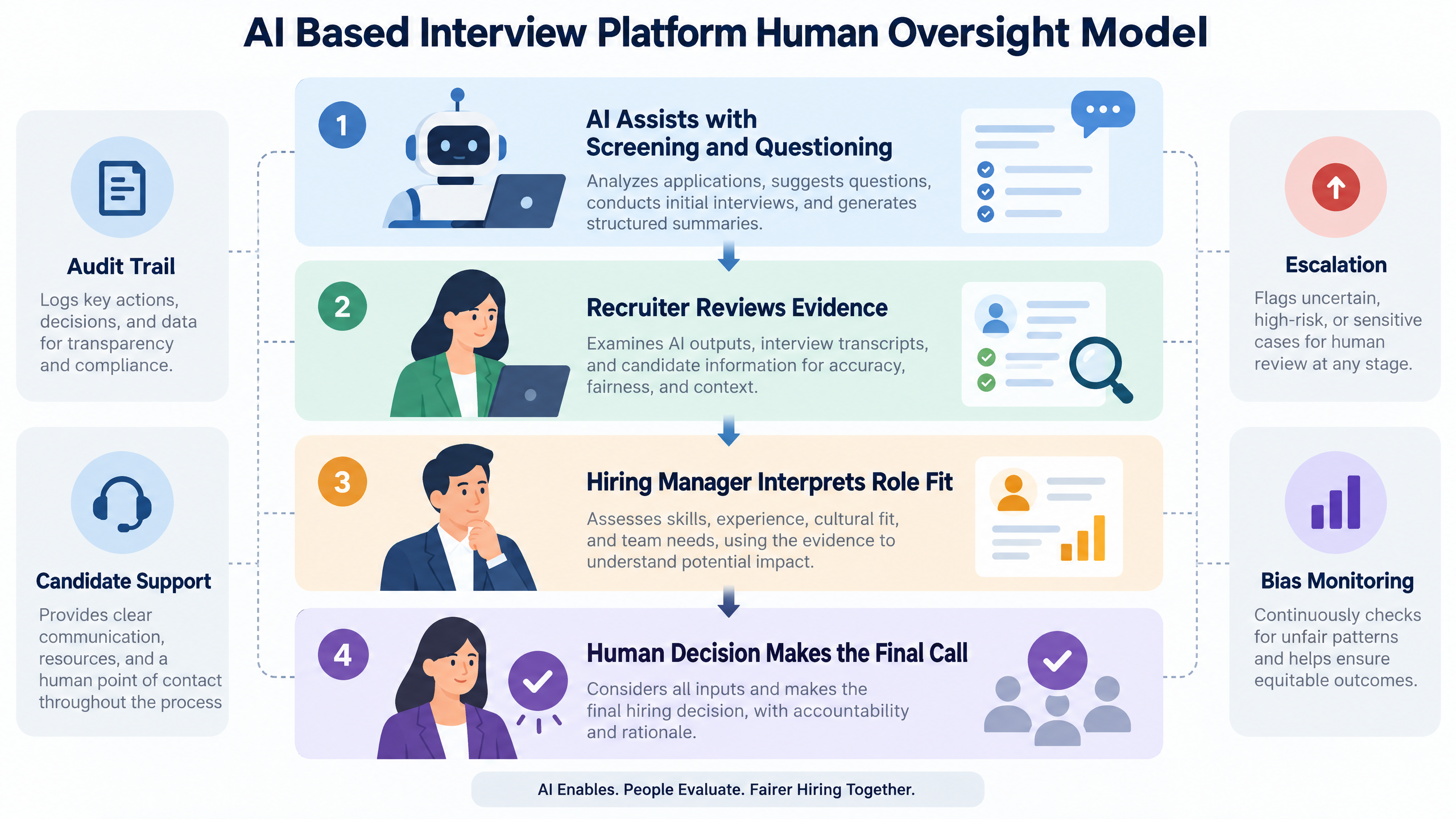
Human oversight should be part of the workflow design, not an informal promise. Define who reviews the output, what evidence they inspect, which cases require a second opinion, and when an AI recommendation cannot be used without additional review.
Create explicit exception paths for:
  • Accessibility or accommodation requests.
  • Technical interruptions or poor recording quality.
  • Candidate questions about the process.
  • Conflicting evidence across interview stages.
  • Nontraditional experience or career paths.
  • Suspected scoring errors or irrelevant questions.
  • Unusual language, communication, or device conditions.
  • Candidate disputes or requests for clarification.
  • High-impact recommendations that a reviewer cannot support.
A reviewer should be able to disagree with the system and document why. If the interface makes disagreement difficult, the organization may create automation bias even when a human technically remains in the loop.

8. Create a quality and governance operating model

Assign ownership across talent acquisition, hiring managers, HR technology, security, privacy, legal, and the vendor. Each group should understand its responsibilities before the first candidate enters the workflow.
Governance should cover:
  • Approved use cases and excluded uses.
  • Role and competency ownership.
  • Question and prompt review.
  • Scoring-anchor calibration.
  • Data access and retention.
  • Vendor security and subprocessor review.
  • Candidate notice and support.
  • Monitoring for quality and disparate outcomes.
  • Incident response.
  • Model or configuration changes.
  • Audit and reporting cadence.
The offers a voluntary structure for identifying, measuring, managing, and governing AI risks . It is not a substitute for legal advice or an organization-specific control framework, but it can help teams make responsibilities explicit.

9. Run a controlled pilot with a human baseline

Pilot the AI based interview platform on one role family, location, or hiring campaign. Keep the scope large enough to reveal workflow issues but small enough for close review.
Where practical, compare the new workflow with the existing process. The comparison should not assume that faster is better. Review screening time, completion, candidate feedback, reviewer agreement, shortlist quality, hiring-manager confidence, false negatives, exceptions, and downstream outcomes.
Create a pilot review group with recruiting, hiring-manager, technical, and governance representation. Review sample transcripts, summaries, questions, scores, and candidate communications. Document what should change before scale.

10. Monitor, recalibrate, and scale in stages

An AI interview workflow can drift when roles change, labor markets shift, job descriptions are updated, or the platform configuration evolves. Establish a recurring review cadence rather than treating launch as the end of implementation.
Monitor:
  • Completion and abandonment by stage.
  • Technical failures and support requests.
  • Time from invitation to completion.
  • Reviewer overrides and disagreements.
  • Candidate feedback and complaints.
  • Progression rates by relevant candidate segment.
  • Quality of shortlist and downstream performance.
  • Question relevance and scoring consistency.
  • Access, retention, and audit events.
Scale only after the team can explain the workflow, defend the criteria, support candidates, and respond to exceptions. Add roles in controlled groups and keep an option to pause a workflow when monitoring identifies a material problem.
AI based interview platform human oversight model showing AI assistance, recruiter review, hiring manager interpretation, and human final decision

AI interview platform architecture for a modern TA stack

A practical architecture has five layers. The exact products will vary, but the responsibilities should remain visible.

Candidate and job layer

This layer contains the job description, role requirements, candidate profile, application status, consent or notice records, and communication preferences. It should provide only the information needed for the interview purpose.

Interview experience layer

This is the candidate-facing interaction. It may include a web or voice interview, video, coding environment, question display, response capture, accessibility support, and candidate help.

Intelligence layer

This layer may generate or select questions, adapt follow-ups, transcribe answers, summarize evidence, map responses to competencies, detect workflow conditions, or calculate configured signals. Each function should have a defined purpose and evaluation method.

Review and decision layer

Recruiters, interviewers, and hiring managers review evidence, compare it with the role framework, record decisions, and handle exceptions. The interface should make source evidence available rather than presenting an unexplained score as the entire result.

Workflow and governance layer

This layer manages scheduling, reminders, ATS updates, notifications, reports, permissions, retention, audit logs, monitoring, and configuration changes. It connects the AI interview to the wider TA operating model.
The key implementation principle is traceability. A reviewer should be able to understand where a recommendation came from, which criteria were used, what evidence supports it, and who approved the next action.

Human oversight and responsible AI hiring

An AI based interview platform can reduce repetitive work, but it can also reproduce poor criteria at a larger scale. Human oversight should therefore address both individual decisions and system-level performance.

Review job relevance

Every question, signal, and scoring criterion should relate to the job. Remove criteria that do not measure a skill or behavior needed for the role. Revisit the framework when the role changes.

Review evidence, not only summaries

Summaries save time, but they may omit nuance. Reviewers should be able to inspect transcripts, recordings, code, response context, or other source evidence where appropriate and permitted.

Monitor patterns, not just individual cases

Look for changes in completion, progression, overrides, support needs, and complaints across relevant groups and conditions. A system can appear consistent in individual sessions while producing uneven outcomes at scale.

Preserve decision accountability

Define the person or group accountable for the progression decision. An AI score should not become an invisible authority that no one feels able to challenge.

Make changes auditable

Record updates to job descriptions, questions, prompts, rubrics, thresholds, integrations, and model or vendor configurations. When outcomes change, the team needs to know what changed in the workflow.
The explains that employment-discrimination laws continue to apply when AI or automated technologies are used in employment contexts . Organizations should obtain appropriate legal and compliance guidance for their jurisdictions and use cases.

Candidate experience and accessibility requirements

The candidate experience is part of implementation quality. A system that is efficient for recruiters but confusing or inaccessible for candidates creates operational and employer-brand risk.
Review whether candidates can:
  • Understand why the interview is being used and what it measures.
  • Know the expected time, format, device, browser, and preparation requirements.
  • Access instructions, controls, captions, and errors clearly.
  • Use keyboard navigation or assistive technologies where needed.
  • Request an accommodation or alternate process.
  • Recover from a connection, device, or browser failure.
  • Reschedule or contact a human when the standard path does not work.
  • Understand how recordings, transcripts, and interview data are used.
  • Receive accurate status updates and next steps.
The provides recommendations for making web content more accessible . Teams should test the complete candidate journey rather than rely only on a vendor’s general accessibility statement.
Candidate communication should be specific and proportional. Explain the role of AI in the process without overstating what the system can infer. Make clear how the organization will use the output and who makes the decision.

How to choose an AI based interview platform
Evaluate the operating model, not just the AI demonstration. A compelling demo may show question generation or instant summaries, but enterprise buyers also need to understand implementation, security, support, integration, review, and measurement.
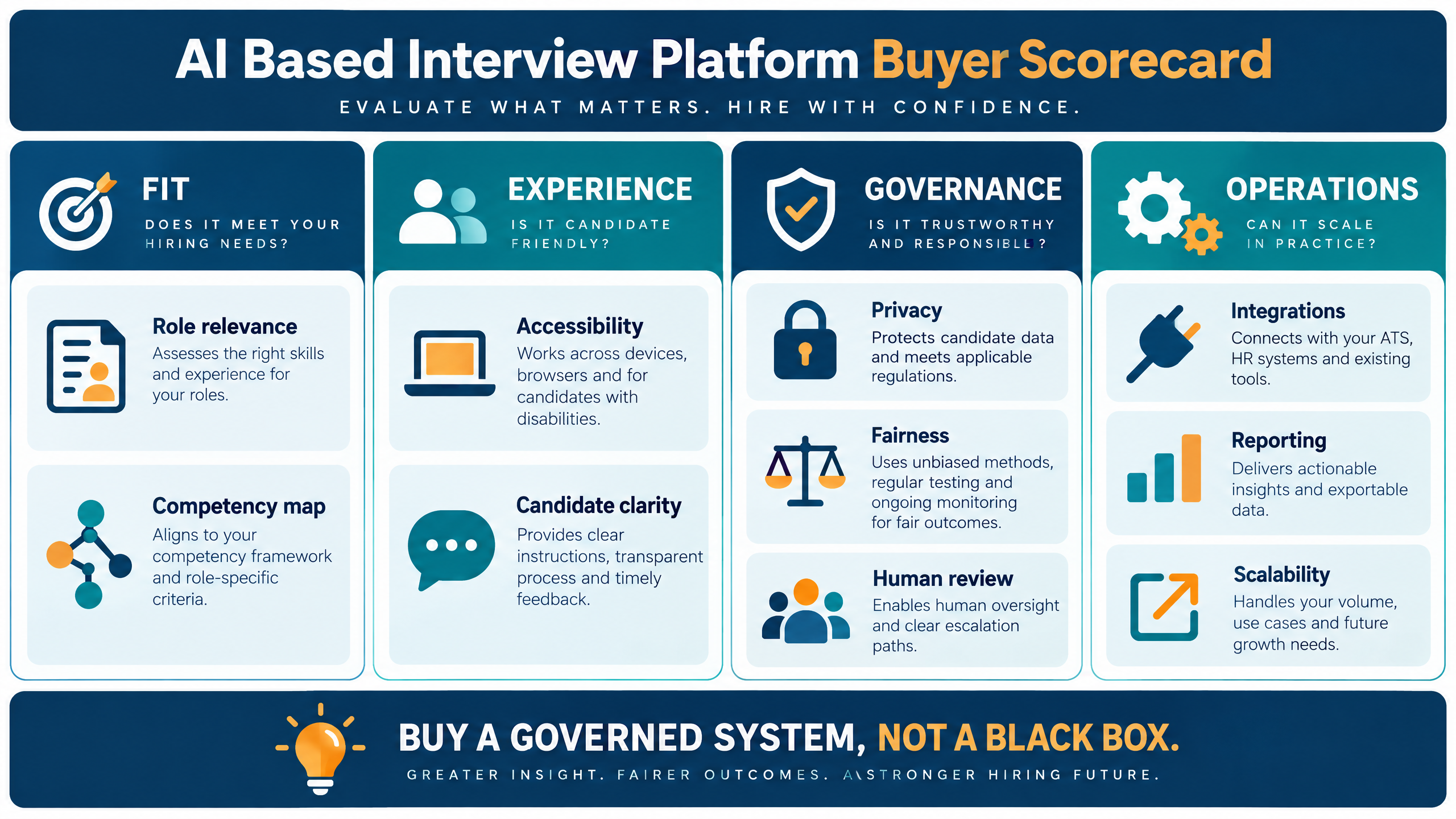
AI based interview platform buyer scorecard covering role fit, candidate experience, governance, and operations
Evaluation area
Questions to ask
Suggested weight
Role relevance
Can the team configure competencies, question plans, scoring anchors, and role-specific evidence?
20%
Human oversight
Can reviewers inspect evidence, override outputs, escalate cases, and document decisions?
20%
Candidate experience
Are instructions, accessibility, support, privacy, rescheduling, and recovery built into the journey?
15%
Governance and security
Are permissions, retention, audit, monitoring, incident response, and vendor controls clear?
15%
Workflow integration
Can it connect to ATS, calendars, communication channels, assessment tools, and hiring-manager workspaces?
10%
Reporting and evidence
Are transcripts, summaries, scorecards, source evidence, and exports available at the right level?
10%
Scalability and support
Can the provider support volume, time zones, implementation, change management, and service issues?
10%
Ask for a role-specific demonstration. Provide an actual job description and request that the provider show configuration, candidate invitation, interview flow, follow-up behavior, transcript or summary, scorecard, review controls, integration events, exception handling, audit history, and reporting.
Also ask what the platform cannot do. A credible implementation discussion should explain limitations, required human actions, supported languages, accessibility conditions, data boundaries, and how the system behaves when evidence is incomplete.

How to run an AI interview platform pilot

A pilot should test the whole operating system, not only the model output.

Define the baseline

Record current first-round time, recruiter effort, candidate completion, interviewer capacity, scheduling delay, shortlist quality, progression rate, candidate feedback, and time to decision.

Select a controlled role

Choose a role with a stable job description, clear competencies, sufficient volume, and an available review group. Avoid beginning with the most sensitive or ambiguous use case.

Set acceptance thresholds

Define the minimum acceptable level for candidate completion, technical reliability, reviewer agreement, response time, support resolution, and evidence quality. Do not approve scale based only on speed.

Review sessions and decisions

Sample completed sessions across candidates and outcomes. Inspect questions, follow-ups, transcripts, summaries, scoring, reviewer overrides, and communications. Compare what the system surfaced with what experienced reviewers considered important.

Test exception paths

Simulate a connection failure, accommodation request, incomplete response, unclear answer, duplicate record, unsupported device, candidate dispute, and a human reviewer who disagrees with the system.

Report and decide

At the end of the pilot, document what worked, what failed, what changed, and what remains unknown. Choose one of four outcomes: scale, redesign, limit to a narrower use case, or stop.

How futuremug fits into an AI hiring stack

futuremug’s public describes a self-service platform with automated scheduling, video interviews, real-time coding, a question library, dedicated interviewer dashboards, candidate management, AI-generated transcripts and summaries, personalized reports, and centralized interview reporting.
Its describe dynamic job-specific questioning, follow-ups based on candidate answers, competency evaluation, standardized scoring, searchable transcripts, recordings, summaries, red-flag signals, bulk scheduling, ATS or CRM updates, next-round scheduling, and hiring-manager notifications. Buyers should validate current capabilities, governance controls, integrations, and implementation responsibilities in a live evaluation.
Teams may also connect AI interview workflows with futuremug’s when they need expert-led technical or functional interviews, structured evaluation frameworks, automated scheduling, multi-channel updates, and operational support alongside platform capabilities.
For a broader evaluation workflow, review the , which describes automation for candidate workflows, scheduling, reporting, assessments, and interviews.
A useful implementation discussion should cover:
  • The roles and interview stages suitable for AI assistance.
  • Role-specific competency and question configuration.
  • Candidate notices, support, accessibility, and recovery.
  • ATS, calendar, communication, and reporting integrations.
  • Human review, escalation, and decision ownership.
  • Data access, retention, security, and audit requirements.
  • Pilot design, success measures, implementation timeline, and support model.

Request an AI interview platform demo

Implementation is most successful when the platform is evaluated against a real hiring workflow. Bring one job description, competency framework, current interview process, candidate volume, systems, communication requirements, governance constraints, and pilot goal to the discussion. to review AI-based screening, dynamic questioning, automated scheduling, video or coding interviews, transcripts, reports, human oversight, integrations, and a controlled implementation plan.

Frequently Asked Questions

What is an AI based interview platform? ▼

An AI based interview platform uses artificial intelligence to support or conduct defined interview activities such as question generation, conversational screening, coding interviews, transcription, summarization, structured evaluation, scheduling, reporting, and workflow routing.

How do I implement an AI based interview platform? ▼

Define the hiring problem, select a suitable role, map competencies, configure questions and scoring, design candidate communication, integrate the TA stack, establish human oversight, run a controlled pilot, monitor outcomes, and scale in stages.

Can an AI interview platform replace human interviewers? ▼

It can automate or support selected screening and coordination tasks, but human review remains important for context, exceptions, role interpretation, candidate support, and final decisions. The appropriate division depends on the role, jurisdiction, evidence, and risk.

What should an AI interview platform evaluate? ▼

It should evaluate job-related competencies and evidence defined by the role framework. Avoid vague traits, irrelevant personal characteristics, or criteria that cannot be explained and reviewed.

How can AI interview implementation reduce bias? ▼

Standardized questions, role-relevant rubrics, consistent workflows, and structured evidence can reduce some sources of inconsistency. They do not eliminate risk. Teams should monitor outcomes, review exceptions, test the candidate experience, and retain human decision accountability.

What integrations are important? ▼

Common integrations include an applicant tracking system, recruiting CRM, calendar, communication channels, assessment tools, identity provider, analytics, and hiring-manager workspace. The buyer should define data ownership, permissions, retention, status synchronization, and audit events for each integration.

How should candidates be informed about AI interviews? ▼

Explain the purpose of the interview, the role of AI, what information is collected, how it will be used, expected duration, support options, accessibility or accommodation routes, and what happens after completion. Adapt communication to the organization’s policy and applicable legal requirements.

What metrics should be tracked during an AI interview pilot? ▼

Track candidate completion, technical reliability, support requests, scheduling time, recruiter effort, reviewer agreement, overrides, shortlist quality, progression, candidate feedback, exception volume, and downstream hiring outcomes.

Is an AI interview platform suitable for high-volume hiring? ▼

It can support high-volume screening, bulk scheduling, standardized questions, transcripts, summaries, and workflow triggers. High-volume use requires capacity planning, candidate support, quality monitoring, and human escalation.

What makes an AI interview platform enterprise-ready? ▼

Enterprise readiness includes role relevance, integration, permissions, security, privacy, auditability, accessibility, support, monitoring, configuration control, scalability, and a clear operating model for human review.

What should I ask in an AI interview platform demo? ▼

Ask the provider to demonstrate one real role from job-description intake through candidate invitation, interview, follow-up, transcript, scoring, human review, exception handling, ATS update, reporting, and next-step communication. Ask to see governance and audit controls as well as the candidate experience.

Leave a Reply

Your email address will not be published.