
A Practical Guide to Why Is Employer Branding Important for Talent Acquisition
What is employer branding?
- Employer reputation: what people believe about the organization before they engage.
- Employee advocacy: what employees and alumni can credibly say about working there.
- Talent attraction: why a person notices and considers an opportunity.
- Candidate experience: how the hiring process confirms or contradicts the promise.
- Recruitment operations: how consistently the organization communicates and follows through.
- Employee expectations: what a new hire expects when they join.
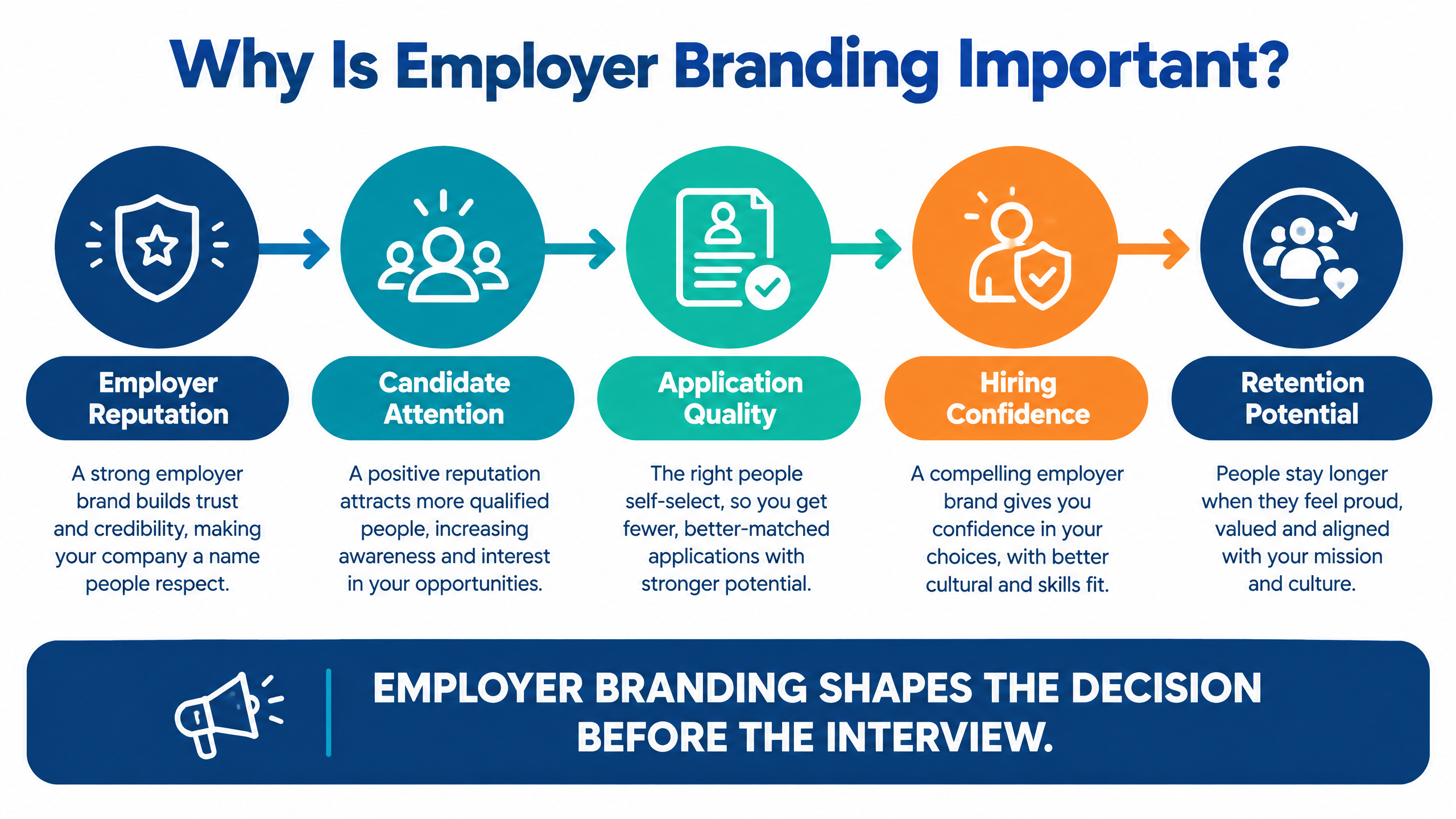
Why is employer branding important for talent acquisition?
|
Talent acquisition challenge
|
How employer branding can help
|
|
Low awareness
|
Make the organization easier to recognize and understand.
|
|
Weak qualified-candidate flow
|
Communicate role relevance, work context, and employee value more clearly.
|
|
High application drop-off
|
Reduce uncertainty about process, expectations, and next steps.
|
|
Offer declines
|
Build confidence before the offer and align expectations earlier.
|
|
Candidate ghosting
|
Create a more respectful, predictable, and responsive journey.
|
|
Hard-to-fill roles
|
Explain why the work matters and what makes the opportunity credible.
|
|
Inconsistent recruiter messages
|
Give teams shared language and evidence for candidate conversations.
|
|
Early attrition
|
Set more accurate expectations before people join.
|
|
High recruitment spend
|
Improve the efficiency and quality of attraction over time.
|
10 powerful employer-branding benefits
1. It increases awareness among relevant talent
2. It clarifies the employee value proposition
3. It improves the quality of applications
4. It strengthens candidate trust
5. It supports stronger candidate experience
6. It improves offer confidence and acceptance
7. It helps hard-to-fill roles compete for attention
8. It improves recruiter and hiring-manager consistency
9. It supports employee advocacy and referrals
10. It connects recruitment to long-term workforce outcomes
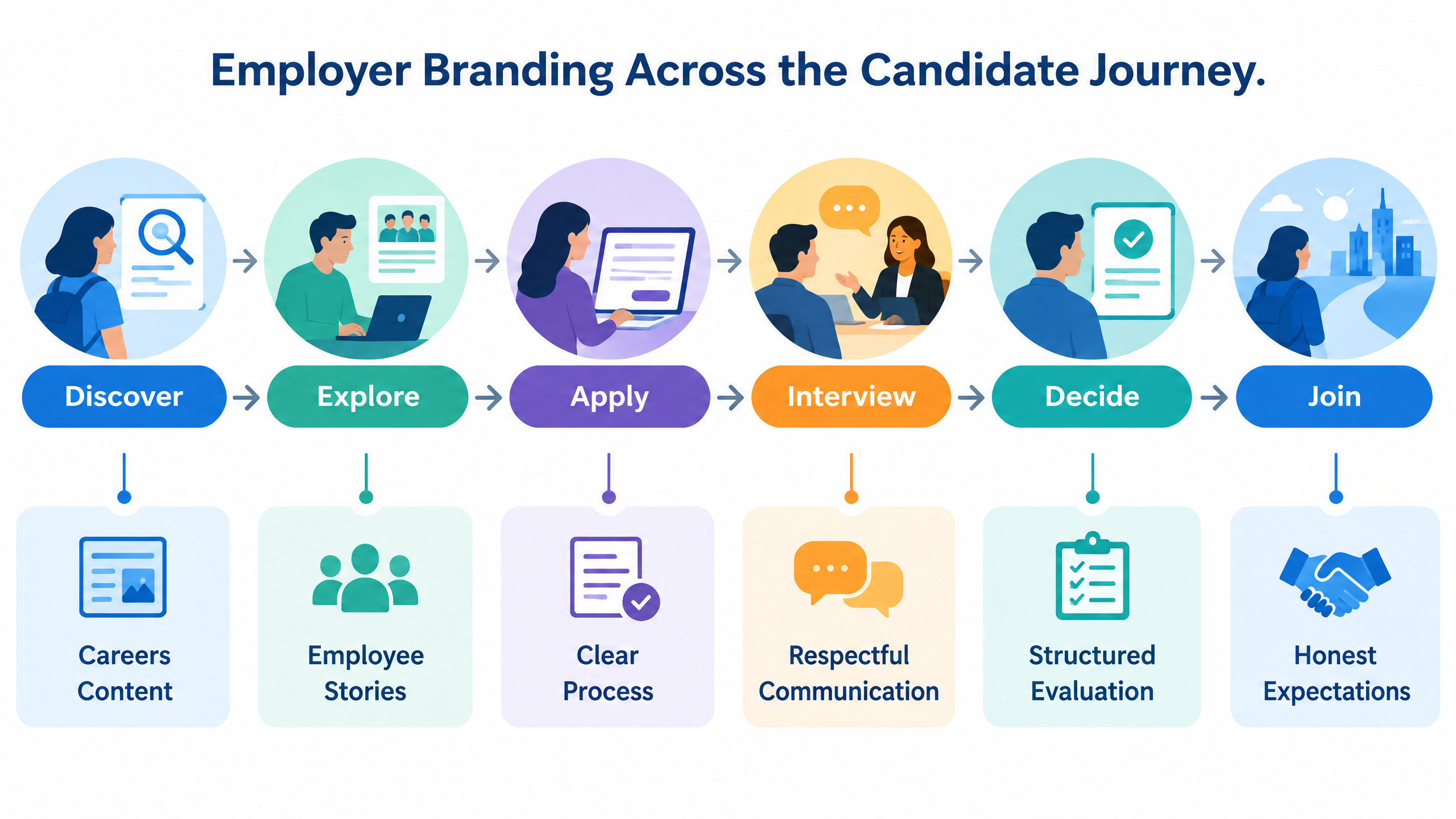
Employer branding and candidate experience
- Employer-brand content creates an expectation.
- The candidate enters the hiring process with that expectation.
- Recruiters, systems, interviewers, and communications deliver an experience.
- The candidate compares the experience with the expectation.
- The experience influences whether the candidate continues, accepts, recommends, or shares an opinion.
- Those opinions affect future employer-brand perception.
|
Employer-brand promise
|
Candidate-experience proof
|
|
We value people’s time
|
Clear timelines, prepared interviews, punctual communication, and fewer unnecessary steps.
|
|
We support development
|
Specific role information, learning examples, manager conversations, and realistic growth expectations.
|
|
We are inclusive
|
Accessible processes, respectful language, accommodation support, and consistent criteria.
|
|
We are innovative
|
Modern work examples, relevant technology, and a hiring process that is efficient without being impersonal.
|
|
We are transparent
|
Accurate job information, clear stages, honest delays, and understandable next steps.
|
|
We care about quality
|
Structured evaluation, prepared interviewers, useful feedback, and consistent decision standards.
|
Employer branding and recruitment marketing
- Which audience should we reach?
- Which channel should we use?
- What content should we promote?
- How should we measure engagement and conversion?
- Which campaign should support the hiring plan?
- What should people understand about working here?
- Which experiences make the organization credible?
- What do employees and candidates actually perceive?
- Where is the external promise different from the internal reality?
- What should remain consistent across roles and channels?
How employer branding supports recruitment operations
- The accuracy and clarity of job descriptions.
- The speed and quality of application confirmation.
- The accessibility of forms, assessments, and interview tools.
- The ease of scheduling and rescheduling.
- The consistency of recruiter and interviewer communication.
- The transparency of assessment and interview expectations.
- The timing and tone of status updates.
- The handling of delays, technical issues, and candidate questions.
- The quality of candidate records and handoffs.
- The respect shown when a candidate is rejected or withdraws.
How to build an employer-branding strategy
1. Define the talent priorities
2. Gather perception evidence
3. Identify credible proof points
4. Create audience-specific narratives
5. Connect content to the candidate journey
6. Align recruiters and interviewers
7. Fix process friction
8. Create a feedback loop
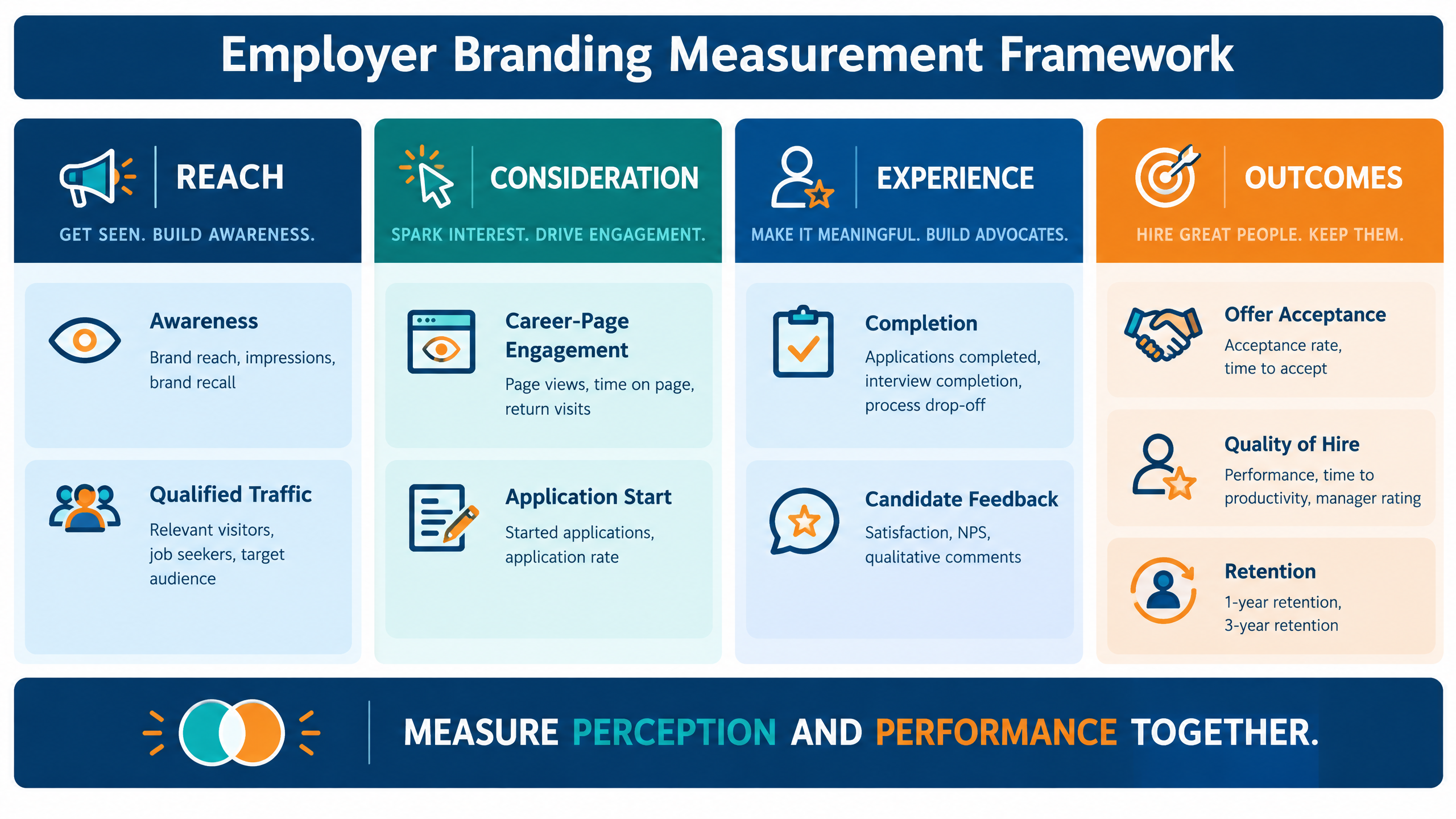
How to measure employer-branding impact
|
Measurement layer
|
Example metrics
|
Question answered
|
|
Reach
|
Relevant audience awareness, branded search, qualified traffic, community growth.
|
Are the right people encountering the organization?
|
|
Consideration
|
Careers-page engagement, content completion, application starts, event registration.
|
Are people exploring the opportunity?
|
|
Application
|
Qualified application rate, source quality, application completion, drop-off.
|
Are the message and process attracting suitable candidates?
|
|
Experience
|
Candidate feedback, response time, scheduling satisfaction, assessment completion, support requests.
|
Does the process reinforce the promise?
|
|
Decision
|
Interview progression, offer acceptance, decline reasons, time to decision.
|
Do candidates remain confident through the process?
|
|
Outcome
|
Quality of hire, early retention, referral activity, employee advocacy, regretted attrition.
|
Does the promise align with longer-term results?
|
How futuremug supports the hiring experience
Create a more consistent hiring experience



Frequently Asked Questions
Employer branding is important because it shapes how candidates perceive an organization before and during hiring. It can influence awareness, application quality, candidate trust, process completion, offer confidence, employee expectations, referrals, and long-term workforce outcomes.
Talent acquisition depends on attracting the right people, helping them understand the opportunity, and giving them a credible reason to continue. Employer branding makes the organization’s employee proposition clearer and helps align recruitment communication with the candidate experience.
No. Recruitment marketing focuses on campaigns, channels, content distribution, and conversion. Employer branding is the broader perception and employee proposition that those campaigns communicate. Recruitment marketing works better when it is built on a credible employer brand.
Employer branding creates expectations about the organization. Candidate experience shows whether the hiring process supports or contradicts those expectations. Clear communication, reliable scheduling, structured evaluation, respectful treatment, and timely updates can reinforce the employer brand.
No. Smaller organizations may benefit from employer branding because they need to explain their mission, work, leadership access, growth opportunity, and employee experience clearly when competing with better-known employers.
It may improve recruitment efficiency by increasing relevant awareness, improving application quality, reducing avoidable drop-off, supporting referrals, and strengthening offer confidence. Cost outcomes depend on the role, labor market, compensation, process quality, and employee experience.
Credibility comes from alignment between the promise and the lived experience. Specific evidence, honest expectations, employee voice, accurate job information, consistent hiring operations, and transparent communication are stronger than generic claims.
Use a balanced framework covering reach, consideration, application behavior, candidate experience, offer outcomes, quality of hire, early retention, referrals, and employee advocacy. Segment results by role, audience, location, stage, and source where appropriate.
Automation affects employer branding through the practical hiring experience. Accurate reminders, easy scheduling, status updates, structured feedback, and reliable support can reinforce trust. Broken workflows, silence, irrelevant messages, and no escalation path can weaken it.
Ask whether job information is accurate, messages are consistent, scheduling is reliable, assessments and interviews are accessible, candidates can receive support, delays are communicated, and outcomes are measured. The brand is delivered through these operational details.
Ask the provider to show candidate intake, job information, invitations, scheduling, reminders, assessments, interviews, feedback, reports, status updates, support, exception handling, permissions, integrations, and a measurement plan.