How to Scale With Interview as a Service Companies to Reduce Interview Bottlenecks

What are interview as a service companies?
Interview as a service companies provide managed interview capability to organizations that need additional interviewer capacity, faster scheduling, more consistent evaluation, specialist expertise, or a scalable workflow. Instead of asking internal engineers and recruiters to conduct every technical interview, the employer works with a provider that may supply expert interviewers, AI-assisted interviews, scheduling coordination, structured rubrics, reporting, and operational support.
The employer normally provides the job description, seniority level, technology stack, competencies, interview stages, and decision criteria. The provider then designs or follows an agreed interview plan, matches interviewers or workflows, coordinates candidates, conducts the round, captures evidence, and returns a structured report or recommendation.
The employer still owns the hiring standard and final decision. A reliable service partner should make the evidence clearer and the process faster, not replace accountability.
futuremug’s combine expert panels, automated scheduling, structured interviews, reporting, and AI-enabled workflow options for teams that need to scale evaluation without expanding internal interviewer capacity.
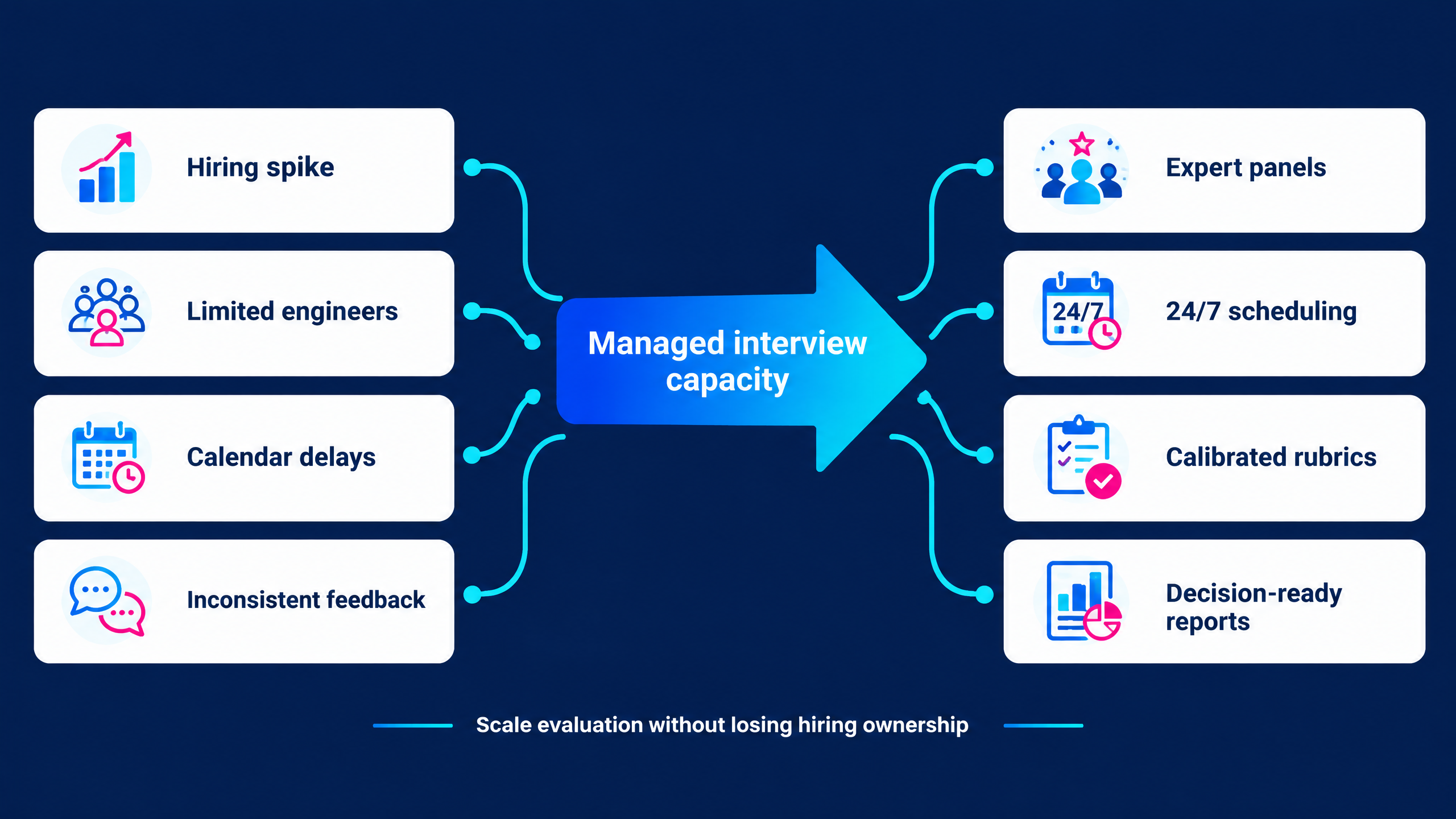
Interview as a service companies infographic showing the bottleneck-to-capacity model across interviewer bandwidth, scheduling, structured evaluation, reporting, and hiring decisions

Why interview bottlenecks appear

Interview bottlenecks rarely come from one problem. They usually develop when hiring demand grows faster than the organization’s ability to provide qualified interviewers, available calendars, consistent evaluation, and timely feedback.
Bottleneck
Operational effect
Business consequence
Limited interviewer capacity
Candidates wait for an available engineer or specialist.
Slower hiring and lost candidate interest.
Calendar coordination
Recruiters exchange repeated emails and messages.
More administrative work and rescheduling.
Inconsistent questions
Different candidates receive different levels of difficulty.
Difficult comparisons and weaker confidence.
Delayed feedback
Interview notes remain incomplete or scattered.
Hiring managers cannot make timely decisions.
Niche skill coverage
The team cannot staff every technology or domain.
Specialist candidates move slowly through the funnel.
Hiring spikes
Existing panels cannot absorb sudden volume.
Quality drops or time-to-hire increases.
Distributed teams
Time zones and locations complicate scheduling.
More no-shows and candidate friction.
The hidden cost also includes engineering time. A senior engineer may spend several hours preparing, interviewing, writing feedback, joining a debrief, and helping with rescheduling. At low volume, this may be manageable. At scale, it competes directly with product delivery and technical leadership.

What an interview as a service workflow includes

A strong managed interview workflow connects role requirements to a repeatable candidate evaluation.

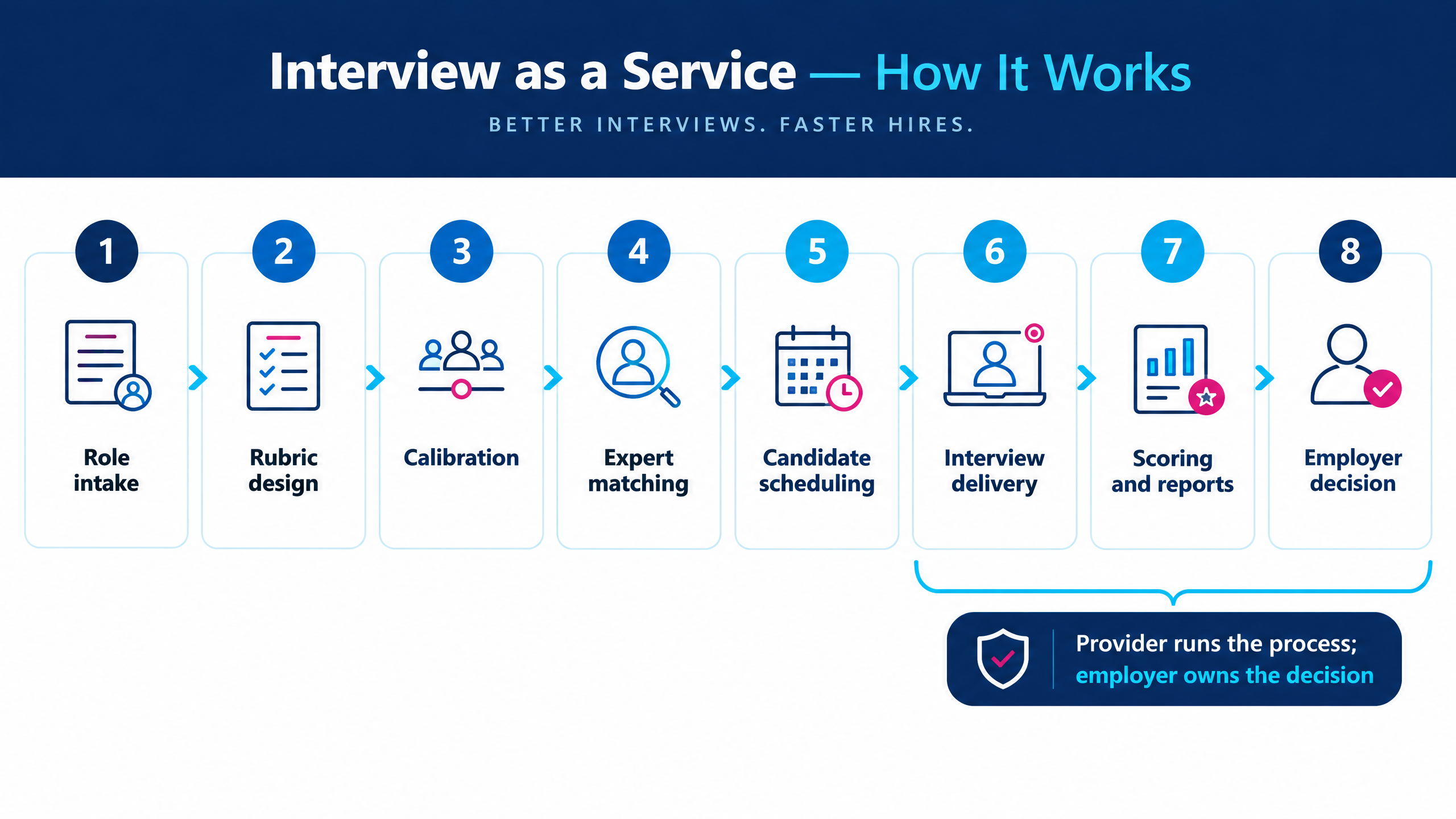
1. Role intake

The provider reviews the job description, level, technology stack, business context, must-have competencies, interview stage, volume, target turnaround, and reporting requirements.

2. Rubric and interview design

Questions, coding exercises, system-design prompts, behavioral topics, and evaluation criteria are mapped to the role. The goal is not to make every interview identical; it is to ensure that every candidate is assessed against the same relevant bar.

3. Calibration

The employer and provider align on what strong, acceptable, weak, and borderline performance looks like. Calibration is essential when an external expert or AI workflow will conduct the round.

4. Interviewer or workflow matching

Human interviewers are matched by domain, seniority, availability, language, location, and relevant experience. AI or blended workflows are selected according to the round’s purpose and the level of human oversight required.

5. Candidate scheduling

The provider coordinates invitations, reminders, time zones, calendar availability, rescheduling, candidate support, and interviewer notifications.

6. Interview delivery

The interview is conducted using an expert panel, AI interviewer, or hybrid model. The format may include technical screening, coding, debugging, system design, behavioral evaluation, communication, or managerial assessment.

7. Scoring and reporting

Responses are evaluated against the approved rubric. A useful report should show strengths, gaps, competency-level scores, evidence, integrity or risk signals, and a clear next-step recommendation.

8. Employer decision

Recruiters and hiring managers review the evidence and decide whether to advance, hold, reject, or conduct a further round. The provider supports the decision; it should not obscure who owns it.
Interview as a service companies infographic showing the end-to-end workflow from role intake and calibration through scheduling, interview delivery, scoring, reporting, and employer decision

10 capabilities to evaluate

1. Interviewer quality and coverage

Ask how interviewers are sourced, vetted, matched, calibrated, monitored, and replaced when performance is inconsistent. A large expert network is useful only when expertise is relevant to the role and level.

2. Role-specific customization

The provider should work from your job description and competency model rather than use an identical interview for every candidate. Confirm whether your team can approve the rubric, questions, coding tasks, and scoring thresholds.

3. Scheduling and turnaround

Evaluate calendar integrations, time-zone handling, candidate self-service, reminders, rescheduling, escalation paths, and service-level reporting. Ask what happens when a candidate or interviewer cancels.
futuremug describes 24/7 auto-scheduling and on-demand scheduling on its . During a demo, ask the provider to show the complete path from candidate intake to confirmed slot.

4. Interview formats

Check support for technical screening, coding, debugging, system design, architecture, functional skills, behavioral interviews, communication, managerial rounds, panel interviews, and specialist assessments.

5. Structured evaluation

Review scorecards, competency mapping, interviewer prompts, evidence capture, calibration, and feedback quality. The report should help a hiring manager act without requiring a second interview simply to understand what happened.

6. AI and platform capabilities

An interview platform may support automated screening, video interviews, coding environments, transcripts, summaries, reports, and scheduling. futuremug’s is a relevant internal resource for evaluating software-led workflows.
AI outputs should remain reviewable. Candidates should not be rejected solely because a model produces an unexplained score or summary.

7. Candidate experience

Check invitation clarity, mobile and browser support, accessibility, preparation information, technical help, privacy notices, reminders, and human escalation. A faster process is not successful if candidates cannot understand or complete it.

8. Reporting and integrations

Ask whether reports can be delivered to the ATS or exported in a useful format. Review dashboards for stage status, turnaround, feedback completion, interviewer utilization, candidate drop-off, and outcomes.

9. Governance and security

Review access controls, data retention, consent, audit trails, recordings, transcript handling, privacy terms, incident response, and AI monitoring. The is a useful external reference for governance discussions involving AI-enabled evaluation.

10. Commercial flexibility

Understand pricing by interview, candidate, batch, project, monthly volume, or managed program. Ask about minimum commitments, peak-volume pricing, cancellation, re-interviews, pilot fees, report access, and support coverage.

Interview as a service vs in-house interviewing

The choice is rarely binary. In-house interviewing may be best for low-volume hiring, context-critical final rounds, culture discussions, confidential roles, and positions requiring deep knowledge of the team or codebase.
Interview as a service may be stronger for high-volume first rounds, hiring spikes, specialist coverage, distributed recruiting, and repetitive evaluation that consumes engineering time.
Consideration
In-house interviewing
Interview as a service
Cost at low volume
Often efficient when internal capacity is available.
May be more expensive per interview at very low volume.
Speed under load
Limited by internal calendars.
Adds elastic capacity after calibration.
Context and culture
Strong internal knowledge.
Requires careful briefing and role calibration.
Consistency
Depends on interviewer training and discipline.
Can be standardized through rubrics and QA.
Specialist coverage
Limited to available employees.
Can provide access to external experts.
Operational effort
Owned by recruiting and engineering teams.
Shared or managed by the provider.
Control
Direct internal control.
Requires clear governance and review paths.
Best model
Context-critical and final decisions.
Scalable, repeatable, or overflow rounds.
A hybrid model is often practical: outsource high-volume or specialist rounds, while keeping final interviews, bar-raiser rounds, offer conversations, and context-critical decisions internal.

What to outsource and what to keep internal

Good candidates for outsourcing

High-volume technical screening, overflow during hiring spikes, coding or domain interviews requiring specialist coverage, first-round qualification, repeatable assessments, and scheduling-heavy interview programs are often suitable for a managed provider.

Usually best kept internal

Final-round decisions, culture- and context-critical discussions, confidential product or customer roles, offer conversations, leadership hiring, and decisions requiring deep knowledge of team dynamics should generally remain with internal leaders.
The right question is not “Should we outsource interviews?” It is “Which interview stages need internal context, and which stages need scalable evaluation capacity?”

How to compare interview as a service companies

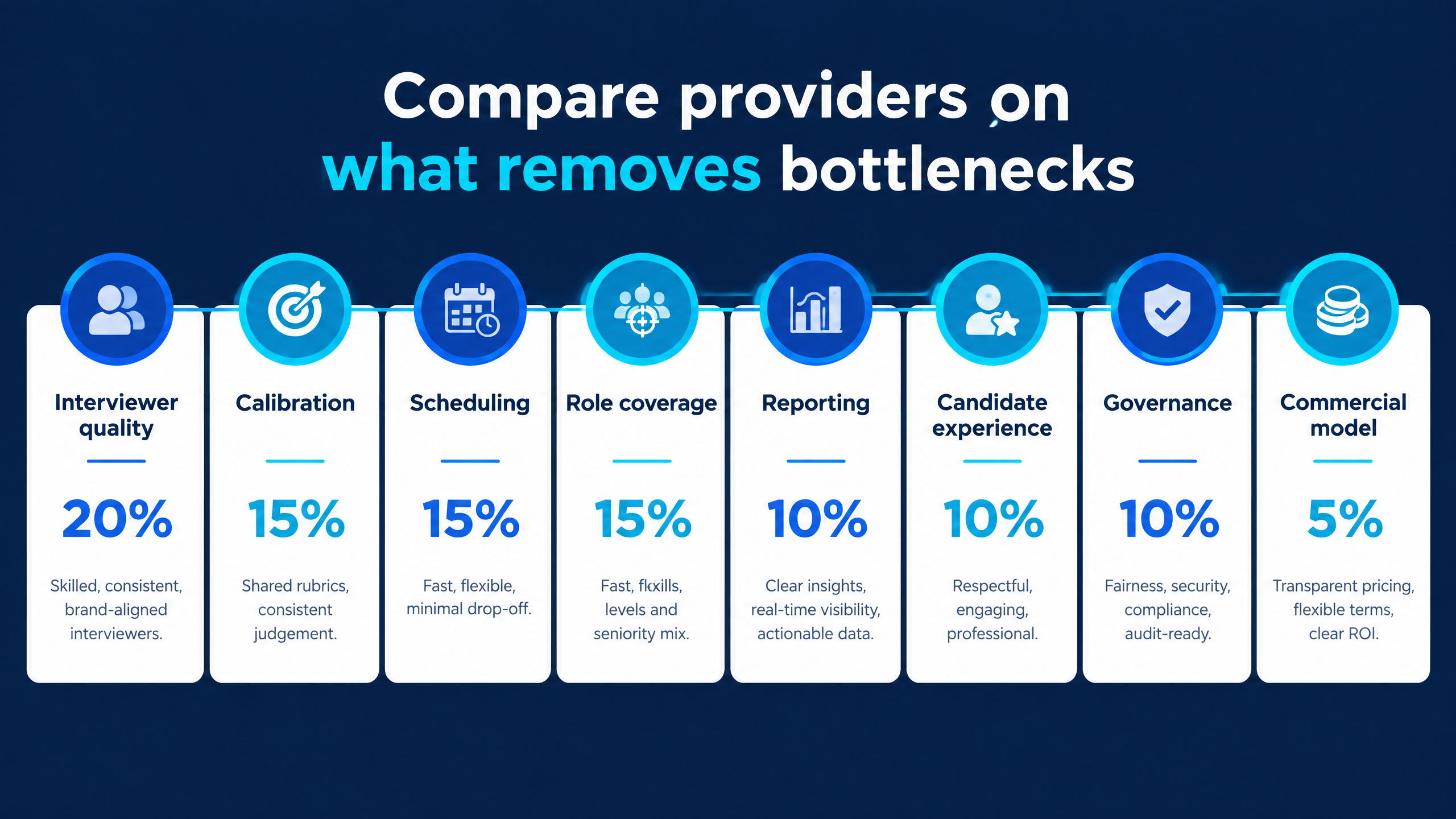
Create a weighted scorecard before taking vendor demos. This prevents a polished presentation from outweighing the criteria that matter operationally.
Evaluation area
Questions to ask
Suggested weight
Interviewer network
How are experts vetted and matched?
20%
Quality and calibration
How is the hiring bar defined and monitored?
15%
Scheduling
Can the provider meet peak-volume SLAs?
15%
Role coverage
Which technologies, levels, and interview types are supported?
15%
Reporting
Are reports evidence-based and decision-ready?
10%
Candidate experience
How are instructions, support, accessibility, and escalation handled?
10%
Governance and security
Can you audit access, data, AI, and quality controls?
10%
Commercial model
Is pricing flexible enough for normal and peak demand?
5%
Ask every provider to demonstrate one real role rather than a generic dashboard. Give them a job description, competency model, sample candidate volume, required turnaround, and reporting expectation. Then compare how clearly each provider explains the process, exceptions, evidence, and ownership.
Interview as a service companies infographic showing a buyer scorecard across interviewer quality, calibration, scheduling, role coverage, reporting, candidate experience, governance, and commercial flexibility

How to run a low-risk pilot

A pilot should test the operating model, not only the software interface.

Define the pilot scope

Select one role family, level, geography, or interview stage. Include enough candidates to test normal coordination and at least one realistic scheduling challenge.

Set a baseline

Record current interview volume, time to schedule, interviewer hours, feedback completion, candidate drop-off, time to decision, and hiring-manager satisfaction.

Agree on the rubric

Document competencies, questions, scoring thresholds, evidence requirements, escalation rules, and who makes the final decision.

Test the candidate journey

Review the invitation, reminders, preparation information, technical support, rescheduling, interview experience, and outcome communication.

Review reports and recordings

Check whether hiring managers can understand the candidate’s strengths, gaps, and evidence without chasing additional context.

Decide using agreed measures

Compare the pilot with the baseline. Useful measures include scheduling turnaround, interviewer hours saved, feedback completion, report quality, candidate experience, pass-through quality, and cost per completed interview.

Governance, fairness, and human oversight

A managed interview service should make accountability clearer, not less visible. Define who owns the hiring bar, who approves changes to the rubric, who reviews exceptions, who can access recordings and transcripts, and how candidates can request support or challenge an issue.
When AI is used, ask what the system does and does not decide. A model may generate questions, summarize responses, identify skill signals, or support scoring. The employer should retain human review for borderline cases, accommodations, disputed outcomes, sensitive roles, and consequential decisions.
Monitor outcomes for inconsistent scoring, accessibility barriers, candidate complaints, false positives, false negatives, and unexplained differences across relevant groups. Keep an audit trail for significant workflow or rubric changes.

Explore futuremug’s interview solutions

Request an IaaS consultation or demo

If your team is losing time to interview scheduling, interviewer bandwidth, inconsistent scorecards, or specialist coverage gaps, . Bring one real role, your current interview rubric, expected volume, target turnaround, and the stages you are considering for outsourcing.

Frequently Asked Questions

What are interview as a service companies?

Interview as a service companies provide managed interview capacity through expert interviewers, AI workflows, scheduling coordination, structured evaluation, reporting, or a combination of these services. They help organizations scale candidate evaluation without placing every interview on internal engineering and recruiting teams.

Are interview as a service companies the same as interview platforms?

No. An interview platform is primarily software for conducting or managing interviews. An interview as a service provider may add expert interviewers, calibration, scheduling, quality assurance, reporting, and operational execution. Some providers offer both models.

When should a company use interview as a service?

Consider it when technical hiring volume is high, interviewer capacity is constrained, scheduling is slow, specialist skills are difficult to cover, hiring spikes are expected, or evaluation quality varies across interviewers.

Does outsourcing interviews mean the provider makes the hiring decision?

It should not. A provider may return scores, evidence, reports, or recommendations, but the employer should retain ownership of the hiring standard and final decision.

Can interview as a service support bulk or campus hiring?

Yes. Managed interview capacity can support large candidate cohorts, parallel interview slots, standardized rubrics, automated reminders, and consolidated reporting. The model should still include human support for exceptions and candidate concerns.

How do interview as a service companies protect quality?

Quality controls may include interviewer vetting, role matching, calibration, structured rubrics, recording or transcript review where appropriate, quality audits, feedback checks, and escalation for borderline or disputed cases. Ask each provider to explain its controls in detail.

How should we compare pricing?

Compare total cost rather than only the per-interview fee. Include internal interviewer hours, scheduling effort, engineering opportunity cost, re-interviews, quality assurance, reporting, platform access, support, and peak-volume requirements.

How long should a pilot run?

A pilot should last long enough to test setup, calibration, normal scheduling, exceptions, reporting, and decision cycles. The exact duration depends on volume, but the success criteria should be agreed before the pilot begins.

Leave a Reply

Your email address will not be published.