
The Complete Guide to Interview as a Service India for Better Hiring Decisions
What is interview as a service India?

Why companies use interview as a service
|
Hiring challenge
|
How interview as a service can help
|
|
Limited engineering bandwidth
|
Adds interview capacity without pulling every round into the product roadmap.
|
|
Specialist skill gaps
|
Provides access to interviewers with relevant technical or domain experience.
|
|
Inconsistent evaluation
|
Applies a shared rubric, interview structure, and reporting format.
|
|
Scheduling delays
|
Uses on-demand calendars, automated reminders, and centralized coordination.
|
|
High application volume
|
Adds structured first-round screening before scarce senior-panel time.
|
|
Distributed candidates
|
Supports remote interviews, coding environments, and digital evidence.
|
|
Feedback bottlenecks
|
Returns standardized scorecards, summaries, and decision-ready reports.
|
|
Hiring spikes
|
Scales capacity up for a project or batch and down after the demand passes.
|
What can be outsourced?
Technical screening
Live coding
System design
Domain interviews
Behavioral and managerial rounds
First-round and volume screening
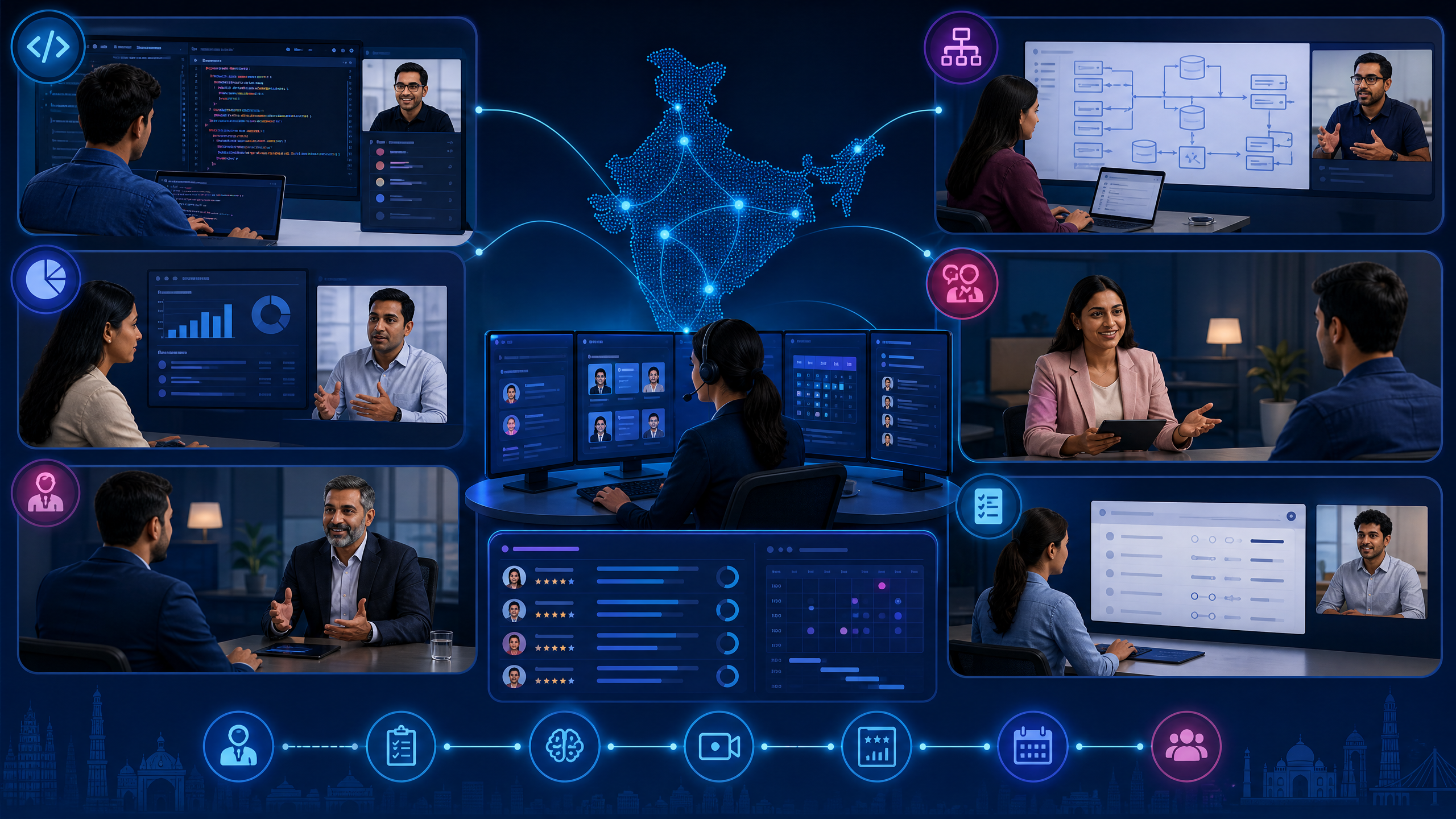
How the model works from kickoff to verdict
1. Kickoff and role intake
2. Rubric calibration
3. Interviewer matching
4. Candidate intake and scheduling
5. Interview delivery
6. Scoring and evidence capture
7. Review and verdict
8. Quality review and improvement
Human panels, AI interviews, and hybrid delivery
|
Delivery model
|
Best suited for
|
Strengths
|
Questions to ask
|
|
Expert human panel
|
Technical depth, specialist roles, senior hires, and nuanced judgment.
|
Context, probing, domain knowledge, and two-way discussion.
|
How are experts vetted, matched, calibrated, and monitored?
|
|
AI interview platform
|
High-volume screening, structured first rounds, and repeatable workflows.
|
Consistency, availability, automated scheduling, and scalable reporting.
|
How are prompts, scoring, oversight, accessibility, and escalation managed?
|
|
Hybrid workflow
|
Multi-stage hiring where speed and expert judgment both matter.
|
Automation for volume plus human review for depth and final decisions.
|
Which stage is automated, where does human review occur, and what evidence is retained?
|
How quality and fairness are protected
Calibrated rubrics
Interviewer vetting and matching
Structured questions and probing
Evidence-linked scorecards
Integrity controls
Human oversight
Candidate experience

When interview as a service India is the right fit
What to evaluate before choosing a provider
|
Evaluation area
|
Buyer questions
|
|
Role fit
|
Can the provider support our stack, seniority, domain, geography, and interview format?
|
|
Interviewer quality
|
How are interviewers sourced, vetted, matched, calibrated, and reviewed?
|
|
Rubrics
|
Can we define competencies and scoring standards by role and level?
|
|
Candidate flow
|
How do candidates enter, schedule, reschedule, receive reminders, and get support?
|
|
Interview evidence
|
Do we receive scorecards, recordings, transcripts, code, notes, and integrity signals?
|
|
AI governance
|
Where is AI used, where is human review required, and how can decisions be challenged?
|
|
Turnaround
|
What are the standard and peak-volume SLAs for interviews and reports?
|
|
Scalability
|
Can the service support a hiring spike without reducing interviewer quality?
|
|
Reporting
|
Can hiring managers compare candidates using consistent, role-specific reports?
|
|
Integration
|
How do data and status move between the service, ATS, calendars, and HR systems?
|
|
Security
|
What permissions, retention, confidentiality, consent, and data-protection controls apply?
|
|
Commercial model
|
Is pricing per interview, batch, project, subscription, or a combination?
|
|
Support
|
Who owns coordination, exceptions, candidate issues, and quality escalations?
|
Cost, turnaround, and scalability
|
Cost area
|
Questions
|
|
Direct service cost
|
What is included per interview, batch, or project?
|
|
Internal coordination cost
|
How many hours do recruiters and engineers spend outside the interview itself?
|
|
Delay cost
|
How does slower scheduling affect time to fill, candidate conversion, and project delivery?
|
|
Quality cost
|
What happens when inconsistent evaluation creates a bad hire or loses a strong candidate?
|
Implementation checklist
Before launch
During the pilot
After the pilot
At scale
Request an IaaS consultation with futuremug



Frequently Asked Questions
Interview as a service India is a model in which an external provider conducts selected candidate interviews for an employer in India, using the employer’s role requirements and evaluation standards. The provider returns structured evidence and recommendations while the employer keeps the final hiring decision.
Companies can outsource technical, coding, system-design, domain, behavioral, managerial, screening, campus, graduate, and volume-hiring interviews. The right scope depends on the role, seniority, required signal, and internal capacity.
No. A provider can reduce scheduling, interviewing, and reporting workload, but recruiters and engineering leaders remain responsible for role definition, calibration, candidate relationships, final evaluation, and hiring decisions.
They can be useful when the workflow is structured, role-relevant, validated, monitored, and supported by human oversight. Buyers should ask how prompts and scoring are governed, how accessibility is handled, what evidence is retained, and how candidates can request support or review.
Expert panels add technical or domain depth, probing, contextual judgment, and communication. Their value depends on matching, vetting, calibration, and quality monitoring rather than simply having a large expert network.
The setup depends on role complexity, rubric readiness, integration needs, interviewer availability, and candidate volume. A credible provider should explain the kickoff, calibration, pilot, and scale-up steps rather than promise a generic timeline.
Pricing may be per interview, candidate, batch, project, subscription, or a combination. Compare the complete operating cost, including internal coordination, engineering time, turnaround, reporting, integrations, and support.
Run a defined pilot using real roles and a representative candidate sample. Request a calibrated rubric, matched interviewer profiles, sample reports, evidence, SLA measurements, candidate feedback, and a clear escalation process.
Many companies keep final interviews, bar-raiser rounds, culture and leadership discussions, compensation conversations, and final hiring decisions in-house. The ideal split depends on the organization’s risk, capacity, and desired candidate relationship.