A Practical Guide to Campus Hiring Platform for Indian Campus Recruitment Teams

What is a campus hiring platform?

A campus hiring platform is software that helps employers and college placement teams plan, manage, and measure recruitment from educational institutions. It brings employer branding, college and Training & Placement Officer coordination, candidate registration, resume screening, assessments, interviews, scheduling, communication, and reporting into a connected workflow.
Instead of managing each campus drive through separate spreadsheets, email threads, forms, video links, and assessment tools, teams can use one system to move candidates from application to decision. A platform may support both on-campus and off-campus recruitment, as well as fresher hiring, graduate programs, internships, apprenticeships, and large-scale entry-level technical recruitment.
The strongest platforms are more than event-management tools. They connect college relationships with candidate evaluation. That means a recruiter can reach the right institutions, define job-specific selection criteria, identify suitable candidates, run assessments or interviews, and share clear outcomes with hiring managers and placement coordinators.
For Indian recruitment teams, the platform should also accommodate multiple colleges, high candidate volumes, regional coordination, mobile-friendly candidate journeys, campus-drive timelines, and the operational role of TPOs. Explore futuremug’s to see how these workflows can be combined.
Campus hiring platform connecting employers, colleges, recruiters, and students

Why campus recruitment teams need a unified platform

Campus hiring often appears simple from the outside: publish a role, collect applications, conduct a test, interview shortlisted students, and make offers. In practice, every stage creates coordination work. Recruiters communicate with colleges, TPOs share candidate lists, students ask questions, interview panels manage time slots, and hiring managers need reliable summaries before making decisions.
When this process is fragmented, teams experience duplicated data, inconsistent eligibility filters, missed communication, manual shortlisting, unclear ownership, and delayed feedback. These issues become more costly when an employer is hiring across dozens of campuses or running multiple drives in parallel.
A unified campus hiring platform creates a shared operating layer. The employer can manage hiring requirements, college engagement, candidate movement, evaluation stages, and reporting in one place. The college placement team receives a clearer process for communicating opportunities and coordinating students. Candidates receive a more predictable journey with fewer repeated forms and unclear instructions.
The business case is not only about saving administrative time. A well-designed platform can help teams improve speed, visibility, candidate experience, evaluation consistency, and hiring-program scalability.

How a campus hiring platform works

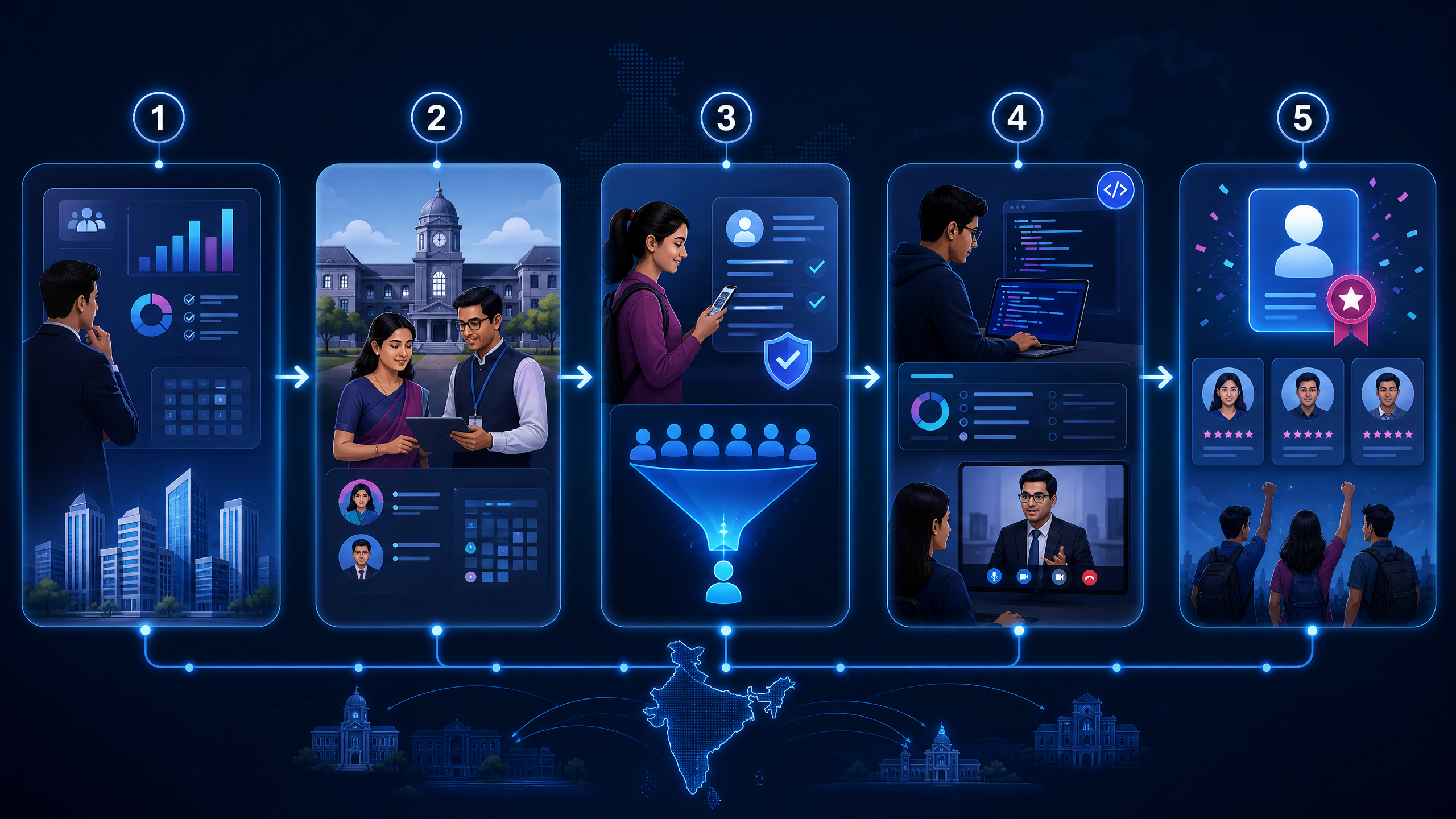
A typical campus recruitment workflow includes the following stages.
Stage
Employer or placement-team activity
Platform outcome
1. Define the hiring plan
Set roles, locations, eligibility, skills, compensation information, hiring targets, and timelines.
A structured campaign brief and role configuration.
2. Build the campus pipeline
Identify institutions, contact TPOs, publish opportunities, and manage drive participation.
Centralized college, TPO, and campaign records.
3. Showcase the employer
Share the company story, role details, culture, learning opportunities, and selection process.
A consistent employer-facing or candidate-facing experience.
4. Collect applications
Register students, import candidate lists, or accept applications through a shareable link.
A searchable candidate pool with required information.
5. Screen and assess
Apply eligibility rules and conduct aptitude, technical, coding, or domain assessments.
Candidate scores, status updates, and assessment reports.
6. Conduct interviews
Schedule group discussions, video interviews, technical interviews, or expert-led panels.
Coordinated interview slots and structured evaluations.
7. Shortlist and communicate
Review results, select candidates, notify students, and share next steps.
Clear decision records and candidate communication workflows.
8. Measure outcomes
Compare colleges, roles, stages, conversion rates, and hiring results.
Program-level dashboards and actionable reports.
The purpose of this workflow is to make campus hiring repeatable. Teams should be able to reuse proven campaign structures while still customizing the process for each role, college group, geography, or hiring season.
Campus hiring platform workflow from employer planning to student placement

Essential features for Indian campus recruitment

Employer branding and campaign pages

Students often evaluate the employer before they evaluate the role. A campus hiring platform should help employers present a consistent, credible profile with company information, role details, work locations, learning opportunities, selection stages, and application instructions. Branded pages can reduce confusion when several employers are recruiting from the same institution.

College and TPO coordination

A platform should make it easy to maintain college relationships, share drive information, manage TPO communication, confirm participation, collect student data, and track campus-level activity. This is particularly important when recruiters work with many institutions at once.

Candidate registration and data management

Candidate data should be collected once and managed throughout the process. Look for configurable registration forms, bulk uploads, duplicate handling, eligibility fields, consent workflows, resume capture, and searchable candidate profiles. The system should help teams maintain a clear record of each candidate’s current stage.

Eligibility filters and AI-assisted screening

Campus campaigns commonly use academic, graduation-year, location, branch, backlog, experience, or skill filters. A platform can make these rules easier to apply consistently. AI-assisted resume or profile screening may add another layer of prioritization, but employers should retain control over the criteria and review process.

Assessments and coding tests

Technical and graduate hiring often requires aptitude tests, multiple-choice questions, descriptive questions, coding challenges, or role-specific assessments. futuremug’s includes assessment creation, question-bank management, coding formats, reporting, and configurable controls. For managed delivery, employers can evaluate .

Group discussions and video interviews

For roles where communication, collaboration, or confidence matters, group discussions and one-way video interviews can add useful evidence before the final interview stage. These activities should have clear evaluation criteria rather than becoming subjective elimination rounds.

Technical interviews and expert panels

A campus hiring platform can connect shortlisted students to qualified interviewers for technical evaluation. This helps employers expand technical coverage when internal engineering teams have limited availability. Futuremug’s are relevant for employers that need managed interview capacity, structured feedback, or support during bulk hiring.

Scheduling, reminders, and candidate communication

Missed slots and unclear instructions create unnecessary friction for students, recruiters, interviewers, and TPOs. The platform should support calendar coordination, automated reminders, time-zone handling when required, rescheduling, attendance tracking, and clear status communication.

Reports and decision dashboards

Decision-makers need more than a list of names. Look for college-wise, role-wise, stage-wise, and candidate-level views. Reports should help teams understand who participated, who qualified, where candidates dropped out, which skills were demonstrated, and which candidates should move forward.

Integrations, access controls, and data governance

Larger teams should evaluate role-based access, candidate-data permissions, APIs, export options, ATS or HRIS integration, audit trails, and retention practices. College placement users may need limited access to campaign or student information, while employer teams may need broader reporting and decision controls.

Campus hiring platform for employers

For employers, the right platform should reduce the distance between hiring strategy and campus execution. Recruiters should be able to define a role once, reuse the evaluation structure, and track the campaign across multiple colleges.
The platform is most valuable when it helps the employer manage the full funnel: employer visibility, institution outreach, applications, screening, assessment, interviews, shortlisting, offers, and reporting. This gives TA leaders a clearer view of program performance and helps engineering leaders participate at the points where their judgment adds the most value.
Employers should also consider whether they need software only or a software-plus-services model. A platform is appropriate when the internal team has the people and operational capacity to run each stage. A managed partner is useful when the employer needs help with college coordination, assessment operations, interview panels, scheduling, or candidate support. Some hiring programs need both.

Campus hiring platform for colleges and TPOs
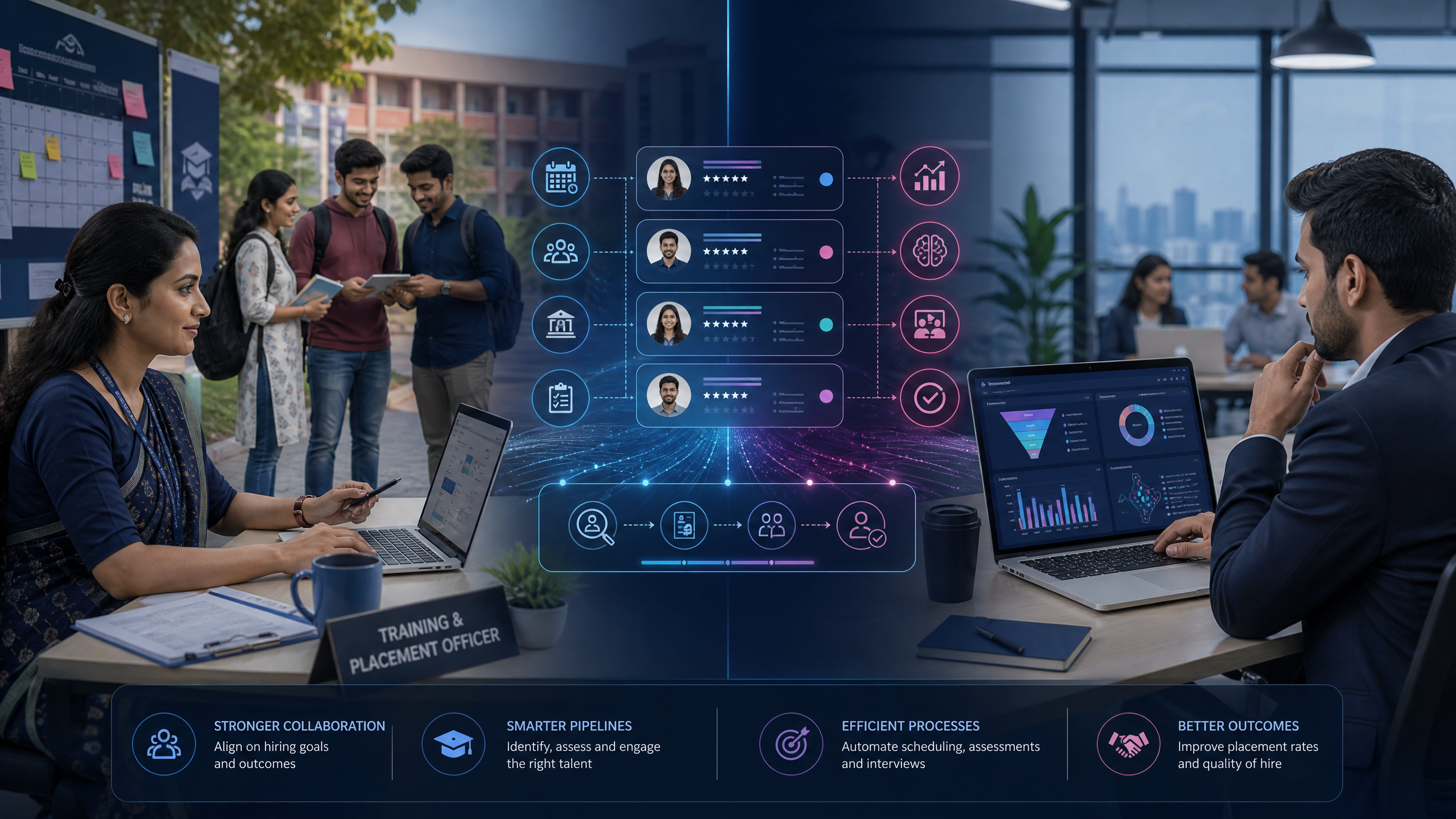
For college placement teams, a campus hiring platform should simplify how opportunities are shared, students are registered, eligibility is verified, and drive updates are communicated. TPOs need visibility without being forced to maintain several disconnected systems for every employer.
A good experience allows the placement office to manage student records, communicate deadlines, track participation, support candidate queries, and view the status of each campus drive. It should also make employer requirements easier to interpret so that eligible students are identified before the selection process begins.
Campus hiring platform supporting employer and TPO coordination
The platform should support a professional candidate journey. Students should receive clear information about the employer, role, eligibility, assessment format, interview stages, deadlines, and next steps. This reduces uncertainty and gives the placement team a more reliable way to support large cohorts.

Campus hiring platform vs. spreadsheets, ATS tools, and recruitment agencies

A commercial evaluation is easier when the alternatives are defined clearly.
Option
Strength
Limitation for campus hiring
Spreadsheets and email
Low initial cost and familiar to teams.
Fragmented records, manual coordination, weak reporting, and high error risk at scale.
General ATS
Useful for requisitions, applications, and hiring workflow.
May not provide deep college/TPO coordination or campus-drive operations.
Assessment software
Strong for tests, scoring, and candidate evaluation.
Usually does not manage employer branding, college relationships, or the full recruitment funnel.
Recruitment agency
Can provide sourcing and operational support.
Less direct process control and potentially less reusable platform visibility.
Campus hiring platform
Connects institutions, candidates, assessments, interviews, communication, and reporting.
Requires implementation, process ownership, and platform adoption.
Platform plus managed services
Combines workflow technology with operational and interviewer support.
Needs clear scope, service levels, governance, and commercial alignment.
The right decision depends on the bottleneck. If the problem is only applicant tracking, an ATS may be enough. If the problem is assessment delivery, assessment software may solve it. If the problem spans college coordination, candidate operations, evaluation, and reporting, a dedicated campus hiring platform is more likely to fit.

How to evaluate a campus hiring platform

Start with the hiring program rather than the feature list. Document the number of colleges, expected applicants, roles, hiring targets, recruitment stages, internal users, TPO touchpoints, peak campaign periods, and reporting requirements.
Then ask vendors to demonstrate the complete journey with a realistic use case. A useful demo should show how a recruiter creates a campaign, invites colleges, collects candidates, applies eligibility rules, assigns an assessment, schedules interviews, reviews reports, and communicates decisions. Ask to see the TPO and candidate experiences as well as the employer dashboard.
Evaluate the following dimensions before selecting a provider:
Evaluation area
Questions to ask
Coverage
Can the platform support on-campus, off-campus, internship, graduate, and bulk hiring programs?
College network
How are colleges and TPO relationships managed? Can the team track participation and communication?
Candidate scale
How does the system handle bulk registration, imports, invitations, and concurrent assessments?
Assessment depth
Are aptitude, MCQ, descriptive, coding, proctoring, and AI-assisted evaluation options available?
Interview operations
Can the provider support group discussions, video interviews, expert panels, and technical interview outsourcing?
Reporting
Can recruiters compare candidates, colleges, roles, stages, and outcomes?
Customization
Can teams customize forms, rules, messages, workflows, branding, and evaluation rubrics?
Security and governance
Are access controls, data handling, retention, and integrations clearly documented?
Support model
Is implementation support available for recruiters, students, interviewers, and TPOs?
Commercial model
Is pricing based on users, candidates, assessments, campaigns, services, or a combination?
Do not judge a platform only by the number of features. Prioritize the workflows your team will use every week during the hiring season. A smaller set of reliable, connected capabilities is more valuable than a long list of disconnected modules.

Why futuremug for campus hiring?

futuremug presents a unified AI-and-human campus hiring solution covering assessments, interviews, and TPO coordination. Its published campus placement workflow includes employer branding, college partnerships, AI-assisted resume screening, MCQ and coding assessments, group discussions, one-way video interviews, expert verification, scheduling, and support.
The platform page also states that futuremug works with 2,000+ colleges and provides access to a network of 5,000+ expert panelists. It describes support for on-campus and off-campus outsourcing, bulk drives, candidate management, AI-powered assessments, expert and AI interview panels, custom hiring strategies, and detailed candidate insights. Review the for the current product scope.
For employers that want to combine campus assessments with AI-led screening, futuremug also offers an and an . These can support automated first-level interactions, structured questioning, transcripts, summaries, evaluations, and scalable candidate screening, subject to the organization’s governance and human-review requirements.

Implementation plan for a campus hiring program

A successful implementation should begin with one role family, college group, or hiring campaign rather than attempting to digitize every process at once.

Phase 1: Map the current process

Document how employers engage colleges, how students register, where eligibility is checked, how assessments are conducted, how interviews are scheduled, and how final decisions are communicated. Note every spreadsheet, form, tool, and manual handoff.

Phase 2: Define the target workflow

Agree on campaign stages, ownership, eligibility rules, assessment criteria, interview rubrics, communication templates, escalation paths, and reporting requirements. Include representatives from TA, engineering, HR operations, IT, and the placement team where appropriate.

Phase 3: Configure and pilot

Set up the employer profile, campus campaign, candidate forms, assessment stages, interview panels, notifications, and dashboards. Run a controlled pilot with a small number of colleges or one job family before expanding.

Phase 4: Measure and improve

Track applicant-to-assessment conversion, assessment completion, interview turnaround, candidate drop-off, feedback turnaround, college participation, offer conversion, and stakeholder satisfaction. Use the results to refine the next campaign.

Request a campus hiring platform demo

If your campus recruitment process is spread across spreadsheets, email, assessment tools, video calls, and manual reports, a unified platform can help you create a more visible and repeatable hiring operation.
Before the demo, prepare your expected college count, candidate volume, role types, assessment stages, interview requirements, TPO workflow, reporting needs, and hiring timeline. This enables the vendor to demonstrate a realistic process rather than a generic feature tour.
. You can also review the for the broader assessment, interview, and campus hiring product ecosystem.

Frequently Asked Questions

What is the best campus hiring platform for Indian employers?

The best platform is the one that fits the employer’s hiring model, college coverage, candidate volume, evaluation process, reporting needs, and service expectations. During evaluation, compare the full workflow rather than selecting based only on an assessment module or an attractive dashboard.

Can a campus hiring platform support both employers and colleges?

Yes. A well-designed platform should provide employer tools for campaign planning and evaluation, while also supporting college and TPO coordination, student registration, communication, eligibility, and drive status.

Can campus hiring platforms support coding and technical recruitment?

Many platforms support technical assessments, coding tests, structured interviews, and expert-led panels. Confirm the supported languages, question formats, evaluation rules, proctoring controls, interviewer expertise, and reporting depth before purchase.

Is a campus hiring platform useful for off-campus hiring?

Yes. The same workflow can support off-campus campaigns, graduate hiring, referral campaigns, pooled hiring, and other high-volume entry-level recruitment programs. The key requirement is flexible candidate intake and campaign management.

Can TPOs manage multiple employers on one platform?

That depends on the platform model. Ask whether TPOs can access relevant employer opportunities, manage student participation, communicate updates, and track drive-level status without seeing information that should remain restricted.

Should employers choose software or managed campus hiring services?

Choose software when your team can own college coordination, candidate operations, assessments, interviews, and reporting. Choose managed services when you need additional operational capacity, interviewer support, or campaign execution. A blended model may be the most practical for peak hiring seasons.

How quickly can a campus hiring platform be implemented?

Implementation time depends on the number of roles, colleges, workflows, integrations, data requirements, and services included. A focused pilot can usually begin sooner than a multi-region, multi-role rollout. Ask vendors for a phased implementation plan tied to your recruitment calendar.

Leave a Reply

Your email address will not be published.