
What Is Interview As A Service? for Faster, Consistent Technical Hiring
What is interview as a service?

What does “as a service” mean in hiring?
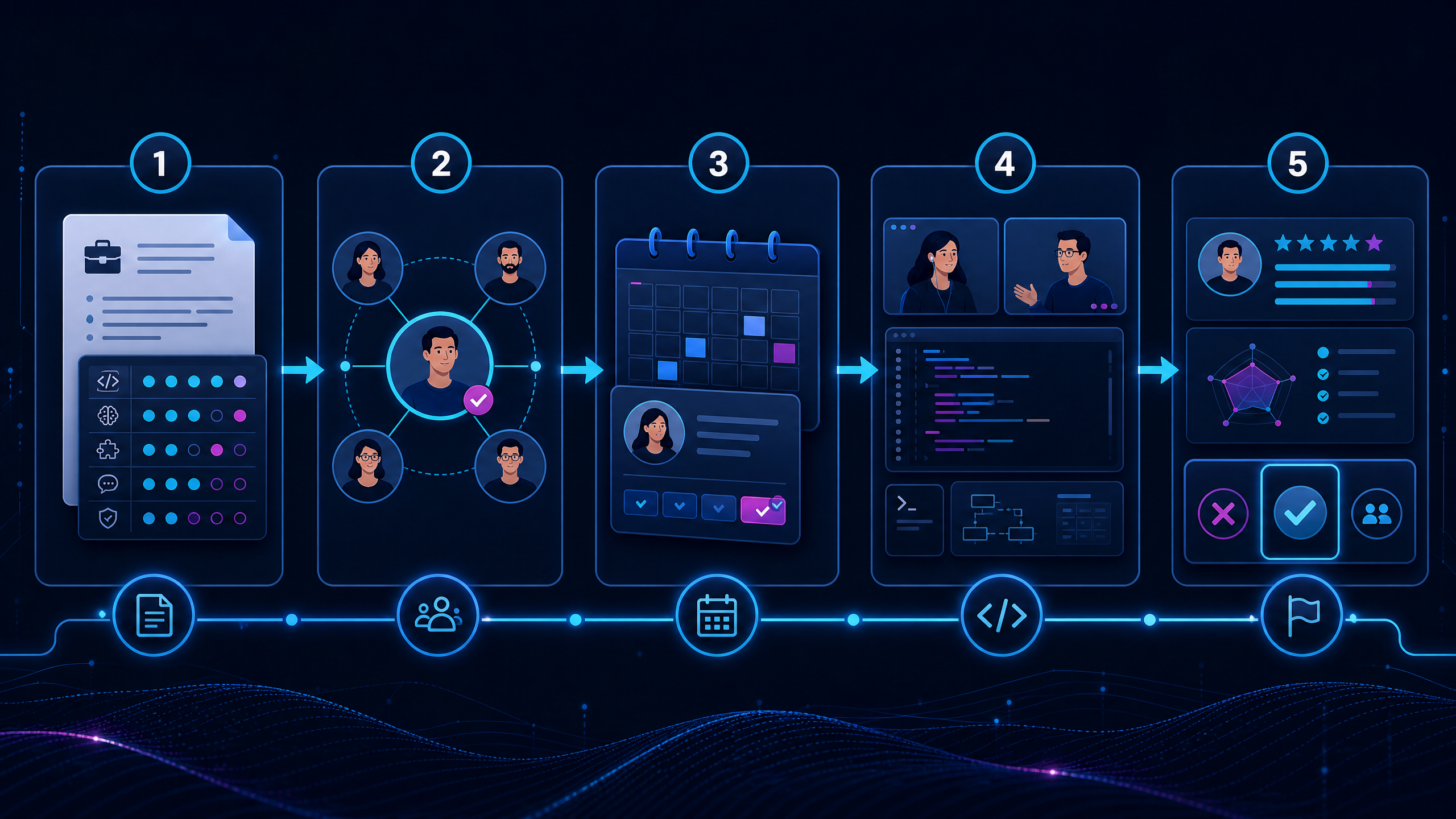
How does interview as a service work?
|
Stage
|
What happens
|
Output for the hiring team
|
|
1. Role intake
|
The provider reviews the job description, seniority, technology stack, business context, and must-have competencies.
|
A role-specific interview plan and evaluation rubric.
|
|
2. Interview design
|
Questions, coding exercises, system-design prompts, behavioral topics, or other activities are mapped to the role.
|
A structured interview format that can be applied consistently.
|
|
3. Interviewer matching
|
Interviewers are selected according to domain expertise, seniority, time zone, language, and availability.
|
A qualified panel without a large internal scheduling effort.
|
|
4. Candidate scheduling
|
Candidates receive invitations, reminders, time-zone support, and rescheduling assistance.
|
Fewer coordination delays and a clearer candidate experience.
|
|
5. Interview delivery
|
The interview is conducted by an expert, an AI system, or a blended human-plus-AI workflow, depending on the engagement.
|
Comparable evidence across candidates.
|
|
6. Evaluation and reporting
|
Responses are assessed against the agreed rubric, with strengths, gaps, signals, and recommendations recorded.
|
Structured scorecards or reports for hiring decisions.
|
|
7. Decision support
|
Recruiters and hiring managers review the findings and decide whether to advance, reject, or further assess the candidate.
|
A faster, more evidence-based next step.
|
What types of interviews can be outsourced?
Why do companies use interview as a service?
To reduce interviewer bandwidth pressure
To make evaluations more consistent
To support urgent or bulk hiring
To improve scheduling speed
To access specialist expertise
To receive decision-ready reporting
Interview as a service vs. an interview platform

|
Consideration
|
Interview platform
|
Interview as a service
|
|
Who conducts interviews?
|
Usually the company’s own interviewers or a configured AI workflow.
|
External experts, AI, or a blended model managed by the provider.
|
|
Main value
|
Software, workflow control, and automation.
|
Additional capacity, expertise, coordination, and execution.
|
|
Best fit
|
Teams with interviewer capacity that need better tooling.
|
Teams facing bandwidth, speed, scale, or specialist-coverage gaps.
|
|
Internal effort
|
The company owns interviewer allocation and operations.
|
The provider handles an agreed portion of interview operations.
|
|
Typical outcome
|
A more efficient in-house process.
|
A scalable evaluation capability without expanding the internal team.
|
Who benefits most from IaaS?
How to choose an interview-as-a-service provider
Why futuremug for interview outsourcing?
Next step: evaluate your interview process



Frequently Asked Questions
They are closely related. Interview outsourcing generally means assigning some interview work to an external provider. Interview as a service describes a more structured, repeatable delivery model that can include interviewer capacity, scheduling, interview design, evaluation, reporting, and ongoing operational support.
Yes. The provider’s panel and evaluation model should match the role. Technical use cases may include coding, system design, debugging, cloud, data, or cybersecurity interviews. Non-technical use cases may include functional, communication, behavioral, customer-support, or operations interviews.
Not when the engagement is designed well. The employer should retain control over competencies, hiring thresholds, interview stages, and final decisions. The provider executes the agreed process and returns evidence for internal review.
Yes. Bulk and campus hiring are common use cases because they require repeatable evaluation, high scheduling capacity, and fast reporting. For best results, define the role rubric and candidate communication process before the campaign begins.
AI can automate or assist with early-stage screening, question generation, transcripts, summaries, and standardized scoring. However, many organizations still use human experts for nuanced technical judgment, architecture discussions, final rounds, and context-specific decisions. A blended model is often more appropriate than treating AI as a complete replacement.
Track metrics connected to the original bottleneck. Useful measures include time from candidate submission to interview, interview completion rate, interviewer hours saved, feedback turnaround time, candidate progression rate, report quality, hiring-manager satisfaction, and quality-of-hire indicators. Establish a baseline before the pilot so results can be compared fairly.