
What Does Interview Outsourcing Cost in India? Pricing Models Explained
If you’re comparing quotes for interview outsourcing in India, the first thing to know is why you won’t find a straight price online: there isn’t one. Interview outsourcing is priced by quote, because the cost depends on what you’re actually buying — the seniority of the rounds, the volume, the turnaround, and how they’re delivered. What you can know precisely is how the pricing works, what moves it up or down, and how to compare two quotes so the cheaper-looking one isn’t secretly the more expensive one. That’s what this guide gives a budget owner.
| Quick answer: Interview outsourcing in India is priced by quote, not by public rate card, because the number depends on your mix. It’s structured one of four ways — per interview, subscription or retainer, per hire, or hybrid — and the price is driven by role seniority, round depth, volume, turnaround, whether delivery is human or AI, and any add-ons. To compare quotes fairly, normalise every one to cost per completed, calibrated interview, and benchmark that against your in-house cost per interview. |
Why There’s No Single Price
A published rate card would be misleading, because the same provider will quote very different numbers for a hundred junior AI screens and for twenty senior system-design rounds with 24-hour turnaround. Pricing is assembled from your specific requirements, which is why every credible answer starts with a quote. The good news for a budget owner is that the structure behind those quotes is consistent — learn it, and you can estimate your own cost and read any quote critically.
The Four Pricing Models
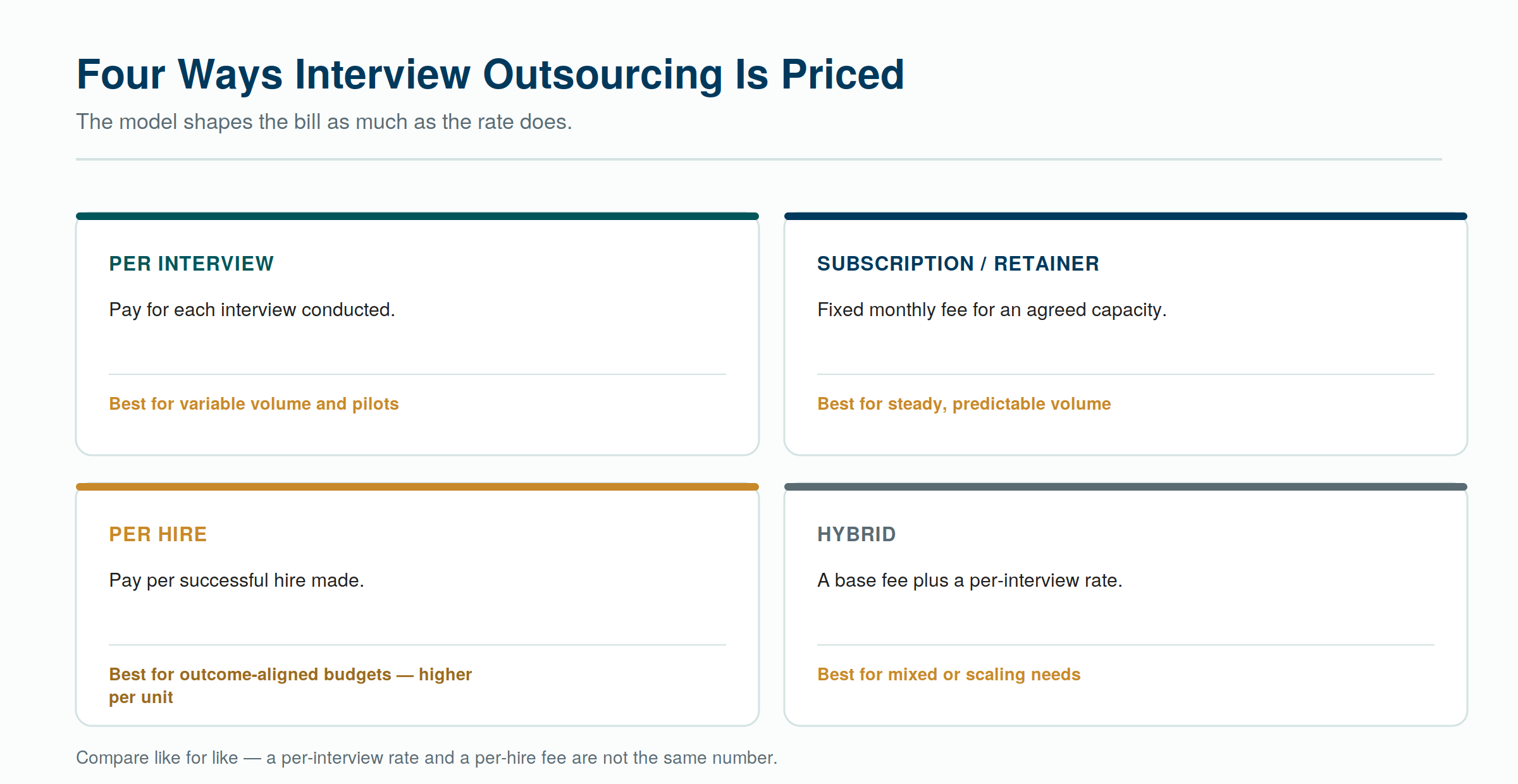
Almost every interview outsourcing quote in India uses one of four structures. The model matters as much as the rate, because it decides how your cost scales.
Per interview. You pay for each interview conducted. Transparent and low-commitment — the best fit for variable volume and for a first pilot, since you pay only for what you use.
Subscription or retainer. A fixed monthly fee for an agreed capacity. Usually a lower effective per-unit rate in exchange for commitment — the fit when your volume is steady and predictable.
Per hire. You pay per successful hire rather than per interview. Outcome-aligned and easy to budget, but the per-unit cost is higher because the provider carries more risk — and you’ll want clarity on what counts as a completed hire.
Hybrid. A base fee plus a per-interview rate. Often the cheapest structure for bursty or scaling volume, because the base covers readiness and the per-unit charge flexes with demand.
What Moves the Price
Within any model, six drivers explain why one quote is higher than another. Three tend to push the price up; two can bring it down; one sets the base.
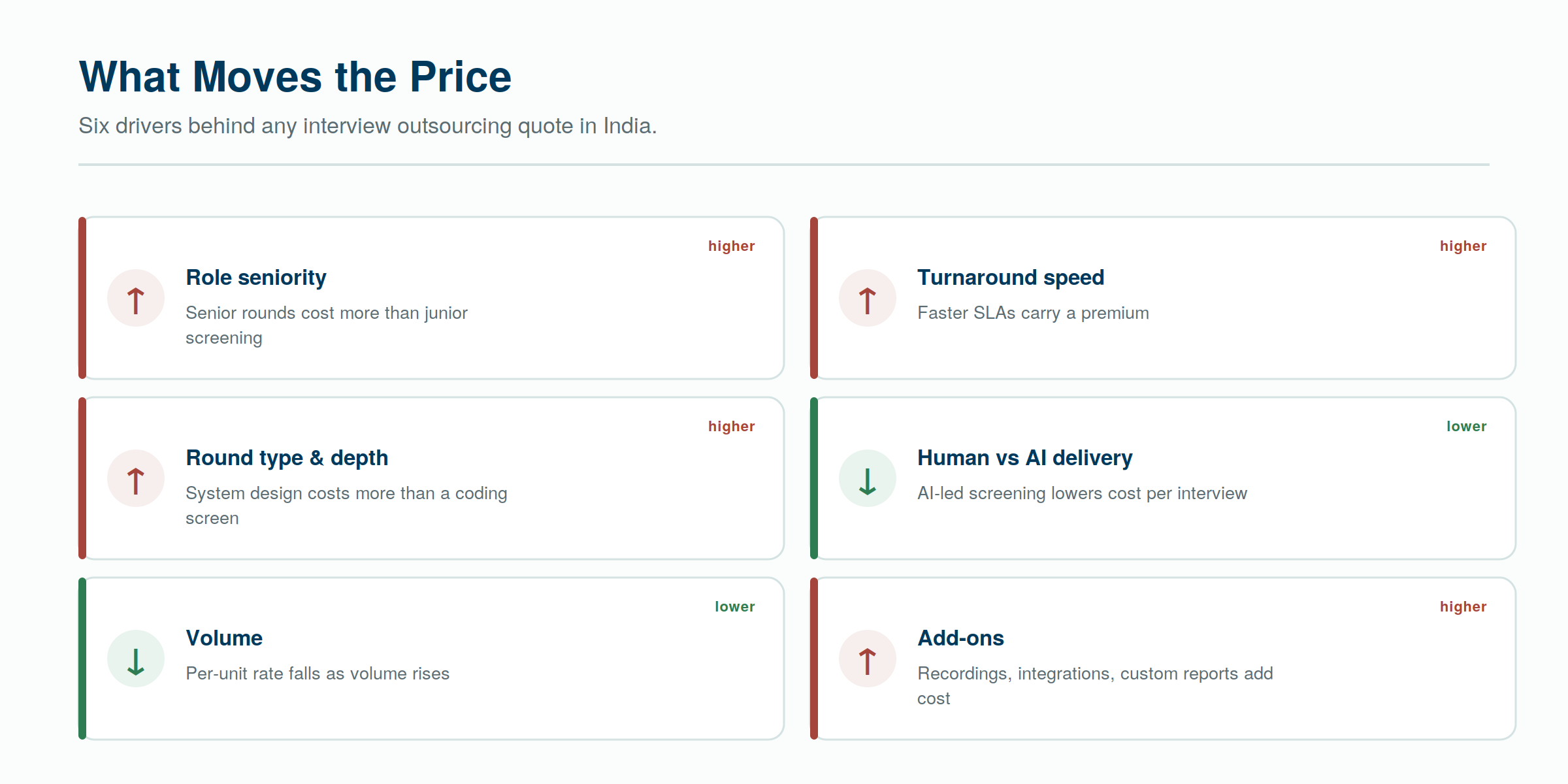
The two levers most in your control are volume and delivery model. Consolidating volume with one provider steps the per-unit rate down, and routing high-volume first rounds to AI-structured interviews lowers cost per interview — reserving human panels for the senior rounds where the depth justifies the rate.
How to Estimate Your Cost
You can build a defensible estimate before you have final quotes. Multiply the interviews you’ll actually outsource by a rate band for each round type, adjust for volume and add-ons, and factor in completion rate — because you pay for interviews that happen, and value only the ones that complete.
| Estimate input | How to fill it | Effect on total |
| Interviews needed | Roles × candidates per role × rounds outsourced | Sets the base volume |
| Rate band per round | Get quotes by seniority and round type | Junior AI screen lowest; senior human highest |
| Volume tier | Ask where per-unit rates step down | Higher volume lowers the per-unit rate |
| Add-ons | Recordings, ATS integration, custom reports | Adds to the per-interview or monthly figure |
| Completion rate | Ask the provider’s typical show/complete rate | Low completion raises true cost per useful interview |
This gives you a range to take into quote conversations and a structure to slot real numbers into. It also stops the most common budgeting error — estimating on the headline rate alone and being surprised by add-ons and no-shows.
How to Compare Quotes Fairly
Two quotes with different headline rates are rarely comparable as written. Before you judge on price, normalise both to the same basis — the all-in cost per completed, calibrated interview — and check what each one quietly includes or excludes.
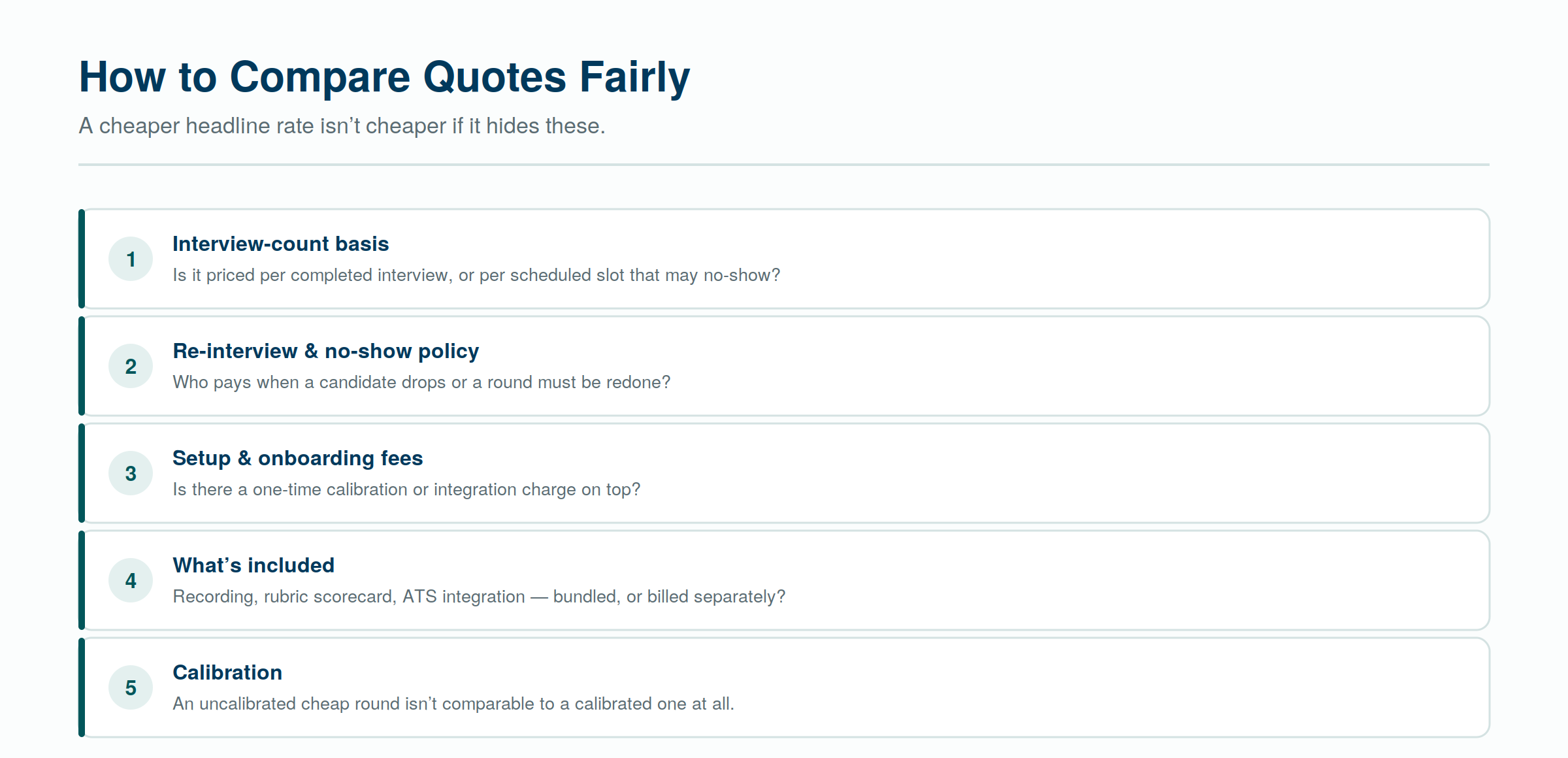
The check that catches the most is calibration. A cheap round from an uncalibrated provider isn’t a cheaper version of the same thing — it’s a different, lower-value thing. Comparing its rate to a calibrated provider’s is comparing a number to a number that means something. The common mistakes guide covers why comparing on price alone is the most expensive habit in this category.
Cost Versus Building In-House
The real benchmark for any quote is what interviewing costs you now. In-house looks free because there’s no invoice, but the cost is real — senior-engineer hours plus lost sprint velocity. Judge an outsourcing quote against that fully-loaded internal cost, not against zero. Our outsourcing vs in-house comparison models the cross-over, and the engineering-time analysis shows what an in-house interview really costs.
What interview outsourcing costs in India comes down to your mix, not a rate card: pick the pricing model that matches your volume pattern, understand the six drivers behind the number, estimate on completed interviews rather than headline rates, and normalise every quote to cost per completed, calibrated interview before you compare. Do that, and you’ll buy on true value rather than on the lowest sticker — which, in this category, is usually the most expensive mistake.
For a real number against your actual volume, the fastest route is a scoped quote and a short pilot. futuremug prices transparently across expert panels and AI interviews, and a pilot gives you a cost per completed interview you can budget against with confidence.



Frequently Asked Questions
There is no single published rate, because pricing is quote-based and depends on your mix of seniority, round type, volume, and turnaround. It's typically structured as per interview, subscription, per hire, or hybrid. The reliable way to answer it for your situation is to get two or three quotes and normalise them to cost per completed, calibrated interview — then compare that to what an interview costs you in-house.
Per-interview suits variable or low volume and pilots — you pay only for what you use. Subscription or retainer suits steady, predictable volume, usually at a lower effective per-unit rate in exchange for commitment. If your volume is bursty, a hybrid (base plus per-interview) often lands cheapest. Match the model to your volume pattern before comparing rates.
Six drivers: role seniority, round depth (a system-design round costs more than a coding screen), volume, turnaround speed, whether delivery is human or AI-led, and add-ons like recordings and integrations. A higher headline rate can still be cheaper overall if it includes things a lower quote bills separately — which is why you normalise before comparing.
It depends on volume. In-house has no per-interview fee but hides senior-engineer hours and lost velocity; outsourcing replaces those with a visible rate. At low, steady volume in-house is usually cheaper, and as volume or spikes grow, outsourcing wins on true cost. Our cost cross-over analysis shows where the line falls.
Yes, for the rounds it fits. AI-structured and agentic AI interviews lower the cost per interview for high-volume screening, because they don't consume a human expert's hour. Reserve human panels for senior and specialist rounds where the depth justifies the higher rate, and use AI for first-round volume.
Setup or onboarding fees, charges for re-interviews and no-shows, whether recordings and scorecards are bundled or billed separately, and integration costs. Also check the interview-count basis — a rate priced per scheduled slot rather than per completed interview looks cheaper until candidates no-show. Ask for the all-in cost per completed interview.