
Technical Interview Outsourcing: A Framework for Engineering Leaders
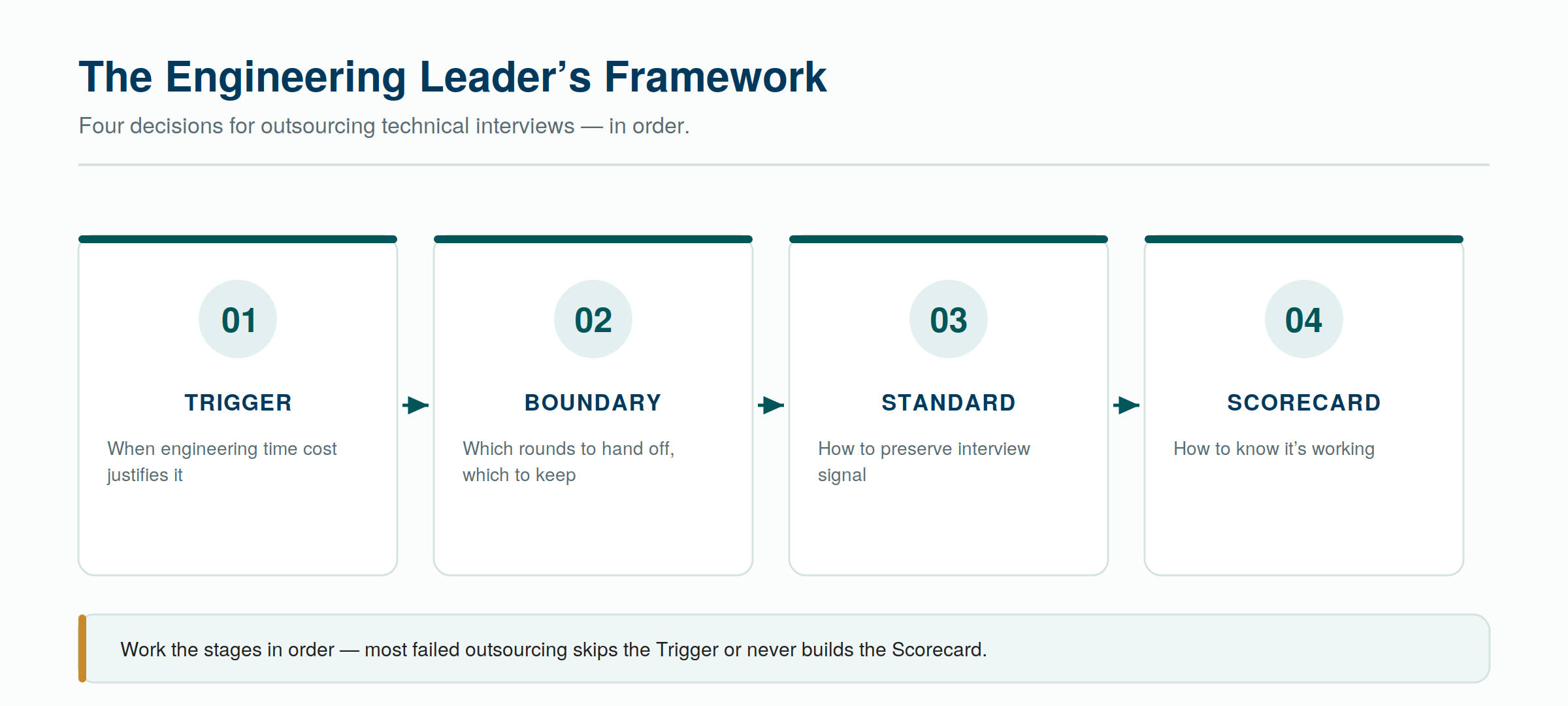
For an engineering leader, technical interview outsourcing is not a procurement decision — it’s a capacity decision that trades a per-interview fee for your team’s most scarce resource: engineering time. Handled well, it gives your senior engineers their calendars back without lowering the bar. Handled as a purchase rather than a system, it lowers the bar quietly. This is a framework for handling it well: four decisions, in order, ending with the scorecard that tells you it’s working.
| Quick answer: Technical interview outsourcing works for engineering leaders when it’s run as a framework, not a purchase. Four decisions, in order: the Trigger (when engineering time cost justifies it), the Boundary (which rounds to hand off and which to keep), the Standard (how to preserve interview signal), and the Scorecard (how to prove it’s working). Get the order right — most failed outsourcing skips the Trigger or never builds the Scorecard. |
Why This Is an Engineering Leadership Decision
Technical interviews are conducted by the people you can least spare — senior engineers whose main job is shipping. Every interview hour is an hour off the roadmap, and the true cost is higher than the scheduled hour: prep, the context-switch out of deep work, and the debrief push a one-hour interview to two or three hours of real engineering time. That’s the lens this framework applies, and the full arithmetic is in our engineering-time analysis. The decision to outsource is a decision about velocity, which makes it yours to own.
Stage 1: The Trigger — When to Outsource
Outsourcing too early wastes money on a problem you don’t have; too late means the roadmap has already paid for it. Three signals tell you the moment has arrived.
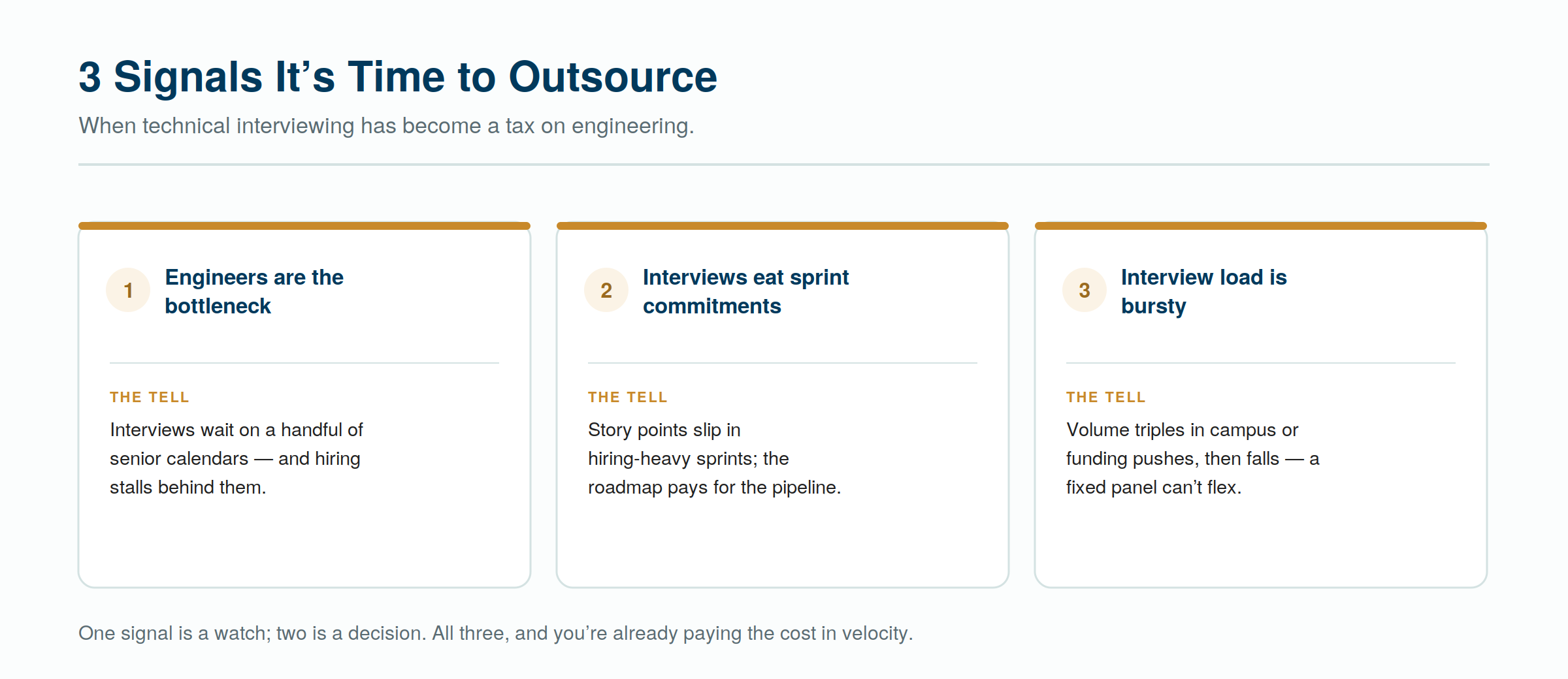
The common thread is that interviewing has stopped being a manageable cost and started competing with delivery. If you’re seeing two of the three, the framework’s remaining stages are how you act on it without introducing new risk.
Stage 2: The Boundary — What to Hand Off
Not every technical round should leave your team. Outsource the high-volume, standardised rounds — first-round coding screens, DSA, overflow during spikes, and specialist rounds you can’t staff internally. Keep the final round and the bar-raiser: culture read, the offer, and your calibration standard are yours. The full line is drawn in our guide to what you can and can’t safely outsource — the short version is that you hand off the rounds that scale and keep the ones where judgement is the signal.
Stage 3: The Standard — Preserving Signal
A handed-off round is only useful if its score means what your own would. Three safeguards hold the standard: calibrate the rubric with the provider before any interview runs, require a recording and scorecard for every round, and — the 2026 essential — insist on AI-assist and plagiarism detection with interviewers who probe beyond the first answer. The mechanics of how this is delivered are covered in our guide to technical interviews as a service. Where AI interviews are used, add human-agreement data on the scores to the list of things you require.
Stage 4: The Scorecard — Proving It Works
This is the stage most teams skip, and the reason outsourcing quietly fails. You cannot govern what you don’t measure. Five metrics tell an engineering leader whether outsourced technical interviewing is actually working — track them from the first pilot batch.
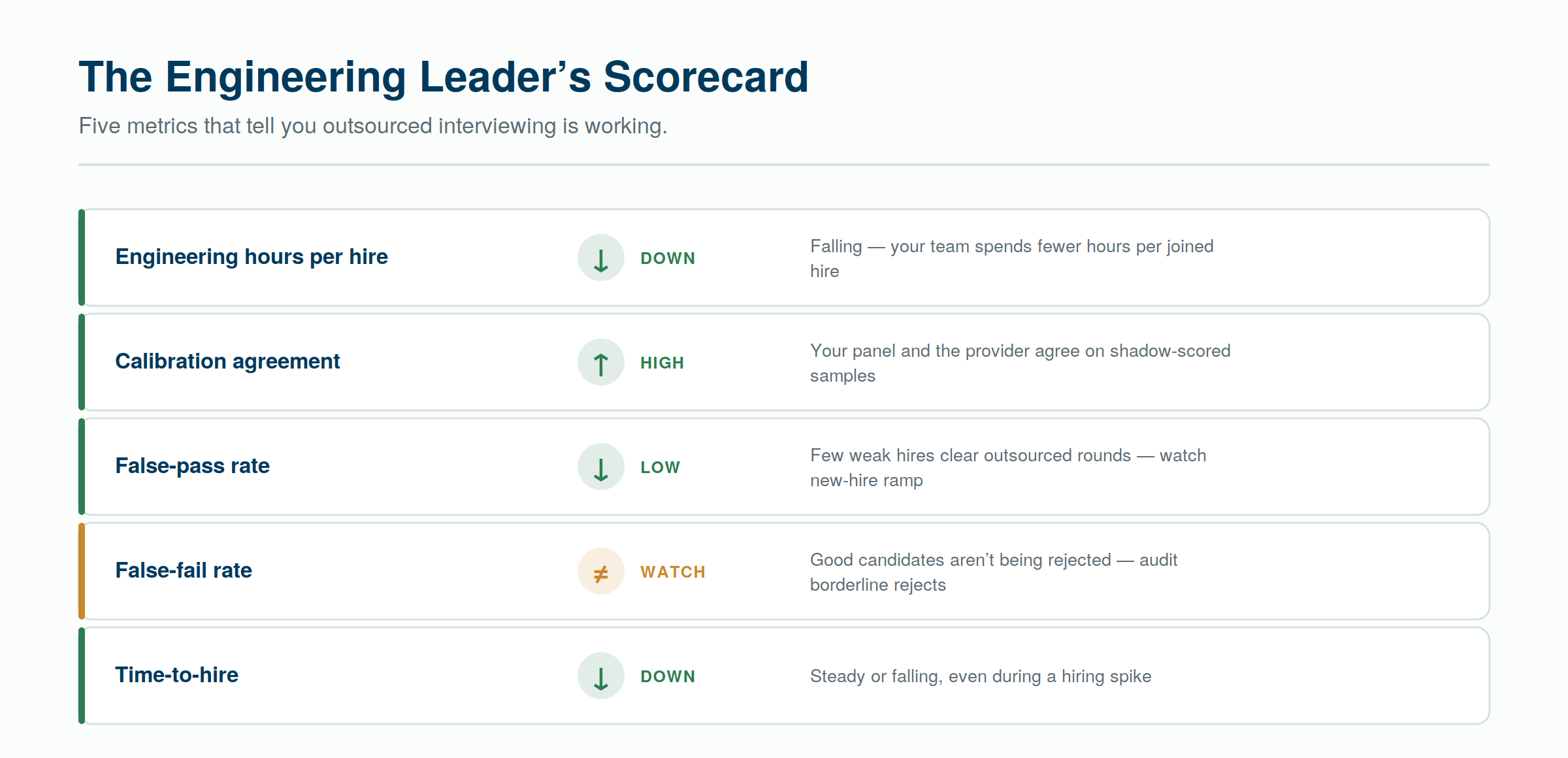
The metric that reveals the most is false-fail rate. Engineering leaders instinctively watch for weak hires slipping through (false-pass), but the quieter, costlier failure is good candidates being rejected by an over-strict or miscalibrated outsourced round. Audit a sample of borderline rejections periodically — it’s the check that keeps outsourcing from silently shrinking your top of funnel.
Choosing Who Runs It
With the framework set, the vendor decision becomes concrete: you’re looking for a provider that fits your bottleneck and can meet the Standard and feed the Scorecard. Our comparison of interview outsourcing companies covers the company types and evaluation criteria, and the common mistakes guide covers what to avoid while choosing.
Technical interview outsourcing rewards engineering leaders who treat it as a system: pull the Trigger when interviewing taxes velocity, set the Boundary so only the scalable rounds leave, hold the Standard so signal survives the handoff, and run the Scorecard so you can prove it’s working. Do that, and you convert your engineers’ interview hours back into shipped work — with the bar intact and the evidence to show it.
futuremug is built to slot into this framework — expert panels, AI interviews, and agentic AI interviews that meet the Standard and give you the data for the Scorecard. If your Trigger has fired, a pilot is where the framework starts.



Frequently Asked Questions
Technical interview outsourcing is the practice of having an external provider conduct your coding, system-design, and domain interviews against your rubric, returning recorded and scored evaluations while your team keeps every hiring decision. For the delivery mechanics end to end, see how technical interviews are run as a service.
When technical interviewing has become a tax on engineering: senior engineers are the hiring bottleneck, interviews are eating into sprint commitments, or interview volume is bursty in a way a fixed panel can't absorb. One signal is a watch; two is a decision. The trigger is about engineering velocity, not just cost per hire.
Keep the final round and the bar-raiser — culture read, the offer conversation, and your calibration standard are yours to own. Outsource high-volume first rounds, overflow during spikes, and specialist rounds you can't staff internally. Our guide to what you can safely outsource draws the full boundary.
Calibrate the rubric with the provider before any interview runs, require a recording and scorecard for every round, and — critically in 2026 — insist on AI-assist and plagiarism detection with follow-up probing. Then have your own panel shadow-score a sample to confirm calibration holds. Signal integrity is a process, not a promise.
Track five metrics: engineering hours per hire (should fall), calibration agreement between your panel and the provider (should stay high), false-pass rate (weak hires clearing rounds — should be low), false-fail rate (good candidates rejected — watch it), and time-to-hire (steady or falling under load). The scorecard is what separates governed outsourcing from hope.
For the rounds that scale, yes — a technical interview often costs two to three hours of real engineering time once prep, context-switching, and debrief are counted, and outsourcing first rounds reclaims most of it. The full engineering-time math is in our on-demand technical interviews guide.