
How Interview Outsourcing Works: The Process From Kickoff to Verdict
If you’re researching interview outsourcing, the fear underneath the research is simple: you’re about to hand a stranger a piece of your hiring, and you want to know exactly what happens before you commit. This is that walkthrough — the full process, from the kickoff call to the verdict that lands on your desk. No jargon, no black box: six clear stages, what each one involves, and precisely where your team stays in control.
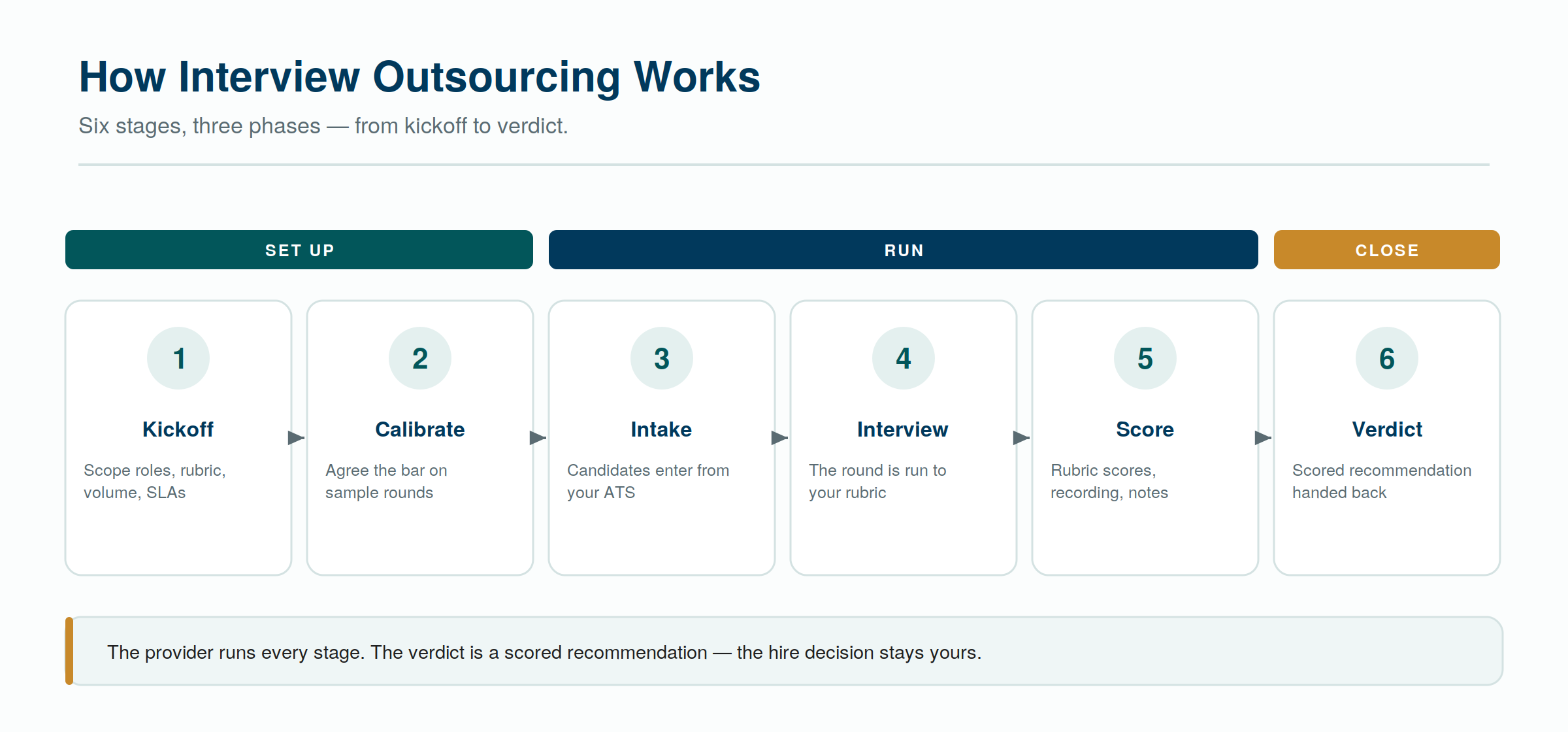
| Quick answer: Interview outsourcing works in six stages across three phases. You set up (kickoff to scope roles, rubric, volume and SLAs; calibration to agree the bar), the provider runs the process (candidates enter, the interview is conducted to your rubric, and each round is scored with evidence), and you close (a scored verdict is handed back per candidate). The provider runs every stage; the verdict is a scored recommendation, and the hiring decision stays yours. |
The Process at a Glance
Interview outsourcing runs in three phases. You set up (kickoff and calibration). The provider runs the interviews (intake, interview, scoring). You close (the verdict comes back). The single most important thing to understand before the detail: the provider runs every operational stage, but the verdict it produces is a scored recommendation — the hiring decision itself never leaves your team.
Stage 1: Kickoff — Scoping the Engagement
Everything starts with a kickoff, and its quality determines everything downstream. This is a working session, not a form, where you and the provider agree the shape of the engagement — the decisions that let a stranger interview for you as if they were you.
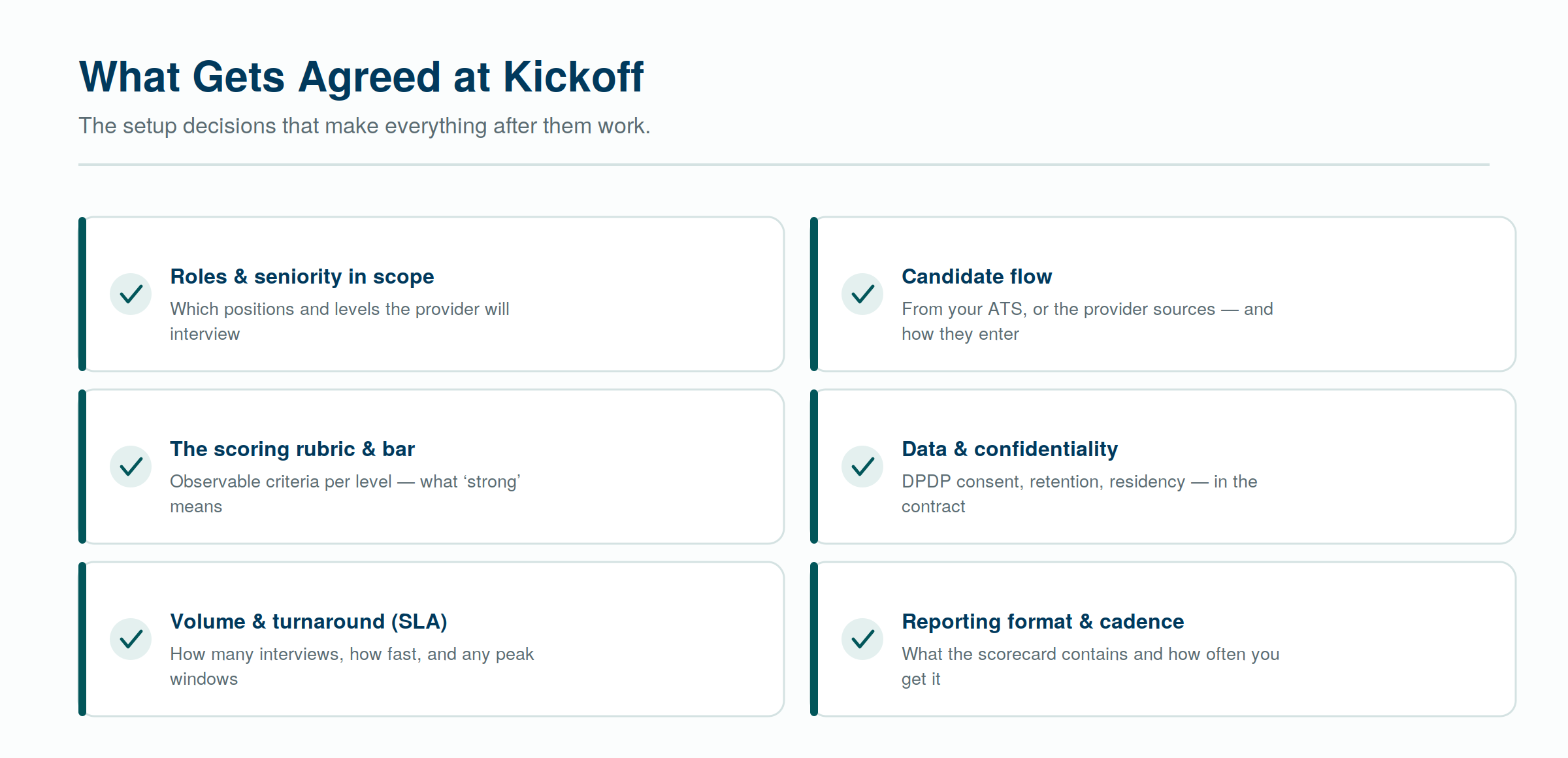
Nail these six, and the rest of the process runs on rails. Rush the kickoff, and every later stage inherits the ambiguity — which is why a provider that wants to start interviewing tomorrow, with no scoping, is telling you something important about the quality to expect.
Stage 2: Calibrate — Aligning the Bar
Before interviews run at volume, the provider calibrates against your standard: interviewing a small sample, scoring them on the agreed rubric, and comparing those scores with your own team’s read of the same candidates. The point is to confirm that a ‘strong hire’ means the same thing to them as to you. Calibration is what makes an outsourced score trustworthy — the mechanics of it are covered in depth in our guide to how technical interviews are run as a service.
Stage 3: Intake — Candidates Enter the Pipeline
With setup done, candidates start flowing. In most engagements they come from your ATS — you push shortlisted candidates and the provider picks them up and schedules the round. Where the provider also sources, candidates enter from their pipeline instead. Either way, this stage is largely automated once the connection is configured, and it’s where the coordination overhead that used to sit on your team quietly disappears.
Stage 4: Interview — The Round Is Conducted
The interview itself runs to your rubric, conducted by a vetted human expert, an AI interviewer, or both depending on the round. High-volume first rounds often run on AI-structured or agentic interviews for speed and consistency; senior and specialist rounds use expert human panels. Whoever conducts it, the round is recorded and scored against the criteria agreed at kickoff — not against an interviewer’s private judgement.
Stage 5: Score — Rubric and Evidence
Immediately after the round, it’s scored criterion by criterion against the calibrated rubric, with each rating tied to a moment in the interview rather than an overall impression. This is the stage that separates outsourcing interviewing from outsourcing judgement: what’s produced is evidence — scores you can trace, a recording you can review — not a verdict you’re asked to take on faith.
Stage 6: Verdict — What Lands on Your Desk
The verdict is the output of the whole process: a scored recommendation for each candidate, delivered back to you (usually into your ATS). Here’s exactly what it contains — so ‘the verdict’ stops being an abstraction.
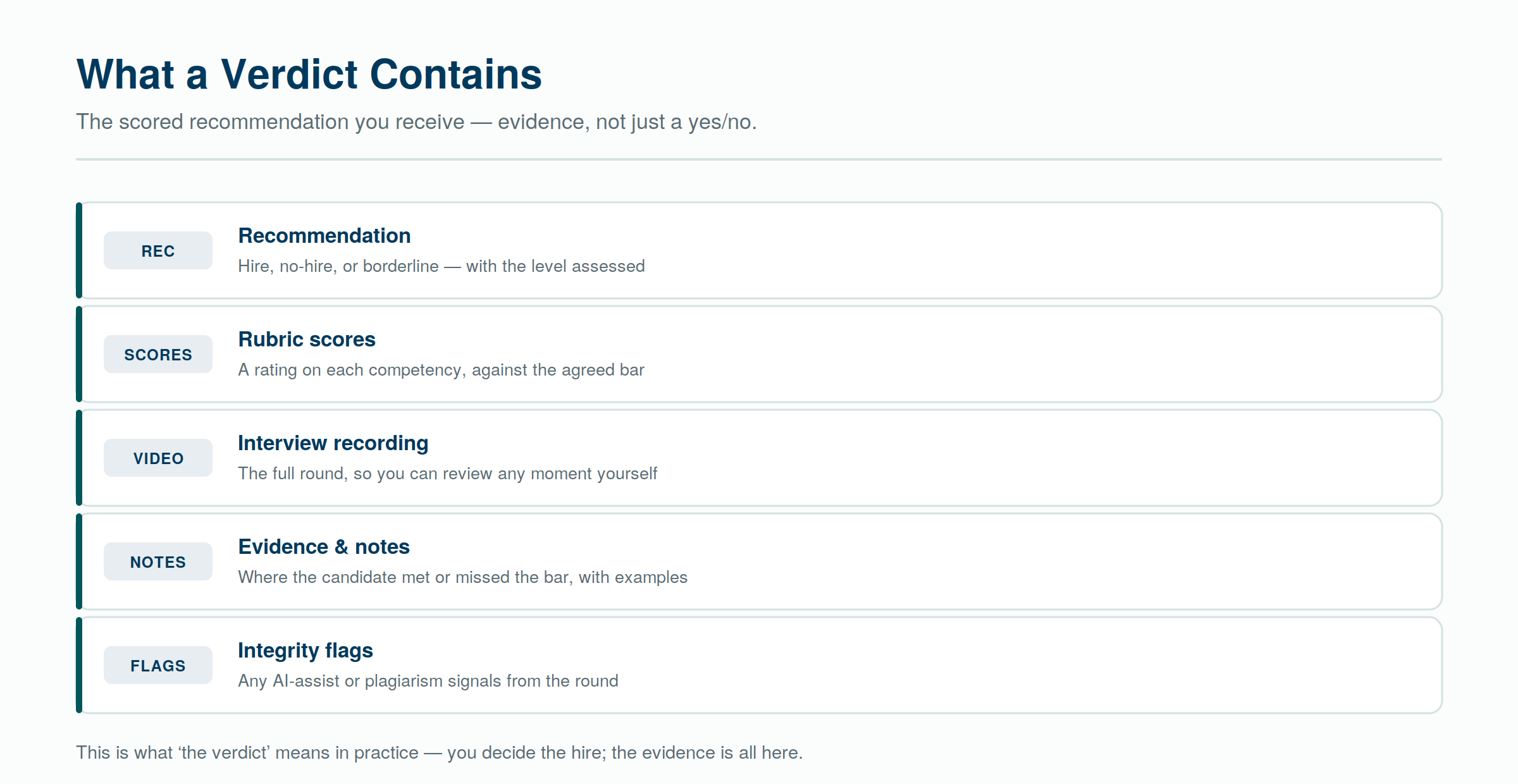
You read the recommendation, check the evidence where it matters, and make the call. For a borderline candidate, the recording settles the question faster than a re-interview. The verdict informs your decision; it never replaces it.
How Long the Process Takes
Research-mode buyers usually want a timeline, so here’s the honest shape of one. Set-up is a one-time ramp; after that, the per-interview and per-verdict cycle repeats at your agreed pace.
| Phase | Typical duration | What’s happening |
| Set up | 1–2 weeks (one-time) | Kickoff scoping plus a calibration round on sample candidates |
| Run (per interview) | Interview turnaround per SLA | Candidate intake, the interview, and scoring — repeating at volume |
| Close (per candidate) | Same-day to a few days | The scored verdict and recording are returned for your decision |
Steady-state, the process is typically faster than internal interviewing, because it isn’t queuing behind your team’s calendars — and it holds that speed during a hiring spike, when in-house scheduling slows most.
Choosing a Provider to Run It
The process above is only as good as the company running it. When you’re ready to evaluate providers, our comparison of interview outsourcing companies covers the company types and the criteria to score them on, and our guide to what interview outsourcing costs covers how it’s priced.
How interview outsourcing works is no mystery once it’s laid out: you scope it at kickoff, calibrate the bar, and then the provider runs intake, interviews, and scoring — handing back a verdict that’s a recommendation plus the evidence behind it. The operational load leaves your team; the hiring decision doesn’t. Understand the six stages, and you know exactly what you’re buying before you buy it.
If you’d like to see the process on your own roles, the fastest way is a pilot. futuremug runs the full kickoff-to-verdict process across expert panels and AI interviews — and a pilot lets you watch every stage before committing to any of it.



Frequently Asked Questions
In six stages: kickoff (scope roles, rubric, volume, SLAs), calibration (agree the bar on sample rounds), intake (candidates enter, usually from your ATS), the interview (conducted to your rubric by a vetted human or AI interviewer), scoring (rubric ratings plus a recording and notes), and verdict (a scored recommendation handed back). You set up the first two, the provider runs the middle three, and you receive the verdict to make the hire.
Kickoff is the scoping session that makes everything after it work: you agree which roles and levels are in scope, the scoring rubric and what ‘strong’ means at each level, volume and turnaround, how candidates flow in, the data and confidentiality terms, and the reporting format. Skipping a proper kickoff is the root of most disappointing outsourcing — our guide to common mistakes covers why.
The verdict is the scored recommendation you receive for each candidate — a hire / no-hire / borderline call with the level assessed, rubric scores per competency, the interview recording, evidence notes, and any integrity flags. It is a recommendation backed by evidence, not the hire itself. You always make the final hiring decision; the provider gives you the calibrated signal to make it well.
It slots into a single stage of your funnel — usually the screening and technical rounds — while you keep sourcing, final rounds, and offers. Candidates typically flow from your ATS to the provider and scored results flow back into it. For which rounds to hand off and which to keep, see our guide to what you can safely outsource.
Set-up is a one-time ramp of a week or two (kickoff plus calibration). After that, each interview runs at the agreed turnaround, and the verdict comes back within the SLA — often same-day for AI-led rounds. Steady-state, outsourcing is usually faster than internal scheduling because it isn't waiting on your team's calendars.
Depending on the round, a vetted human expert, an AI interviewer, or both. High-volume first rounds often run on AI-structured interviews for speed and consistency, while senior and specialist rounds use expert human panels. Either way, the interviewer works from your calibrated rubric.